CIDR routing fixes: 461k redundant routes clog tables
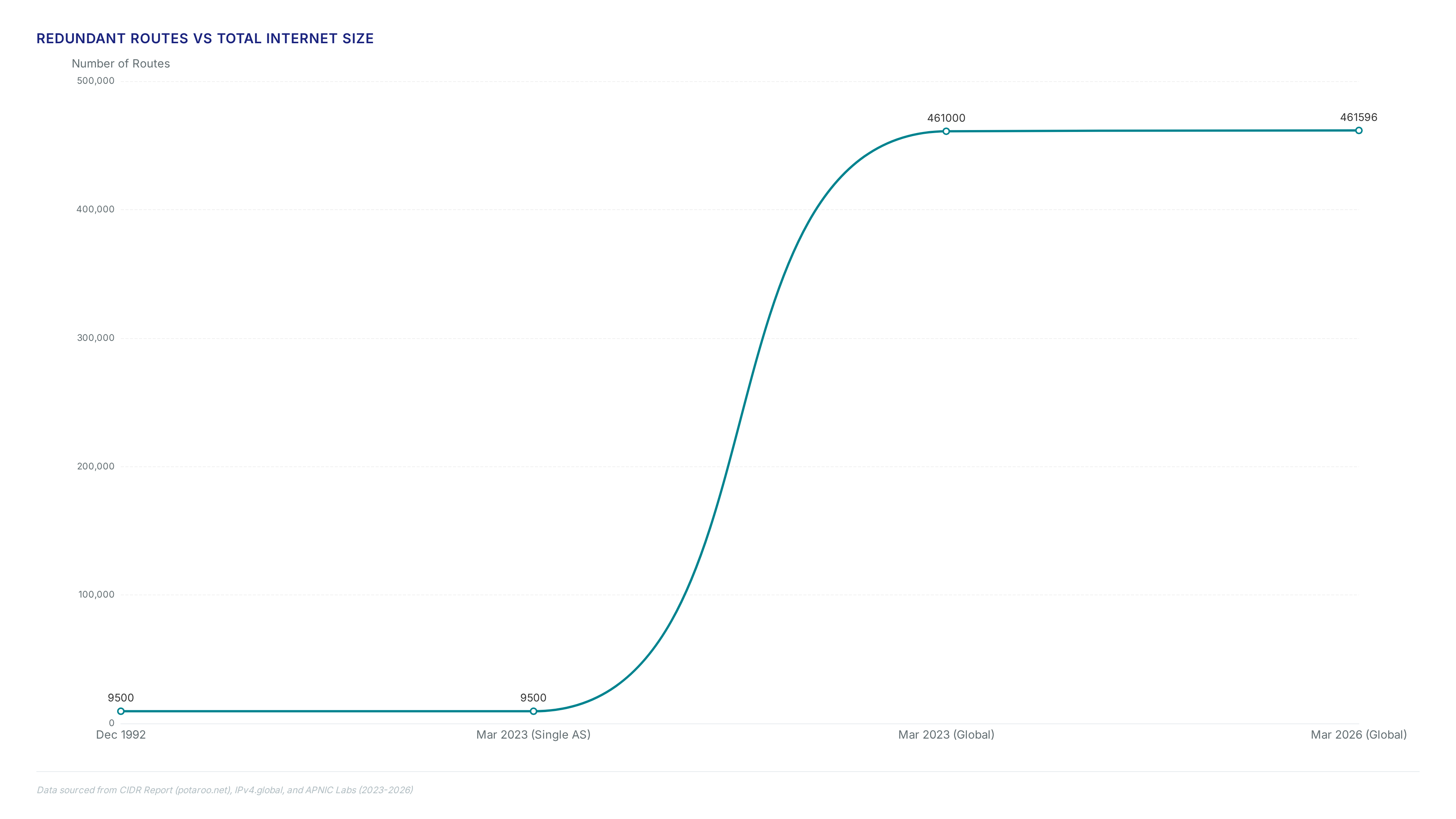
461,596 redundant routes clogged the global routing table in March 2026. This number from the CIDR Report proves prefix de-aggregation has eroded thirty years of routing efficiency. Classless Inter-Domain Routing offered a theoretical fix, yet modern operators prioritize local traffic engineering over the shared routing commons. BGP4 has devolved from a scalable architecture into a bloated ledger of unnecessary announcements.
We must revisit the pivot from rigid RFC 791 classful blocks to flexible prefix lengths. That shift saved the Internet from exhaustion. BGP4 mechanics were built to support route aggregation, yet networks now announce smaller blocks than technically required. APNIC Chief Scientist Geoff Huston calls this "nudge theory," relying on transparency to shame noisy speakers. The data suggests this approach is failing. (APNIC's kirin a bgp flooding attack feasibility)
Operational strategies exist to mitigate AS route noise without sacrificing performance. Two decades of CIDR Report data, pioneered by Tony Bates and Philip Smith, expose the specific Autonomous Systems driving this inefficiency. History matters less than the urgent need for operators to stop treating the global routing table as a private dumping ground for granular prefixes.
The Fundamental Shift from Classful Addressing to CIDR
RFC 791 Classful Addressing and the 1992 Exhaustion Crisis
RFC 791 arrived in 1981 with a rigid fixed-size network model. It allocated IP space strictly as Class A, Class B, or Class C blocks. The math was brutal: Class A received approximately 16,777,214 addresses, Class B got 65,534, and Class C merely 254. Organizations faced inefficient allocations regardless of actual host requirements. A mid-sized entity needing 300 devices received a full Class B block, wasting over 65,000 usable addresses per assignment. Structural inflexibility accelerated depletion rates beyond sustainable limits for the expanding internet infrastructure.
Quantifying Address Waste: The 65,234-Host Loss in Class B Assignments
Rigid Class B assignments forced a company needing 300 devices to discard 65,234 usable IP addresses immediately upon allocation. RFC 791 defined fixed blocks rather than scalable prefixes, leaving no middle ground between 254 and 65,534 hosts. An organization requiring exactly 214 hosts similarly absorbed a penalty of 49,150 wasted addresses by purchasing an oversized Class B network. Massive over-provisioning accelerated global exhaustion while bloating routing tables with unnecessary reachability data.
| Requirement | Classful Allocation | Wasted Addresses |
|---|---|---|
| 300 Devices | Class B | 65,234 |
| 214 Hosts | Class B | 49,150 |
Classless Inter-Domain Routing (CIDR) permits arbitrary block sizes, such as a /28 for 14 devices, eliminating fixed-boundary waste. Legacy classful logic failed because it could not match supply with demand, creating permanent holes in the IPv4 space. Modern deployments ignore CIDR at the risk of inefficient address utilization and inflated global routing table entries.
The internet routing table held exactly 9,500 routes in December 1992. This established a critical baseline before Classless Inter-Domain Routing replaced rigid addressing.
Classful addressing forced binary choices: small entities took tiny Class C blocks while medium firms absorbed massive Class B assignments. Rigidity caused exponential table growth as every /24 required a separate entry. CIDR introduced variable-length subnet masking, allowing operators to aggregate contiguous prefixes into single advertisements. A network could now combine multiple /24s into one /22 route, drastically reducing global table size.
| Feature | Classful Model | CIDR Model |
|---|---|---|
| Boundary Logic | Fixed top three bits | Flexible prefix length |
| Allocation Unit | Class A, B, or C | Any power-of-two block |
| Aggregation | Impossible | Native supernetting support |
| Waste Factor | Extreme (65k+ hosts) | Minimal (exact fit) |
Aggregation demands strict topological alignment. Misaligned address blocks prevent route summarization and perpetuate bloat. Modern incidents prove this risk remains active. A single network announced nearly 9,500 redundant routes in March 2023, exceeding the entire December 1992 global count through unnecessary de-aggregation. Ignoring aggregation rules recreates historical scaling crises instantly.
Operators must enforce prefix filtering policies that reject overly specific advertisements unless justified by multihoming requirements. Permissive default-accept policies cost memory and cause convergence delays.
BGP4 Mechanics: Explicit Prefix Lengths Replacing Inferred Masks
BGP4 transmits explicit prefix lengths in updates. This eliminates the fixed mask inference used by earlier classful protocols. The shift allows Variable Length Subnet Masks to function across domain boundaries, replacing the rigid boundaries of RFC 791. Classful routing protocols like early RIP versions omit subnet mask data, forcing receivers to apply default masks based on IP address class rather than actual topology. Such inference prevents efficient aggregation and wastes address space when network sizes do not align with historical classes.
Implementing CIDR requires inter-domain routing protocols to carry mask information explicitly, a capability absent in legacy systems. Operators gain the ability to allocate custom-sized subnets, such as a /30 for point-to-point links, without adhering to arbitrary class limits. This flexibility supports precise subnetting that matches exact host requirements instead of forcing oversized blocks.
Configuration complexity increases. Operators must manually define prefix lengths rather than relying on implicit defaults. Misconfigured prefix lengths in BGP4 cause route leaks or blackholes, whereas classful errors were limited to scope mismatches.
March 2026 CIDR Report data identifies 461,596 redundant more-specific routes that operators could aggregate into single prefixes. Network engineers reduce announcement volume by combining contiguous blocks like 192.168.0.0/24 and 192.168.1.0/24 into a single 192.168.0.0/22 advertisement. This supernetting technique directly counters the routing table explosion caused by millions of individual Class C entries in earlier architectures.
Implementation requires strict adherence to topological contiguity and policy alignment across peer sessions.
- Verify address blocks share identical AS path attributes and egress points.
- Configure BGP aggregators to suppress more-specifics while advertising the summary prefix.
- Apply longest prefix match logic to ensure traffic engineering goals remain intact.
A single network announcing 9,500 redundant routes in March 2023 demonstrates how de-aggregation exceeds historical baselines. Such behavior imposes processing costs on every BGP speaker receiving these updates. Aggregation masks failure domains; a downed /24 within a /22 summary becomes invisible to upstream peers until the entire block withdraws.
| Factor | De-aggregated Approach | Aggregated Approach |
|---|---|---|
| Table Size | Maximizes entries | Minimizes entries |
| Failure Visibility | Granular per-prefix | Obscured within summary |
| Policy Control | High specificity | Reduced granularity |
Efficiency gains from reduced table size must balance against the loss of granular fault isolation. Ignoring this balance costs router CPU cycles and memory consumption across the global routing system.
The Risk of De-aggregation: IPv6 /29 Blocks Generating Million-Route Explosions
A single IPv6 /29 block holds the technical capacity to generate over 1,000,000 unique prefixes if an operator fails to aggregate. This prefix explosion occurs when networks announce hyper-specific subnets rather than a consolidated parent route, directly inflating the global routing table. The CIDR Report has tracked these aggregation trends for 20 decades, exposing how minor configuration errors create disproportionate systemic load.
| Announcement Strategy | Route Count Impact | Router CPU Load |
|---|---|---|
| Aggregated /29 Parent | 1 entry | Minimal |
| De-aggregated /64s | >1,000,000 entries | Critical saturation |
Operators must minimize BGP announcements by adhering to strict topological summarization at the network edge.
- Configure border routers to suppress more-specifics unless traffic engineering demands otherwise.
- Validate that all advertised prefixes fall within the assigned IPv6 allocation boundary before export.
- Monitor peer sessions for accidental leakage of internal subnets.
This approach reduces granularity for inbound traffic optimization, as summarization hides internal path diversity. Unchecked de-aggregation imposes processing costs on every global router attempting to maintain the full table.
Operational Strategies for Mitigating AS Route Noise
Defining AS Route Noise and Prefix De-aggregation Costs
AS route noise manifests when individual Autonomous Systems prioritize local traffic engineering over global table efficiency through excessive prefix announcements. The CIDR Report identifies this behavior by tracking the "Top 30" contributors whose aggregation could significantly reduce internet routing table size. Announcing more routes often serves rational performance goals for a single network, yet it imposes a measurable processing cost on every other BGP speaker maintaining the shared system.
De-aggregation transforms manageable address blocks into systemic burdens. It theoretically generates over one million unique prefixes if an operator fails to consolidate advertisements. This prefix explosion forces routers to consume memory and CPU cycles on redundant entries rather than valid path changes. Classful systems previously caused similar routing table explosion scenarios before CIDR enabled supernetting to combine multiple networks into single advertisements.
| Announcement Type | Global Impact | Operator Benefit |
|---|---|---|
| Aggregated Parent | Minimal load | Standard reachability |
| De-aggregated Specifics | High memory strain | Marginal traffic tweak |
Most noisy announcements provide negligible performance gains while accumulating collective debt across the routing commons. Transparency mechanisms expose these inefficiencies, forcing operators to weigh marginal traffic optimization against the tangible resource exhaustion of peer infrastructure.
The CIDR Report identifies specific Autonomous Systems (ASes) as noisy speakers by quantifying the strain their de-aggregated announcements add to the global routing table. Network operators fix excessive BGP routing load by consulting this data to pinpoint peers announcing redundant more-specific routes instead of consolidated blocks. A single network once announced nearly 9,500 unnecessary routes in March 2023, a volume exceeding the entire internet route count from December 1992. Individual engineering decisions impose disproportionate costs on the shared routing commons without providing commensurate performance benefits.
Operators optimize BGP announcements by targeting the Top 30 contributors listed in the report for direct peering policy adjustments or aggregation requests. The mechanism relies on transparency to shame or encourage these entities into reducing their prefix count while maintaining reachability. Voluntary compliance drives this approach, not protocol-enforced constraints. Operators cannot unilaterally filter these routes without risking connectivity loss if the noisy speaker lacks proper aggregate coverage.
| Optimization Step | Action Required | Expected Outcome |
|---|---|---|
| Identify Noisy AS | Review daily CIDR Report rankings | Pinpoint top contributors to table bloat |
| Analyze Prefixes | Compare announced specifics against aggregates | Quantify redundant route count per peer |
| Engage Peer | Request consolidation of contiguous blocks | Reduce global routing table size |
Passive observation no longer suffices when 461,000 redundant routes exist. Active engagement with noisy speakers becomes a necessary operational task to maintain router stability. This proactive stance transforms raw data into actionable configuration changes that directly mitigate routing table exhaustion risks.
Challenging CIDR Report Relevance Amid Name-Based Content Steering
Debates questioning BGP relevance due to name-based content steering ignore that prefix de-aggregation actively persists. Data from March 2023 identifies over 461,000 redundant routes, proving aggregation failures remain a tangible operational burden. Critics argue application-layer logic supersedes routing metrics, yet the CIDR Report continues exposing noisy Autonomous Systems (ASes) that fracture address space.
Operators announce hyper-specific subnets to manipulate local preference or engineer traffic paths without consolidating parent blocks. This behavior forces every BGP speaker to process unnecessary updates, consuming CPU cycles and memory regardless of how end-users resolve domain names. Relying solely on name-based steering fails because the underlying transport layer still requires efficient path selection; bloated tables degrade convergence times for all peers.
| De-aggregation Driver | Impact on Global Table | Mitigation Strategy |
|---|---|---|
| Traffic Engineering | High volume of /24s | Enforce strict ROV policies |
| Multi-homing Redundancy | Duplicate path entries | Publish consolidated AS path lists |
| Misconfigured Aggregators | Exponential prefix growth | Audit border router exports |
Ignoring prefix de-aggregation because "DNS handles it" leaves infrastructure vulnerable to control-plane exhaustion during flash-crowd events. Transparency tools remain necessary because individual rationality in route announcements collectively destroys global stability.
Interpreting CIDR Report Data for Network Governance
Defining Noisy Speakers and Prefix De-aggregation Strain
Autonomous Systems (ASes) appearing on the Top 30 list function as noisy speakers when they refuse to aggregate prefixes, creating measurable routing table bloat. These entities announce redundant more-specific routes that consume memory on every peer router without improving reachability. The report quantifies this strain by calculating the difference between announced prefixes and the theoretical minimum required for full coverage.
| Metric | Aggregated State | De-aggregated State |
|---|---|---|
| Prefix Count | 1 parent block | Hundreds of /64s |
| Memory Usage | Minimal | Linear increase |
| Convergence Time | Seconds | Minutes during churn |
Prefix explosion transforms a manageable address block into a systemic burden through de-aggregation. This behavior persists despite known costs, with March 2023 data showing over 461,000 redundant routes still active globally. Local traffic engineering goals often clash with global scalability limits. Operators frequently justify hyper-specific announcements for granular control, yet this choice forces downstream peers to process unnecessary updates.
Reduced network durability during mass withdrawal events stands as the hidden consequence of ignoring these metrics. Routers spending cycles parsing noise cannot react quickly to genuine path failures.
Comparison: CIDR Report Utility vs Name-Based Content Steering Relevance
Correlating the Top 30 list with specific redundant more-specific routes allows operators to identify non-compliant networks inflating global memory usage. This data exposes how individual engineering choices impose linear processing costs on every peer router maintaining the shared system. Unnecessary paths in March 2023 exceeded the entire internet route count from December 1992. Such extreme de-aggregation demonstrates that rational local traffic engineering often creates disproportionate systemic burdens without commensurate performance gains.
| Dimension | Aggregated Announcement | De-aggregated Announcement |
|---|---|---|
| Prefix Count | Single parent block | Hundreds of child prefixes |
| TCAM Utilization | Minimal footprint | Linear memory exhaustion |
| Convergence Stability | Seconds during churn | Minutes of instability |
Functioning as a transparency mechanism, the CIDR Report lacks enforcement power to compel aggregation among resistant peers. Operators must manually cross-reference these noisy speakers against peering policies to decide whether to filter or maintain sessions. Persistent trends show over 461,000 redundant routes identified in March 2023, proving that voluntary compliance remains insufficient for global stability. The economic incentive structure drives this failure: providers gain granular traffic control by fracturing address space while competitors absorb the hardware costs. This proactive stance shifts the operational model from reactive troubleshooting to predictive capacity planning.
Prefix de-aggregation remains a tangible burden despite name-based steering arguments, as proven by March 2023 data showing 461,000 redundant routes. Critics citing declining importance of BGP routing overlook that application-layer logic cannot suppress memory exhaustion caused by noisy Autonomous Systems (ASes). The CIDR Report functions as a transparency mechanism, whereas content steering optimizes delivery paths without addressing underlying table bloat.
| Dimension | CIDR Report Utility | Name-Based Steering |
|---|---|---|
| Primary Target | Global routing table size | End-user latency |
| Visibility Scope | Full AS path announcements | Application request flows |
| Mitigation Action | Prefix aggregation | DNS resolution tweaks |
| Operator Cost | High memory usage | Low configuration overhead |
Recent podcast discussions feature Geoff Huston noting that cloud providers still rely entirely on CIDR notation for Virtual Private Cloud architecture. This dependency creates a tension where steering improves performance but ignores the systemic risk of unaggregated IPv6 blocks. A single /29 block could theoretically generate over one million unique prefixes, a threat steering does not mitigate. Operators must treat the report as a diagnostic for routing commons health rather than a performance tuning guide. InterLIR recommends maintaining aggregation policies regardless of steering adoption to prevent table exhaustion.
About
Evgeny Sevastyanov serves as the Support Team Leader at InterLIR, a specialized IPv4 marketplace based in Berlin. His daily responsibilities involve managing RIPE and APNIC database objects, ensuring clean BGP announcements, and maintaining the integrity of global routing resources. This hands-on technical experience makes him uniquely qualified to discuss the CIDR Report and the complexities of the global routing table. By overseeing the creation of route objects and verifying IP reputation for clients, Sevastyanov directly engages with the redundant more-specific routes and efficiency challenges highlighted in Geoff Huston's decades-long analysis. At InterLIR, where the mission focuses on transparent IPv4 redistribution, understanding the historical context and current state of Classless Inter-Domain Routing is necessary. Sevastyanov bridges the gap between theoretical routing data and practical network availability, offering insights grounded in real-world IP resource management and customer support operations.
Conclusion
Scaling network infrastructure reveals that memory exhaustion on edge routers becomes the primary bottleneck long before address space depletion occurs. The economic misalignment persists because individual providers capture traffic engineering benefits while the collective industry absorbs the hardware penalty of fragmented prefixes. Relying on application-layer steering creates a false sense of security; it optimizes latency but leaves the control plane vulnerable to exponential table growth driven by unaggregated IPv6 allocations. This operational debt accumulates silently until hardware refresh cycles can no longer keep pace with route injection rates.
Organizations must mandate strict prefix aggregation policies for all new IPv6 deployments by the end of Q3 2026, treating de-aggregation as a critical severity incident rather than a minor configuration preference. Do not wait for hardware limits to force this architectural correction. The CIDR Report serves as the definitive audit tool for this compliance, exposing gaps that DNS-based solutions completely ignore. Start by auditing your current BGP announcements against the latest CIDR Report data this week to identify any prefixes larger than a /48 that lack proper aggregation. Immediate remediation of these specific blocks prevents future instability without requiring expensive hardware upgrades today.
Frequently Asked Questions
Fixed blocks forced massive waste by assigning 17 million addresses regardless of need. CIDR replaced this rigid model to allow flexible sizing between huge ranges and small subnets.
Individual networks announcing extra routes impose a real cost on every other BGP speaker globally. This behavior transforms the shared routing commons into a bloated ledger of unnecessary data.
The report uses transparency and naming-and-shaming to nudge noisy speakers into better behavior. It highlights exactly which Autonomous Systems are adding strain to the global routing system.
Experts debate its relevance as name-based content steering increasingly drives internet traffic today. However, it remains vital for exposing operators who treat the routing table as a private dumping ground.
Tony Bates and Philip Smith pioneered the original data tracking efforts over two decades ago. Geoff Huston has continued running the report continuously since their initial work began.