Critical internet infrastructure beats human right claims
When 167 major internet disruptions struck 28 countries in 2024, the failure of rights-based protections became undeniable. Framing the internet as a human right is insufficient. We must reclassify it as critical infrastructure, comparable to electricity or water. UN resolutions affirm access, but they cannot physically restore a severed submarine cable or halt state-mandated blackouts. This strategic shift changes the obligations of states and corporations toward the physical layers of the web.
Global networks harbor inherent physical vulnerabilities. A single cut in the Red Sea can eliminate 25% of data traffic between Europe and Asia overnight. The economic fallout is immediate: Sub-Saharan Africa alone lost over $1.6 billion in 2024 due to connectivity failures. These are not abstract rights violations. They are tangible assaults on digital highways that carry 99% of international traffic.
Treating these assets as optional rather than necessary invites disaster. Adversaries already target undersea links in the Baltic Sea, rendering current legal frameworks powerless against physical sabotage. Moving beyond the human right narrative allows policymakers to enforce the rigorous security standards required for global stability. This reclassification is the only viable path to securing the internet backbone against escalating geopolitical threats.
The Strategic Shift From Human Right to Critical Infrastructure Designation
Defining Internet Shutdowns and Critical Infrastructure Status
An internet shutdown is a deliberate, state-ordered disruption halting data flow across national or regional networks. Submarine cables, often no thicker than a garden hose, carry the vast majority of international traffic yet remain physically fragile. Incidents in the Red Sea exposed this weakness when specific cuts disrupted flow between continents, illustrating how 25% of data traffic between Europe and Asia can disappear overnight. Such physical dependencies reveal the insufficiency of viewing access merely as a human right. The human right model emphasizes expression but lacks enforcement mechanisms against physical destruction or state coercion. A critical infrastructure designation mandates durability standards, redundancy, and legal protection akin to power grids. This shift addresses the reality where subSaharan Africa lost over $1.6 billion due to connectivity failures in 2024 alone. Rights frameworks function as soft law, whereas infrastructure status imposes binding obligations on providers and states. InterLIR advocates for this reclassification to secure the physical layer of the global network. Economic stability remains vulnerable to arbitrary disruption without this legal evolution. The distinction determines whether networks survive geopolitical tension with enforced continuity.
Real-World Failures of the Human Right Framework in 2024
UN resolutions affirming access failed to prevent 167 major disruptions across 28 countries in 2024. The human right model, derived from Article 19 of the UDHR, focuses on preventing states from removing access but lacks mechanisms to stop physical disconnection. Theoretical protection proved useless when governments deliberately severed connectivity despite signed agreements. Sudan experienced over 12,707 hours of blackouts across 529 consecutive days, isolating millions from emergency services. These events demonstrate that rights exist on paper while infrastructure remains vulnerable to state coercion, leaving billions of people, or a significant share of the world's population, who have never used the Internet without reliable access. The critical infrastructure framework addresses this gap by emphasizing durability and regulation rather than just access declarations. Market-based development is required because costs in poorest nations often exceed a significant share of GNI, making rights declarations insufficient for actual deployment. Operators must prioritize physical redundancy and legal protections that survive political shifts. Digital blackouts will continue to devastate economies regardless of international law without this shift. Lost GDP and halted humanitarian aid measure the cost of inaction.
Refuting Government Control Fears and Market Reliance Myths
Designating the internet as critical infrastructure mandates physical redundancy rather than expanding state censorship powers. Critics argue this classification invites government overreach, yet the current lack of binding standards allows unrestricted weaponization of connectivity. Profit motives fail to prioritize rapid restoration of unprofitable routes when commercial entities face complex geopolitical sabotage. Recent analyses of BGP hijacking highlight ongoing and increasing risks of espionage and traffic disruption, demonstrating that even strong private networks face vulnerabilities without mandated coordination protocols. Relying on voluntary cooperation leaves global traffic vulnerable to single points of failure. The shift requires accepting that market failure is inevitable during crises without pre-established repair obligations. True sovereignty comes from guaranteed uptime, not theoretical freedoms. The digital economy remains hostage to both accidental cuts and deliberate blackouts without hard regulation.
Physical Vulnerabilities in Global Submarine Cable Networks
Submarine Cables as Digital Highways Carrying 99% of Traffic
Submarine cables function as the primary physical transport layer, routing 95% of intercontinental data through fiber optics laid hundreds of meters below the ocean surface. These digital highways rely on repeaters spaced at precise intervals to maintain signal integrity across vast distances without electrical regeneration. Terrestrial networks handle local distribution, yet the global backbone depends entirely on these submerged assets to bridge continents. Operational continuity requires acknowledging that fiber optics constitute a finite physical resource vulnerable to environmental and human threats. Data from Africa indicates the region now hosts 60 subsea cables and 145 landing points, creating a complex mesh that demands coordinated maintenance. Such density complicates rapid response during outages.
Reclassifying these assets shifts the operational mandate from voluntary cooperation to enforced redundancy standards. The Internet Advisory Body established by the United Nations highlights this transition, seeking binding agreements on cable durability rather than mere access declarations. Regulatory evolution introduces friction between national security interests and the open architecture required for global routing efficiency. Operators must now balance compliance with emerging physical security protocols against the latency constraints of existing BGP path selection. InterLIR advocates for optimizing IPv4 allocation within this hardened framework, ensuring address scarcity does not compound physical vulnerabilities.
Sabotage Mechanics in Baltic Sea and Red Sea Cable Incidents
Two undersea cables in the Baltic Sea were severed in 2024, marking a deliberate escalation in physical infrastructure targeting. One severed link spanned over 1000km between Finland and Germany, while a separate 218km connection between Lithuania and Sweden suffered similar suspected sabotage. These events illustrate how adversaries exploit the physical vulnerability of deep-sea assets to alter data traffic flows between Europe and Asia without triggering immediate digital detection systems. Immediate intervention upon signal loss anomalies becomes necessary rather than waiting for mechanical confirmation, as delay allows adversaries to compound damage across multiple segments.
The subsea cables supporting global connectivity lack inherent physical self-healing capabilities, relying entirely on rapid human deployment of repair vessels. This dependency creates a critical window where traffic routing fails permanently until physical splicing occurs. Unlike logical attacks, physical severance requires specialized ships and favorable weather, extending downtime notably. Strategic implications for network architects are clear: relying on single-path submarine routes invites catastrophic single points of failure. Treating these assets as critical infrastructure mandates redundant hardware placement and pre-negotiated repair contracts. Economic cost of extended outages outweighs the investment in path diversity. Adversaries recognize that cutting a cable is more impactful than flooding it with packets.
UN and ITU Advisory Body Steps for Cable Durability Standards
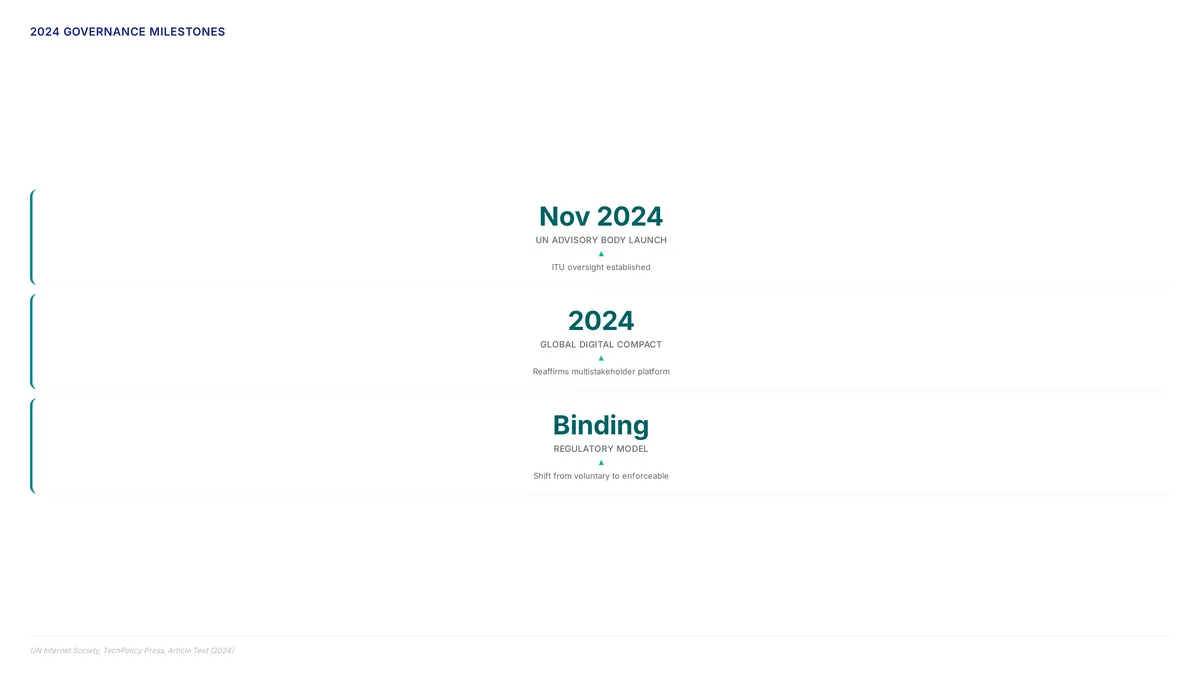
The United Nations launched the International Advisory Body for Submarine Cable Durability in November 2024 to coordinate global protection efforts. This body, overseen by the ITU, works to develop agreements on basic cable durability practices where none previously existed. Operators must understand that current advisory bodies have limited enforcement power regarding physical security mandates. The framework relies on voluntary compliance rather than binding international law. Establishing effective standards requires navigating complex multi-stakeholder platforms involving civil society and business interests. Recent analysis highlights ongoing governance discussions following the adoption of the Global Digital Compact. The EU's 2025 Joint Communication on Cable Security adopted a preventative, cross-sectoral approach to mitigate future risks.
International coordination on repairs remains fragmented without binding treaties. A significant limitation is the inability to compel state actors to prioritize rapid restoration of unprofitable routes. The tension between diplomatic consensus and operational urgency defines current recovery timelines.
Economic Consequences of Internet Disruption and Shutdowns
Defining Economic Dependency on Digital Infrastructure
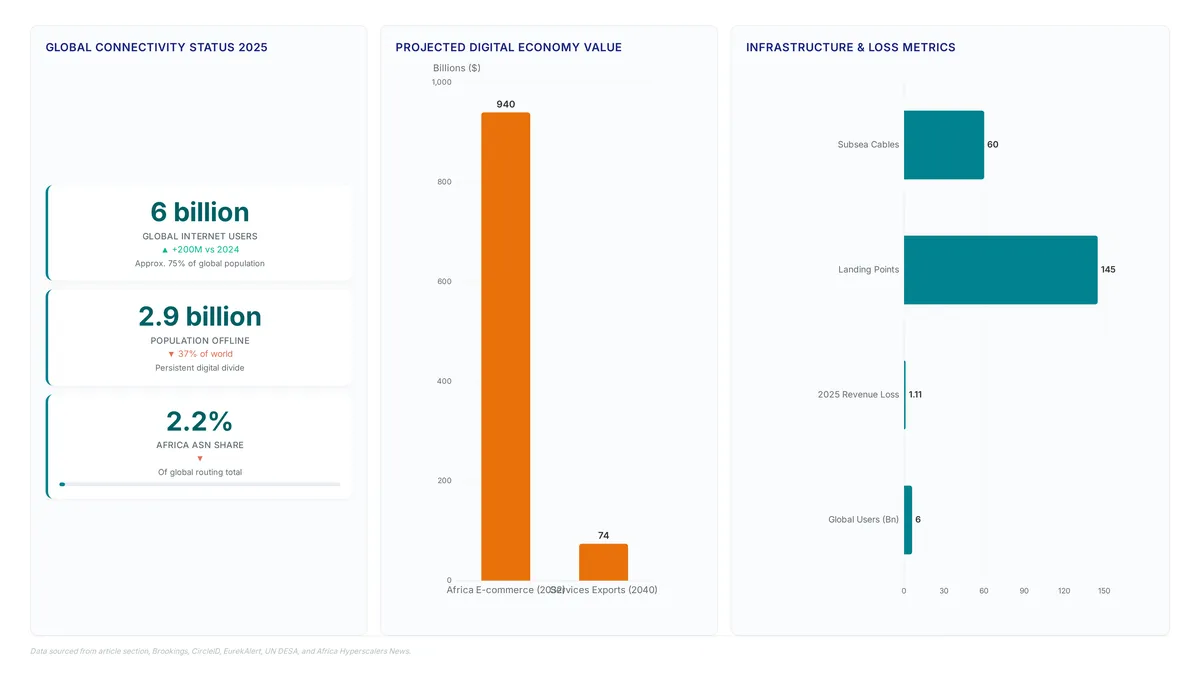
Stability depends on the continuous operation of digital infrastructure rather than abstract rights. Projections indicate Africa's e-commerce market will reach $940 billion in value by 2032, establishing a massive baseline for commercial activity. Simultaneously, digital services exports are expected to grow to $74 billion by 2040. These figures demonstrate that modern economies function as networked systems where connectivity equals revenue generation. The scarcity of Autonomous System Numbers prevents many African enterprises from appearing on the global net, effectively capping their economic potential regardless of local demand. Operators must recognize that treating connectivity as critical infrastructure shifts the focus from legal rights to engineering durability and asset protection. Physical layers supporting these valuations remain vulnerable without this reclassification. Protecting these assets requires recognizing that the African continent is supported by approximately 60 subsea cables and 145 cable landing points, forming the backbone of this digital economy.
Humanitarian and Financial Disruption During Sudan Blackouts
Conflict intensification during the 2024 near blackout in Sudan severed emergency assistance channels precisely when coordination was most vital. Humanitarian actors could not coordinate life-saving deliveries. This event illustrates that treating connectivity as a mere right fails to protect humanitarian services when states deliberately restrict access. The human right framework focuses on preventing access denial yet lacks the regulatory teeth to mandate redundancy or penalize disruption, leaving millions vulnerable during crises. Families lost the ability to communicate. Financial disruption froze assets for populations already facing scarcity. Limited communication with families and disruption of mobile money services affected millions. The limitation of current governance is evident: without critical infrastructure designation, there are no binding international penalties for such outages. Digital networks remain subject to unilateral shutdowns that devastate local economies unlike power grids or water systems.
InterLIR emphasizes that reclassifying these networks is necessary to enforce physical protection and prevent economic devastation. Dependency on digital infrastructure means that any outage directly translates to humanitarian catastrophe. Operators must advocate for frameworks that recognize this reality, moving beyond soft law to binding durability standards. Only by acknowledging the internet as vital physical infrastructure can the global community hope to mitigate such severe operational failures in conflict zones.
Quantifying Losses from Government-Ordered Internet Shutdowns
Government-ordered internet shutdowns cost African economies $1.11 billion in 2025, directly severing revenue streams for mobile money and agricultural sectors. This financial hemorrhage disrupted access for more than 116 million users, paralyzing necessary services that rely on continuous connectivity. These state-mandated blackouts represent deliberate economic sabotage that reclassification as critical infrastructure could legally constrain unlike accidental outages. The current framework emphasizes freedom of expression but lacks mechanisms to penalize states that restrict connectivity for political gain. Treating the internet as critical infrastructure mandates durability standards and creates liability for unilateral disconnection. Enforcing legal consequences remains challenging as the human rights approach is characterized as "soft law" where nation-states face no significant penalties for non-adherence. Most jurisdictions lack specific statutes criminalizing the intentional disruption of digital commerce, leaving economic losses as externalities rather than actionable damages. InterLIR advocates for policy shifts that recognize network availability as a prerequisite for modern economic survival, not merely a civil liberty.
Implementing Durability Through multi-stakeholder Governance Models
Mandatory Durability Standards for Critical Infrastructure Providers
Designating connectivity as critical infrastructure mandates that providers implement redundancy and security protocols under state scrutiny. This regulatory shift moves beyond voluntary best practices to enforceable obligations where operators must demonstrate durability against physical and logical failures. Implementing telecom network redundancy requires diverse physical paths and automated failover mechanisms to maintain service during cable cuts or equipment outages. Operators must now adhere to strict compliance frameworks that dictate minimum uptime and repair timelines. The transition from a human right model to a critical infrastructure approach introduces binding legal requirements rather than soft law suggestions.
Mandatory international coordination transforms submarine cable restoration from a voluntary commercial courtesy into a binding regulatory obligation. The United Nations launched the International Advisory Body for Submarine Cable Durability in November 2024 to codify these repair protocols under ITU oversight. This body develops agreements ensuring that cross-border fixes proceed without diplomatic deadlock, addressing the fragmentation where current advisory bodies lack enforcement power. Operators must now integrate redundancy planning that accounts for mandated cross-sectoral cooperation during physical layer failures.
- Establish direct liaison channels with assigned national authorities for immediate incident reporting. 2.
Advisory mandates from the ITU lack legal teeth to stop sovereign actors. The Global Digital Compact reaffirms a platform involving civil society, yet this structure cannot override national security directives. States retain the technical capacity to sever links regardless of international consensus. Regulation is noted as politically unpopular when it constrains state power. The core tension exists between legally binding obligations for providers and the voluntary nature of multi-stakeholder agreements. Without enforcement mechanisms, governance gaps persist during crises.
- Identify single points of failure in cross-border paths.
- Deploy automated rerouting policies before outages occur.
- Establish private peering sessions independent of public exchanges.
The limitation is that diplomatic pressure rarely restores traffic quicker than engineering workarounds. Operators must assume state cuts are permanent until physical repair completes. InterLIR advises treating political will as an unreliable variable in network design. Reliance on soft law leaves economic stability exposed to abrupt disconnection.
About
Evgeny Sevastyanov, Customer Support Team Leader at InterLIR, brings a unique operational perspective to the critical discussion on submarine cables as essential infrastructure. While his daily work at InterLIR focuses on the stability and redistribution of IPv4 resources, he understands that digital connectivity relies entirely on the physical layer beneath our oceans. Managing technical database objects and ensuring clean IP reputation requires a deep appreciation for network reliability, which submarine cables directly dictate. When these cables are severed, the resulting traffic loss impacts the very IP markets InterLIR serves, validating the argument that the internet requires infrastructure-level protection rather than just rights-based frameworks. Sevastyanov's experience coordinating complex technical solutions for global clients highlights how fragile digital access can be without reliable physical foundations. By connecting the dots between IP resource management and physical cable integrity, he illustrates why reclassifying the internet is vital for maintaining the global digital economy that companies like InterLIR depend.
Conclusion
Voluntary governance leaves submarine cable networks exposed to state-level coercion that diplomatic pressure cannot swiftly resolve. When political will fractures, the operational cost shifts entirely to network architects who must assume cross-border paths are permanently severed until physical repair occurs. Soft law agreements fail to provide the enforcement mechanisms necessary to prevent months of downtime, rendering economic stability in developing regions vulnerable to abrupt disconnection. The current model of multi-stakeholder consensus creates a dangerous lag between outage onset and restoration, particularly where telecom networks serve as the primary transport layer for global data.
Organizations must treat international coordination as a secondary support system rather than a primary reliability guarantee. Start by mapping single points of failure in your cross-border infrastructure this week and deploy automated rerouting policies that function independently of public exchanges. This engineering-first approach acknowledges that state cuts are a persistent threat vector requiring technical mitigation rather than political negotiation. Operators should establish private peering sessions now to bypass potential choke points before seeking regulatory remedies. Prioritizing redundant physical paths over diplomatic assurances ensures continuity when governance gaps widen during crises.
Frequently Asked Questions
Connectivity failures cause massive financial losses for affected regions. SubSaharan Africa lost over $1.6 billion in 2024 due to these specific network outages.
Nearly all international internet traffic travels through these underwater fibers. Specifically, 99% of international traffic depends on this fragile physical layer for global connectivity.
Rights frameworks lack enforcement mechanisms against physical destruction or state coercion. This gap leaves a large number people without reliable access despite existing international declarations.
A significant segment of humanity has never accessed the internet. Currently, a portion of the world's population remains offline, highlighting a persistent and dangerous digital divide.
Government-ordered disruptions severely damage emerging digital markets and services. In 2025, internet shutdowns cost African economies $1.11 billion, directly severing revenue streams for millions.
References
- As governments, economies and essential services become ever more
- Local Peering May Be Africa’s Cheapest Infrastructure Upgrade: Africa
- APNIC Articles – APNIC: Internet addressing in the 2010s
- What we know about Iran’s Internet shutdown: It is
- Why IPv4 Still Handles 70% of Internet Traffic –
- To 4,294,967,296 and Beyond – Under 10% of IPv4