Deep space networking: Why TCP fails now
Packet round-trip times now span hours. Standard TCP collapses under interplanetary latency. Delay-Tolerant Networking is no longer theoretical; it is mandatory for sustaining IP packet delivery beyond Low Earth Orbit. Starlink proves IP viability in orbit with 4 million subscribers and sub-60ms latency. NASA MVN data confirms these terrestrial standards fail catastrophically when distances reach the Moon or Mars.
Laser communication hybrids and RF backups form the backbone of the 2026 interplanetary internet supporting active missions to near-Earth asteroids. We must examine the mechanics of protocol failure. TCP's reliance on immediate acknowledgments breaks down when light-speed delays stretch into hours. This necessitates a shift toward QUIC over unreliable transports. Engineers now rely on Earth-based simulation techniques using Linux TUN devices and TC-NETEM. These tools allow programmable injection of multi-hour delays to test router behavior before launch.
This analysis draws from Marc Blanchet's recent presentations at APRICOT 2026 and IETF 120. It highlights work by the TIPTOP Working Group to adapt infrastructure for the mid-1980s legacy of the NASA Science Network. (IETF's draft many tiptop ip architecture 01) (APRICOT's bytes from ietf 120 deep space networking) As Google and NASA collaborations from the late 1990s evolve, the industry must accept that deep space requires fundamentally different network conditions than those governing our current digital economy.
The Role of IP Networking in Deep Space Infrastructure
Deep space IP networking defines a store-and-forward architecture for links where round-trip delays exceed protocol timeouts. One-way latency between Earth and Mars ranges from 4 to 24 minutes. Standard TCP acknowledgement streams become ineffective in this window. The environment demands buffering packets in forwarders facing intermittent links rather than relying on continuous end-to-end paths. The proposed architecture explicitly handles these discontinuities by decoupling transmission from immediate delivery confirmation.
Traditional terrestrial networking assumes persistent connectivity. That premise fails beyond low Earth orbit shells. Spacecraft typically apply Ethernet or Time-Triggered Ethernet on-board. Deep space trunks rely on CCSDS link-layers for point-to-point communication. The TIPTOP working group addresses this gap by standardizing IP suites for such extreme delay scenarios. Delay-Tolerant Networking transitions from theoretical framework to practical necessity as disaster environments on Earth begin sharing these intermittent connectivity characteristics.
Router memory allocation strategies must shift fundamentally. InterLIR notes that buffering requirements scale linearly with propagation delay. This forces hardware redesigns for deep space gateways. QUIC replaces TCP as the transport layer to manage session state without constant ACK traffic. Packet reordering becomes expected rather than anomalous. Receiving stacks require updated reassembly logic. Simulation tools now model these conditions using 64-bit delay values to test edge cases. Without these architectural adjustments, interplanetary data transfer remains impossible regardless of available bandwidth.
TCP Acknowledgement Failures at 22000 Miles Altitude
Geostationary links at 22,000 miles altitude create ~500 ms round-trip delays that break TCP acknowledgement clocks.
Standard TCP relies on a steady stream of ACKs to manage sending rates. This mechanism collapses when latency stretches beyond timer thresholds. Packet reordering in these high-delay paths triggers spurious retransmissions. The system wastes scarce bandwidth on duplicate data segments. The protocol interprets silence as loss rather than propagation delay. The congestion window shrinks unnecessarily. QUIC emerges as a superior alternative due to its independence from static IP addresses and durability to reordering events.
| Protocol | ACK Dependency | Reordering Handling | Suitability |
|---|---|---|---|
| TCP | High | Poor | Low |
| QUIC | Low | Native | High |
Operators deploying COTS components must simulate these delays locally before launch. Validating stack behavior is non-negotiable. Ignoring this step risks total link saturation during initial handshakes. The cost of failure is absolute: no data flows if the transport layer cannot distinguish delay from dropout. Low Earth Orbit constellations deliver 25 ms latency. Geostationary arcs impose ~500 ms delays that break interactive TCP sessions. This disparity defines the operational baseline for orbital IP performance before attempting interplanetary extension. Starlink serves 4 million subscribers with sub-60 ms response times. Users expect immediate feedback. GEO architectures cannot satisfy this expectation. Traditional GEO satellites orbit at 22,000 miles. Packets must traverse physical distances that guarantee half-second round trips regardless of bandwidth capacity.
| Metric | LEO Constellation | Geostationary (GEO) |
|---|---|---|
| Altitude | ~550 km | ~35,786 km |
| Round-Trip Delay | 25–60 ms | ~500 ms |
| Topology | Mesh Anycast Routing | Point-to-Point |
| Protocol Fit | Standard TCP | Degraded TCP |
Protocol behavior exposes the cost of this latency gap. GEO links trigger spurious retransmissions because acknowledgments arrive after timeout thresholds expire. Unlike the proliferated mesh of LEO nodes, GEO relies on fixed ground stations. These create single points of failure during link intermittency. Operators modeling deep space paths must recognize that even 500 ms represents a best-case scenario compared to multi-minute planetary delays. The architectural shift from continuous streams to delay-tolerant buffering begins here. Standard congestion control algorithms mistake propagation delay for packet loss.
64-Bit Delay Counters and IP Packet Buffering Mechanics
Recent code changes represent delay as a 64-bit value. This enables theoretical testing out to the edge of the galaxy. Standard 32-bit integers overflow quickly when measuring propagation times spanning hours rather than milliseconds. This expansion allows simulation tools to model packet-in-flight times that exceed traditional timer thresholds without arithmetic errors.
Forwarders must buffer IP packets facing intermittent links instead of expecting immediate delivery confirmation. Ietf. Html) decouples transmission from receipt. Routers must hold data during deep space blackouts. Such store-and-forward mechanics prevent data loss when spacecraft move behind planetary bodies or suffer antenna misalignment.
TCP fails because it interprets silence as packet loss rather than propagation delay. Retransmission timers expire before acknowledgements arrive. The congestion window collapses unnecessarily. QUIC handles this improved by managing packet reordering within a single design that supports connection migration.
| Protocol | Delay Handling | Retransmission Logic |
|---|---|---|
| TCP | Timer-based collapse | Aggressive duplicate sending |
| QUIC | Session-layer agility | Selective acknowledgement |
Operators cannot simply increase timeout values without risking resource exhaustion on intermediate nodes. Buffer capacity becomes the limiting factor rather than bandwidth during extended occultation events.
Spacecraft IP address changes during orbital maneuvers break standard TCP sessions instantly. This requires QUIC to maintain connectivity. This protocol operates over UDP to manage packet reordering and support connection migration when mobility alters network topology. Legacy transport layers bind sessions to static IP pairs. Total failure occurs when a spacecraft switches antennas or handovers between ground stations. QUIC decouples the session identifier from the underlying IP address. The data stream survives network path changes without renegotiation.
Remote management of these flexible nodes relies on RESTCONF and potentially SSH over the same encrypted tunnel. Administrators can push configuration updates to moving assets without waiting for stable, long-lived TCP handshakes that latency would otherwise timeout. The mechanism treats the transport layer as a flexible envelope rather than a rigid pipe. It accommodates the erratic nature of deep space links.
| Feature | Standard TCP | QUIC over UDP |
|---|---|---|
| Address Binding | Strict IP/Port pair | Connection ID based |
| Handshake Rounds | Three-way (1.5 RTT) | Zero-RTT possible |
| Migration Support | None (session reset) | Native address switching |
| Loss Recovery | Head-of-line blocking | Stream-level retransmission |
Implementing this agility introduces operational complexity regarding state synchronization across distributed forwarders. Network operators must configure firewalls to allow persistent UDP flows. Many legacy security appliances reject this by default. The shift demands updated monitoring tools capable of parsing connection IDs instead of relying solely on five-tuple inspection. TCP acknowledgement streams collapse under multi-minute delays. QUIC operates effectively over unreliable transports like UDP. Standard TCP requires a steady flow of ACKs to regulate transmission rates. This mechanism fails when silence indicates propagation delay rather than packet loss. The protocol mistakenly shrinks its congestion window during long quiet periods. The link starves of data. In contrast, QUIC manages packet reordering and loss automatically without depending on immediate feedback loops. This design allows the session to persist even when IP addresses change due to spacecraft mobility.
Chinese researchers are already experimenting with this modern approach to overcome legacy limitations. The TIPTOP Working Group actively explores these protocol options for extreme environments where traditional handshakes time out. A critical tension exists between strict reliability and availability. Insisting on ordered delivery guarantees starvation during deep space blackouts. Operators must accept unordered datagrams to maintain any throughput at all across interplanetary distances.
Linux TUN Devices and TC-NETEM for Programmable Delay Injection
Marc Blanchet deploys the Linux TUN device to capture IP packets before injecting synthetic latency via TC‑NETEM.
- Create a virtual interface to intercept outbound traffic from the test host.
- Apply TC‑NETEM rules to impose specific millisecond or hour-long delays on the stream.
- Configure 64‑bit delay counters to prevent integer overflow during multi-hour propagation simulations.
Standard 32-bit timers fail when modeling interplanetary internet. This software stack enables programmatic definition of experiments where packet-in-flight times span hours rather than seconds. Such fidelity allows operators to observe how routers buffer data during intermittent link blackouts without launching hardware. The simulation environment reveals that switches often drop packets due to queue exhaustion long before propagation delay becomes the limiting factor.
Engineers must balance simulation duration against host stability. Keeping machines running for galactic-edge tests remains theoretically possible but practically fragile. While the tools support RESTCONF management workflows, the underlying OS scheduler may terminate long-running processes unexpectedly. This constraint forces teams to segment multi-day experiments into smaller, verifiable windows to ensure data integrity.
Marc Blanchet uses the Linux TUN device and TC‑NETEM to programmatically define experiments where packet‑in‑flight times span hours.
- Instantiate a virtual interface using Linux TUN to intercept outbound IP traffic from the test host.
- Apply TC‑NETEM rules to impose specific delay, loss, and reordering parameters on the captured stream.
- Enable 64‑bit delay counters within the kernel module to prevent integer overflow during multi-hour propagation simulations.
This configuration allows the study of how switches, routers, and other intermediate elements behave in an end‑to‑end IP exchange under extreme stress.
The simulation environment validates architectures where RoutingDataProvider systems build connectivity graphs to compute optimal next-hop routing based on future network states. Unlike terrestrial testing, these scenarios require buffering IP packets in forwarders facing intermittent links instead of expecting immediate delivery confirmation. The cost of ignoring reordering logic is total session collapse. QUIC must manage packet arrival sequences without relying on immediate feedback loops.
| Parameter | Standard Lab Value | Deep Space Simulation |
|---|---|---|
| Max Delay | 500 ms | Hours |
| Timer Precision | 32-bit | 64-bit |
| Link State | Stable | Intermittent |
Transitioning Delay-Tolerant Networking Operators must configure buffers to hold data during blackouts. This requirement is absent in commercial Starlink deployments.
Validate RoutingDataProvider graphs by injecting hour-long packet flights before deploying to actual deep space links.
- Capture outbound traffic on a Linux TUN interface to intercept standard IP streams for modification.
- Apply TC‑NETEM rules that force delays matching the light-time between Earth and distant asteroids.
- Verify the system handles 64‑bit delay counters without rolling over during multi-hour silence periods.
Standard kernels truncate timing values. Immediate test failure occurs when simulating galactic distances. The theoretical testing capability extends to the edge of the galaxy, assuming the machines could remain running for that duration. These simulations help validate architectures where RoutingDataProvider systems build connectivity graphs to compute optimal next-hop routing based on future network states. Engineers must confirm that path computation logic survives the absence of immediate feedback loops. Active missions to Mars and the Moon will rely on this rigorous pre-deployment verification to ensure hybrid communication Scalable ground station networks address historical bottlenecks. Local simulation remains the only safe method to stress-test routing daemons.
Strategic Adoption of QUIC for Future Space Missions
Application: QUIC Session Migration for Artemis II Mobility Scenarios
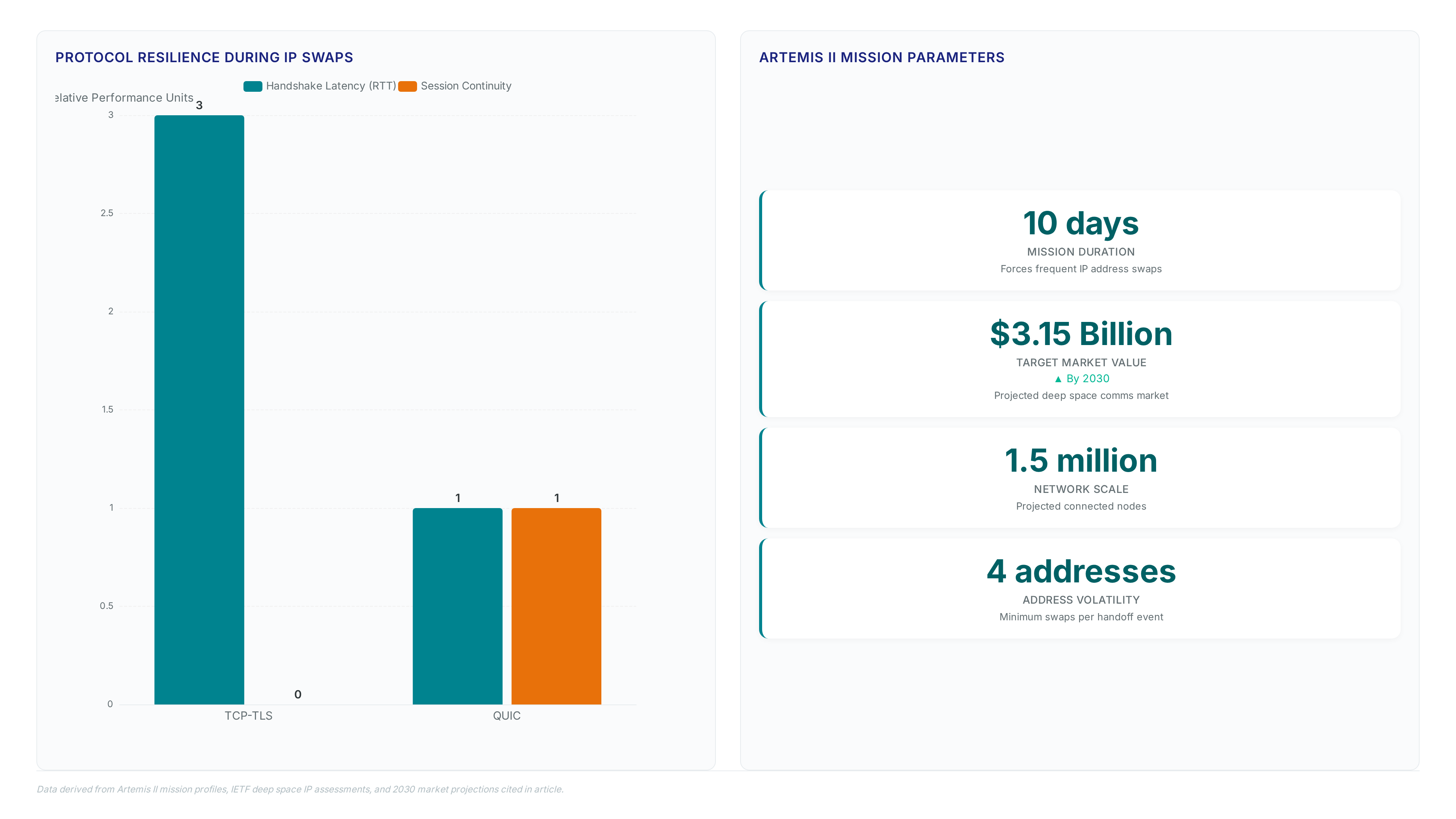
The 10-day Artemis II mission forces frequent IP address swaps. These break TCP sessions but leave QUIC connections intact. Spacecraft handoffs between ground stations trigger new source addresses. Legacy transports drop the stream entirely during such mobility events. QUIC binds the session to a connection ID rather than a static IP tuple. This enables smooth continuity across network boundaries. This connection migration capability prevents application-layer timeouts during orbital maneuvers. Operators must configure endpoints to preserve state while the underlying path shifts from high-gain antennas to relay satellites. TCP interprets such address changes as fatal errors. It requires a full three-way handshake restart that wastes precious bandwidth.
Deploying these protocols demands rigorous validation before launch. Configuration errors cannot be patched in real-time across vast interplanetary distances. Engineers must simulate connection migration events using extended delay counters. They must verify that management daemons do not timeout during multi-hour silence periods. Skipping this step costs total loss of node controllability. Teams must rely on pre-scripted autonomy rather than adaptive remote intervention.
| Feature | TCP-based Management | QUIC-based Management |
|---|---|---|
| Address Change Handling | Session Termination | Smooth Migration |
| Encryption Layer | Separate (TLS/SSH) | Integrated |
| Packet Reordering | Head-of-Line Blocking | Independent Streams |
Operators should prioritize automated configuration pipelines similar to terrestrial cloud networks. This reduces human error margins. The projected multi-billion dollar deep space comms market value by 2030 depends on such strong, self-healing management planes functioning without constant human oversight. Legacy manual command structures cannot scale to support the proposed architecture for IP in deep space.
Operational Risks of Replacing TCP With QUIC in Deep Space Architectures
Abandoning TCP workflows introduces immediate failure modes when UDP datagrams vanish across intermittent deep space links without retransmission guarantees. Operators face a maturity gap. Terrestrial QUIC deployments benefit from dense infrastructure. Space environments lack equivalent debugging visibility for lost packets. The protocol suitability analysis confirms QUIC handles migration improved. Yet, reliance on user-space stacks increases CPU overhead on radiation-hardened hardware with limited processing headroom.
Remote configuration attempts via RESTCONF may stall if the underlying UDP transport drops management frames during solar conjunctions. SSH over QUIC offers durability against address changes. However, the absence of kernel-level optimization in flight hardware creates a single point of failure in the user-space daemon. The cost is measurable: a crashed QUIC process terminates all multiplexed streams instantly. TCP faults often isolate to single sockets. InterLIR recommends rigorous TC‑NETEM validation before migrating critical telemetry to UDP encapsulation.
About
Vladislava Shadrina serves as a Customer Account Manager at InterLIR, a Berlin-based marketplace specializing in IPv4 address redistribution. While her background includes architecture, her daily professional focus is entirely dedicated to managing client relations within the critical domain of IP resources. This role provides her with unique, practical insights into the scarcity and vital importance of internet protocol addresses, making her well-qualified to contextualize discussions on IP packet evolution. At InterLIR, she enables access to clean, secure network resources, directly engaging with the infrastructure challenges that advanced protocols aim to solve. By bridging the gap between technical IETF developments, such as those for deep space communication, and real-world resource allocation, Shadrina highlights how fundamental IP mechanics impact global connectivity. Her work ensures that organizations maintain reliable network availability, grounding high-level theoretical advancements in the tangible realities of modern network management and resource security.
Conclusion
Scaling IP beyond Earth exposes a critical fragility: user-space protocol daemons become single points of failure when radiation strikes limited CPU headroom. QUIC solves mobility. Its process-level crash domain means one software fault kills every active telemetry stream simultaneously. TCP isolates socket failures. This architectural risk compounds as the multi-billion dollar market expands. Operators cannot afford total link blackouts during solar conjunctions simply to save milliseconds on handshakes. The industry must pivot from chasing terrestrial latency benchmarks to designing fault-domain isolation specifically for radiation-hardened environments.
Adopt QUIC only for non-critical data links by Q4 2026. Mandate hybrid transport stacks for all command-and-control telemetry until flight-proven user-space hardening exists. Do not migrate core flight software to UDP encapsulation without proving that a daemon crash leaves management channels intact. Start this week by running TC‑NETEM simulations that inject process-killing errors into your current QUIC testbeds, not just packet loss. Measure exactly how many distinct telemetry streams vanish when the user-space daemon dies. If that number equals your total active sessions, your architecture is unfit for deep space regardless of handshake speed. Prioritize kernel-level durability over connection migration features until your simulation proves otherwise.
Frequently Asked Questions
TCP collapses because it requires immediate acknowledgments that light-speed delays prevent. Starlink proves IP viability in orbit with 4 million subscribers, but those terrestrial standards fail catastrophically when distances reach the Moon.
Geostationary links create roughly 500 ms round-trip delays that break standard TCP acknowledgement clocks. While Low Earth Orbit constellations serve 4 million subscribers effectively, these higher altitude arcs impose unacceptable latency for interactive protocols.
Engineers use Linux TUN devices and TC-NETEM to programmatically inject multi-hour delays into Earth-based simulations. This allows testing of router behavior and packet reordering logic without needing the 4 million subscribers found in active commercial networks.
QUIC manages session state without constant acknowledgement traffic, making it durable against reordering events. Unlike TCP which fails under extreme delay, QUIC supports the connectivity needs demonstrated by systems serving 4 million subscribers in lower orbits.
Delay-Tolerant Networking architectures are now mandatory because they decouple transmission from immediate delivery confirmation. Standard models relying on continuous paths fail beyond the environment where 4 million subscribers currently enjoy reliable low-latency connectivity.