DNS lookup speeds under 100ms for ASN mapping
With over 92,000 registered ASNs globally, legacy WHOIS tools struggle to match the speed of modern DNS-based lookup services. The central thesis is that flexible, database-driven DNS architectures have superseded static zone files as the critical infrastructure for real-time network intelligence. This shift enables agentic networks to bypass the latency of TCP-based queries, delivering instant Autonomous System Number attribution necessary for 2026 security operations.
Readers will explore how Regional Internet Registries like ARIN and RIPE historically constrained data access through rigid whois daemons, contrasting this with the fluidity of Team Cymru's DNS variant service. Finally, the article demonstrates executing real-time network intelligence via command line, proving that UDP efficiency offers a superior, zero-cost baseline for low-volume users compared to expensive enterprise APIs from vendors like WhoisXML.
As EfficientIP reports, 97% of IT professionals now prioritize IPAM tools capable of managing these distributed DNS resources, signaling a definitive move away from siloed management. The era of manual string manipulation for IPv6 lookups is ending, replaced by authoritative servers that generate correlated responses on the fly. This evolution transforms IP address lookup from a retrospective administrative task into a proactive component of automated network defense.
The Evolution of DNS-Based IP Resource Lookup Services
IP-to-ASN Mapping and the Shift from Static Zone Files
IP-to-ASN mapping translates an IP prefix into its originating Autonomous System Number using live routing data rather than static zone files. Global growth pushed registered counts beyond the 16-bit limit of 65,536, forcing a migration to 32-bit identifiers that now support over 92,000 active systems. This expansion broke the rigid structure of traditional DNS zone files, which require exact label matches and cannot dynamically compute responses for arbitrary IP inputs without preprocessing. Operators previously reversed IPv4 octets or stripped IPv6 colons to query legacy services like the Team Cymru DNS variant, introducing significant parsing overhead. Modern implementations bypass these constraints by using database backends that execute procedures correlated to the query name instead of relying on fixed text records. Data aggregation from the five Regional Internet Registries ensures global coverage without manual file updates. The shift eliminates the need for client-side string manipulation, allowing direct queries against authoritative servers running plug-in modules. However, this flexibility demands strong backend infrastructure capable of real-time lookups against BGP snapshots and geolocation databases. Static files offer simplicity but fail to reflect the flexible nature of modern routing announcements.
Octet reversal defines the mandatory preprocessing step for querying the legacy Team Cymru service, forcing operators to manipulate address strings before resolution. This mechanism contrasts sharply with flexible DNS backends that accept standard notation, creating a distinct friction point for automation scripts. The service requires reversing IPv4 octets, transforming `216.90.108.31` into `31.108.90.216` within the DNS query structure IPv6 handling imposes greater complexity, demanding nibble reversal and complete colon stripping to form valid labels. A single query for Google's ASN 15169 illustrates this burden, requiring a 32-character reversed hex string appended to the origin domain.
Direct IP string queries eliminate octet reversal requirements found in legacy Team Cymru architectures. The established service mandates that operators reverse IPv4 octets and strip IPv6 colons before transmission, a preprocessing burden absent in newer systems. This mechanical friction increases script complexity for automation tools relying on standard address notation. APNIC launched ipasn. (APNIC's from the stupid dns tricks department ipasn net) net on February 9, 2026, using PowerDNS to accept native IP formats without string manipulation. The architectural shift moves logic from the client to the server backend, reducing local parsing errors.
| Feature | Team Cymru Legacy | Modern ipasn.net |
|---|---|---|
| Query Format | Reversed octets/nibbles | Native IP notation |
| IPv6 Handling | Colon stripping required | Delimiters preserved |
| Backend Engine | Static zone files | Flexible database plugins |
| Preprocessing | Mandatory client-side | Zero client-side |
Commercial entities often charge for bulk access, whereas these platforms operate as community resources with no cost barrier. The limitation remains dependency on specific server capabilities; only platforms supporting plug-in backends can replicate this functionality. Operators sticking with static zone files face unscalable maintenance as the global routing table expands. The cost of maintaining legacy client parsers outweighs the effort of migrating to direct-query capable resolvers. Data freshness relies on continuous BGP table snapshots rather than static registry dumps. This approach ensures real-time accuracy but demands higher server-side compute resources per query. Network engineers must weigh client simplicity against server infrastructure costs when selecting a lookup strategy.
Inside the PowerDNS Architecture Driving Flexible ASN Queries
PowerDNS Backend Logic for Flexible BGP and RIR Data Synthesis
PowerDNS executes procedural logic to synthesize responses from live BGP snapshots, geolocation databases, and RIR statistics rather than reading static zone files. This architecture treats the authoritative server as a compute engine that triggers three distinct lookups per query: retrieving the origin AS from current routing tables, fetching country codes, and pulling registration dates from RIR reports. Unlike services focusing on historical DNS records to track changes over time, this backend prioritizes real-time mapping of current IP-to-ASN relationships for immediate validation. The system returns a pipe-delimited string containing the prefix, ASN, country, RIR, and date, matching the output format of legacy providers while eliminating client-side preprocessing.
| Data Source | Lookup Target | Output Field |
|---|---|---|
| BGP Table | Origin AS | ASN Number |
| Geolocation DB | IP Prefix | Country Code |
| RIR Statistics | Registration Record | Date and RIR Name |
Operators using this flexible synthesis gain access to real-time mapping capabilities necessary for detecting botnets via ASN reputation analysis without maintaining local state. The limitation lies in the dependency on external data freshness; if the BGP snapshot lags, the synthesized DNS response propagates stale routing information instantly. This trade-off shifts the burden of data currency from the querying client to the backend infrastructure, requiring rigorous update cycles to maintain accuracy. The procedural approach allows DNS flexibility that static files cannot match, enabling complex correlations like ROA validity checks within a single TXT record response.
Constructing Direct Attribute Queries for Country Codes and RPKI Status
Direct attribute retrieval uses specific DNS labels like `. Cc` and `. Rpki` to fetch single values without parsing full strings. A query such as `$ dig +short TXT 216.88.0.0. Cc. Ipasn.net` returns "US" immediately, while appending `. Rpki` isolates validation status. This method bypasses the need to split pipe-delimited responses containing ASN, prefix, and registration dates. Operators avoid client-side string manipulation by offloading logic to the authoritative server backend. The response format typically delivers thorough data, yet direct labels extract only the required field. Legacy systems demand complex preprocessing, but modern platforms accept native IP notation for immediate resolution. This architectural shift reduces script complexity and eliminates errors from manual octet reversal or nibble translation. Network engineers should prioritize direct IP DNS queries over full-record parsing when automation requires only country codes or RPKI states. The cost of processing unused data fields increases latency in high-volume polling scenarios. Filtering at the query level rather than the application layer improves efficiency significantly.
| Query Type | Label Suffix | Output Example | ||
|---|---|---|---|---|
| Country Code | `.cc` | "US" | ||
| RPKI Status | `.rpki` | "VLD" | ||
| Full Record | (none) | "ASN \ | Prefix \ | CC" |
Meanwhile, direct queries minimize payload size for constrained environments.
Legacy DNS implementations mandate octet reversal for IPv4 and nibble reversal for IPv6, creating a persistent preprocessing burden for query generation. Team Cymru forces operators to transform `216.90.108.31` into `31.108.90.216` before transmission, a mechanical step that introduces script fragility. IPv6 handling worsens this friction by requiring complete colon stripping and hex character expansion across 32 distinct labels. This rigid structure contrasts with modern backends that exploit the surprising flexibility of DNS query name characters to accept standard notation directly. The DNS query structure php/2026/02/08/from-the-stupid-dns-tricks-department-ipasn-net/) for `ipasn. Net` permits colons and dots within labels, eliminating client-side string manipulation entirely.
| Constraint | Legacy Requirement | Native Handling |
|---|---|---|
| IPv4 Format | Reversed octets | Standard dotted decimal |
| IPv6 Format | Reversed nibbles, no colons | Standard colon-hex notation |
| Client Logic | Complex parsing scripts | Direct string insertion |
| Error Surface | High (formatting mistakes) | Low ( |
The operational cost of legacy formatting is measurable in automation failures where malformed strings trigger silent lookup errors. Modern PowerDNS deployments bypass these constraints by executing procedural lookups against flexible datasets rather than static zone files. This architectural shift moves parsing logic from the edge client to the authoritative server, reducing local compute overhead. However, relying on non-standard characters in query names risks incompatibility with strict recursive resolvers that enforce RFC compliance aggressively. Operators must validate their specific resolver chain before adopting native IPv6 query formats in production environments.
Defining RPKI Validation Status in DNS TXT Responses
The `VLD` marker in a DNS TXT response confirms a valid Route Origin Authorization exists for the queried prefix. Operators query the `. Rpki` label to isolate this status without parsing full pipe-delimited strings. A response stating `VLD` indicates the origin AS matches a signed ROA within the trust anchor chain. Conversely, an `Invalid` result signals a cryptographic mismatch where the announcing AS lacks authorization, demanding immediate traffic inspection. The `Unknown` state appears when no ROA covers the specific prefix length, leaving the path unvalidated rather than explicitly rejected.
- Execute a direct query using the `. Rpki` suffix to retrieve the single-word validation token.
- Parse the returned string to identify `VLD`, `Invalid`, or `Unknown` as the security posture.
- Correlate `Invalid` findings with malicious traffic analysis data showing 5.3% of flows often originate from suspicious networks.
- Apply filtering policies based on the ROV field before accepting routes into the local routing table.
This method bypasses the need to reverse octets or strip delimiters, using DNS query structure Relying on `Unknown` results as safe creates risk, as unsigned prefixes remain vulnerable to hijacking despite lacking an explicit reject signal. The data assembly process pulls RIR statistics to ensure the registration date and holding RIR align with the cryptographic proof.
Direct IPv6 queries on ipasn. Net accept standard colon notation, eliminating the nibble-reversal steps mandatory in legacy systems.
- Construct the query string using the full IPv6 address followed by `. Origin6. Asn. Ipasn.net` without modifying delimiters.
- Execute the lookup using `dig` to retrieve a pipe-delimited string containing the prefix, origin AS, and registration date.
- Parse the single response line to extract the country code and RIR assignment details simultaneously.
Legacy workflows force operators to reverse nibbles and strip colons, a mechanical friction point that increases script fragility during automation.
In practice, direct attribute suffixes extract country codes and registration dates without parsing full pipe-delimited strings. 1. Append `. Cc` to the target IP address to retrieve the two-letter country code instantly. 2. Query the base domain to capture the complete allocation date alongside the origin AS number. 3. Validate the returned date format against RIRs' statistics reports for temporal accuracy. 4. Cross-reference the country code with geolocation databases to detect potential registry mismatches. | Query Suffix | Returned Data | Parsing Overhead | | :--- | :--- | :--- | | `.cc` | Country Code Only | None | | (Base) | Full Attribute Set | High | | `.rpki` | Validation Status | Low |
Operators bypass client-side string manipulation by offloading logic to the authoritative server backend. This approach eliminates the risk of script errors during field extraction from complex responses. Commercial alternatives often provide enriched JSON responses that include organization names and hosting flags, yet DNS labels offer lower latency for single-field checks. The trade-off is reduced context; isolating the registration date forfeits immediate visibility into the advertised prefix length. Security teams using integrated IP Intel services gain reputation data but may miss precise allocation timelines found in raw RIR stats. Direct queries ensure data freshness by hitting the source rather than cached third-party aggregates.
Strategic Value of Centralized IPAM in Modern Network Operations
Centralized IPAM as a Distributed Processing System for ASN Data
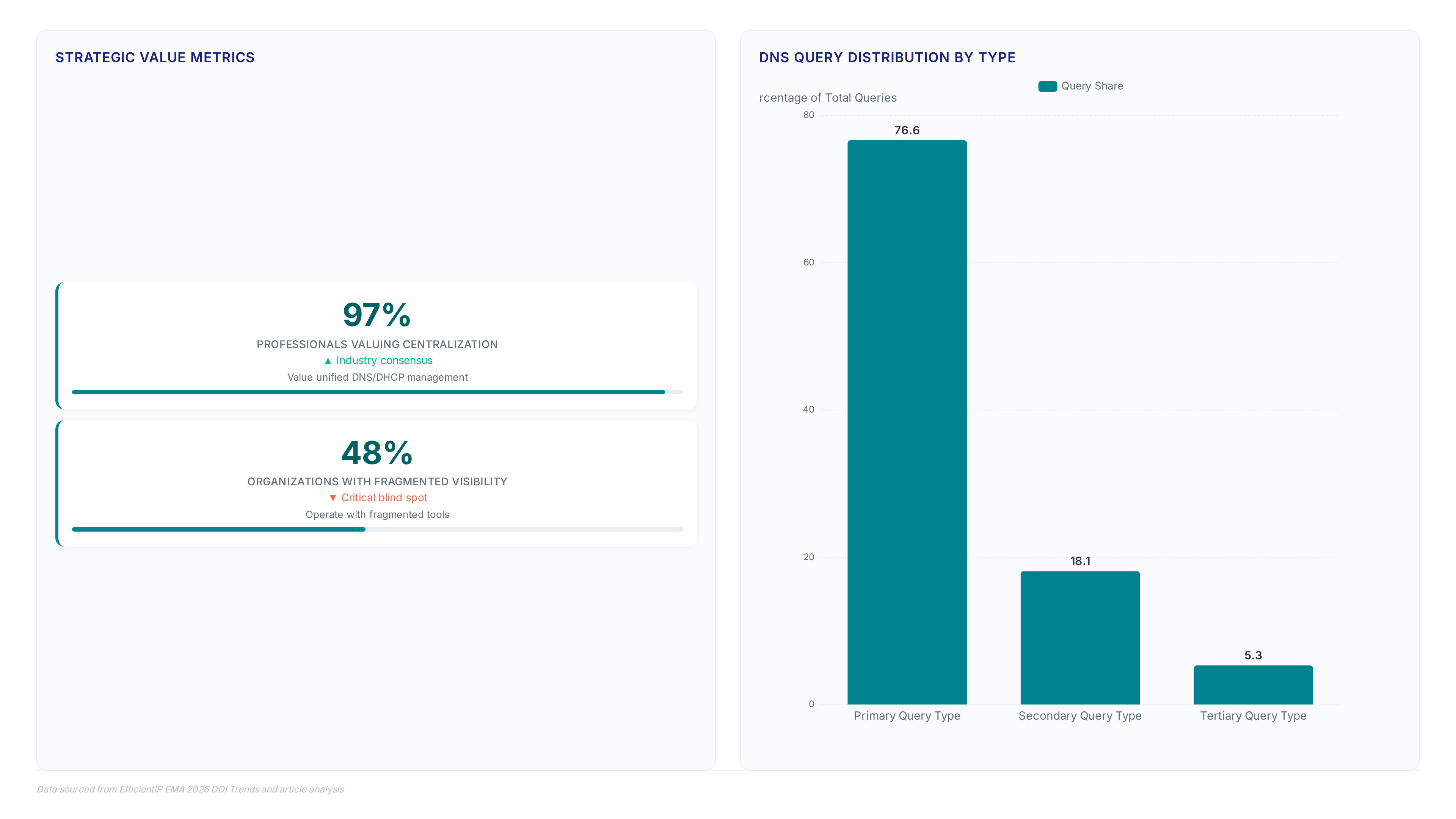
The DNS functions as a distributed processing system where queries act as coded instructions executed by PowerDNS backends rather than static directory lookups. This architectural shift eliminates the mechanical friction of octet reversal found in legacy services, allowing standard IP notation to trigger immediate data assembly procedures. Operators use this flexibility to bypass complex pre-processing scripts, directly ingesting BGP snapshots and RIR statistics for real-time response generation. Adoption trends reflect a broader industry move toward unified management, with 97% of IT professionals valuing tools that centrally manage third-party DNS and DHCP services within agentic networks. Security teams exploit this capability to map complete IP footprints of substantial cloud providers, enforcing policies against malicious infrastructure without external API dependencies. The query execution model transforms the resolver into an active computation node, synthesizing geolocation and registration data on demand.
| Legacy Approach | Modern Backend |
|---|---|
| Static zone files | Flexible procedure execution |
| Manual octet reversal | Direct standard notation |
| High parsing overhead | Instant attribute retrieval |
Despite these advantages, the lack of standardized schema definitions across custom backends introduces interoperability risks for multi-vendor environments. Operators must validate output consistency when migrating from established services like Team Cymru to newer implementations. The cost of this flexibility is the responsibility to maintain accurate upstream data sources within the processing logic. ### Real-Time Botnet Detection via Pangea.
Pangea. Cloud users use the integrated Team Cymru IP Intel service to query IPs in real-time, successfully detecting and defending against bots by identifying the ASN reputation of incoming traffic. This operational model eliminates the latency of batch processing, allowing security stacks to reject malicious flows before session establishment completes. The mechanism relies on direct DNS queries that return ASN reputation data without requiring the octet reversal or delimiter stripping found in legacy implementations. Operators configure their PowerDNS backends to execute these lookups dynamically, treating each query as a coded instruction for immediate threat classification rather than a static record retrieval. The shift toward agentic networks drives this consolidation, moving away from siloed management where IPAM and security tools operate independently. The cost of this integration is the dependency on external data freshness; if the upstream BGP snapshot lags, the reputation score may reflect a hijacked prefix rather than the legitimate owner.
| Data Source | Query Format | Pre-processing Required |
|---|---|---|
| Legacy Services | Reversed Octets | Yes |
| Modern Backends | Standard Notation | No |
InterLIR recommends deploying these lookups at the network edge to minimize round-trip time during high-volume attack vectors. The limitation remains that DNS-based validation cannot inspect packet payloads, so it serves as a filtering layer rather than a complete intrusion detection system. This approach transforms the DNS infrastructure into an active distributed processing system, where the query itself triggers the security logic.
The Visibility Gap: Why 48% of Organizations Lack DNS Confidence
Less than half of enterprises maintain full confidence in their DNS visibility, creating a blind spot where 48% of organizations operate with fragmented IP management data. Legacy query mechanisms exacerbate this gap by forcing operators to manually reverse octets or strip IPv6 delimiters before executing lookups, a process that introduces script fragility and parsing errors. Modern backends eliminate this friction by accepting standard IP notation directly, treating the DNS system as a distributed processing engine rather than a static directory.
Security applications now extend beyond simple lookups to address broader network integrity issues, yet fragmented visibility hinders proven deployment. Teams attempting to integrate IP Intel services for botnet detection often fail because their underlying DNS infrastructure cannot handle the query volume or format flexibility required. The cost of this limitation is measurable: operators relying on pre-processed queries face higher latency and increased failure rates during automated scans. Bridging this gap requires adopting platforms that execute coded instructions on demand, allowing smooth integration of geolocation and RIR statistics without manual intervention. Without this shift, the majority of networks remain vulnerable to routing incidents they cannot see or validate in real-time.
About
Vladislava Shadrina serves as a Customer Account Manager at InterLIR, placing her at the forefront of daily operations involving IP resource allocation and network infrastructure validation. Her role requires constant verification of Autonomous System Numbers (ASNs) and IP reputation to ensure clean transfers within the marketplace, making her uniquely qualified to explain DNS-based lookup services. By routinely using tools that query Regional Internet Registries (RIRs), she validates data accuracy for clients seeking reliable network resources. This hands-on experience with whois databases and BGP route objects directly informs her understanding of how organizations verify digital assets. At InterLIR, a Berlin-based specialist in the IPv4 marketplace, Shadrina applies this technical knowledge to maintain transparency and security for global users. Her practical engagement with these lookup mechanisms ensures that the article provides actionable insights grounded in real-world network management challenges rather than theoretical concepts.
Conclusion
Scaling DNS-based lookup services reveals a critical breaking point: manual data normalization cannot survive the throughput demands of modern Agentic Networks. As automation agents begin orchestrating traffic flows in 2026, the operational cost of maintaining fragmented IP management will skyrocket, specifically for teams still relying on pre-processed queries that introduce latency and parsing failures. The industry shift toward unified management is not merely a preference but a technical necessity to eliminate the blind spots where routing incidents currently thrive undetected. Organizations must commit to migrating their DNS infrastructure to flexible, procedure-driven backends by the end of Q4 2027 to ensure compatibility with next-generation security agents. Delaying this transition locks teams into a reactive posture where threat validation lags behind actual network movement. Start by auditing your current DNS query logs this week to identify any scripts performing manual octet reversal or IPv6 delimiter stripping, then replace those specific workflows with a backend supporting direct IP notation before your next scheduled maintenance window.
Frequently Asked Questions
Legacy services mandate octet reversal because they rely on rigid static zone files. This preprocessing creates unnecessary friction, contrasting with modern database backends that 97% of IT professionals now prioritize for direct query capabilities.
PowerDNS utilizes plug-in backend modules to execute procedures instead of matching static zone file labels. This dynamic approach allows direct IP queries, a capability 97% of IT professionals value for eliminating manual string parsing overhead.
Older systems require stripping colons and reversing hex nibbles to form valid DNS labels. This ugly syntax burden drives the shift toward unified tools that 97% of IT professionals prefer for streamlined network intelligence operations.
Yes, modern authoritative servers accept standard notation by using database backends rather than fixed text records. This flexibility supports the unified management strategy that 97% of IT professionals currently prioritize in network operations.
Static zone files cannot dynamically compute responses for arbitrary inputs required by global routing data. Modern database-driven architectures solve this, aligning with the needs of 97% of IT professionals managing distributed resources today.