DNSSEC automation fixes manual key rollover failures
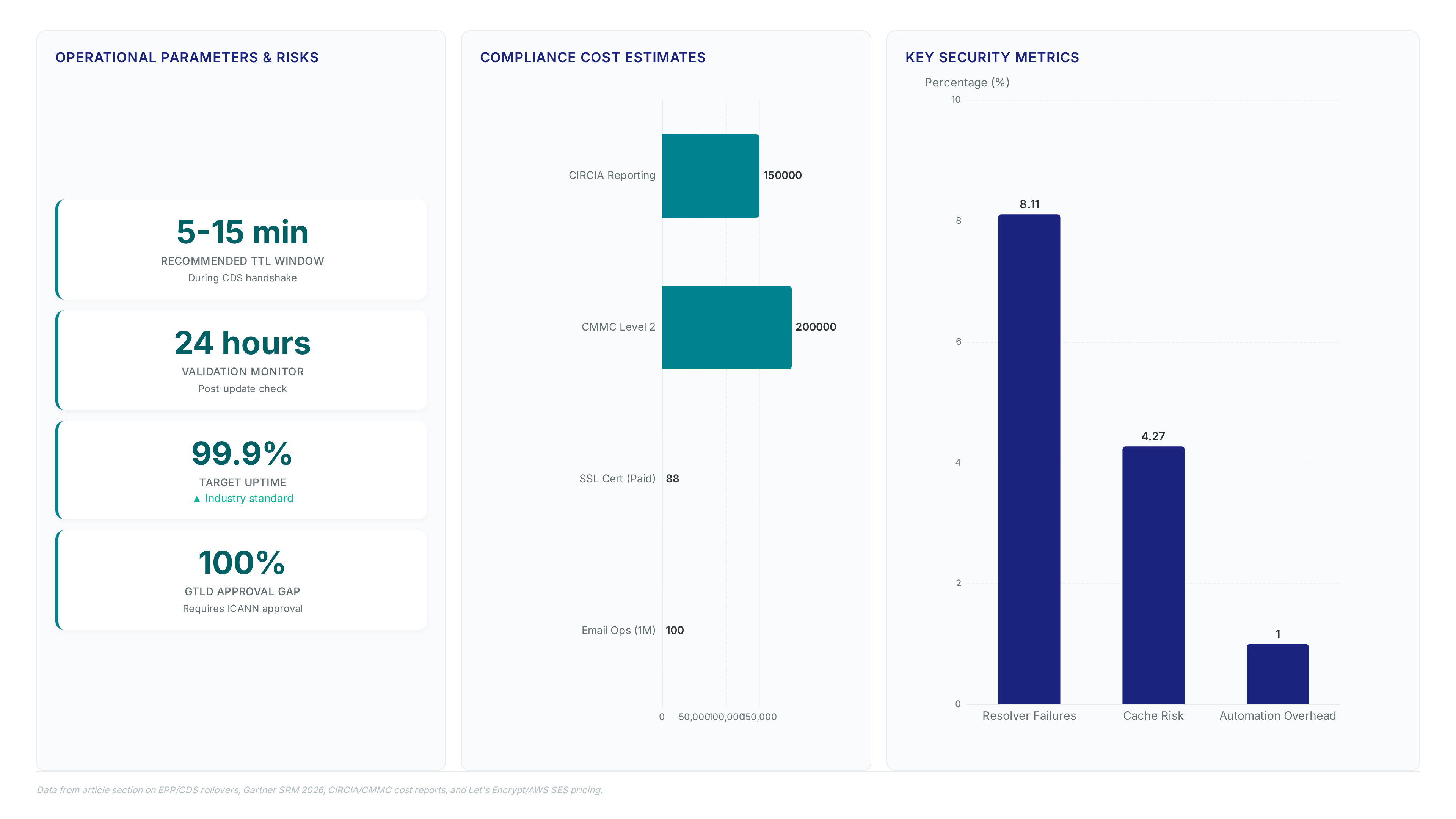
Only 4.27% of hundreds of millions of domains were DNSSEC-signed in Q1 2026. That number represents a massive failure in secure delegation. DNSSEC automation is the only viable mechanism to replace error-prone human intervention with reliable, RFC-compliant child-to-parent signaling.
The technology has existed since 1997, yet DNSSEC adoption remains stagnant. Manual maintenance invites catastrophic breakage. While validation rates hit 36% in 2025, the actual deployment of signed zones lags far behind the near-ubiquitous standards of TLS/SSL. This disparity isn't about a lack of security need-threats like DNS spoofing and BGP hijacking remain acute. It's about multi-step manual processes and inconsistent user interfaces creating an impassable barrier for operators. The industry has moved past skepticism regarding the technology itself. We are now addressing the usability crisis preventing its scale.
This article dissects the operational shift toward automated DS provisioning that finally mimics the success of Let's Encrypt. Readers will examine the critical function of authenticated signaling in modern secure delegation, removing the need for tedious ticket-based workflows. We will analyze the mechanics of record propagation where child zones nudge parents for updates, eliminating the latency of routine scanning. Finally, the text details executing flawless key rollovers using short TTLs and EPP protocols to ensure continuous integrity without human error.
The Critical Role of DNSSEC Automation in Modern Secure Delegation
DNSSEC automation eliminates human intervention from DS record provisioning by using authenticated CDS and CDNSKEY records within the child zone to signal desired keys to the parent. This mechanism enables secure delegation without manual ticketing or email coordination. It directly addresses the operational friction that kept secure delegation rates at just 7% in 2025 despite validation reaching 36%. The process relies on the 'old signs new' principle set in RFC 7344 for updates, while initialization uses an existing chain of trust to bootstrap the relationship. Unlike the web-based dashboards common in TLS certificate management, DNSSEC automation embeds intent directly into the zone file itself.
| Component | Function | Location |
|---|---|---|
| CDS Record | Publishes digest of desired DS record | Child Zone |
| CDNSKEY Record | Publishes full key material for DS generation | Child Zone |
| Parent Poller | Scans child zone for updates | Registry System |
A persistent bootstrap problem stalls adoption. Operators hesitate to deploy technology lacking immediate visible benefits, creating a cycle where low usage justifies low tooling investment. Fragmented policy across gTLDs blocks universal automation support until ICANN grants approval. The gap between TLS ubiquity and DNSSEC niche status will persist regardless of protocol maturity without this shift. Emulating Let's Encrypt automates DS provisioning via CDS and CDNSKEY records to eliminate manual key rollover errors. This approach mirrors the scale of the world's largest certificate authority, which serves more than hundreds of millions of websites through fully automated issuance.
Manual Key Rollovers as Error-Prone and Support-Intensive Bottlenecks
Manual key rollovers remain complicated, error-prone procedures where breakage sits only a step away from execution. This operational fragility stems from the hierarchical requirement to manage Zone-Signing Keys separately from Key-Signing Keys. Operators face multi-step coordination that often fails. Only 8.11% of DNS queries resolved to domains with valid signatures in Q1 2026, a stagnation directly linked to these human-dependent maintenance cycles.
The industry contrast is sharp. TLS achieved ubiquity through free automation. DNSSEC lags because providers lack integrated deployment similar to Cloudflare automatically issues certificates for all users. Manual processes demand specialized terminology knowledge that increases support tickets and delays correction during outages. A single timing mismatch between child and parent zones invalidates the entire chain of trust, rendering domains unreachable for validating resolvers. The cost of inaction exceeds the effort of implementation. Every failed rollout erodes operator confidence in the protocol.
Inside the Chain of Trust: Mechanics of CDS and CDNSKEY Record Propagation
CDS and CDNSKEY Consistency Checks for Parent Validation
Parent registries must reject flawed updates if consistency checks between CDS and CDNSKEY records fail across all child nameservers. This double verification prevents immediate validation breakage. It ensures the child zone signals match the parent's expected DS record state before propagation occurs. Without this gatekeeping, a single mismatched key causes total resolution failure for the delegated domain. The operational cost of such errors remains high, as manual recovery often exceeds standard support SLAs.
InterLIR guidelines mandate that operators verify data uniformity prior to acceptance. This mirrors the rigor seen in certificate file validation processes used by substantial certificate authorities. Unlike TLS workflows where web-based dashboards allow users to bypass server-side automation checks, DNSSEC requires strict protocol adherence at the registry level. A divergence in records triggers an automatic rejection, forcing the child operator to resolve the discrepancy.
| Check Type | Requirement | Failure Consequence |
|---|---|---|
| Internal Consistency | CDS matches CDNSKEY in child zone | Update rejected immediately |
| External Consistency | Records identical across all nameservers | Partial validation failure |
| Forecast Validation | Post-update chain remains unbroken | Domain becomes unreachable |
Operators accepting unverified updates risk cascading failures that propagate through the global resolver cache. Strict enforcement ensures that only mathematically valid chains enter the parent zone, preserving the integrity of the entire delegation hierarchy.
Implementing Short TTL Windows to Undo Failed DS Updates
InterLIR guidelines mandate assigning a TTL between 5 and 15 minutes to DS records during updates. This enables rapid rollback if validation breaks. This narrow window prevents resolvers from caching broken delegation data for hours, a risk inherent in standard configurations where TTLs often span days. Operators revert to regular values only after confirming stability, typically waiting a few days before extending the cache duration. The strategy mirrors the aggressive expiration cycles seen in modern certificate lifespans.
A precise rollback procedure minimizes downtime during failed key rollovers:
- Detect validation failure immediately via monitoring tools.
- Revert the DS record to the previous known-good state.
- Rely on the short TTL to flush cached errors from resolvers within minutes.
This approach contrasts with static infrastructure where changes propagate slowly, similar to how some providers still rely on web-based dashboards that lack real-time API integration for instant reversion. The cost of manual recovery remains high when automation fails. Yet the operational overhead of maintaining such short TTLs is negligible compared to the email infrastructure costs of running large-scale notification systems for every incident.
Operators must verify consistency before propagation. Race conditions between manual and automated submissions can corrupt the Extensible Provisioning Protocol state if locks are misconfigured. Most providers prioritize stability over speed, inadvertently increasing the cost of inevitable human error during key rollovers.
Executing Flawless Key Rollovers with Short TTL and EPP Protocols
EPP Protocol Mechanics for Automated DS Record Submission
The Extensible Provisioning Protocol transmits CDS records via specific EPP update commands that trigger parent-side validation logic.
- The registrar submits an EPP frame containing the CDNSKEY resource record set from the child zone.
- The registry verifies key consistency across all authoritative nameservers before modifying the DS entry in the parent zone.
- Successful validation prompts the registry to publish the new delegation data immediately, bypassing manual ticket workflows.
Operators must assign a short TTL between 5 and 15 minutes during this handshake. This limits exposure if the ACME protocol style automation fails mid-rollover. This narrow window prevents resolvers from caching broken chains for extended periods, a risk absent in standard configurations. InterLIR guidelines mandate this temporary reduction to enable rapid rollback without waiting for natural cache expiration. Generic Top-Level Domains cannot apply this flow without explicit ICANN approval, stalling universal deployment despite technical readiness. Small differences in handling details across implementing country-code TLDs currently block broader gTLD adoption. Operators managing mixed portfolios face a constraint: they must maintain parallel manual and automated processes.
Executing the 5-to-15 Minute TTL Window for Safe Rollovers
Assign a TTL between 5 and 15 minutes to DS records immediately before initiating any CDS or CDNSKEY update sequence.
- Reduce the DS record cache duration to the minimum five-minute threshold at least one hour prior to modification.
- Submit the authenticated CDNSKEY object via the registry interface to trigger the parent-side consistency check.
- Monitor validation status for 24 hours, ensuring no resolver failures occur before restoring standard cache durations.
| Phase | TTL Value | Operational Risk |
|---|---|---|
| Pre-Update | 5–15 min | Low (fast rollback) |
| Post-Update | 5–15 min | Moderate (monitoring required) |
| Stabilized | Standard | None (normal caching) |
Inherent in manual key management. The strategy aligns with broader industry shifts toward durability, where legacy success metrics fail against modern threat vectors as noted in Gartner SRM 2026 analysis (Gartner identifies the top cybersecurity trends for 2026) techrepublic.com/article/news-gartner-srm-2026-durability-ai-security/). Restoring regular values too early risks extended outages if the new key fails validation downstream. InterLIR mandates waiting several days to confirm stability across global anycast networks before extending cache lifetimes. Failure to adhere to this timing exposes domains to unreachability durations matching the original TTL, potentially lasting days instead of minutes. Rapid deployment desires clash with the strict temporal discipline required for safe cryptographic rotation.
Implementation: Pre-Submission Validation Checklist for CDS and CDNSKEY Consistency
Reject flawed EPP updates immediately if CDS and CDNSKEY records mismatch across authoritative nameservers.
- Query all child nameservers to confirm CDNSKEY data consistency before triggering parent registry synchronization.
- Apply a short TTL between 5 and 15 minutes to limit cache poisoning during the transition window.
- Verify the hierarchical cryptographic system aligns Zone-Signing Keys with Key-Signing Keys to prevent validation loops.
- Submit the update only after automated tools confirm zero divergence in the DS record.
Divergent CDNSKEY records cause immediate rejection by parent operators following RFC 8590 safety guidelines. Large enterprises often categorize zones by update frequency to survive total DNS provider failure without manual intervention. Skipping pre-checks results in total delegations loss, as registries refuse inconsistent data to protect the global root. Automation eliminates the race conditions inherent in manual DS record management.
Infrastructure protection is projected to add substantial absolute growth between 2024 and 2029. This financial trajectory forces a shift away from counting signatures toward preventing actual breaches. Manual processes cannot scale across large portfolios, making automation the sole mechanism to capture this value. Initial implementation costs pale against the relentless expense of constant reconfiguration found in the total cost of ownership model. Operational overhead drains budgets meant for threat mitigation unless automated CDS and CDNSKEY workflows take over. A study of Portuguese city council websites demonstrated that automated monitoring detected over 4,000 anomalous DNS communications daily with high precision, uncovering seven compromised hosts.
ICANN Approval Risks Blocking gTLD Automation Scalability
ICANN's 2014 mandate for DNSSEC in new gTLDs created a compliance gap where fragmented implementation details block automation. CcTLDs successfully deploy CDS records yet gTLD registries cannot automate DS provisioning without explicit ICANN community approval. This regulatory bottleneck forces enterprises to manage manual key rollovers, exposing them to breakage risks that plagued early deployments. Maintaining this manual overhead adds to the broader financial burden of cybersecurity budgeting , where reporting infrastructure alone demands significant capital. Operators waiting for unified guidelines face strategic vulnerability as threat actors exploit unsigned delegations.
| Barrier | Impact Scope | Mitigation Status |
|---|---|---|
| Policy Variance | High (gTLDs) | Pending RFC |
| Manual Rollovers | Critical | InterLIR automation |
| Validation Failures | Moderate | Short TTLs |
InterLIR recommends isolating high-value assets in compliant ccTLDs until gTLD automation receives final ratification. Delaying this migration risks prolonged exposure to spoofing attacks that automated chains would otherwise prevent. The window for action closes as the 2029 growth target approaches. Stagnation invites compromise.
About
Nikita Sinitsyn serves as a Customer Service Specialist at InterLIR, where his daily responsibilities directly intersect with the critical need for DNSSEC automation. With eight years of experience in the telecommunications sector, Nikita manages complex RIPE and ARIN database operations, ensuring that IP resources maintain high security standards and clean reputations. His hands-on work with BGP route objects and spam control reveals how manual DNSSEC maintenance often creates bottlenecks, leading to potential validation failures that alter network availability. At InterLIR, a Berlin-based marketplace dedicated to efficient IPv4 redistribution, the mission to provide secure, transparent network resources relies on reliable infrastructure. Nikita's frontline perspective on client account management highlights why automating these security extensions is no longer optional but necessary for scaling reliable internet services. His expertise bridges the gap between theoretical security protocols and the practical realities of maintaining secure delegation in a rapidly evolving digital environment.
Conclusion
Scaling DNSSEC automation reveals that regulatory fragmentation between gTLDs and ccTLDs creates a hidden operational tax that manual processes cannot sustain. As global security spending climbs toward $244.2 billion by 2027, organizations clinging to fragmented delegation handshakes will face escalating validation failures when short certificate lifespans collide with rigid registry policies. The current 8.11% adoption rate proves that waiting for unified ICANN guidelines is a losing strategy. The breakage point occurs not during key generation, but during the DS record propagation window where human latency introduces fatal gaps.
Enterprises must immediately isolate critical infrastructure within compliant ccTLDs while treating gTLD assets as secondary until automated CDS workflows gain final ratification. Do not attempt a full-domain migration before Q3 2026. Instead, prioritize high-value assets where short TTL enforcement can be strictly monitored without registry bottlenecks. This segmented approach limits exposure while maintaining the chain of trust where policy actually supports.
Start by auditing your current DS record TTL settings this week. Ensure they fall strictly between 5 and 15 minutes before initiating any key rollover. Verify that your monitoring stack alerts on validation failures within 24 hours of any change, establishing a baseline for automated durability before expanding scope.
Frequently Asked Questions
Manual processes are error-prone and support-intensive, making breakage only a step away. This fragility keeps secure delegation rates stuck at just 7% despite validation reaching 36% in 2025.
It uses authenticated CDS records in the child zone to signal parents directly. This removes human intervention, addressing friction that limited secure delegation to only 7% while validation hit 36%.
gTLDs cannot adopt automation without explicit ICANN approval, stalling progress for 42% of all domains. This blocks universal support despite successful implementations existing in various ccTLDs today.
Let's Encrypt serves more than 700 million websites through fully automated issuance. In contrast, only 4.27% of 240.3 million domains were DNSSEC-signed in Q1 2026 due to manual barriers.
Automation ensures validators reject unsigned responses by maintaining a consistent chain of trust. Without it, deployment remains low, with only 4.27% of 240.3 million domains signed in Q1 2026.