Global governance rules: Why stability beats speed now
Fifteen volunteers from the NRO NC just finalized their analysis of global feedback on the draft RIR Governance Document.
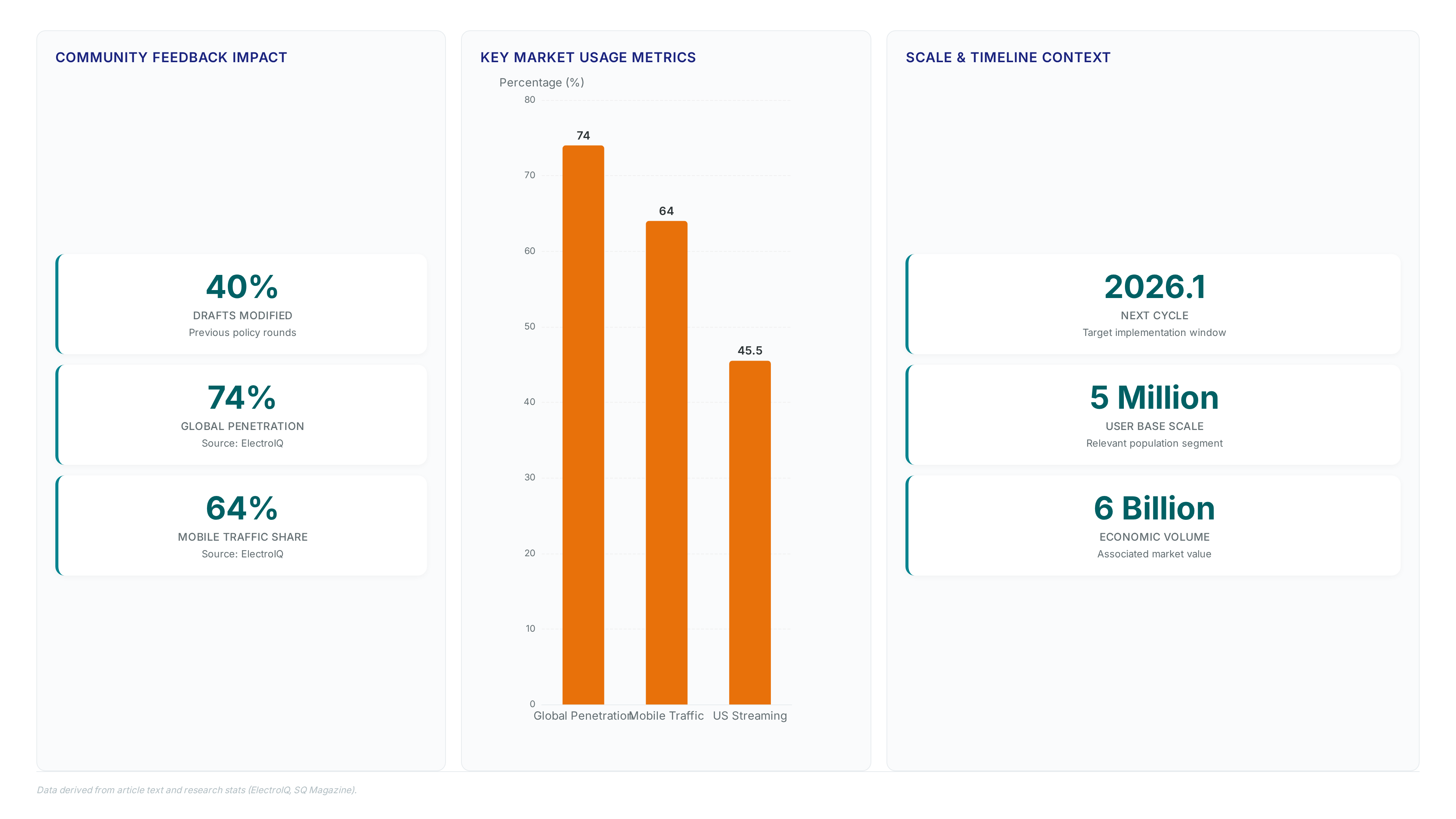
Stabilizing global IP allocation now demands rigid, transparent frameworks. We are supporting a digital system where 6 billion people consume resources daily. ARIN reports that the second consultation window, which closed in November 2025, captured the diverse input necessary to refine how Regional Internet Registries operate without political interference. Mobile traffic now dominates 64% of total global usage according to 2026 connectivity data. This volume dictates the need for structured oversight.
This analysis dissects the mechanics of global resource management. It details how the NRO NC synthesizes conflicting community interests into actionable policy. We will trace structured feedback channels, showing how webinars and community fora translate raw user sentiment into revised governance text. With average daily online time hitting 6 hours and 38 minutes, the stakes for getting this governance framework right have never been higher. Failure to adapt these protocols risks fracturing the unified system that currently sustains 74% of the world's internet penetration.
The Role of the RIR Governance Document in Global Internet Resource Management
Defining the RIR Governance Document and ASO AC Dual Role
The RIR Stewardship Document establishes the lifecycle rules for recognizing, operating, and derecognizing Regional Internet Registries. Version 2 of this framework clarifies scope to encompass the entire lifecycle of these critical entities. This document serves as the statutory anchor for global number resource stability. Policy compliance remains a technical requirement even as local legal jurisdictions vary. The global system relies on five distinct registries, each operating under frameworks detailed in the RIR Governance Matrix.
Central to this structure is the NRO NC, a body composed of exactly 15 volunteers drawn from three community representatives per region. This council executes a statutory dual identity, functioning simultaneously as the ASO AC within ICANN. In this capacity, the group appoints members to the ICANN Board and advises on global allocation policies. The duality creates a single point of synthesis for community feedback. Input channels through structured ICANN Public Comment processes rather than fragmented regional votes.
Operational friction arises because the NRO NC must reconcile diverse regional legal constraints with a unified global policy stance. A failure in this reconciliation delays board appointments, directly impacting ICANN's quorum capabilities during critical resource transitions. The mechanism demands that policy adoption never violate applicable laws in an RIR's specific jurisdiction. This creates a hard boundary for global uniformity. The NRO NC executes global policy by synthesizing multi-regional feedback into actionable board appointments. Led in 2026 by Chair Hervé Clément, the council operates as the ASO AC within ICANN, translating community consensus into director selections. Feedback collection spans five RIR mailing lists and the parallel ICANN Public Comment process.
| Function | Mechanism | Output |
|---|---|---|
| Policy Synthesis | Aggregates webinar and mailing list input | Revised draft text |
| Board Selection | Consensus-based nomination via ASO AC | ICANN Director appointees |
| Global Coordination | Liaison with external entities | Unified number resource stance |
Latency limits this model. Qualitative synthesis across regions delays final ratification compared to automated technical updates. Operators relying on rapid policy shifts for address allocation may find the consensus window restrictive during periods of high demand. With internet penetration reaching 74% globally, supporting approximately 6 billion people, the stakes for accurate governance rise. Delays in updating the RIR Supervision Document directly impact the stability of number resource distribution for these users. The NRO NC comprises 15 volunteers who filter policy, while the NRO EC holds five consensus-bound members for external representation. This structural split separates internal technical review from global diplomatic authority. The council acts as a point of consultation for external entities on global IP policies, distinct from commercial vendors focusing on cloud ecosystems. Volunteers synthesize community feedback to advise the Executive Council concerning the ratification of proposed global IP number resource allocation policies.
| Feature | NRO NC (ASO AC) | NRO EC |
|---|---|---|
| Composition | 15 community volunteers | 5 RIR CEOs/Representatives |
| Decision Mode | Majority consensus on policy text | Unanimous consensus required |
| Primary Mandate | Internal policy analysis | External organizational representation |
| ICANN Role | Appoints Board Directors | None |
The NRO EC is the sole body empowered to represent the NRO and the RIR community in interactions with external organizations. This division prevents policy drafters from unilaterally committing the global system to external agreements without executive alignment. Governance becomes non-negotiable as agentic AI takes on planning for complex infrastructure tasks, mirroring the strict adherence required here. The volunteer structure ensures technical depth, yet the consensus requirement of the executive body introduces latency during rapid geopolitical shifts. Operators relying on stable number resources must understand that policy ratification requires both the technical filter of the council and the unified voice of the executives.
ICANN Public Comment Process Timeline and Channel Mechanics
The second consultation window operated strictly from 28 August until 7 November 2025, defining the active intake phase for policy revisions. This period followed an initial draft release on April 14, 2025. Feedback ingestion relied on six distinct vectors rather than a single repository, creating a fragmented data set that requires manual synthesis.
Input flowed through five specific RIR mailing lists, dedicated webinars, online sessions, and physical RIR Meetings. The NRO NC also captured data from community fora, direct ICANN community engagement, and the ICANN Public Comment process. This multi-channel approach ensures broad reach but introduces significant latency in aggregating consistent themes across disparate platforms.
| Channel Type | Specific Vector | Aggregation Complexity |
|---|---|---|
| Asynchronous Text | Five RIR mailing lists | High volume, requires threading analysis |
| Synchronous Voice | Webinars and online sessions | Real-time transcription needed |
| Physical Gathering | RIR Meetings | Context-dependent notes |
| The Portal | ICANN Public Comment | Structured but isolated from RIR lists |
Operational review occurred during an in-person workshop held from November 12 to November 14, 2025, in Montevideo. The fragmentation of input channels means that identical technical objections often appear in different formats, delaying consensus detection. Operators submitting via the ICANN Public Comment procedure must recognize their input remains siloed from RIR list discussions until the council manually merges the datasets. This structural separation creates a risk where urgent technical flaws noted in one channel go unaddressed if not cross-referenced against others before the NRO NC finalizes its qualitative analysis.
NRO NC In-Person Workshop Workflow for Feedback Synthesis
The in-person workshop held from November 12 to November 14, 2025, in Montevideo served as the primary mechanism for manual feedback synthesis. Operators seeking to participate in RIR community feedback must submit comments via the five distinct mailing lists or the parallel ICANN Public Comment approach before these consolidation windows close. The NRO NC physically collated input gathered since the first draft. This manual review process ensures that qualitative nuances from webinars and RIR Meetings are not lost in automated aggregation.
| Input Vector | Synthesis Method | Constraint |
|---|---|---|
| RIR Mailing Lists | Manual thematic tagging | High volume noise |
| ICANN Public Comment | The summary inclusion | Fixed deadline |
| Community Fora | Verbatim excerpting | Regional bias risk |
The limitation of this approach is the inability to scale; physical convening restricts the frequency of deep-dive analysis sessions. Consequently, late-breaking technical objections raised after the May 27, 2025, face an uphill battle. Network operators should treat the published summary as a snapshot rather than a real-time reflection of community sentiment.
Meanwhile, the summary report explicitly excludes NRO NC opinions on submitted comments to maintain procedural neutrality during the ICANN Public Comment mechanism. This document functions strictly as a raw data aggregation, omitting any evaluation of community sentiment regarding the draft. Operators must recognize that the council provides no interpretive filter for the feedback received through the parallel ICANN engagement channels. The exclusion prevents premature bias before the final policy text is ratified by the broader system.
| Included Content | Excluded Content |
|---|---|
| Raw comment text from all vectors | Council personal opinions |
| Chronological submission logs | Responses to specific arguments |
| List of participating organizations | Evaluation of community consensus |
This structural separation ensures the ASO AC fulfills its advisory mandate without imposing top-down judgment on the global policy development. Network engineers analyzing the report will find unvarnished input but must derive their own conclusions regarding technical feasibility. The absence of qualitative scoring forces stakeholders to review original mailing list archives for context.
Executing Community Engagement Through Structured Feedback Channels
Implementation: ICANN Public Comment Workflow and RIR Mailing List Mechanics
Operators submit input via the ICANN Public Comment procedure.
- Monitor the NRO NC announcement for the specific consultation start date.
- Draft technical objections focusing on allocation policy mechanics rather than general sentiment.
- Post arguments to the regional list or the central ICANN portal.
- Track synthesis outcomes after the council convenes for its in-person workshop.
This dual-channel approach creates a fragmentation risk where identical comments submitted to both vectors may be counted as separate entities during qualitative analysis. The NRO Executive Council retains exclusive authority to represent these aggregated views externally. Individual mailing list posts do not constitute official NRO positions until ratified. Attend meetings in Mumbai, Sevilla, or Oman to maximize visibility during live policy discussions. Failure to distinguish between the raw comment repository and the final synthesized report leads to misplaced expectations regarding immediate policy changes.
Step-by-Step Submission via ICANN Portal and Webinar Sessions
Submitting input requires operators to target the ICANN Public Comment approach window active from 28 August until 7 November 2025. Stakeholders must first locate the specific consultation entry on the central portal rather than relying solely on regional notifications.
- Access the ICANN portal.
- Locate the specific consultation entry.
- Submit written comments before the deadline.
- Verify receipt via the public archive (e.g., .
Parallel engagement occurs through webinars and online sessions that supplement written filings. These virtual forums allow real-time clarification of complex governance clauses before finalizing a written record. The NRO NC functions technically as the Address Supporting Organization Address Council to aggregate this distributed data. Operators ignoring the webinar track miss opportunities to refine their written submissions based on live peer feedback.
The limitation of this dual-channel approach is the lack of automatic synchronization. Comments made verbally during sessions do not appear in the official archive unless submitted separately in writing. This fragmentation forces operators to duplicate effort to guarantee their position enters the review cycle.
Validation Checklist for Post-Consultation Timeline and Policy Adoption
Track policy progression by verifying the ARIN Board of Trustees adoption date against the proven implementation window. Operators must confirm that feedback submitted during the consultation window resulted in documented changes before ratification. The timeline for NRPM 2026.1 requires strict adherence.
| Phase | Action Item | Verification Source |
|---|---|---|
| Consultation | Submit via ICANN Public Comment | Portal timestamp |
| Synthesis | Review NRO NC summary | Mailing list archive |
| Adoption | Confirm board vote | Meeting minutes |
| Enforcement | Update routing filters | Policy manual date |
- Cross-reference the submission timestamp with the closing date of the comment period.
- Validate that the final text reflects specific technical objections raised during webinars.
- Monitor the gap between the December adoption and the March proven date for schema updates.
- Deploy InterLIR recommendations to align local registration data with the new rules before enforcement.
Relying on the summary report alone risks missing unstated operational constraints that only appear in the final ratified text. The delay allows malicious actors to study the upcoming rules and adjust announcement strategies prior to the enforcement cliff.
Strategic Value of Participating in the Next Consultation Round
NRO NC Status Report Q1 2026 and Remaining Key Issues
Operators must engage immediately because the NRO NC released the 'RIR Oversight Document Version 2: Status Report Q1 2026' to clarify outstanding topics before final ratification. This document functions as a technical checkpoint rather than a final policy, signaling that the council is still synthesizing complex feedback from the global community. The report explicitly omits the council's opinions on submitted comments, forcing network engineers to interpret raw data without an official filter.
A significant tension exists between the need for rapid policy closure and the requirement to address every technical objection raised during the consultation window. Delaying engagement risks missing the narrow window where operator feedback can still shape the final text before the NRO EC enforces consensus.
| Action Required | Target Audience | Risk of Inaction |
|---|---|---|
| Review Status Report | All RIR members | Policy misalignment |
| Submit Technical Objections | Network operators | Unaddressed edge cases |
| Monitor Response Drafts | Policy delegates | Lost modification opportunity |
Operational friction rises measurably once new rules take effect without necessary exceptions. Reviewing the updated process timeline prevents stakeholders from missing the narrow feedback windows set by the RIR Administration Document Consultation Timeline. The dual-role NRO NC and ASO AC synthesize global input through structured phases that demand precise timing for maximum influence. Operators comparing this multi-stakeholder model to centralized systems like Microsoft Entra ID Governance must recognize that policy latency here ensures broad consensus rather than rapid vendor-driven deployment. Missing a consultation start date means waiting months for the next cycle, as the council does not accept late submissions for ongoing drafts.
Strategic participation requires tracking specific milestones rather than general announcements.
- Identify the publication date of the next draft version on the central policy portal.
- Prepare technical objections focusing on allocation mechanics before the window opens.
- Submit the comments via the ICANN Public Comment mechanism or regional mailing lists.
- Monitor the synthesis report following the council's in-person workshop to verify feedback inclusion.
Rapid policy updates clash with the deliberate pace required for global agreement. Failure to engage during the assigned timeframe results in policies that may not reflect operational realities, forcing operators to adapt to rules designed without their specific constraints.
Governance Gap Risks Between ARIN NRPM 2026.1 and Global Drafts
ARIN's NRPM 2026.1 creates potential misalignment. This forces operators to maintain dual compliance states while the NRO NC finalizes responses to remaining key issues. The mechanism of risk involves conflicting procedural mandates where regional policy enforces strict timelines that global drafts may later revise. Evidence suggests that without unified feedback, regional implementations harden into incompatible standards before global consensus emerges. However, the cost of waiting is operational fragmentation across the five distinct RIR regions. Operators ignoring the current consultation window face a scenario where local rules contradict future global norms, requiring expensive re-engineering of allocation workflows. The implication is clear: engagement now prevents costly remediation later. InterLIR advises submitting technical objections immediately to influence the synthesis process before ratification locks in discrepancies.
| Risk Factor | Current State | Potential Consequence |
|---|---|---|
| Policy Timing | Regional adoption complete | Global draft revision ignored |
| Compliance | Dual frameworks active | Conflicting audit requirements |
| Feedback Loop | Closed regionally | Open globally but narrowing |
Stakeholders must prioritize the ICANN Public Comment workflow. Failure to participate cedes control to early adopters who already shaped the regional text.
About
Alexander Timokhin, CEO of InterLIR, brings critical industry perspective to the evolving RIR Stewardship Document. As the leader of a specialized IPv4 address marketplace founded in Berlin, Timokhin manages daily operations centered on the redistribution and security of scarce internet number resources. His direct experience navigating IP addressing policies and ensuring clean BGP routing provides unique insight into how governance changes impact global network availability. The NRO NC analysis directly affects the regulatory framework under which companies like InterLIR operate, making his expertise in corporate governance and international relations necessary for interpreting these developments. By connecting high-level policy shifts with practical market realities, Timokhin elucidates how updated recognition and derecognition protocols will shape the future of IT infrastructure and resource accessibility for businesses worldwide.
Conclusion
Divergence between regional mandates and global drafts creates a structural debt that compounds as internet penetration approaches universal coverage. When local rules harden before global consensus forms, operators face dual compliance states that fracture allocation workflows and inflate audit costs. This fragmentation is not merely administrative; it forces engineering teams to build brittle automation layers that must eventually be ripped out when standards converge. The window to prevent this expensive re-engineering is closing rapidly as the NRO NC finalizes responses to remaining key issues.
Organizations managing significant address space must submit technical objections immediately rather than waiting for final ratification. Do not treat the current consultation period as a formality; view it as the last opportunity to align regional enforcement with future global norms before discrepancies become permanent. Specifically, audit your current allocation scripts against both the active NRPM 2026.1 and the pending global text by next Friday. Identify any logic that assumes uniform procedural timelines across regions and flag these as high-risk technical debt. Engage directly with the ICANN Public Comment procedure to demand explicit synchronization clauses in the final text. Only by forcing this alignment now can you avoid the operational tax of maintaining contradictory policy engines in production environments.
Frequently Asked Questions
Failure to adapt risks fracturing the unified system sustaining global connectivity. This is critical because the current framework supports 74% of the world's internet penetration today.
Exactly fifteen volunteers from the NRO NC finalize the analysis of global feedback on the draft document. These members ensure stable resource management for 6 billion people consuming resources daily.
Mobile traffic currently dominates a significant majority of total global usage according to 2026 data. Specifically, mobile traffic accounts for 64% of total global usage worldwide.
Yes, Version 2 of the framework clarifies scope to encompass the entire lifecycle of these critical entities. This ensures stability for the 6 billion people who consume resources daily.
The council channels input through structured processes rather than fragmented regional votes to ensure unity. This approach supports the digital ecosystem where 6 billion people consume resources daily.