Governance shifts: Why 15 volunteers shape IPv4
On 2 Feb 2026, RIPE published the draft replacing ICP-2. The NRO NC's 15 volunteers immediately finalized their feedback analysis. (RIPE's nro nc) This isn't just paperwork. The RIR Governance Document is shifting from a static rulebook to a flexible lifecycle management tool. Global internet coordination needs this stability to support 6 billion users. Gartner predicts dedicated governance headcounts will become the 2026 norm for managing complex risks; the internet's infrastructure demands similar specialized oversight.
Here is how the NRO NC synthesized input gathered between August and November 2025 across five distinct regions to refine operational recognition standards. The mechanics involve aggregating disparate feedback streams, ranging from regional webinar insights to submissions via the ICANN Public Comment process. We must clarify the strategic divergence between the council's dual identities: its regional coordination role versus its function as the ASO AC within the global policy sphere.
Mobile traffic now consumes 64% of global bandwidth according to RIPE data. The stakes for precise resource governance have never been higher. Specific procedural adjustments in the new document address these scaling pressures without relying on outdated assumptions. The upcoming sections dissect the tangible outcomes of this second consultation, moving beyond summary statistics to reveal the structural shifts defining the next era of number resource administration.
The Role of the RIR Governance Document in Global Internet Coordination
Defining the RIR Governance Document and NRO NC Structure
The RIR Stewardship Document replaces ICP-2 to define the full lifecycle of Regional Internet Registry recognition and derecognition. This framework governs how five regional bodies coordinate number resources for a global user base reaching 6 billion people. Scope expansion now includes explicit maintenance criteria absent in previous iterations.
Governance execution falls to the NRO NC, a council of exactly 15 volunteers distributed equally across RIR regions. This body operates under a dual identity as the ASO AC within ICANN, a role formalized by an MoU signed in October 2004. Policy oversight extends through ICANN channels to validate global number resource procedures.
| Component | Composition | Primary Function |
|---|---|---|
| NRO NC | 15 volunteers | Global policy oversight |
| ASO AC | Same 15 members | ICANN advisory role |
| RIRs | 5 regional entities | Resource distribution |
Community input shaped the second draft via a consultation window ending in November 2025, with parallel Public Comment process engagement. Voluntary compliance lacks enforcement teeth until ICANN formally adopts the text. Delayed ratification creates a temporal gap where derecognition criteria remain undefined.
ARIN nro. 1 demonstrates how the RIR Supervision Document translates policy into routing stability. This framework manages number distribution for a global population where internet penetration hit 74%. Regional implementation varies significantly based on local regulatory pressure. The RIPE NCC currently processes bylaws amendments to align with the February 2026 draft publication. Meanwhile, APNIC (APNIC's rir oversight document version 2 status report m...) apnic.
| Region | Status | Proven Date |
|---|---|---|
| North America | Adopted | March 3, 2026 |
| Europe | Consulting | June 9, 2026 |
| Asia-Pacific | Reporting | Ongoing |
The NRO NC faces a structural tension between rapid policy iteration and the need for consensus among 15 volunteers. Accelerating updates to match market growth projected at $558.83 billion risks fragmenting the single global registry. Delaying changes to ensure full agreement leaves the system vulnerable to regional divergence.
Operators must monitor these divergent timelines to prevent address space conflicts. A failure to synchronize regional rules creates loopholes where bad actors exploit jurisdictional gaps.
Meanwhile, the RIR Administration Document replaces ICP-2 to mandate full lifecycle control spanning recognition, operation, and derecognition. This shift moves beyond simple status acknowledgment to enforce continuous compliance standards for regional bodies.
| Feature | ICP-2 Framework | New RIR Stewardship Document |
|---|---|---|
| Scope | Recognition only | Full lifecycle management |
| Compliance | Voluntary alignment | Mandatory policy adherence |
| Termination | Undefined process | Explicit derecognition triggers |
| Records | Periodic review | Continuous financial transparency |
Previous rules lacked mechanisms to remove non-compliant registries, creating a single point of failure in global coordination. The updated text requires RIRs to maintain impartial operations and detailed financial records under strict governance framework. Operators must now verify that local policies do not violate applicable laws before adoption. This legal constraint introduces friction where national regulations conflict with global technical consistency.
The NRO NC initiated this substantial update via a first draft published on April 14, 2025, signaling urgency. ICANN Derecognition clauses now provide a clear exit strategy for failed regions, a capability absent in the old model. Network engineers should audit their upstream providers against these new maintenance criteria immediately. Stability now depends on documented operational health rather than historical presence.
Mechanics of the ICANN Public Comment Process and Feedback Aggregation
The second consultation window opened on 28 August and closed 7 November 2025, extending the feedback cycle beyond the initial May 27, 2025. This prolonged duration accommodated complex input from a global user base averaging 6 hours and 38 minutes of daily online activity. The NRO NC aggregated responses through five distinct mechanisms rather than a single portal.
- Five regional RIR mailing lists served as the primary text-based channel.
- Various webinars and online sessions provided real-time clarification.
- Physical sessions at RIR Meetings facilitated direct operator dialogue.
- Community fora allowed asynchronous threaded discussions.
- The engagement occurred via the ICANN public comment process alongside interactions at ICANN 85.
| Channel Type | Interaction Mode | Data Granularity |
|---|---|---|
| Mailing Lists | Asynchronous Text | High (archivable) |
| Webinars | Synchronous Audio/Video | Low (transcript dependent) |
| RIR Meetings | Synchronous In-Person | Medium (minutes only) |
| Public Comment | The Submission | High (structured) |
Operational friction arises because parallel collection across these vectors complicates sentiment analysis. Merging these divergent data types requires manual normalization before policy revision can proceed. Consequently, the summary report explicitly excludes NRO NC opinions to prevent premature bias during this aggregation phase.
The NRO NC ingested raw feedback from five RIR mailing lists and ICANN 85 sessions into a neutral summary without editorial filtering. Operators submitted technical corrections through asynchronous channels while debating scope definitions during live webinars. This multi-vector approach captured nuance from the 62% of video traffic driven by live streaming services. The aggregation mechanism separates data collection from policy formulation to prevent early bias.
- Collect unstructured text from regional lists and community fora.
- Transcribe verbal arguments from physical ICANN 85 breakout rooms.
- Map duplicate comments across different engagement platforms.
- Publish a raw log excluding council opinions or evaluations.
The resulting document omits the NRO NC's stance, forcing readers to interpret conflicting operator requirements independently. This transparency creates friction for stakeholders seeking immediate resolution on derecognition triggers. The Q1 2026 Status.
| Input Channel | Data Type | Bias Risk |
|---|---|---|
| Mailing Lists | Text archives | Low |
| Webinars | Real-time audio | Medium |
| RIR Meetings | Face-to-face debate | High |
| Public Comment | The submissions | Low |
Relying on qualitative synthesis delays the finalization of mandatory adherence clauses. The published summary deliberately excludes the NRO NC's own opinions or responses to submitted comments to preserve procedural neutrality. This omission creates a distinct separation between raw community input and the council's internal evaluation of the draft document. Operators reviewing the text will find aggregated feedback from the ICANN Public Comment workflow. The report explicitly states it contains no assessment of the communities' collective stance, leaving the policy formulation phase opaque until final revision.
This structural gap forces network engineers to infer governance alignment without direct confirmation of the council's position on specific routing or allocation critiques.
| Document Component | Included Content | Excluded Content |
|---|---|---|
| Community Input | Raw comments from RIR lists and ICANN fora | NRO NC rebuttals or agreements |
| Evaluation | Qualitative summary of themes | Council's specific opinion on validity |
| Outcome | List of issues for further discussion | Final decision rationale |
The limitation ensures the feedback aggregation remains unbiased, yet it delays operator visibility into whether critical security concerns influenced the final text.
Dual Identity of NRO NC and ASO AC Roles
The same 15-member body operates as the NRO NC for Regional Internet Registries and the ASO AC within ICANN following an October 2004 MoU. This structural duality means the council switches identities based on whether it addresses regional allocation or global policy coordination. The distinction prevents conflation of operational registry management with high-level Internet governance mandates.
| Context | Primary Mandate | Voting Scope | Governance Layer |
|---|---|---|---|
| NRO NC | Regional resource distribution | RIR-specific members | Operational execution |
| ASO AC | Global policy ratification | All 15 volunteers | ICANN Board liaison |
Operators must track which identity is active during policy debates to understand voting authority limits. Recent bylaws amendments at the regional level run parallel to these global discussions, creating overlapping consultation windows. The board composition varies significantly across regions, unlike the fixed 15-seat global council structure. This variance complicates synchronization when local rules conflict with global consensus.
The hidden cost is procedural latency; dual requires separate ratification paths for identical technical changes. Network engineers relying on InterLIR com) tools should verify which governance layer triggered a specific policy update. Failure to distinguish these roles leads to incorrect assumptions about implementation timelines. The system functions only because the human operators remain constant across both hats.
Comparison: NRO NC Execution of RIR Supervision Document Analysis
The second draft of the RIR Oversight Document published on 2 Feb 2026 triggered the review by the 15-member NRO NC to replace the legacy ICP-2 framework. This analysis phase strictly separates raw data collection from policy formulation, ensuring the council does not inject bias before final revision. The process ingested feedback from five regional mailing lists and live sessions at ICANN 85. Hervé Clément, the elected Chair. This transparency constraint forces network engineers to interpret raw feedback without guidance on which objections might block adoption. The dual identity of the body complicates accountability, as the same volunteers switch between regional execution and global liaison roles. In June 2026 to influence the final text before the council closes the loop.
Regional Representation Variance in NRO NC Versus ICANN Structures
Strict regional quotas force the NRO NC to select exactly three volunteers per region, ignoring population density disparities across the five Regional Internet Registries.
| Dimension | NRO NC Model | Generic ICANN Model |
|---|---|---|
| Seat Allocation | Fixed at 3 per region | Variable by stakeholder group |
| Geographic Scope | Tied to RIR service regions | Global constituencies |
| Policy Trigger | Bottom-up community consensus | Board resolution or GAC advice |
| Representation Cap | 15 total members | Hundreds of participants |
This rigid structure ensures equal voice for ARIN and AfriNic despite vastly different subscriber bases, whereas broader ICANN structures often weight influence by organizational size. The NRO NC. However, the cost is slower adaptation to market shifts in high-growth zones where user counts exceed fixed representation limits. Operators in Asia-Pacific face diluted influence relative to their vast connected users because the seat count remains static. The ICANN. Equal regional weighting protects minority regions from being outvoted but creates a bottleneck when rapid IPv6 deployment requires synchronized global action. Network engineers must navigate this tension when proposing changes that benefit dense regions but lack support from sparsely populated areas with equal voting power.
Practical Guide to Participating in RIR Community Fora and Providing Feedback
NRO NC Feedback Channels and Consultation Windows
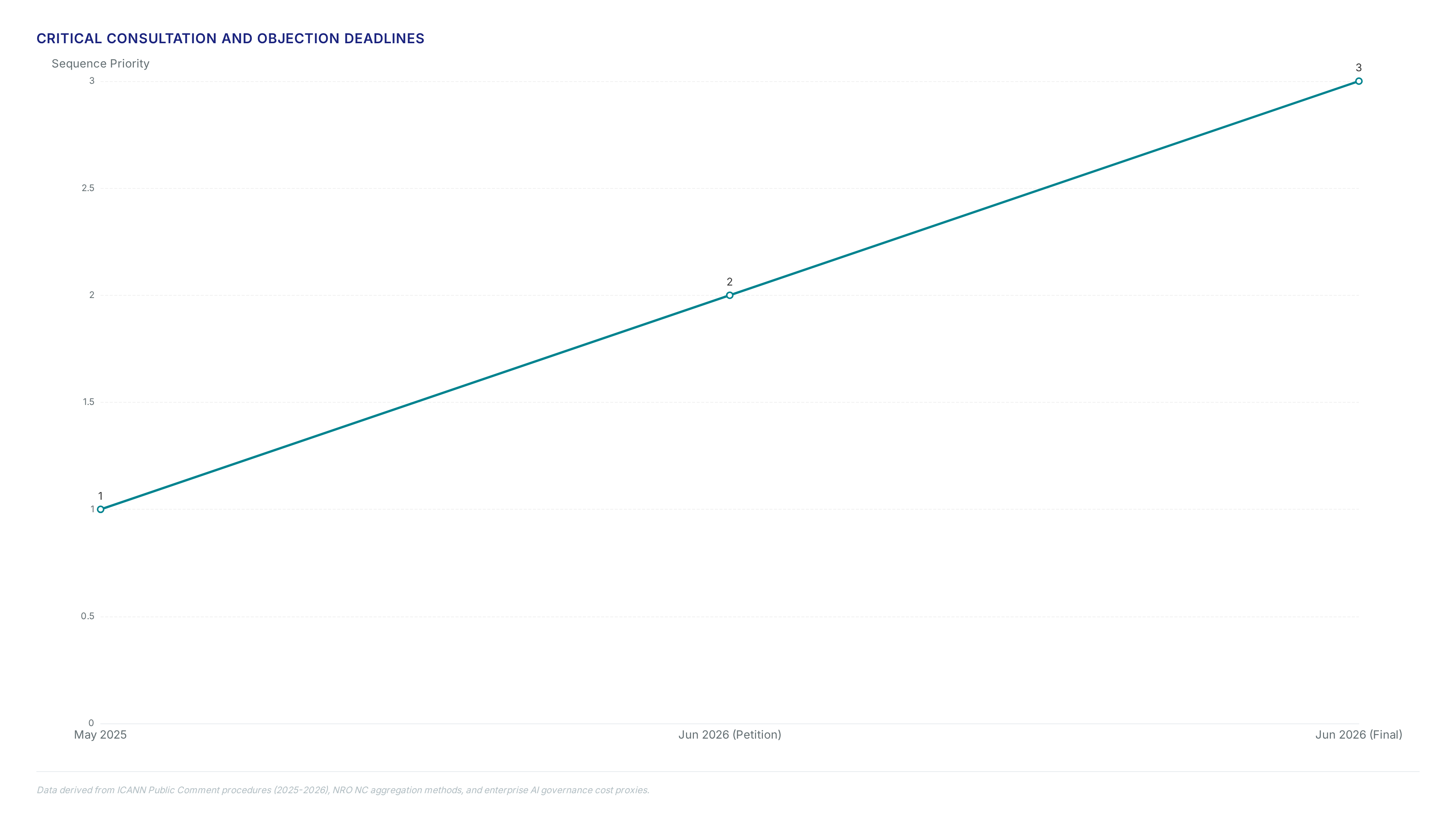
May 27, 2025 marked the closure of the first consultation window, establishing a baseline for the ICANN Public Comment procedure. Operators submitting feedback during the second period utilized five distinct RIR mailing lists alongside webinars, creating a fragmented data stream that complicates consensus tracking. The NRO NC aggregates these inputs without evaluating community sentiment, leaving the weight of technical objections opaque until final revision. This separation between collection and analysis forces stakeholders to monitor consultation windows aggressively, as missed deadlines exclude technical constraints from the record permanently. Unlike the initial phase, the second window integrated sessions at ICANN meetings, broadening the participant pool beyond traditional registry attendees. However, the lack of real-time response mechanisms means operators cannot clarify ambiguities in the draft text before submission. Failure to engage during these specific intervals cedes influence to entities with dedicated government relations teams.
Submitting Comments on RIPE NCC Fundamental Bylaws Amendments
Operators must file rejection petitions by June 1, 2026, or forfeit the right to block RIPE NCC Fundamental Bylaws Amendments. This strict cutoff precedes the final comment window closing on June 9, 2026, creating a narrow ten-day interval for the objection and subsequent technical review. Missing the initial date removes the ability to halt changes, leaving only the option to submit comments that the Executive Board may ignore. The mechanism separates veto power from advisory input, forcing stakeholders to prioritize legal challenges over policy suggestions if they oppose specific clauses.
Discussion of these governance shifts continues at RIPE NCC Days Baltics in Riga, yet attendance does not extend statutory filing periods. The limitation here is procedural rigidity; remote participation in webinars offers no exception to the hard June 1 cutoff for petitions. Operators relying solely on dialogue risk finding their objections categorized as mere feedback rather than binding rejections. Failure to distinguish these paths results in valid technical concerns losing their legal weight under RIPE NCC rules.
Engagement Checklist for ICANN 2026 Meetings in Mumbai and Sevilla
Physical attendance at the March, June, and October 2026 meetings requires operators to cross-reference specific bylaws deadlines against travel schedules. Missing the June 1 rejection petition window eliminates veto power over RIPE NCC Fundamental Bylaws Amendments regardless of physical presence in Sevilla. Virtual participants must review the Q1 2026 Status.
- Verify the updated process timeline to avoid missing future feedback opportunities.
- Monitor NRO NC responses to key issues prior to the next reporting cycle.
- Submit the comments on governance documents through assigned RIR mailing lists.
- Acknowledge the May 28, 2026 passing of Alan Barrett when addressing historical community context.
- Distinguish between legal objections and policy suggestions to prevent dismissal of technical constraints.
- Cross-reference travel plans with the June 1 and June 9 deadlines to ensure timely filing.
InterLIR advises separating legal objections from policy suggestions, as the council treats these streams differently during revision. The cost of conflating advisory input with rejection petitions is the potential dismissal of valid technical constraints.
About
Nikita Sinitsyn serves as a Customer Service Specialist at InterLIR, where his daily operations directly intersect with the evolving environment of RIR governance. With eight years of experience in telecommunications support, Nikita manages critical RIPE and ARIN database operations, making him uniquely qualified to analyze the implications of the new Governance Document. His routine work involves navigating strict KYC procedures and ensuring IP reputation security, tasks that rely heavily on the stability and clarity of regional registry frameworks. As InterLIR specializes in the redistribution of IPv4 resources, any shifts in how RIRs are recognized or derecognized fundamentally impact the company's ability to provide transparent and efficient address leasing. Nikita's frontline perspective on how policy changes affect real-world network availability allows him to bridge the gap between high-level regulatory updates and the practical needs of IT professionals seeking reliable internet resources.
Conclusion
Scaling current governance frameworks to match a $558.83 billion market exposes a critical fragility: procedural rigidity actively fragments the global internet when regional implementation speeds diverge. As penetration rates surge, relying on informal dialogue without strict adherence to filing windows renders technical objections legally inert. The operational cost of this confusion is the silent erosion of veto power, where valid constraints are reclassified as mere suggestions. Operators must recognize that virtual participation does not extend statutory deadlines, creating a disparity between those who monitor timelines and those who assume flexibility exists.
Organizations should immediately formalize a dual-track engagement strategy by Q4 2026, separating legal petitions from policy advisory inputs to ensure technical constraints retain binding weight. Do not wait for the next general assembly to validate this approach; the window for influencing the 2027 cycle closes before the physical meetings commence. Start by auditing your internal calendar against the June 1 rejection petition deadline this week to verify that your legal team distinguishes these filings from standard feedback submissions. This specific verification prevents the accidental dismissal of critical infrastructure concerns under current RIPE NCC rules. Securing resource distribution authority requires treating procedural compliance as a technical dependency, not an administrative afterthought.
Frequently Asked Questions
Delaying changes leaves the system vulnerable to regional divergence and bad actors. Accelerating updates to match market growth projected at $558.83 billion risks fragmenting the single global registry without full consensus.
The framework governs how five regional bodies coordinate number resources for a massive global user base. This scope explicitly covers maintenance criteria for a population reaching 6 billion people worldwide.
Failure to synchronize regional rules creates loopholes where bad actors exploit jurisdictional gaps for malicious activities. Operators must monitor divergent timelines to prevent address space conflicts across the network.
Mobile traffic now consumes a significant majority of global bandwidth according to recent RIPE data. Specifically, mobile usage accounts for 64% of global bandwidth, raising stakes for precise resource governance.
This framework manages number distribution for a global population where internet penetration hit 74%. Regional implementation varies significantly based on local regulatory pressure and asynchronous adoption cycles.