IANA Performance: Don't Miss the March Deadline
The clock is ticking. The global Internet community has exactly 30 days to critique the 2025 IANA Performance Matrix before the deadline hits March 6, 2026. This isn't just another review cycle; it's the friction point where theoretical governance slams into the operational reality of Public Technical Identifiers managing root zone data. If we don't bring rigorous, data-backed scrutiny to this window, the post-2016 multi-stakeholder model devolves into a bureaucratic rubber stamp.
We need to dissect the Governance Framework empowering the IANA Numbering Services Review Committee. Its advisory role frequently clashes with the rigid constraints of the existing Service Level Agreement. We must also tear apart the Evaluation Methodology behind the 2025 matrix. Do current metrics actually capture service degradation, or do they just track uptime statistics that mask deeper systemic inefficiencies? Finally, we cover the tactical execution of Community Participation. Stakeholders must bypass generic feedback to force substantive changes before the NRO publishes its final report.
While the industry obsesses over AI-driven Wi-Fi optimization, the fundamental plumbing of the Internet relies on this often-ignored review cycle to maintain trust. The five Regional Internet Registries jointly prepared this summary, yet the burden of validation falls entirely on external observers willing to navigate the complex submission process via [email protected]. Ignoring this window cedes control of critical infrastructure oversight to internal consensus. That is a dangerous precedent in an era demanding transparent verification.
The Governance Framework of the IANA Numbering Services Review Committee
IANA Numbering Services Review Committee Mandate and 2016 Origin
The IANA Numbering Capabilities Review Committee advises the NRO Executive Council on PTI performance metrics under the signed Service Level Agreement.
Stewardship moved from the US government to the global multi-stakeholder community in 2016, creating a direct accountability line between the five RIRs and the operator. Public Technical Identifiers executes daily functions while the committee evaluates compliance against version 5.2 terms established on May 31, 2016. This structure isolates operational delivery from policy oversight, preventing unilateral changes to numbering resource allocation procedures. The NRO Executive Council relies on this advisory body to validate monthly performance data before publishing summary reports.
| Function | Entity | Scope |
|---|---|---|
| Operational Delivery | PTI | Daily numbering assignments |
| Policy Oversight | NRO EC | Regional resource policy |
| Performance Review | IANA RC | SLA compliance validation |
Operators often assume the transition eliminated all single points of failure. It didn't. The committee lacks enforcement power beyond reporting findings to the council. Reliability depends entirely on the willingness of the NRO EC to act upon negative performance trends identified during annual reviews. Without mandatory remediation clauses in the SLA, the committee serves as a detection mechanism rather than a correction tool.
Public Technical Identifiers executes daily IANA Numbering Offerings functions under strict contractual obligations.
The operator generates monthly performance reports detailing allocation latency and error rates against set thresholds. These documents serve as the primary evidence for the five RIRs SLA version 5.2, signed on May 31, 2016, mandates specific response windows for unicast IP address and AS number requests. Failure to meet these windows triggers an automatic review process by the oversight committee. The mechanism relies entirely on transparent data publication rather than periodic inspection visits.
| Responsibility | Entity | Output Artifact |
|---|---|---|
| Operational Execution | PTI | Monthly Performance Matrix |
| Policy Oversight | IANA RC | Annual Summary Report |
| Community Validation | NRO EC | Public Comment Record |
The current framework lacks real-time alerting for SLA breaches, forcing reliance on retrospective analysis. This delay means operators might process invalid requests for weeks before detection. The cost of this latency is measurable in delayed router provisioning for downstream networks. Service Level Agreement adherence remains high, yet the absence of automated enforcement tools creates a manual verification burden. Pre-2016 operations relied on a US Department of Defense contract, whereas the current model binds ICANN to the five RIRs via a Service Level Agreement. The shift replaced unilateral government oversight with a multi-stakeholder framework where Public Technical Identifiers This architectural change distributes accountability across the global community rather than concentrating it within a single national jurisdiction.
| Feature | Pre-2016 Model | Post-2016 Model |
|---|---|---|
| Steward | US Government | Global multi-stakeholder Community |
| Operator | Private Contractor | Public Technical Identifiers |
| Oversight | Department of Commerce | Five RIRs |
| Basis | Federal Contract | Service Level Agreement |
The transition established the review mechanism absent in the prior era. ICANN now faces contractual penalties for performance failures, creating a direct financial incentive for reliability that federal contracts lacked. However, this distributed governance introduces coordination latency; consensus among five distinct regional bodies slows emergency protocol updates compared to the previous top-down directive capability. The cost of inclusivity is measurable in decision velocity. Operators gain transparency but lose the ability to enact immediate unilateral changes during crises. This tension defines the modern operational environment. The Service Level Agreement ensures consistent metrics, yet the requirement for cross-regional alignment remains a structural bottleneck. No single entity holds the emergency override key previously possessed by the US government. Stability increased, but agility decreased. The trade-off favors long-term predictability over rapid response.
Inside the 2025 Performance Matrix Evaluation Methodology
Defining the 2025 IANA Performance Matrix Scope and Metrics
The 2025 report evaluates numbering services for IPv4, IPv6, and Private Enterprise Numbers under prefix 1.3.6.1.4.1, excluding DNS root operations. This boundary isolates allocation latency from resolution performance, ensuring metrics reflect registry throughput rather than name server reliability. Lacnic..
| Service Category | Identifier Type | Validation Scope |
|---|---|---|
| Global Unicast | IPv4 / IPv6 | Prefix length and RIR delegation |
| Protocol Parameters | PENs | 1.3.6.1.4.1 structure integrity |
| Autonomous Systems | AS Numbers | 16-bit and 32-bit pool availability |
Operators often conflate policy delay with operational failure, yet the matrix measures only processing time after request acceptance. This distinction masks upstream supply constraints where pool exhaustion triggers artificial latency unrelated to PTI The cost of this narrow scope is visible when IPv4 depletion causes multi-day waits that register as SLA-compliant despite business impact.
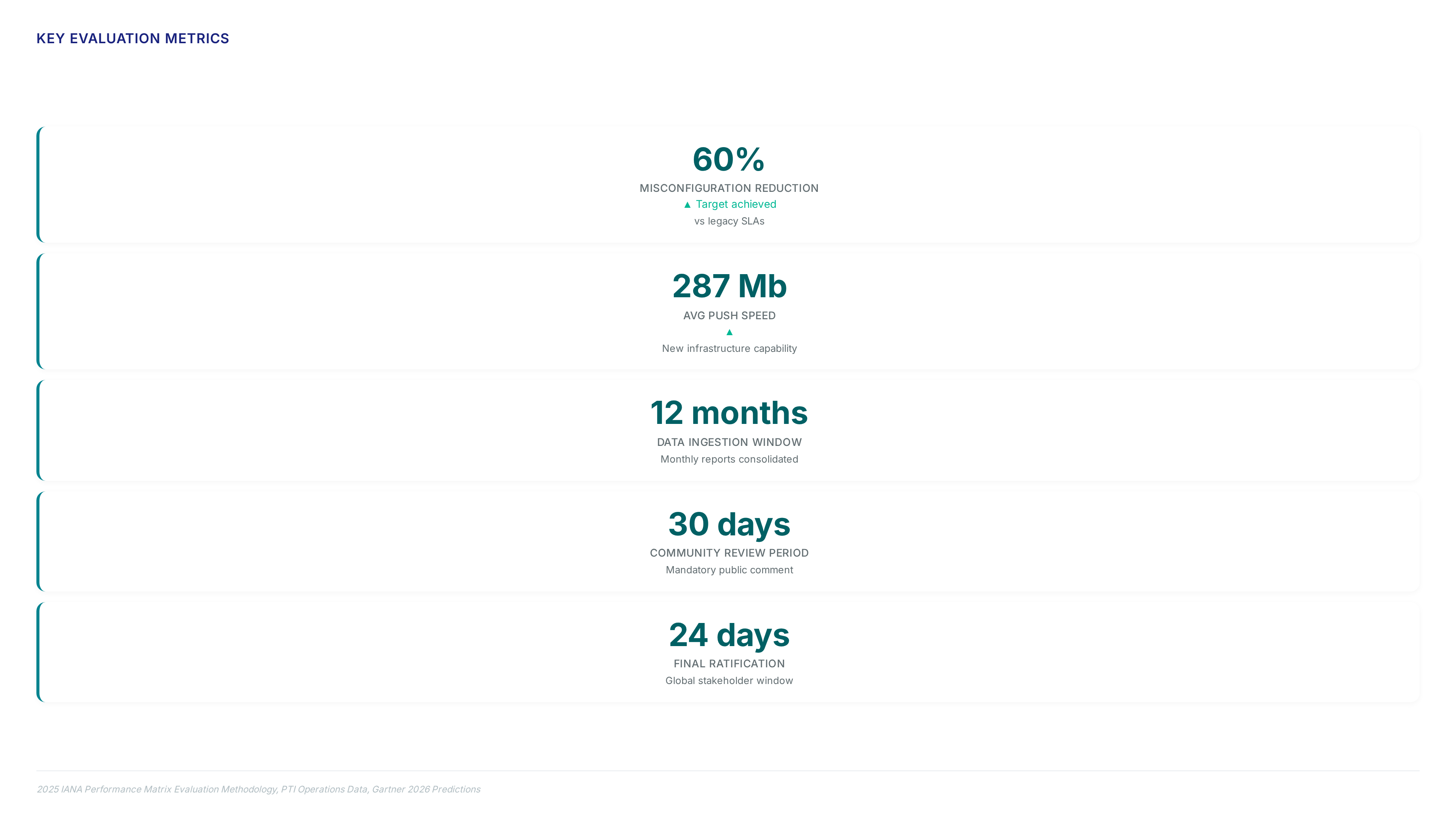
Consolidation begins by ingesting twelve discrete monthly performance reports from Public Technical Identifiers into a unified dataset for annual review. The IANA RC compiles these records to verify adherence against strict latency thresholds set in the governing contract. This aggregation process transforms raw operational logs into a structured summary matrix ready for community scrutiny.
| Phase | Duration | Primary Actor |
|---|---|---|
| Data Ingestion | 12 months | PTI Operations |
| Community Review | 30 days | Global Stakeholders |
| Final Ratification | 24 days | IANA RC |
Validation occurs during a mandatory 30-day public comment period where operators audit the compiled findings for accuracy. The comment window closes at 23:59 UTC on 6 March 2026, creating a hard deadline for submitting technical corrections or objections. Failure to participate in this review cycle forfeits the opportunity to challenge data interpretations before finalization. The scheduled publication date for the 2025 IANA RC Report is 30 March 2026, marking the official closure of the evaluation cycle. This timeline ensures that no report reaches final status without explicit community verification of the underlying metrics. Operators accessing the monthly performance reports directly can cross-reference the summary claims against original source data. The mechanical separation between data collection and public validation prevents unilateral edits to historical performance records.
Industry trends indicate a shift toward agentic AI systems and increased infrastructure complexity by 2027, straining current reliability baselines for numbering service evaluations. Deploying AI-ready infrastructure in a multi-cloud environment involves doubling the number of links and ports compared to standard setups, effectively escalating hardware connectivity costs for enterprises. This physical expansion introduces new failure domains that traditional SLA metrics fail to capture.
| Metric Type | Traditional Baseline | AI-Ready Complexity |
|---|---|---|
| Port Density | Standard | Double requirement |
| Link Redundancy | Static | Flexible mesh |
| Cost Model | Predictable | Variable surge |
Organizations facing the 2026 hardware supply crisis are seeing affected infrastructure costs, prompting a shift toward fixed-cost infrastructure models to improve EBITDA forecasting. Hardware connectivity costs rise non-linearly as port counts double, creating budgetary pressure on operators who must also fund compliance audits.
- Evaluate current port utilization against projected AI workloads.
- Recalculate redundancy requirements for agentic system interconnects.
- Adjust SLA thresholds to reflect increased mean time to repair.
Problem accessing the summary report often stems from these underlying infrastructure shifts delaying data aggregation. Service reliability depends on accurate capacity planning that accounts for this doubled density.
Scope of the 30-Day IANA Performance Comment Window
Submissions targeting the 2025 IANA Performance Matrix Summary Report must reach [email protected] before 23:59 UTC on Friday, 6 March 2026.
Operators execute this validation step through a strict sequence:
- Download the raw dataset from the IANA Numbering Functions portal to verify monthly latency logs against internal records.
- Draft technical objections focusing on SLA Compliance deviations rather than policy preferences.
- Transmit the final document to the NRO inbox before the hard deadline expires.
Missing this window excludes feedback from the IANA RC The Service Level Agreement dictates that only comments received during this specific interval inform the March 30 publication. Late arrivals receive no the consideration, rendering technical corrections useless for the current cycle. This rigid cutoff prioritizes schedule adherence over thorough error correction, forcing operators to maintain continuous monitoring rather than reacting post-deadline.
Accessing the Public Technical Identifiers portal provides the raw dataset required for technical validation before drafting comments.
Operators must execute a strict submission workflow to guarantee inclusion in the final review cycle:
- Retrieve monthly logs from the IANA Numbering Provisions performance dashboard to cross-reference internal allocation latency records.
- Compose a plain-text message detailing specific SLA Compliance deviations without embedding binary attachments that trigger spam filters.
- Transmit the finalized critique to [email protected] prior to the absolute cutoff time.
Submission failures frequently stem from malformed headers or missed 23:59 UTC deadlines, resulting in automatic rejection by the mail gateway. Dictates that only timely arrivals undergo the analysis by the committee. Late entries vanish from the record, leaving operational grievances unaddressed in the final publication.
Submit feedback to [email protected] before 23:59 UTC on Friday, 6 March 2026 to influence the final report.
Operators execute this validation through a strict sequence:
- Portal to verify allocation latency against internal records.
- Transmit the plain-text document to the NRO inbox before the hard deadline expires.
| Requirement | Valid Format | Invalid Format |
|---|---|---|
| Content Focus | Metric deviation | Policy opinion |
| File Type | Plain text | Binary attachment |
| Timing | Before cutoff | Post-deadline |
Ripe. The Public Technical Identifiers entity publishes the underlying data, yet only specific metric challenges trigger the review. Generic praise or vague complaints receive no procedural weight during the 30-day interval.
Strategic Role of Global Internet Number Community Input
The 30-day window transforms raw operator observations into validated data for the final IANA RC assessment.
Defining the global Internet number community Feedback transitions from informal email drafts to the report considerations only after passing a strict temporal boundary at 23:59 UTC on Friday, 6 March 2026. This mechanism relies on the historical precedent set when the Consolidated RIR IANA Stewardship Proposal established community oversight in 2015.
| Input Stage | Actor | Outcome |
|---|---|---|
| Drafting | Network Engineers | Technical deviation logs |
| Submission | Community Members | Public archive entry |
| Integration | IANA RC | Final report amendment |
However, the exclusion of late submissions creates a hard cliff where valid technical corrections vanish if received one minute past the deadline. Unlike commercial SLA disputes that allow grace periods, this governance model accepts no extensions for time-zone miscalculations. The IANA Numbering Capabilities depend on this binary cutoff to maintain schedule integrity for the March 30 publication. Operators must treat the [email protected] address as a singular ingestion point rather than a discussion forum.
Submitted technical objections directly alter the SLA compliance findings in the final 2025 IANA RC Report before its March 30 release.
The workflow transforms raw operator data into binding report amendments through a strict validation gate. All submissions sent to the assigned inbox undergo publication on the NRO website. This transparency forces the committee to address specific metric deviations rather than dismissing general concerns. Operators who verify monthly logs against the Public Technical Identifiers dataset provide the evidentiary basis for these corrections. Without this external verification, internal performance claims remain unchallenged.
| Input Type | Processing Outcome | Report Impact |
|---|---|---|
| Metric deviation | Published archive | Mandatory response |
| Policy opinion | Discarded | None |
| Late submission | Rejected | Excluded |
The limitation remains that only comments arriving before 23:59 UTC on Friday, 6 March 2026 trigger this mechanism. Late feedback loses all use regardless of technical merit. The consequence of silence is a finalized document that may overlook systemic delays affecting global routing stability. Participation converts passive observation into active governance.
Skipping the 30-day comment window leaves multi-cloud AI latency gaps unrecorded in the final IANA RC assessment.
Agentic systems demand doubled physical links, yet standard reports omit these emerging hardware connectivity costs. Deploying such infrastructure effectively doubles expenses, but operators rarely map this strain to identifier allocation speeds without the feedback loop. Historical data shows core utilities struggle to adapt when market entrants push average speeds to 287Mbps while legacy SLAs remain static. Without community validation, the IANA Numbering Offerings risk defining performance targets that ignore modern traffic bursts.
| Factor | Traditional Workload | Agentic AI Load |
|---|---|---|
| Link Count | Baseline | Double |
| Port Density | Standard | Saturated |
| Feedback Loop | Reactive | Absent |
Silence during the consultation period creates a dangerous false positive: perfect compliance scores despite operational failure. The cost of deploying these complex environments remains invisible to stewards who rely solely on automated logs. Missing the Friday, 6 March 2026 deadline at 23:59 UTC cements these blind spots into the official record. InterLIR advises submitting specific latency deviations to [email protected] immediately. Failure to act allows outdated metrics to govern next-generation infrastructure.
About
Alexei Krylov, Head of Sales at InterLIR, brings critical industry perspective to the discussion surrounding the 2025 IANA Performance Matrix Summary Report. As a specialist managing B2B transactions for IPv4 resources, Krylov's daily operations rely heavily on the stability and efficiency of global numbering services. His direct experience working with Regional Internet Registries (RIRs) provides him with unique insights into how IANA's performance metrics directly impact market liquidity and network availability. At InterLIR, a Berlin-based marketplace dedicated to redistributing unused IP resources, Krylov ensures that clients receive clean, secure addresses, making the transparency highlighted in the IANA report necessary for his work. This expertise allows him to effectively analyze the findings and advocate for the global Internet number community during this 30-day public comment period, bridging the gap between high-level governance and practical resource allocation.
Conclusion
The current validation framework fractures when agentic AI workloads saturate port density, rendering static legacy SLAs incapable of capturing real-time infrastructure strain. As traffic bursts double physical link requirements, the 30-day public comment period becomes the only mechanism to prevent operational blind spots from hardening into permanent policy. Without active operator intervention, the IANA RC Validation will ratify performance targets that ignore the doubled expenses and latency gaps inherent in next-generation deployments. Relying on automated logs alone creates a false sense of compliance while actual routing stability degrades under unrecorded load.
Organizations must submit granular latency deviation data before 23:59 UTC on Friday, 6 March 2026, to ensure the final matrix reflects modern hardware realities rather than historical baselines. Waiting for the 2026 shift toward on-device AI decision-making without correcting these metrics now guarantees a mismatch between allocated resources and actual demand. The window to influence global stakeholder ratification closes strictly at the deadline; late technical merit holds no procedural weight.
Audit your current multi-cloud AI latency logs against existing SLA thresholds this week and draft a specific deviation report highlighting where port density saturation exceeds standard baselines. Submit this findings document to [email protected] immediately to secure your operational reality within the official record before the consultation window expires.
Frequently Asked Questions
Late submissions receive no procedural weight during the review interval. The mandatory 30-day public comment period closes strictly on March 6, 2026, excluding any late operator observations from the final report consideration.
The committee serves as a detection mechanism rather than a correction tool. It lacks enforcement power beyond reporting findings to the NRO Executive Council for potential action against Public Technical Identifiers.
Comments on service performance must be submitted to [email protected]. This specific email address ensures your feedback enters the official record for the five Regional Internet Registries to consider.
The current framework lacks real-time alerting for SLA breaches entirely. Operators might process invalid requests for weeks before detection because the system relies on retrospective analysis instead of live monitoring.
Stewardship moved to the global multistakeholder community in 2016 specifically. The five Regional Internet Registries now jointly prepare the summary report using data provided by Public Technical Identifiers under the Service Level Agreement.