Ingress Security: Stop Paying for Redundant Stacks
Scattering security controls creates unmanageable configuration drift. The industry has finally admitted that the Ingress VPC model is the only viable strategy for 2026. AWS Cloud WAN service insertion now allows architects to funnel global traffic through a unified inspection point rather than maintaining fragmented per-VPC defenses.
You will learn why the distributed deployment model fails under scale, specifically how independent scaling leads to cost inefficiency and policy inconsistency. We dissect the packet flow mechanics that enable AWS Network Firewall integration within a centralized architecture, replacing local internet gateways with a single policy enforcement layer. The analysis covers strategic advantages of consolidating IDS/IPS and WAF tools, proving that isolated failure domains do not justify the operational burden of managing dozens of disjointed security stacks.
Amazon Web Services confirms that moving away from local firewall appliances reduces the attack surface while streamlining compliance audits across multiple Regions. This shift transforms network security from a reactive, patchwork effort into a proactive, globally consistent standard. Stop paying for redundant infrastructure and start enforcing uniform rules where they actually matter.
The Role of the Ingress VPC in Modern Cloud Security
AWS Cloud WAN functions as a managed wide area networking service connecting resources across multiple Amazon Web Services Regions and on-premises locations. This architecture replaces fragmented perimeter defenses with a single control plane that defines network policies and automates routing logic. Operators apply a central dashboard to visualize network health while enforcing consistent security postures globally. The service insertion capability enables granular traffic steering through specific actions that distinguish between east-west inspection and internet egress flows. Such differentiation prevents unnecessary hair-pinning of internal traffic while ensuring all external ingress traverses dedicated security segments.
Adopting this model allows organizations to consolidate security resources into a single Ingress VPC rather than maintaining duplicate appliances in every application VPC. This shift reduces the operational burden associated with managing distinct firewall instances across distributed environments. Policy enforcement becomes declarative; engineers define simple statements to route traffic through inspection points instead of modifying route tables manually.
But there is a catch. AWS Cloud WAN operates strictly at Layer 3. It cannot terminate HTTP sessions or perform TCP load balancing before passing packets to security appliances. You must deploy Application Load Balancers or Network Load Balancers within the Ingress VPC to handle Layer 4 or Layer 7 processing. This dependency creates a hard requirement for additional compute resources in the inspection path that pure routing architectures do not demand.
Cross-Region Traffic Flows in Centralized Ingress VPCs
Centralized ingress architectures route external traffic through a dedicated Ingress VPC before forwarding it to target applications via AWS Cloud WAN.
This model supports two distinct deployment topologies: same-Region placement for minimal latency and different-Region placement for global consolidation. Traffic entering the edge encounters Network Load Balancers that distribute flows across security appliances scaled by vCPU utilization thresholds. The core network then applies policy-driven steering to move inspected packets toward the application segment. Operators define these paths using send-via actions. This separation eliminates manual route table updates across multiple accounts.
| Deployment Model | Latency Profile | Operational Scope |
|---|---|---|
| Same-Region | Low | Single Region policy |
| Different-Region | Higher | Global policy enforcement |
Cross-Region flows introduce variable latency because packets traverse the AWS global backbone twice: once to the inspection hub and again to the destination. Enforcing a unified security posture means accepting the performance penalty of hair-pinning traffic across geographic boundaries. A single misconfigured policy statement can blackhole traffic for applications in remote Regions, whereas distributed failures remain isolated in legacy models.
Auto-scaling rules trigger when vCPU utilization crosses set thresholds to match ingress volume. Operators configure security appliances within the centralized hub to expand capacity dynamically as internet traffic flows increase. This mechanism prevents packet loss during sudden surges without manual intervention. The Experian Traffic splitting distributes load across all firewall endpoints inside the Edge VPC before reaching downstream applications.
Configuration Checklist:
- Define vCPU utilization targets for scale-out events.
- Enable auto-scaling groups on security appliances
- Verify traffic splitting logic across deployed endpoints.
- Monitor capacity alignment with ingress flow volumes.
The cost of this approach is the latency introduced by additional scaling decisions during micro-bursts. Static provisioning avoids this delay but risks resource exhaustion under unpredictable loads. Flexible scaling trades milliseconds of decision time for guaranteed availability during spikes. Most operators accept the minor latency penalty to eliminate the risk of dropped connections.
Direct Internet-to-Application Routing in Distributed VPCs
Each application Amazon VPC ingests external traffic through a dedicated internet gateway paired with locally deployed Network Firewall endpoints. This topology forces every workload to manage its own perimeter, resulting in isolated failure domains where a compromise in one segment does not propagate to others. The architecture relies on independent operation; a single VPC outage leaves adjacent application environments fully functional.
However, this isolation demands duplicate infrastructure for every deployment unit. Scaling to 10 VPCs necessitates provisioning 10 Firewall Instances, 10 Internet Gateways, and 10 NAT Gateways rather than a shared pool. Such duplication drives cumulative infrastructure costs notably higher than consolidated models, as each unit requires full resource allocation regardless of actual throughput utilization.
Operational overhead compounds when enforcing consistent security postures across these fragmented boundaries. Administrators must manually synchronize rules across every local appliance, creating high risks of configuration drift that weaken the overall security stance. The distributed approach offers simplified traffic flow by removing extra network hops, yet this latency benefit often fails to offset the management burden in large-scale environments. Policy updates become iterative chores rather than atomic events, delaying critical patch deployment.
| Component | Distributed Count (10 VPCs) | Centralized Count |
|---|---|---|
| Firewall Instances | 10 | ~2-4 |
| Internet Gateways | 10 | 1 |
| NAT Gateways | 10 | 1 |
Organizations facing strict compliance mandates prohibiting direct internet gateway attachment to application VPCs cannot apply this model. The requirement for all traffic to traverse a central inspection point forces a move away from distributed ingress regardless of latency preferences.
Direct internet-to-application routing eliminates intermediate hops, reducing latency compared to centralized hair-pinning. This architecture ensures isolated failure domains where a fault in one VPC does not cascade to adjacent workloads. Operators gain durability because each application segment functions independently during local outages. But this model fails when organizational policies forbid internet gateway attachment. Such constraints force all traffic through a central inspection point, negating the direct path advantage.
IPv6 deployments face further restrictions; centralized ingress currently supports only dual-stack applications using specific load balancer configurations. Architects must route IPv6 flows through Network Load Balancers with IPv4 targets if direct target groups remain unsupported.
| Feature | Distributed Model | Centralized Model |
|---|---|---|
| Traffic Path | Direct ingress | Hair-pinned via Ingress VPC |
| Failure Scope | Single VPC impact | Potential global outage |
| Policy Consistency | High drift risk | Uniform enforcement |
| IPv6 Support | Native per VPC | Limited to dual-stack NLB |
Scaling this approach requires duplicating Network Firewall instances for every new workload. A deployment across 10 VPCs demands 10 Firewall Instances and 10 Internet Gateways. This duplication increases cost and configuration surface area notably.
Distributed architectures grant each application independent scaling of ingress capacity, avoiding shared hub bottlenecks. This model deploys Network Firewall endpoints locally, allowing traffic volume spikes in one workload to trigger resource expansion without affecting neighbors. Operators managing 10 VPCs under this model must provision 10 Firewall Instances, 10 Internet Gateways, and 10 NAT Gateways to maintain isolation. Such duplication drives cumulative infrastructure costs higher than a consolidated approach requiring only ~2-4 Firewall Endpoints for the same footprint. Teams seeking to save on security infrastructure.
Centralized hubs constrain scaling to the aggregate capacity of the shared inspection layer. Security appliances here auto-scale based on vCPU utilization thresholds. A noisy neighbor in one application VPC can exhaust central firewall resources, starving adjacent workloads of inspection capacity.
Independent scaling prevents cross-application interference but forces operators to over-provision capacity for peak loads in every single VPC. Centralization optimizes spend but introduces a systemic limit where total throughput cannot exceed the maximum node count of the central cluster.
Defining the Centralized Ingress VPC Inspection Model
Dedicated Ingress VPCs with Network Firewall endpoints intercept internet traffic arriving through the internet gateway before routing it to Application VPCs. This architecture consolidates inspection into a single hub connected to an Ingress Segment. Application workloads reside in separate VPCs lacking direct internet gateways, forcing all inbound flows through the central security appliance cluster. The design contrasts sharply with distributed models where every VPC maintains independent perimeter defenses.
| Dimension | Centralized Ingress | Distributed Ingress |
|---|---|---|
| Gateway Count | 1 Internet Gateway | 10 Internet Gateways |
| Firewall Scale | ~2-4 Firewall Endpoints | 10 Firewall Instances |
| NAT Resources | 1 NAT Gateway | 10 NAT Gateways |
| Policy Drift Risk | Low (single source) | High (multiplied overhead) |
| Failure Domain | Shared (single point) | Isolated per VPC |
Consolidating resources reduces cumulative infrastructure costs compared to maintaining duplicate inspection hubs. Operators manage fewer configuration objects, directly lowering the probability of policy drift during updates. However, this efficiency introduces a shared failure domain; an outage in the Ingress VPC blocks connectivity for all attached applications simultaneously. The model suits organizations with strict mandates prohibiting internet gateways in application tiers. Such policies force traffic through AWS Cloud WAN, making centralized inspection the only compliant option. Amazon.
The cost of isolation manifests in duplicate infrastructure. Amazon. Deepika Khalarka notes that while distributed approaches offer isolation, they introduce significant operational overhead.
Implementing Hybrid Inspection with AWS Cloud WAN Service Insertion
Hybrid inspection architectures deploy send-to segment actions. This approach uses GWLB endpoints within a dedicated Egress VPC to centralize internet exit points for both IPv4 and IPv6 traffic. Operators consolidate resources to save on security infrastructure.
Distributed models offer isolated failure domains but multiply operational overhead through configuration drift. Centralized hybrid designs enforce uniform rules yet introduce a single point of congestion if capacity planning ignores peak throughput. A critical limitation emerges when application VPCs require direct internet access for latency-sensitive protocols; hair-pinning traffic through the core network adds measurable jitter. Teams must evaluate whether the reduction in management burden outweighs the potential performance penalty for specific workloads. Amazon. The architectural shift demands precise tuning of auto-scaling thresholds to prevent bottlenecks during traffic spikes.
Implementing Centralized Ingress with Cloud WAN and Network Firewall
Configuring Segment Sharing for Cross-Region Ingress VPCs
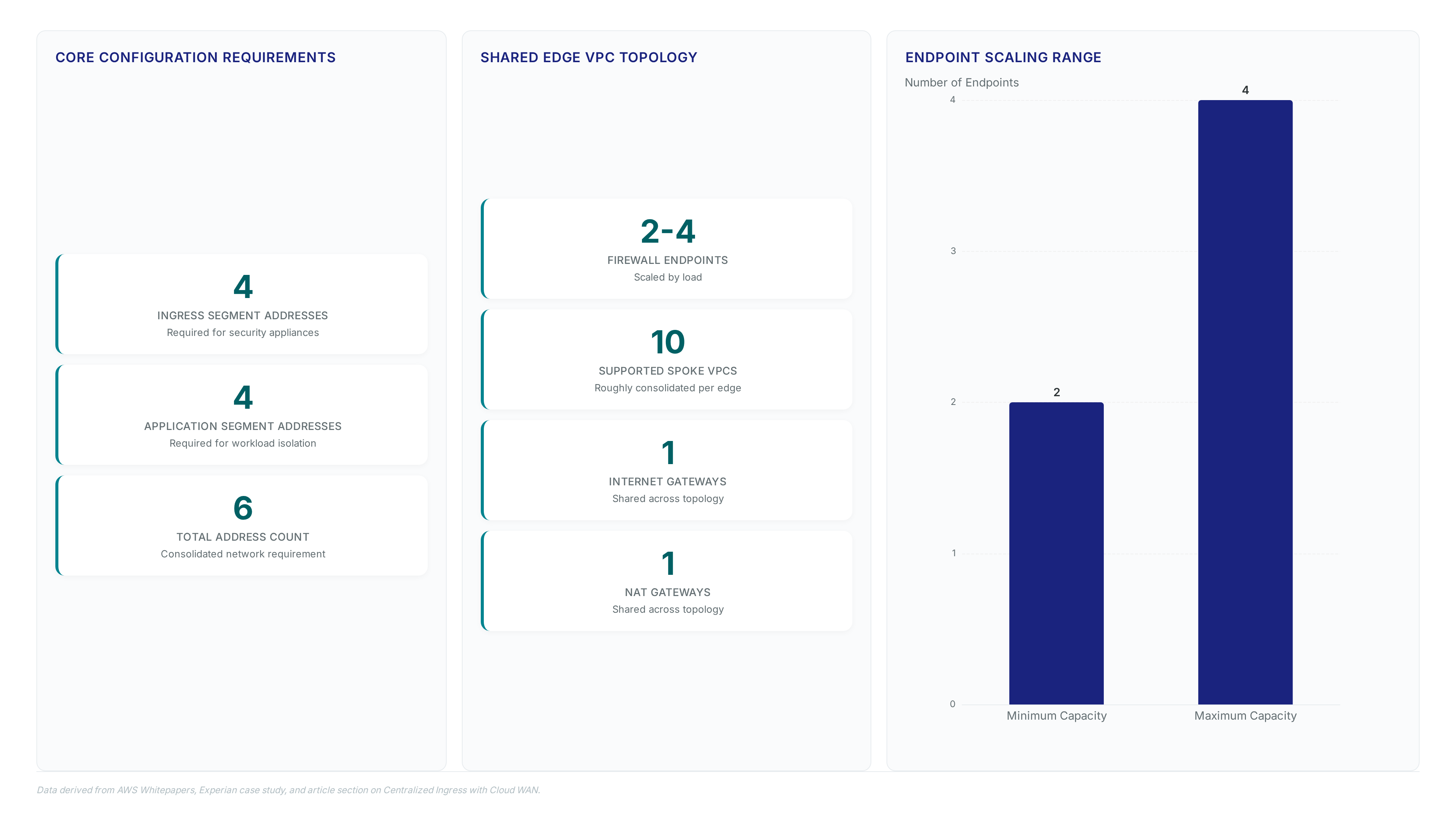
Cross-region ingress demands attaching the Ingress VPC and remote Application VPCs to distinct segments inside the AWS Cloud WAN core network policy. Operators define an Ingress Segment for security appliances plus separate Application Segments for workloads without direct internet gateways. Four specific steps enable bidirectional flow across regional boundaries.
- Create a core network policy defining the global Ingress Segment and regional Application Segments.
- Attach the centralized Ingress VPC containing Network Firewall endpoints to the global segment.
- Attach remote Application VPCs to their each regional segments via automated attachment.
- Enable segment sharing in the policy to allow traffic traversal between the ingress and application zones.
Traffic steering uses send-via actions. This mechanism enforces consistent security controls. Same-region traffic pays a hard latency penalty when traversing the global core unnecessarily. Architectural rigidity guarantees policy compliance. A single core network policy error impacts all connected regions simultaneously, removing the isolated failure domains.
Deploying Network Firewall Endpoints in the Ingress VPC
Place Network Firewall endpoints in the Ingress VPC to intercept traffic before it reaches application workloads. Operators provision a Shared Edge VPC containing multiple firewall instances alongside a single internet gateway. This topology consolidates inspection for roughly 10 spoke VPCs using only 2-4 endpoints scaled by load. Auto-scaling groups monitor vCPU utilization thresholds to add capacity during traffic spikes. The Experian Traffic splits automatically across all active endpoints within the edge boundary before forwarding to the Ingress Segment.
- Define the core infrastructure policy with distinct Ingress and Application segments.
- Launch Network Firewall endpoints in private subnets of the Shared Edge.
- Configure the internet gateway route table to target the firewall endpoint group.
- Enable segment sharing to allow bidirectional flow between ingress and application zones.
- Attach application VPCs lacking internet gateways to the assigned Application Segment.
Layer 3 limitations define the architectural cost because AWS Cloud WAN cannot perform Layer 7 load balancing natively. An ALB or NLB stays mandatory in the Ingress VPC to handle HTTP or TCP distribution before inspection. IPv6 support introduces another constraint since target groups must reside in the same VPC IPv6 space as the load balancer. Cross-VPC IPv6 targeting fails over transit gateways or core networks. Dual-stack designs must terminate locally.
Validating ALB Setup and Traffic Splitting Across Firewall Endpoints
Operators must verify Application Load Balancer target groups contain only IPv4 addresses because IPv6 centralized ingress. Traffic distribution fails silently if the Ingress Segment routes packets to unavailable Network Firewall endpoints during scaling events. Dual-stack applications require careful validation since Infrastructure Load Balancers Balancer target groups contain only IPv4 addresses because IPv6 centralized ingresshttps:/ networkfirewall/ cannot yet point to IPv6 addresses across AWS Cloud WAN connections.
| Protocol | Target Support | Limitation |
|---|---|---|
| IPv4 | Full | None |
| IPv6 | Limited | No remote peering |
Execute these checks to confirm correct splitting:
- Confirm ALB listeners accept dual-stack traffic while backend targets remain IPv4-only.
- Validate auto-scaling policies trigger on vCPU utilization thresholds before packet loss occurs.
- Test failover by terminating a single firewall endpoint in the Ingress VPC.
Misconfigured target groups cause asymmetric flows that bypass inspection entirely. InterLIR recommends auditing security group rules to permit only load balancer health checks from specific subnets.
About
Vladislava Shadrina serves as a Customer Account Manager at InterLIR, where she specializes in client relations within the critical domain of IP resources. While her background includes architecture, her daily professional focus on networking and IP address management provides a unique perspective on the infrastructure required to support scalable cloud environments. At InterLIR, a company dedicated to solving network availability through transparent IPv4 redistribution, Shadrina understands that reliable address allocation is the foundation for advanced architectures like AWS Cloud WAN. Her experience guiding clients through complex network setups allows her to effectively contextualize the necessity of centralized ingress inspection. By connecting InterLIR's mission of ensuring clean, secure IP reputation with modern AWS networking patterns, she highlights how reliable IP resources are necessary for deploying secure, high-performance global networks using services like AWS Network Firewall and load balancers.
Conclusion
Scaling this architecture reveals a critical fragility: asymmetric routing spikes dramatically when auto-scaling groups expand quicker than firewall endpoint provisioning. The operational debt accumulates not in initial setup, but in the continuous manual reconciliation of IPv4-only target groups against evolving dual-stack application requirements. As traffic volumes grow, the inability to peer IPv6 addresses across wide-area connections forces teams to maintain parallel inspection paths, effectively doubling the debugging surface area for network flows. This structural gap demands a shift from reactive troubleshooting to proactive constraint management before the next substantial traffic surge.
Organizations must mandate a strict IPv4 termination policy for all centralized inspection points until AWS resolves cross-VPC IPv6 targeting limitations, with a hard deadline to re-evaluate this stance in Q4 2027. Do not attempt hybrid routing models that rely on future feature parity; treat the current IPv6 restriction as a permanent design boundary for the next eighteen months. Start by auditing your ALB target group configurations this week to ensure zero IPv6 addresses exist in backend pools, immediately correcting any dual-stack entries that violate this containment rule.
Frequently Asked Questions
Organizations consolidate security resources to save on infrastructure costs compared to distributed models. Customers specifically deploy AWS Cloud WAN architectures to achieve these financial efficiencies while reducing operational overhead.
Deploying distributed GWLB endpoints allows organizations to optimize data processing costs by removing central traversal needs. This approach eliminates the requirement to send all traffic through a single inspection point.
Balancer target groups contain only IPv4 addresses because IPv6 centralized ingress cannot yet point to IPv6 addresses. This limitation currently exists across AWS Cloud WAN connections for network firewall integration.
Scattering security controls creates unmanageable configuration drift across every single VPC in your environment. This fragmentation makes the Ingress VPC model the only viable strategy for maintaining consistency in 2026.
AWS Cloud WAN operates strictly at Layer 3, necessitating Application Load Balancers for Layer 7 processing. Without these components, the backbone cannot terminate HTTP sessions before passing packets to security appliances.