IPv4 Market Reality: Leasing Beats Migration
Real enterprise IPv6 penetration sits stalled at 8–12%. The promised IPv4 sunset is fiction on the current trajectory. Belief in an imminent switch ignores the economic reality: IPv4 persistence is a deliberate, cost-effective strategy, not technical debt. Registry exhaustion from ARIN, RIPE, and APNIC failed to force adoption. Instead, it created a liquid market with addresses trading between $40 and a modest premium. (ARIN's ip addresses through 2025) We must compare the operational friction of dual-stack migration against IPv4 leasing models priced at $0.38 to $0.45 per IP monthly.
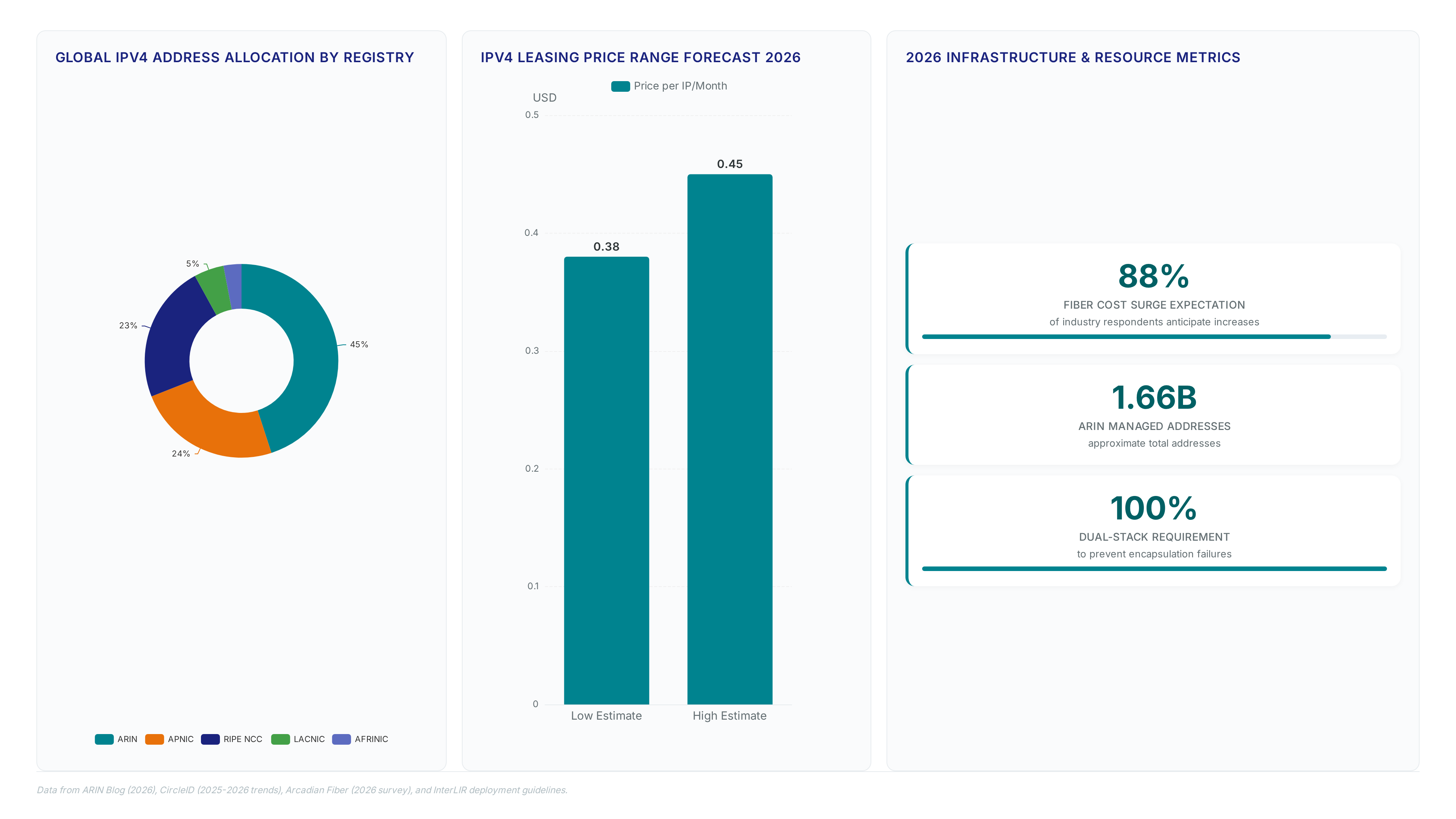
Google statistics showing 45% adoption skew heavily toward mobile carriers. True enterprise traction grows at a negligible half-percentage point annually. As Jamie Thain noted on the NANOG mailing list in May 2026, serious deprecation conversations belong in 2045 or later. Regulatory forcing functions simply do not exist today. Until then, IPv4 dominates public traffic, recycled and leased rather than retired.
The Economic Reality of IPv4 Persistence and the Myth of Sunset
Why No Credible IPv4 Sunset Date Exists in 2026
Market trajectories explicitly reject any hard deprecation deadline for an IPv4 sunset during 2026. A liquid transfer market enables continued operation without migration as addresses trade between $40 and a moderate amount. Verified data confirms IPv4 carries approximately 60% of global internet traffic, disproving narratives of imminent obsolescence. Real enterprise penetration for the successor protocol sits merely between 8% and 12%, indicating sluggish internal adoption despite public metrics. Growth rates have decelerated to 2–3% annually, pushing full global transition estimates toward 2050 or later.
Leasing at $0.38 per IP monthly beats costly stack replacements. Operators rationally defer migration expenses while NAT44 and CGNAT technologies sufficiently mask address shortages. Low enterprise traction validates further delay in a self-reinforcing cycle. IPv4 persists in dual-stack forms similar to legacy telephony systems because no forcing function exists. Renting address space at $0.45 monthly bypasses capital expenditure for block acquisition. The IPv4 transfer market functions as a liquidity engine where operators lease rather than buy to maintain runway. Organizations apply these mechanisms to secure small blocks for AI workloads without committing to permanent ownership costs.
ARIN Size-Based Fees Versus RIPE NCC Flat Fee Models
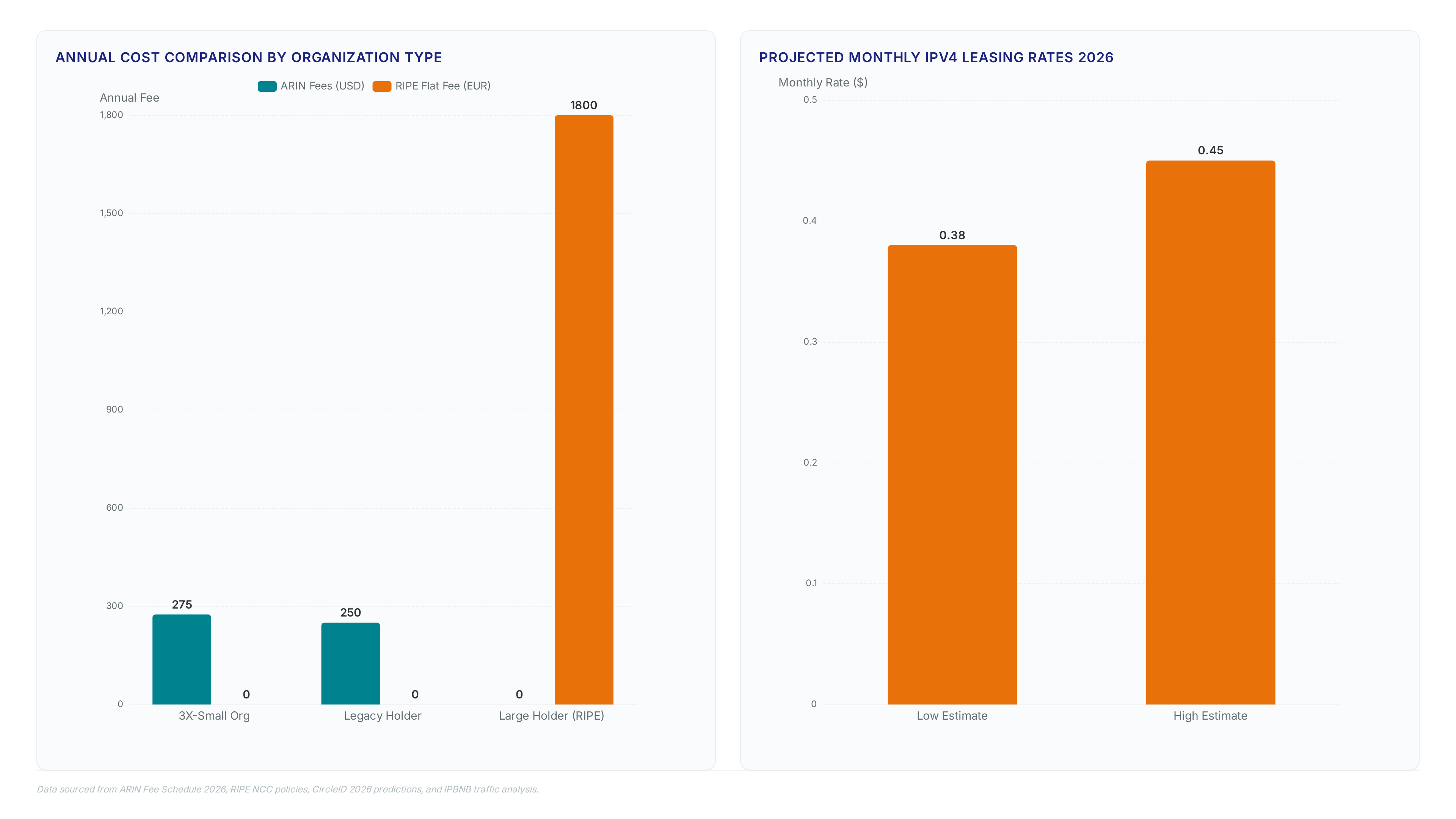
Fee structure divergence between regional registries creates asymmetric economic incentives that actively discourage protocol migration in specific geographies. ARIN applies a size-based fee model that increased by 5% in 2025, directly penalizing organizations holding large legacy blocks. This contrasts sharply with the RIPE NCC flat fee model of €1,800, which effectively subsidizes massive resource holders by decoupling cost from inventory volume. Real enterprise traction remains stagnant because the economic pain required to force migration exists only in select jurisdictions. Operators in flat-fee regions rationally defer the operational retraining and tooling upgrades associated with IPv6 because holding IPv4 remains cheaper than changing protocols. Registry policies insulate large holders from scarcity signals, preventing the market from correcting itself.
Architectural Mechanisms for Extending IPv4 Lifespan Through NAT and Overlays
ILNP Identity-Locator Separation Mechanics Since 2006
ILNP decouples endpoint identity from network location using 64-bit cryptographic identifiers rather than fixed IP addresses. This evolutionary intent, documented by Joe Klein, allows hosts to change topological positions without breaking active sessions. The mechanism splits the traditional address into a static name and a flexible locator, solving mobility issues that plague standard NAT implementations. Unlike CGNAT, which obscures endpoints behind a single shared address, ILNP maintains unique identity visibility across the network edge.
| Feature | ILNP Approach | CGNAT Approach |
|---|---|---|
| Addressing | Separate identity and locator fields | Shared single public IPv4 address |
| Session State | Maintained via identity binding | Maintained via port translation tables |
| Mobility | Smooth handover without re-authentication | Session breakage upon IP change |
| Scalability | Linear routing table growth | Exponential state table requirements |
The architecture emerged between 2006 and 2012 as a direct response to the global free pool exhaustion that occurred in 2011. Operators deploying this model avoid the complex retraining costs associated with full protocol swaps. However, ILNP remains an experimental protocol within the IRTF, lacking the vendor support found in mature standards. The cost of adoption is measurable: integrating identity-locator separation requires upgrading edge devices to parse new header formats. This limitation stalls deployment despite the clear technical advantage over strict transfer policies that constrain address availability. InterLir notes that while ILNP solves the scaling problem, the economic inertia of existing NAT infrastructure prevents widespread migration.
Deploying SD-WAN Overlays to Bypass Address Exhaustion
SD-WAN overlays encapsulate private traffic to bypass public IPv4 address shortages without acquiring new blocks. This mechanism extends the operational lifespan of legacy infrastructure by decoupling logical topology from physical addressing constraints. Operators deploy Carrier-Grade NAT (CGNAT) at the edge to multiplex thousands of internal hosts onto a single public IP, effectively masking the exhaustion crisis. The global traffic share remains dominant despite registry depletion, validating this avoidance strategy over migration.
Implementation requires strict configuration to prevent path MTU discovery failures common in double-NAT scenarios.
- Configure overlay tunnels to carry encrypted payloads across the public internet.
- Apply CGNAT policies to translate private RFC 1918 space to limited public pools.
- Enforce stateful firewall rules to track session tables for millions of concurrent flows.
| Mechanism | Primary Function | Operational Cost |
|---|---|---|
| SD-WAN Overlay | Abstracts underlying transport | High compute overhead |
| CGNAT | Multiplexes many users to one IP | Breaks end-to-end traceability |
| Leasing | Acquires temporary address space | Recurring monthly fees |
The architectural trade-off involves losing end-to-end visibility, which complicates forensic analysis during security incidents. While ARIN manages a significant portion of global holdings, accessing them requires navigating complex policy hurdles that overlays circumvent entirely. This approach delays the inevitable but introduces latency jitter that real-time applications cannot tolerate.
LISP reduces global routing table size by decoupling endpoint identifiers from routing locators, unlike IPX/SPX which bound identity to MAC addresses. Historical IPX/SPX dominated 1980s LANs because it was lighter than early TCP/IP, yet the protocol collapsed under WAN scale due to flat addressing. The OSI model similarly failed as a massive theoretical framework where working code arrived too late to compete. LISP avoids these pitfalls through an overlay architecture that maps EIDs to RLOCs only at the network edge. This separation allows core routers to maintain sparse tables while endpoints retain stable identities during mobility events.
| Feature | LISP Overlay | IPX/SPX Legacy |
|---|---|---|
| Addressing | Separated EID and RLOC fields | MAC-based network identity |
| Scalability | Hierarchical locator aggregation | Flat broadcast domains |
| Deployment | Standardized RFC 9300 | Proprietary Novell stack |
Clean-slate redesigns often ignore installed base reality, whereas LISP functions as an evolutionary patch for existing infrastructure. Operators deploying this today use ARIN RPKI tools to visualize secure locator mappings without ripping out legacy gear. The demand for small IPv4 blocks remains steady precisely because overlays like LISP extend the utility of scarce addresses. Migration costs stall full IPv6 adoption, making locator separation a pragmatic intermediate step. The limitation remains operational complexity in mapping server synchronization during failover events.
Strategic Evaluation of Dual-Stack Migration Versus IPv4 Leasing Models
Defining the dual-stack migration versus IPv4 leasing decision framework requires quantifying the gap between transition technologies and current market valuations. Dual-stack implementation runs native IPv6 alongside legacy IPv4, avoiding encapsulation overhead while demanding full-stack upgrades. Leasing rents scarce capacity at rising rates rather than solving the root address deficit. The United States controls a vast number of addresses, creating a supply concentration that distorts global pricing dynamics. China holds a vast number of addresses, further restricting available inventory for international expansion. Operators must weigh the operational friction of dual-stack implementation against the perpetual liability of rental fees.
Treating protocol upgrades as capital expenditures rather than insurance policies is a strategic error. Waiting for a sunset date that does not exist invites sudden, unplanned migration costs later. Operators delaying dual-stack deployment face regional fee disparities as registry policies diverge and scarcity intensifies over decades.
| Risk Factor | Leasing Strategy | Migration Strategy |
|---|---|---|
| Cost Predictability | Volatile market rates | Fixed capital expense |
| Timeline Alignment | Matches slow growth | Preempts 2045 curve |
| Operational Overhead | Low immediate effort | High initial retraining |
| Scalability | Constrained by supply | Unlimited address space |
Relying on IPv4 leasing locks enterprises into a market where supply cannot expand to meet AI-driven demand spikes. Most organizations underestimate the compounding effect of annual price increases over a twenty-year horizon. Waiting for a forcing function allows competitors to secure favorable long-term positions while late adopters pay premium rates for dwindling inventory.
Executing a Dual-Stack Deployment and Address Management Strategy
Dual-Stack Deployment Mechanics and Address Management Fundamentals
Enabling dual protocol stack technology on every router interface allows simultaneous handling of distinct IPv4 and IPv6 forwarding tables. Separate address pools become necessary because neither protocol shares state or translation logic natively.
- Assign globally unique prefixes from the Regional Internet Registry to avoid private address collisions.
- Disable NAT on internal LAN segments to simplify troubleshooting and preserve end-to-end connectivity.
- Implement DNS records for both A and AAAA types to ensure clients resolve the correct transport.
Strategy must acknowledge that IANA exhausted the global free pool years ago, rendering new IPv4 allocations impossible without market transfers. Leasing serves as a temporary fix yet denies the permanent address ownership needed for stable architecture. Simplifying network diagrams often clashes with maintaining security visibility across two distinct planes. Most monitoring tools flag IPv4 anomalies while silently dropping IPv6 traffic, creating blind spots during incidents.
InterLIR mandates enabling dual protocol stack technology on edge routers before activating SD-WAN overlays to prevent encapsulation failures.
- Provision native IPv6 prefixes alongside existing IPv4 blocks without relying on tunneling mechanisms reserved for legacy constraints.
- Configure RPKI validation on border routers to reject invalid route origins, ensuring global uniqueness for both address families.
- Disable NAT on internal LAN segments to preserve end-to-end connectivity and simplify troubleshooting paths.
| Deployment Phase | IPv4 Action | IPv6 Action |
|---|---|---|
| Addressing | Assign public blocks | Allocate /48 prefixes |
| Routing | Advertise via BGP | Advertise via BGP |
| Validation | Check ROA status | Check ROA status |
SD-WAN controllers frequently default to IPv4-only underlay discovery, causing overlay tunnels to fail when IPv6 becomes primary. This error forces traffic into suboptimal tunnel technology paths that increase latency and obscure failure domains. Skipping RPKI checks allows invalid routes to propagate until manual intervention occurs, extending outage windows notably. Operators often delay this step until a routing incident forces a reactive fix, wasting engineering hours on preventable outages. Proven address management treats IPv6 as a co-equal transport from day one rather than an add-on. Misaligned DNS records cause clients to fall back to slower IPv4 paths, degrading user experience without generating alerts. Operational friction diminishes only when tooling matures to treat both protocols identically. Organizations skipping validation face uncapped size-based fees that escalate without upper limits in 2026.1. Audit registration agreements for pre-2024 signatures to confirm eligibility for legacy pricing tiers. Calculate total cost of ownership against current market rates using a moderate per IP upper bound for lease acquisitions. Validate that the intended block size does not trigger a higher fee schedule bracket under the 2026 update.
InterLIR recommends treating fee validation as a hard gate before provisioning new address pools. The global uniqueness mandate requires strict adherence to registry data, making unvalidated transfers a compliance risk. Reconciling legacy holdings with modern transfer policies involves substantial friction. Failure to cap fees early locks organizations into rising operational expenditures that erode the financial logic of leasing versus migration. Validation must precede acquisition to balance immediate address needs against long-term fee structures. Allocate /48 prefixes. Advertise via BGP. Advertise via static routes where BGP is unavailable. Assign public blocks directly to customer edge devices. These steps prevent lation failures. Cost calculations should reference against current market rates using a moderate per IP upper bound for lease acquisitions.
About
Evgeny Sevastyanov serves as the Support Team Leader at InterLIR, a specialized IPv4 address marketplace based in Berlin. His daily responsibilities involve managing customer support for IPv4 leasing and directly handling technical configurations within RIPE and APNIC databases. This hands-on experience makes him uniquely qualified to discuss the enduring relevance of IPv4, as he witnesses firsthand the continuous global demand for these addresses despite ongoing IPv6 discussions. While industry voices debate protocol sunsets, Sevastyanov's work confirms that organizations still urgently require clean IPv4 resources to maintain operations. At InterLIR, his team ensures transparent and secure access to these critical network assets, validating the article's thesis that IPv4 remains dominant in current traffic patterns. His practical involvement in redistributing unused IP blocks provides a factual grounding for understanding why the IPv4 market remains reliable and necessary for the IT sector's immediate infrastructure needs.
Conclusion
The market stability of IPv4 relies on a fragile arbitrage that breaks at scale when operational overhead outpaces the marginal utility of leasing. While renting bypasses upfront capital, the compounding annual registry fees create a hidden tax that renders long-term leasing economically inferior to migration within three years. Relying on IPv4 as a primary transport beyond 2027 locks organizations into a diminishing return cycle, where address scarcity drives lease volatility while IPv6 adoption stagnates due to implementation friction rather than technical limits. You must treat IPv4 strictly as a legacy bridge, not a permanent foundation. Commit to a hard sunset date for IPv4-only dependencies by Q4 2026, mandating that all new infrastructure provisions support dual-stack natively. Delaying this transition converts a manageable engineering task into an unbounded financial liability. Start by auditing your current lease agreements against the 2026 fee schedule updates before Friday to identify any blocks that will trigger higher pricing tiers next year. This immediate reconciliation prevents unexpected budget shocks and clarifies the exact capital required for a controlled migration.
Frequently Asked Questions
Addresses currently trade between $40 and $60 in the liquid transfer market. This pricing allows organizations to purchase blocks directly rather than relying solely on leasing models for their infrastructure needs.
Renting address space costs between $0.38 and $0.45 per IP monthly. This low operational expense bypasses significant capital expenditure required for purchasing permanent blocks outright.
Verified data confirms IPv4 carries approximately 60% of global internet traffic. This dominance persists because enterprise adoption of the successor protocol remains sluggish at only 8% to 12%.
Annual fees for smaller holders rise to $275 for the 3X-Small category in 2026. This represents a 5% fee increase approved by the Board of Trustees to cover registration services.
Operators use NAT and SD-WAN overlays to mask address shortages without touching the network layer. This approach avoids the high costs of re-architecting applications while maintaining 60% traffic capacity.