IPv6 complexity stems from a 1994 IETF choice
IPv6 complexity isn't an accident; it's the bill for a 1994 IETF decision to reject simple address expansion in favor of a total architectural overhaul. (IETF's ipv6 internet standard) Call it bloat if you want, but that perceived weight is a deliberate engineering trade-off. It solves routing scalability and enables advanced functionality that IPv4 could never touch. We need to look at the IPng design origins, tracing how the IAB workshop in 1991 and the indecisive IPDECIDE BOF in Amsterdam forced the IESG to mandate a reliable solution rather than a quick fix. The shift toward IPv6-mostly networks by 2026, where IPv4 survives only as a legacy compatibility layer per LACNIC reports, proves the point.
Ignore the cynicism Brian Carpenter attributes to critics who claim designers "went mad." RFC 1380 correctly predicted that scaling problems required more than just larger addresses. Once you understand why BGP4 routing and classless addressing were bundled with the new protocol, the steep learning curve makes sense. The IPv6 protocol remains the only viable path forward.
The Historical Origins of IPv6 Complexity and IPng Design
IPng Origins and the 1994 Toronto Decision
Work on IP next-generation started in 1992 to fix the global address shortage documented by the IETF. Appending bits to IPv4 was a non-starter. Existing implementations hardcode the 32-bit format; any larger packet gets discarded immediately. Architects had no choice but to increment the version number, creating a distinct protocol requiring new code paths. This selection occurred at the July 1994 meeting in Toronto, Canada, after years of indecisive proposals like IPv8. Engineers realized scaling address space alone was insufficient without solving advanced functionality gaps noted in early routing reports.
Dual stack architecture forces network devices to maintain parallel forwarding planes for both IPv4 and IPv6 simultaneously. This coexistence model prevents internet fragmentation but mandates that every router process two distinct protocol stacks. Control-plane state tables double. Monitoring overhead doubles. Operational expenditure rises because engineers must troubleshoot two independent failure domains rather than one unified system. Transition mechanisms like tunneling protocols introduce specific latency penalties absent in single-stack environments. The hidden costs accumulate through increased NAT complexity and staff training requirements, not direct address licensing fees. Vincentas Grinius notes that ISPs face significant operational drag when managing these parallel infrastructures at scale. Memory consumption on edge routers increases proportionally with the number of active sessions per protocol version.
| Factor | Single Stack | Dual Stack |
|---|---|---|
| Forwarding Tables | One | Two |
| Debugging Scope | Isolated | Correlated |
| Memory Footprint | Baseline | Elevated |
The industry now shifts toward IPv6-only networking to eliminate this structural redundancy. Reducing protocol diversity lowers the probability of configuration drift between stacks. IPv6 enforces a 40-octet fixed header to eliminate router-side parsing delays inherent in variable-length designs. This structural rigidity contrasts sharply with IPv4, where variable option fields force forwarding engines to inspect every packet deeply, slowing the data plane. The forwarding path suffers under IPv4 because fragmentation occurs at routers, requiring stateful reassembly logic that IPv6 pushes entirely to edge nodes. Such design choices reflect Second System Syndrome, where architects over-engineer solutions to avoid perceived flaws in predecessors like DECNET or the OSI suite.
| Feature | IPv4 Design | IPv6 Design |
|---|---|---|
| Header Size | Variable length | Fixed 40 octets |
| Fragmentation | Performed by routers | Performed by source only |
| Option Fields | Included in main header | Moved to extension headers |
Operators adopting dual-stack implementations face increased resource consumption as routers maintain parallel processing logic for both protocols. The cost is measurable: monitoring overhead doubles when tracking two independent control planes instead of one. IPv6 simplifies the core header, yet the transition period introduces operational friction that single-stack environments avoid. Extension headers in IPv6 restore flexibility without compromising the fast-path efficiency of the base header. This separation ensures that optional features do not penalize standard traffic flows. Network engineers must weigh the long-term routing efficiency gains against the short-term complexity of managing coexistence mechanisms. The fixed structure ultimately stabilizes the routing table expansion seen in recent years.
Architectural Divergence Between IPv4 and IPv6 Protocols
Second System Syndrome and IPv6 Conservative Design Choices
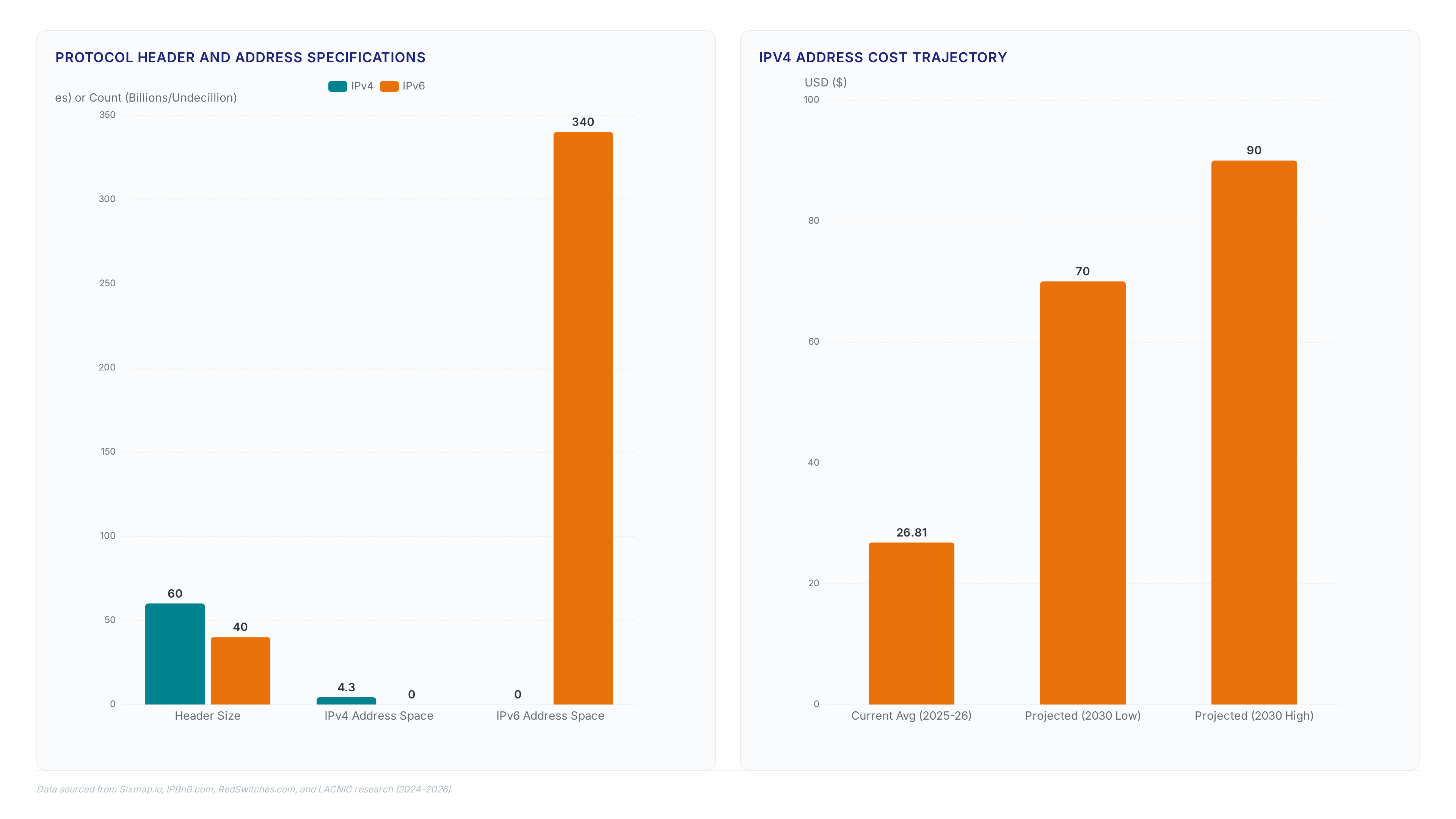
Second System Syndrome describes the tendency for a successful first system to be followed by a second system that becomes over-engineered or bloated. IPv6 avoided this fate by retaining the basic IP model of connectionless packet switching with topological addresses rather than adding unnecessary layers. The design team rejected complex stateful mechanisms in favor of a simplified, fixed-length header of 40 octets. This structural choice eliminates the variable option fields found in IPv4 that force routers to perform deep packet inspection on every flow. By moving fragmentation logic to edge nodes, the protocol removes a substantial source of forwarding path complexity.
| Design Element | IPv4 Behavior | IPv6 Behavior |
|---|---|---|
| Header Length | Variable | Fixed 40 octets |
| Fragmentation | Router-based | Edge-only |
| Option Fields | Inline | Extension headers |
The conservative approach ensures that extension headers remain optional processing steps rather than mandatory delays for core transit traffic. Troubleshooting, however, demands specialized tooling to parse chained headers that legacy monitors often ignore. Operators must deploy updated analysis stacks to visualize the full path logic without stripping necessary metadata. The protocol scales efficiently but demands higher initial configuration precision than its predecessor.
Router Advertisement messages trigger address generation by broadcasting network prefixes that hosts combine with local interface identifiers. This mechanism eliminates manual configuration requirements by allowing devices to construct valid global unicast addresses autonomously upon link attachment. Unlike IPv4, which typically requires a centralized DHCP server for basic network integration, IPv6 hosts derive their own addressing information directly from these periodic router signals. The process relies on the interface identifier to ensure uniqueness, often derived from the hardware MAC address or generated via privacy extensions to prevent tracking.
| Component | Function | Impact on Operations |
|---|---|---|
| Router Advertisement | Broadcasts prefix and default gateway | Removes need for static default routes |
| Interface Identifier | Forms the lower 64 bits of the address | Guarantees local uniqueness without DB |
| Prefix Information | Defines the network scope | Enables immediate global reachability |
Connectivity failures frequently stem from missing RA flags rather than physical layer defects, as hosts ignore prefixes if the autonomous flag is unset. Engineers must verify that routers transmit these advertisements with correct timing intervals to prevent address expiration during silent periods. The shift to exclusive multicast mechanisms further complicates troubleshooting because traditional broadcast ping sweeps no longer discover neighbors on the segment. Stateless autoconfiguration reduces dependency on external infrastructure but introduces a rigid requirement for /64 subnetting that conflicts with legacy conservation habits. Operators attempting to shrink subnets below 64 bits break the SLAAC protocol logic entirely, rendering hosts unable to form valid addresses.
Routing Failures from Geographic Addressing and Semantic Bits
Embedding location data into address bits breaks global BGP aggregation by forcing prefixes to reflect physical topology rather than routing policy. Proposals like the recent IPv8 draft suggest encoding semantics directly into the identifier, yet this approach conflicts with how interdomain routing actually functions. Geographic addressing requires networks to advertise hyper-specific prefixes tied to fixed coordinates, causing the routing table to explode with unaggregatable entries that overwhelm router memory.
Operational rigidity becomes the primary failure mode when addresses carry inherent meaning. Site renumbering shifts from a logical update to a physical impossibility because moving a server changes its identity. This semantic binding forces operators to choose between breaking connectivity or maintaining false topology advertisements. The cost is measurable in increased churn and unstable BGP sessions that flap as physical assets move.
| Constraint | Topological Addressing | Semantic Addressing |
|---|---|---|
| Aggregation | High efficiency | Fragmented prefixes |
| Mobility | Simple renumbering | Identity loss |
| Routing Scale | Stable growth | Exponential expansion |
Multiprotocol BGP extensions set in RFC 2283 enable family separation but cannot fix fundamental aggregation failures caused by non-hierarchical addressing schemes. The interdomain routing system relies on summarization to function, a capability geographic bits actively destroy.
IPv6-Mostly Architecture and Legacy Compatibility Mechanisms
Global traffic hit 50.10% native IPv6 on March 28, 2026, forcing a shift to IPv6-mostly designs where IPv4 acts solely as a legacy shim. This model inverts traditional dual stack logic by treating the older protocol as a constrained compatibility layer rather than an equal peer. Operators configure core forwarding planes for native 128-bit packets while relegating 32-bit flows to specific translation gateways. One Fortune 500 entity cut IPv4 consumption by 60% using this approach on corporate wireless, proving immediate resource relief without full infrastructure overhaul. The mechanism relies on translation gateways that map legacy requests to modern endpoints, removing complex tunneling overlays like 6to4 or Teredo.
| Component | Traditional Dual Stack | IPv6-Mostly Model |
|---|---|---|
| Primary Protocol | IPv4 | IPv6 |
| Legacy Handling | Parallel native stack | Translation gateway |
| Failure Domain | Two independent stacks | Single translation point |
Microsoft characterized its heavily translated legacy environment as "potentially fragile," prompting a strategic pivot to phase out internal IPv4 in favor of single-stack operations. The architectural tension lies in maintaining application reachability while minimizing the attack surface of legacy translation code. This strategy accepts that coexistence requires mathematical inevitability of translation but confines the complexity to edge boundaries.
Transition Planning Driven by IoT Growth and Address Scarcity
The explosion from billions to tens of billions of connected devices forces immediate migration before IPv4 scarcity pricing becomes prohibitive. IoT sensors default to native IPv6 addressing to eliminate NAT traversal complexity, creating a deployment imperative driven by sheer volume rather than feature sets. Provisioning a /48 block remains free with many vendors, contrasting sharply with the rising market costs of legacy address space. A government client secured $300 million in savings by consolidating onto a single IPv6 network, avoiding the perpetual expense of maintaining extensive translation infrastructure.
Dual stack architectures introduce measurable overhead, requiring operators to monitor two parallel control planes while managing increased resource consumption. Microsoft identified its heavily translated IPv4 environment as potentially fragile, prompting a strategic shift toward IPv6 Single-Stack to reduce systemic risk. The U. S. Department of Commerce enforced a mandate to phase out IPv4 for federal systems by FY 2025, signaling that regulatory pressure now complements economic drivers.
| Deployment Model | Operational Cost | Complexity Factor |
|---|---|---|
| IPv4-Only | High (scarcity pricing) | Low (legacy tooling) |
| Dual Stack | Medium (double monitoring) | High (coexistence logic) |
| IPv6 Single-Stack | Low (abundant space) | Medium (translation gateways) |
Transition planning must prioritize address abundance to prevent future renumbering events as device counts scale exponentially. The cost of delay exceeds the engineering effort required for migration, as address scarcity accelerates annually. Operators ignoring this trajectory face escalating lease rates and unavailability of contiguous blocks for new sites.
Application: Dual Stack Versus Translation: Inevitable Coexistence Strategies
Dual-stack and translation mechanisms remain mathematically inevitable strategies because expanding beyond the 32-bit IPv4 format forces all legacy implementations to discard packets. The 128-bit IPv6 address space supports 340 undecillion unique identifiers, effectively eliminating scarcity while requiring complex coexistence layers during the multi-decade transition. Operators must choose between running parallel protocol stacks or deploying translation gateways that map requests between incompatible header formats.
| Feature | Dual Stack | Translation (NAT64) |
|---|---|---|
| Resource Load | High (two stacks) | Moderate (stateful mapping) |
| Failure Domain | Independent per protocol | Single point of failure |
| Legacy Access | Native | Requires gateway |
Running both protocols simultaneously increases complexity and resource consumption, demanding distinct monitoring planes for each address family. Hidden operational costs accumulate over time as teams manage divergent security policies and troubleshooting workflows for the same physical link. However, removing translation layers entirely via native operation eliminates specific points of failure introduced by stateful mapping devices. The drawback is that pure single-stack environments cannot reach legacy services without external proxies. Adoption reached a milestone where native traffic exceeded half of all internet flows, yet the 32-bit versus 128-bit gap ensures both methods persist.
Dual Stack Mechanics and Mathematical Inevitability
Dual stack deployment requires simultaneous IPv4 and IPv6 stacks because 32-bit implementations discard any packet exceeding their hardcoded address length. This mathematical constraint forces operators to execute four specific configuration steps to maintain connectivity during the transition from 1994 design limits to 128-bit capacity.
- Enable both protocol families on every router interface to accept mixed traffic flows.
- Configure distinct routing tables for each address family to prevent path selection errors.
- Assign unique interface identifier values alongside traditional static or DHCP assignments.
- Validate reachability using separate diagnostic tools for each protocol stack independently.
Running parallel stacks introduces measurable overhead, as dual-stack implementations increase complexity and resource consumption compared to single-protocol environments. The hidden cost of maintaining Two Internet layers accumulates over time through NAT complexity and operational friction that standard pricing models ignore. While 340 undecillion addresses eliminate scarcity, the transition period demands double the monitoring effort until legacy dependencies vanish. Organizations aiming to reduce this burden should consult InterLIR for strategies to accelerate the shift toward native IPv6-mostly architectures.
Implementation: Configuring SLAAC and Router Advertisement Mechanisms
Router interfaces require the `ipv6 enable` command to trigger Router Advertisement messages that hosts use for SLAAC address generation.
- Activate the IPv6 process on the interface to allow NDP neighbor discovery traffic.
- Set the RA interval using `ipv6 nd ra interval msec 200` to balance convergence speed against link load.
- Configure the prefix with `ipv6 nd prefix 2001:db8::/64 2592000 604800` to define valid and preferred lifetimes.
- Enable autonomous flag transmission so clients generate their own interface identifier without DHCP state.
Operators must tune RA frequencies carefully because excessive broadcasts consume wireless spectrum while infrequent updates delay host connectivity. This configuration supports stateless address autoconfiguration which eliminates the operational overhead of maintaining lease databases for every endpoint. The reduction in server dependency directly lowers the hidden costs associated with managing dual-stack networks where NAT complexity often masks true expenditure. A critical tension exists between rapid failover and network stability; setting RA intervals too low causes control-plane churn on large segments.
Embedding geographic coordinates or semantic roles into IPv6 address bits breaks global routing aggregation and prevents site renumbering. Operators must avoid encoding physical location data because interdomain routing relies on topological hierarchy rather than geographical semantics.
- Audit existing addressing plans to remove any bits assigned to building IDs or floor numbers before deployment.
- Configure aggregation boundaries strictly along network topology lines instead of organizational or regional structures.
- Reject vendor proposals that suggest embedding device types into the interface identifier for management simplicity.
- Validate that prefix announcements remain stable regardless of physical hardware moves or office relocations.
Encoding semantics creates rigid dependencies that force full renumbering when a site changes providers or merges with another entity. The hidden costs of maintaining such fragmented addressing schemes accumulate over time as operational overhead increases. BGP tables expand unnecessarily when routers cannot aggregate prefixes due to non-contiguous semantic bits scattered across the address space. Dual-stack environments suffer disproportionately because resource consumption spikes when routing tables fail to converge efficiently. A rigid addressing scheme forces operators to choose between breaking connectivity or performing complex, error-prone manual updates during every infrastructure change. InterLIR recommends strictly topological addressing to preserve aggregation efficiency and enable smooth provider transitions without service interruption.
About
Evgeny Sevastyanov serves as the Head of Customer Support at InterLIR, a Berlin-based marketplace specializing in IPv4 address redistribution. His daily work managing RIPE and APNIC database objects provides him with practical, ground-level insight into the complexities of internet addressing protocols. While InterLIR focuses on optimizing current IPv4 resources, Sevastyanov's deep involvement in network registration makes him uniquely qualified to explain why the transition to IPv6 remains technically challenging for many operators. He regularly assists clients navigating strict routing policies and BGP configurations, giving him a clear perspective on why simpler alternatives often fail to gain traction compared to the reliable, albeit complicated, IPv6 standard. By connecting real-world support scenarios with historical protocol decisions, Sevastyanov bridges the gap between theoretical networking standards and the operational realities faced by businesses today.
Conclusion
Scaling IPv6 reveals that semantic addressing creates immediate fragmentation in global routing tables, forcing routers to process non-aggregatable prefixes that degrade convergence speeds. As networks shift toward "IPv6-mostly" architectures by 2027, the operational burden of maintaining legacy IPv4 compatibility becomes the primary cost driver, not the protocol itself. Organizations clinging to geographic or role-based bit-encoding will face exponential complexity when merging assets or switching providers, as these rigid schemes prevent the topological abstraction required for modern cloud elasticity. The industry must abandon the notion that address structure aids management; instead, it actively hinders automation and increases mean-time-to-repair during outages.
Adopt a strict topological addressing policy for all new deployments starting immediately, with a mandatory completion date for legacy audits by Q4 2027. This timeline ensures your infrastructure aligns with the upcoming consolidation of IPv6-dominant networks before legacy technical debt becomes unmanageable. Start by auditing your current prefix assignments this week to identify and flag any bits encoding physical locations, device types, or organizational units. Remove these semantic dependencies before they lock your routing logic into a fragile state that demands manual intervention for every minor network change.
Frequently Asked Questions
Existing implementations physically discard any packet that does not match the hardcoded 32-bit format. This mathematical fact forces a complete protocol change rather than a simple address expansion to ensure connectivity.
Networks must use either dual stack or translation techniques to connect updated systems with legacy machines. These two solutions represent the only known ways to prevent splitting the internet into fragments.
Maintaining parallel forwarding planes effectively doubles the control-plane state tables and monitoring overhead for engineers. This elevation in memory footprint creates two independent failure domains that increase troubleshooting complexity significantly.
Designers integrated advanced functionality and service guarantees that were missing from the original IPv4 specification. This comprehensive overhaul addressed scaling problems while bundling necessary routing improvements like classless addressing.
Such proposals ignore the physical reality that older implementations will reject non-32-bit packets immediately. Changing the version number and adding new code is mathematically required to expand address space safely.