IPv6 complexity: Why 1994 design still matters
IPv6 complexity stems from 1994 IETF mandates for advanced functionality, not merely address exhaustion. (IETF's draft thain ipv8 00) The protocol's complex design was a deliberate architectural choice to integrate service guarantees and routing scalability that simple bit-expansion could never achieve. Readers will examine the historical necessity of IPng, tracing how the 1991 IAB workshop and 1992 IESG reports identified scaling issues beyond simple address counts. We dissect architectural trade-offs where designers rejected "IPv8" style proposals because existing IPv4 implementations would discard any packet deviating from the hardcoded 32-bit format. The analysis covers why dual stack deployment remains the only viable transition path, as highlighted by LACNIC reports on 2026 trends showing infrastructure now operating primarily on IPv6 with IPv4 reduced to a legacy compatibility layer.
The narrative rejects the notion that engineers "went mad" during the July 1994 Toronto meeting. Instead, it details how the IPng Directorate under Scott Bradner and Allison Mankin synthesized competing requirements into a single, albeit complex, standard. By understanding these constraints, network architects can appreciate why classless addressing and BGP4 routing were insufficient alone, necessitating a full protocol overhaul rather than a patch.
The Historical Necessity of IPng Beyond Simple Address Expansion
IPng Origins: From 1991 IAB Workshop to 1994 Toronto Decision
The IPng initiative began as the 1992 IETF response to global IPv4 address exhaustion and routing table scaling limits. This effort evolved from an initial IAB workshop in 1991, documented in RFC 1287, which identified that simple address expansion could not solve underlying protocol rigidity. Engineers realized that expanding the address field to any size beyond 32 bits would cause existing IPv4 implementations to silently discard packets, necessitating a new version number and distinct code paths. The process culminated at the July 1994 IETF meeting in Toronto, where the working group selected the sixteenth-bit protocol over competing proposals like IPv8.
Unlike proposed backward compatible alternatives like IPv8, IPv6 requires maintaining two distinct forwarding planes. This deployment model demands that every application support both protocols, a requirement often criticized as commercially inefficient. Without dual stack, newer nodes cannot reach the vast installed base of IPv4-only resources. That is the bill coming due for 1994's architectural integrity.
IPng design requirements in 1994 mandated feature parity with the dominant Open Systems Interconnection suite while surpassing proprietary stacks like DECNET. Competing proposals within the IETF possessed not even running code, yet faced immediate pressure to outperform established standards. The Open Systems Interconnection protocol suite served as an official international standard that most governments and large enterprises believed represented the future network environment. IPng architects could not simply expand address space; they had to integrate advanced functionality and service guarantees absent in IPv4 to displace these incumbents. Failure to match OSI capabilities would have relegated the new protocol to niche status alongside obsolete proprietary systems.
| Feature | IPv4 (1994) | OSI Suite | IPng Requirement |
|---|---|---|---|
| Address Space | 32-bit fixed | Variable | Must exceed 32-bit |
| Security Model | None inherent | Complex stack | Integrated IPsec |
| Deployment Base | Expanding | Government backed | Must coexist |
Some analysts describe the operational cost of maintaining parallel protocols as commercially unacceptable due to the expense of running two stacks without immediate management improvements. This financial friction explains why alternative proposals generically named IPv8 involving 8-byte addresses appear periodically despite historical precedent. The necessity to support dual stack operations emerged directly from this competitive pressure rather than purely technical preference. Operators today inherit this complexity because 1994 designers refused to launch an inferior product into a market dominated by feature-rich alternatives.
Second System Syndrome in IPv6 Extension Headers and SLAAC
Second System Syndrome describes the tendency for a successful first system to be followed by a second system that becomes over-engineered or bloated. IPv6 avoids this trap by replacing variable IPv4 options with fixed extension headers, a design choice that simplifies router processing despite perceived complexity. The IPv6 packet header remains fixed at 40 octets, whereas legacy headers vary in length and include inefficient fields. This structural rigidity prevents the bloat typical of second-system designs while enabling scalable data processing.
Stateless Address Autoconfiguration (SLAAC) further demonstrates conservative evolution rather than unnecessary feature creep. Inspired by DECNET and Netware, this mechanism eliminates manual configuration without requiring stateful servers. Most deployment friction stems from coexistence requirements, not the protocol itself, as Windows devices now operate essentially over IPv6 by default mechanisms. The router advertisement process handles address assignment locally, reducing operational overhead compared to DHCPv6 retrofits.
| Feature | IPv4 Approach | IPv6 Approach |
|---|---|---|
| Header Format | Variable length | Fixed 40 octets |
| Options | Inline header fields | Chainable extension headers |
| Configuration | Manual or DHCP | SLAAC or DHCPv6 |
| Processing | Complex parsing | Simplified flow |
Operators often mistake these architectural shifts for bloat, yet the fixed header structure actually reduces per-packet processing time. The limitation lies in middlebox compatibility, where legacy firewalls drop packets containing unrecognized extension chains. Network engineers must configure edge devices to inspect extension headers rather than discard them blindly. This requirement adds initial complexity but ensures long-term scalability without protocol fragmentation.
Deploying SLAAC: Router Advertisements and Interface Identifiers
SLAAC eliminates manual configuration by using the router advertisement mechanism and embedding a unique interface identifier directly into the address. This process derives from legacy designs like DECNET, allowing hosts to generate valid IPs without stateful servers. Operators deploy this by enabling RA flags on upstream interfaces, triggering clients to construct addresses using the advertised prefix and their hardware.
Spiceworks. Address notation shifts to eight groups of four hexadecimal digits separated by colons, a format that supports the vast theoretical capacity required for ubiquitous device connectivity.
| Feature | SLAAC Mechanism | DHCPv6 Mechanism |
|---|---|---|
| State Management | Stateless | Stateful server required |
| Configuration Speed | Immediate upon link-up | Dependent on server handshake |
| Administrative Overhead | Low | High |
However, reliance on MAC-based identifiers creates persistent privacy risks unless operators enforce temporary address generation policies. The lack of central logging means troubleshooting specific host assignments requires packet captures rather than database lookups. Enterprises moving wireless networks to IPv6-mostly configurations report immediate efficiency gains, yet must accept reduced visibility into individual client lifecycles.
Why IPv8 Proposals Like Geographic Addressing Break Internet Routing
Geographic addressing fails because interdomain routing relies on topological aggregation, not physical location boundaries. Embedding geography into address bits forces routers to maintain unstable tables as hosts move, breaking the scalability achieved by classless addressing. Such semantic encoding complicates site renumbering, requiring manual updates across entire infrastructures when organizational boundaries shift. The IPv8 draft submitted by J. Thain claims backward compatibility where a zero routing prefix mimics IPv4, yet this ignores fundamental forwarding logic.
| Feature | Topological Addressing | Geographic Addressing |
|---|---|---|
| Routing Stability | High (aggregatable) | Low (fragmented) |
| Mobility Support | Native | Requires renumbering |
| Table Size | Minimal | Exponential growth |
Operators deploying SLAAC understand that address independence from location simplifies network changes. Proposals ignoring this reality reintroduce the fragility of early proprietary stacks. The IoT architecture survey confirms that multihoming and renumbering issues plague schemes lacking topological separation. Attempting to fix address exhaustion with geographic constraints risks running out of usable prefixes again in dense urban zones. The cost of such design errors exceeds the value of marginal address space gains. Network stability depends on separating identity from location, a principle IPv6 upholds but IPv8 proposals discard.
Dual Stack Deployment and Translation Strategies for Modern Networks
Dual Stack and Translation: The Mathematically Inevitable Coexistence Mechanisms
Any address length exceeding 32 bits forces coexistence problems that have persisted since 1994. Expanding the address space requires changing the protocol version, which mandates new code to handle unfamiliar packet formats. IPv4 implementations discard packets with altered address sizes, making dual stack deployment a mathematical necessity rather than an optional strategy. Operators must run both protocols simultaneously because no single-stack solution allows direct communication between older and newer systems without intermediate gateways.
Translation mechanisms offer an alternative path where specific devices convert addresses between the old and new protocols. Common technologies include tunneling to encapsulate IPv6 within IPv4 headers, or using NAT64 to map traffic across protocol boundaries. These approaches introduce latency and complexity that scale with network size. Microsoft described their heavy reliance on such translation as operationally challenging before moving toward an IPv6 Single-Stack model to reduce fragility.
Proposals claiming backward compatibility, such as the IPv8 draft argue that zero routing prefixes can mimic IPv4 behavior. This assertion ignores the fundamental forwarding logic embedded in existing router silicon. The tension lies in maintaining legacy connectivity without perpetuating the dual-stack tax indefinitely.
Implementing IPv6-Mostly Networks: Consolidating Infrastructure for 2026
Global IPv6 adoption reached 50.10% on March 28, 2026, triggering a strategic shift toward IPv6-mostly architectures where IPv4 functions solely as a compatibility layer. Operators enable this by deploying dual stack on edge routers while configuring core infrastructure to prefer IPv6 paths for all native traffic. This approach avoids the fragility of pure translation mechanisms like NAT64, which introduce single points of failure for legacy application access. Security dynamics now compel this consolidation; analysis from Cisco Live EMEA 2026 revealed that 99% of malicious URLs utilized IPv6, forcing teams to harden the primary protocol stack rather than treating it as experimental.
Maintaining parallel stacks costs money. Abandoning IPv4 entirely remains impossible due to entrenched legacy dependencies. Some analysts describe the expense of running two protocols as commercially unacceptable without clear management improvements. Enterprises increasingly treat remaining IPv4 blocks as infrastructure capital, especially as market projections suggest prices could reach $70–$90 by 2030. Migration strategies must therefore prioritize translation only for specific legacy services while moving general user traffic to native IPv6.
Microsoft previously described heavy reliance on translation as operationally challenging, validating the move toward native preference. The consolidation trend for 2026 dictates that networks operate primarily on IPv6, using IPv4 exclusively for backward compatibility. This statistical inversion forces operators to treat dual stack configurations as asymmetric risk surfaces rather than balanced redundancy. Fixing IPv4-IPv6 communication failures becomes secondary when the primary attack vector bypasses legacy filters entirely. However, skipping translation mechanisms entirely creates blind spots where IPv6-only malware slips past IPv4-centric security gates. The cost of this transition is measurable: teams must deploy parallel inspection engines or risk missing the majority of inbound threats. Blindly trusting auto-configuration invites compromise.
The Business Case for Immediate IPv6 Adoption Amid Rising IPv4 Costs
IPv6-Mostly Networks: Defining the 2026 Consolidation Strategy
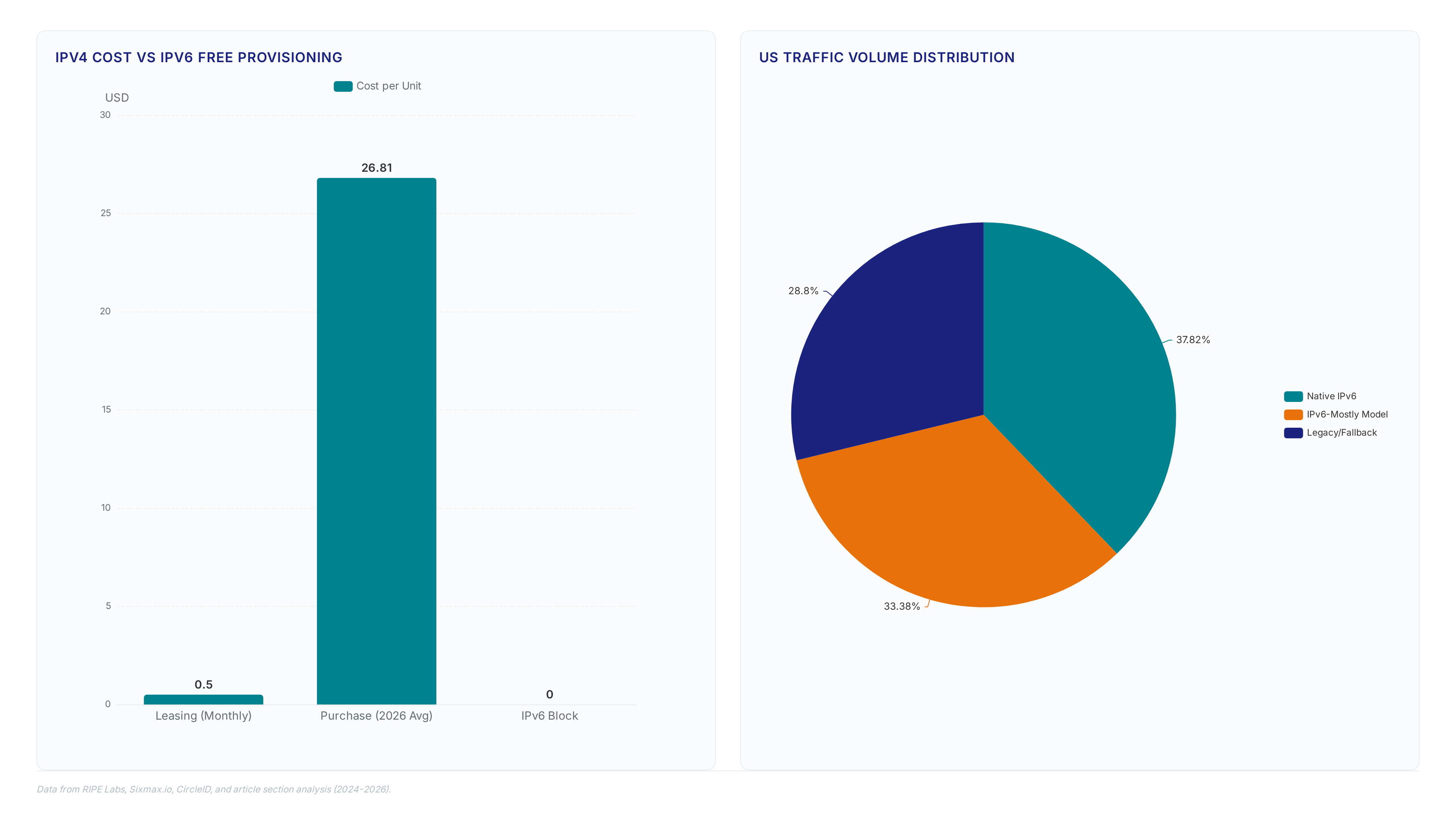
IPv6-mostly architecture treats IPv4 strictly as a legacy transport layer while native IPv6 handles 50.10% of US traffic volume. This model diverges from traditional dual-stack by prioritizing IPv6 paths for all new flows, relegating IPv4 to a fallback role only when absolutely necessary for incompatible endpoints. Windows devices now drive this corporate shift as default OS mechanisms enable operation essentially over IPv6, resorting to translation solely for specific legacy application breaks. The strategy consolidates infrastructure complexity by removing active IPv4 management from the core, contrasting sharply with balanced dual-stack deployments that maintain two parallel operational burdens.
| Approach | Primary Protocol | Legacy Handling | Operational Overhead |
|---|---|---|---|
| Traditional Dual-Stack | Balanced | Full parity | High |
| IPv6-Mostly | Native IPv6 | Compatibility shim | Low |
| Translation Only | Native IPv6 | Gateway dependency | Medium |
Adopting this pattern immediately avoids the fragility inherent in heavy translation architectures that operators previously deemed operationally challenging. A significant limitation remains: organizations must verify that critical internal tools function correctly before disabling IPv4 on core segments. The consolidation trend for 2026 reflects a mature understanding that coexistence problems were mathematically inevitable regardless of the chosen address length. Operators delaying this shift face rising costs as the unallocated free pool shrinks to roughly 3.9 million addresses.
The average IPv4 price of $26.81 per address through early 2026 creates a direct capital expenditure burden that IPv6 eliminates entirely. This saving stems from removing the operational overhead associated with translation workarounds, which accumulate hidden labor costs even when address leases appear affordable. Continuing to rely on Network Address Translation introduces fragility that increases support ticket volume and delays service provisioning. This shift exploits the mandatory IPsec history where encryption became optional, allowing attackers to hide payloads within standard traffic flows that bypass deep packet inspection tuned for IPv4. Security teams treating dual-stack as symmetric redundancy face blind spots; the protocol's global routability removes NAT obscurity, exposing every endpoint directly to the internet unless explicitly firewalled. Operators must assume IPv6-mostly environments are hostile by default, not trusted. InterLIR recommends immediate policy updates to inspect extension headers and enforce stateful filtering on all IPv6 interfaces. Delaying this hardening invites compromise, as threat actors already validated the efficacy of IPv6 evasion techniques. The cost of inaction exceeds the operational overhead of updating security stacks.
About
Vladislava Shadrina serves as a Customer Account Manager at InterLIR, a specialized marketplace dedicated to the redistribution of IPv4 resources. While her daily work focuses on facilitating secure IPv4 transactions and managing client relations, this operational reality provides a unique perspective on the complexities of IPv6. At InterLIR, she witnesses firsthand the persistent global shortage of IPv4 addresses that drives the urgent need for protocol evolution. Her role requires deep familiarity with network addressing challenges, making her well-qualified to explore why IPv6 adoption remains complicated despite its necessity. By bridging the gap between current market demands for legacy addresses and the future requirements of internet infrastructure, Shadrina connects practical industry experiences with the historical and technical nuances of next-generation protocols. This article uses her frontline insights into how organizations navigate the difficult transition from IPv4 to IPv6 in a resource-constrained environment.
Conclusion
Scaling IPv6 reveals that dual-stack symmetry creates a false sense of security, where operational complexity doubles while attack surfaces expand unchecked. The real breaking point arrives when legacy IPv4 dependencies become so expensive that they choke innovation budgets, forcing a reactive rather than strategic pivot. Organizations treating IPv4 as permanent infrastructure will face diminishing returns as lease markets tighten and talent pools shift toward native IPv6 expertise. You must commit to an IPv6-mostly architecture by Q4 2027, relegating IPv4 strictly to legacy translation gateways for specific, unmigratable applications. This timeline aligns with projected market saturation, ensuring you avoid premium leasing rates while modernizing your security posture. Start this week by auditing all firewall rules to identify any IPv6 interfaces currently permitting unrestricted inbound traffic, then immediately apply stateful filtering policies to match your existing IPv4 strictness. This single action closes the most common evasion vector used in recent campaigns and establishes the baseline discipline required for a successful transition. Waiting for perfect application compatibility guarantees you will pay a premium for delayed migration; proactive segmentation now reduces long-term liability and stabilizes network performance before external market forces dictate your hand.
Frequently Asked Questions
Existing IPv4 implementations silently discard any packet with an address larger than 32 bits. This hard-coded limit caps the total unique addresses at exactly 4.3 billion, forcing a complete protocol overhaul.
Legacy IPv4 stacks immediately reject packets containing a 33rd bit due to embedded parser limits. This binary incompatibility prevents simple expansion and restricts the global pool to only 4.3 billion unique addresses.
The legacy address space cannot support the exponential growth of connected devices, which reached 75.44 billion in 2025. IPv4 was strictly limited to a maximum of 4.3 billion unique addresses.
Dual stack prevents splitting the Internet into isolated islands by allowing new machines to speak both protocols simultaneously. This supports the massive scale of 75.44 billion devices without centralized bottlenecks.
No, the complexity was a deliberate architectural choice to integrate service guarantees and routing scalability. Simple bit-expansion could never achieve the necessary future-proofing for 75.44 billion connected devices.