IPv6 native traffic: Pushing past 80% at home
Global IPv6 adoption hit 50% on major networks like Google in 2026. IPv4 dependency is over. We need to talk about aliased prefix detection to stop wasting resources on massive subnet scans, dissect the transition protocols that actually move traffic, and use generative AI to handle the nightmare of renumbering.
This isn't theory anymore. APNIC data from APRICOT 2026 shows 75% of global enterprises are actively modernizing infrastructure. (APNIC's project ipv6 first a case study in achieving an 8...) But naive scanning strategies crash hard against aliased prefixes, where entire subnets map to single interfaces. This poisons cybersecurity situational awareness. Dr. Ren Gang's research proves that ignoring these anomalies makes target generation algorithms useless, burning compute cycles on phantom hosts.
High native traffic ratios demand more than flipping a dual-stack switch. Real-world SOHO experiments show that tweaking DNS resolution timers forces IPv6 preference, pushing native volumes above 90% even with legacy IoT devices cluttering the network. The path forward combines these tactical tweaks with strategic generative AI tools to manage 128-bit addressing scale, keeping networks agile while killing configuration drift.
The Critical Role of Aliased Prefix Detection in Modern IPv6 Scanning
Scan an aliased prefix and you hit a trap: an entire IPv6 prefix maps to one network interface. Dr Ren Gang identifies IPv6 scanning as the foundation of next-generation cyberspace mapping, yet this specific flaw ruins the results. Scanners burn cycles probing billions of addresses that all resolve to a single device. Response counts inflate, but topology data stays flat.
Density-based detection methods like MAPD try to flag these prefixes by counting responses, yet they miss subtle aliasing patterns constantly. The resource drain spikes when flexible allocation obscures boundaries. ISPs assign IPv6 prefixes via DHCPv6 which are not predictable, forcing home gateways to request default prefixes for subnetting. Without accurate detection, tools treat a single router as a dense subnet of active hosts. This error corrupts the Target Generation Algorithm by feeding it false positives.
| Detection Mode | Mechanism | Limitation |
|---|---|---|
| Density-based | Counts random probe responses | High false-negative rate on sparse aliases |
| Fingerprint-based | Analyzes packet headers | Requires prior candidate identification |
Passive analysis offers a correction path. Observe traffic flows before active probing begins. Rationalized allocation strategies, such as assigning a /96 prefix per customer tenancy, help isolate segments but do not prevent aliasing within the block. Operators must integrate passive-enhanced techniques to filter noise. Skip this step, and you guarantee inflated scan times and unreliable census data. The cost is measurable in wasted bandwidth and skewed security situational awareness.
Density-based scanning flags aliased prefixes when response counts exceed a threshold within the massive space of 18 quintillion prefixes. This method probes random addresses, assuming high reply rates indicate a single interface answering for an entire block. Density methods sweep quickly but poison datasets with false positives if thresholds are set too low. Fingerprint analysis cleans the data but introduces latency that slows the overall mapping process. Relying solely on response counts leaves networks vulnerable to misinterpretation of sparse allocation blocks. Hybrid workflows must balance these competing demands to maintain situational awareness without exhausting probe budgets.
Operationalizing PMAPD with Hit Lists and DNS Hints
PMAPD integrates passive hints like the 3.6 billion address hit list to skip blind probing of aliased prefixes. Dr Ren Gang's framework replaces random guessing with targeted generation, using DNS records and TLS data to seed the scanner before active probes launch. This hybrid approach clears non-aliased segments instantly, reserving bandwidth for genuine topology discovery. Yoshinobu Matsuzaki demonstrates this precision by monitoring his hobby network with pf for layer three segments and a device running nfptables for layer two end segments. His setup confirms that scanners ignoring these hints waste cycles on empty space, while hinted scans focus only on responsive interfaces.
The operational cost of ignoring passive data remains high.
Happy Eyeballs DNS Head Start and 464XLAT Translation Logic
Force client resolvers to prioritize AAAA records before A record lookups complete by optimizing local DNS to grant IPv6 a 250ms head start. This mechanical advantage shifts the Happy Eyeballs race outcome, pushing native traffic ratios past 90% in dual-stack environments where latency differences are marginal. Operators observing residual IPv4 flows often overlook that application logic defaults to the first successful connection, making timing the sole determinant for protocol selection.
| Mechanism | Function | Dependency |
|---|---|---|
| Happy Eyeballs | Races IPv6/IPv4 connections | DNS resolution speed |
| 464XLAT | Translates IPv4-only app traffic | NAT64/DNS64 infrastructure |
| DNS64 | Synthesizes AAAA from A records | Absence of native AAAA |
The 464XLAT framework solves the IPv4-only application gap by embedding a Customer-side Translator (CLAT) on the endpoint. This component converts local IPv4 packets into IPv6, routing them to a provider-side NAT64 gateway for final delivery to IPv4 destinations. Such translation logic enables mostly IPv6-only architectures where legacy software functions without native IPv4 stack support. However, reliance on translation introduces stateful processing overhead at the CLAT, consuming CPU cycles on resource-constrained IoT gateways.
Intervention strategies targeting specific protocols yield diminishing returns without addressing the transport layer race condition. BitTorrent remained the dominant source of residual IPv4 traffic in Project IPv6-First until DNS tuning forced IPv6 preference, proving that configuration overrides often fail against hardcoded client behaviors. The limitation of this approach lies in its fragility; any increase in IPv6 path latency beyond the 250ms window causes an immediate reversion to IPv4, breaking the native-only objective.
Optimizing DNS to Eliminate Residual IPv4 Traffic in SOHO Networks
Residual IPv4 flows persist because default application logic accepts the first successful TCP handshake regardless of protocol preference. Mechanically, local DNS resolvers manipulate response timing to bias the Happy Eyeballs algorithm toward IPv6 addresses. Adding a synthetic delay to A record responses grants AAAA records a decisive advantage in the connection race. The intervention targets the specific window where clients evaluate parallel connection attempts.
| Component | Default Action | Optimized Action |
|---|---|---|
| DNS Resolver | Returns A/AAAA simultaneously | Delays A record by 250ms |
| Client Stack | Races both protocols | Selects IPv6 due to head start |
| Application | Accepts first socket | Binds to IPv6 address |
However, this timing adjustment fails against hardcoded IPv4 literals found in legacy IoT firmware. Devices like security cameras often bypass DNS entirely, rendering resolver-side tweaks ineffective for that segment. The cost of aggressive delays is potential user-perceived latency if the IPv6 path suffers packet loss. Operators must balance protocol enforcement against reliability guarantees for critical services.
The deeper implication involves visibility into why traffic falls back. Without flow analysis tools like Akvorado, administrators cannot distinguish between DNS failures and application-level IPv4 preferences. Blindly applying DNS delays masks underlying connectivity issues rather than resolving them. True optimization requires identifying the specific daemon or service initiating the IPv4 request before altering resolution behavior.
EUI-64 Privacy Leakage and Travel Pattern Exposure Risks
Static EUI-64 interface identifiers embed hardware MAC addresses, enabling geolocation tracking of user movement from Japan to Indonesia. Yoshinobu Matsuzaki demonstrated how this persistent suffix allows observers to correlate activity across distinct networks, effectively mapping travel patterns without user consent. The risk extends beyond simple identification; it enables behavioral profiling by linking disparate sessions to a single physical device.
| Generation Method | Privacy Level | Traceability Risk |
|---|---|---|
| EUI-64 | None | High (MAC exposed) |
| Temporary IIDs | High | Low (Rotates) |
| Opaque IIDs | Medium | Medium ( |
Operators seeking to configure networks for traceability must recognize that enabling MAC-based IIDs creates a permanent audit trail suitable for forensic analysis but disastrous for user anonymity. This mechanical trait forces a choice between operational visibility and privacy compliance. Most modern stacks default to temporary addresses to mitigate this, yet legacy IoT gear often reverts to static suffixes.
The limitation of relying on client-side randomization is that it remains optional for many embedded systems. Network architects requiring strict accountability might intentionally deploy RouterOS v7 features to enforce specific identifier generation policies. However, doing so exposes users to scanning algorithms that harvest stable suffixes for hit lists.
Generative AI Workflows for IPv6 Renumbering Cognitive Load
Manual prefix management forces engineers to track complex allocation hierarchies without automated validation, creating a high risk of configuration drift. Generative AI tools like Net AI Copilot eliminate this burden by synthesizing valid subnet structures from high-level policy intent rather than requiring bit-level arithmetic. The research observed a 96.8% time reduction in knowledge tests when operators used AI assistance for these tasks. This efficiency gain directly addresses the projected global shortfall of over a million certified network engineers, allowing smaller teams to manage larger address scopes.
Meanwhile, manual IPv6 renumbering fails at scale because engineers cannot mentally track complex hierarchies without validation tools. Net AI Copilot eliminates this cognitive bottleneck by synthesizing valid subnet structures directly from high-level policy intent. Traditional workflows require operators to validate every subnet hierarchy manually, creating a bottleneck that scales linearly with network size. AI assistance collapses this timeline by generating configurations that adhere to strict routing protocols like Quagga RIPng without bit-level arithmetic errors. The cost of manual intervention includes significant time expenditure and the risk of misconfiguring critical RouterOS v6 sampling rates. Operators must decide whether to adopt these tools based on their tolerance for human error versus the learning curve of automation. Deployment strategies should prioritize 464XLAT integration only after establishing a stable, error-free addressing plan through automation. This approach ensures that the transition to IPv6-only datacenter environments proceeds without the disruptions common in manual migrations.
Implementing a Native IPv6-First Home Network with Advanced Monitoring
RouterOS v7 NetFlow Export Mechanics for Akvorado Integration
Configuring NetFlow export on a Mikrotek rb5009 requires explicit destination definitions to feed the Akvorado analyzer pipeline.
- Enable RouterOS v7 flow monitoring on the WAN interface to capture IPv6 packet headers.
- Define the collector IP address matching the Akvorado ingestion service endpoint.
- Set the export version to v9 or IPFIX to ensure compatibility with modern parsing logic.
- Activate SNMP on the router so the analyzer can resolve interface indices to human-readable labels.
Skipping SNMP configuration results in raw numeric interface IDs within the dashboard, obscuring traffic sources during analysis.
Dr Ren Gang defines aliased prefix detection as the mandatory third step following target generation and active probing. Skipping this validation phase causes scanners to waste resources on single-interface prefixes, poisoning the entire dataset with false positives. Operators must integrate Passive-enhanced Multi-level Aliased Prefix Detection (PMAPD) into their workflow to clear non-aliased candidates before executing expensive active probes. This approach combines passive analysis with active probing to reduce overhead while maintaining high accuracy.
| Detection Method | Primary Mechanism | Overhead Cost | Accuracy Level |
|---|---|---|---|
| Density-based | Random address sampling | High | Moderate |
| Fingerprint-based | Response pattern analysis | Very High | High |
| PMAPD | Passive filtering + active probe | Low | Very High |
Implementing this checklist prevents data corruption in large-scale mapping efforts.
- Deploy passive listeners to fingerprint traffic patterns before sending any active probes.
- Flag any prefix where multiple addresses return identical TTL values or MAC signatures.
- Exclude flagged prefixes from the Target Generation Algorithm input list immediately.
- Re-scan only the remaining candidate set to verify connectivity without aliasing noise.
Failure to filter aliases early forces the scanner to process duplicate data, inflating storage requirements and skewing cyberspace mapping results. Network engineers should treat alias detection as a gatekeeper function rather than a post-processing cleanup task. InterLIR recommends validating every generated target against known alias signatures before probe execution begins.
About
Evgeny Sevastyanov serves as the Support Team Leader at InterLIR, a Berlin-based marketplace specializing in IPv4 address redistribution. While the article focuses on IPv6 deployment, Sevastyanov's daily work managing RIPE and APNIC database objects provides a critical frontline perspective on the transition. (RIPE's deploying ipv6 mostly access networks apnic 55) His team directly assists enterprises navigating the scarcity of IPv4 resources, making them uniquely qualified to discuss the practical challenges driving the shift toward native IPv6. At InterLIR, Sevastyanov observes how organizations balance immediate connectivity needs with long-term infrastructure modernization. This hands-on experience with IP reputation and BGP routing allows him to contextualize global adoption statistics within real-world operational constraints. As companies strive to move beyond "borrowed time" IPv4 hacks, Sevastyanov's insights bridge the gap between current market realities and the future of internet protocol evolution.
Conclusion
Scaling IPv6 deployment breaks when operators treat alias detection as a retrospective cleanup task rather than a real-time gatekeeper. As global adoption surpasses the 50% threshold in 2026, the operational cost of processing false positives inflates storage requirements and skews critical cyberspace mapping data. The latency advantages gained through DNS optimization vanish if the underlying target generation feeds on corrupted, aliased prefixes. This shift moves validation upstream, filtering noise before expensive active probes ever execute. Treat alias signatures as hard exclusion criteria, not soft flags for later review. The window for tolerating inefficient scanning methodologies has closed as network complexity outpaces manual remediation capabilities.
Start by deploying passive listeners on your edge routers this week to capture TTL values and MAC signatures from existing traffic flows. Configure your scanner to automatically exclude any prefix exhibiting identical response patterns across multiple addresses before generating new targets. This single configuration change prevents data poisoning at the source and ensures your mapping efforts reflect actual network topology rather than algorithmic artifacts.
Frequently Asked Questions
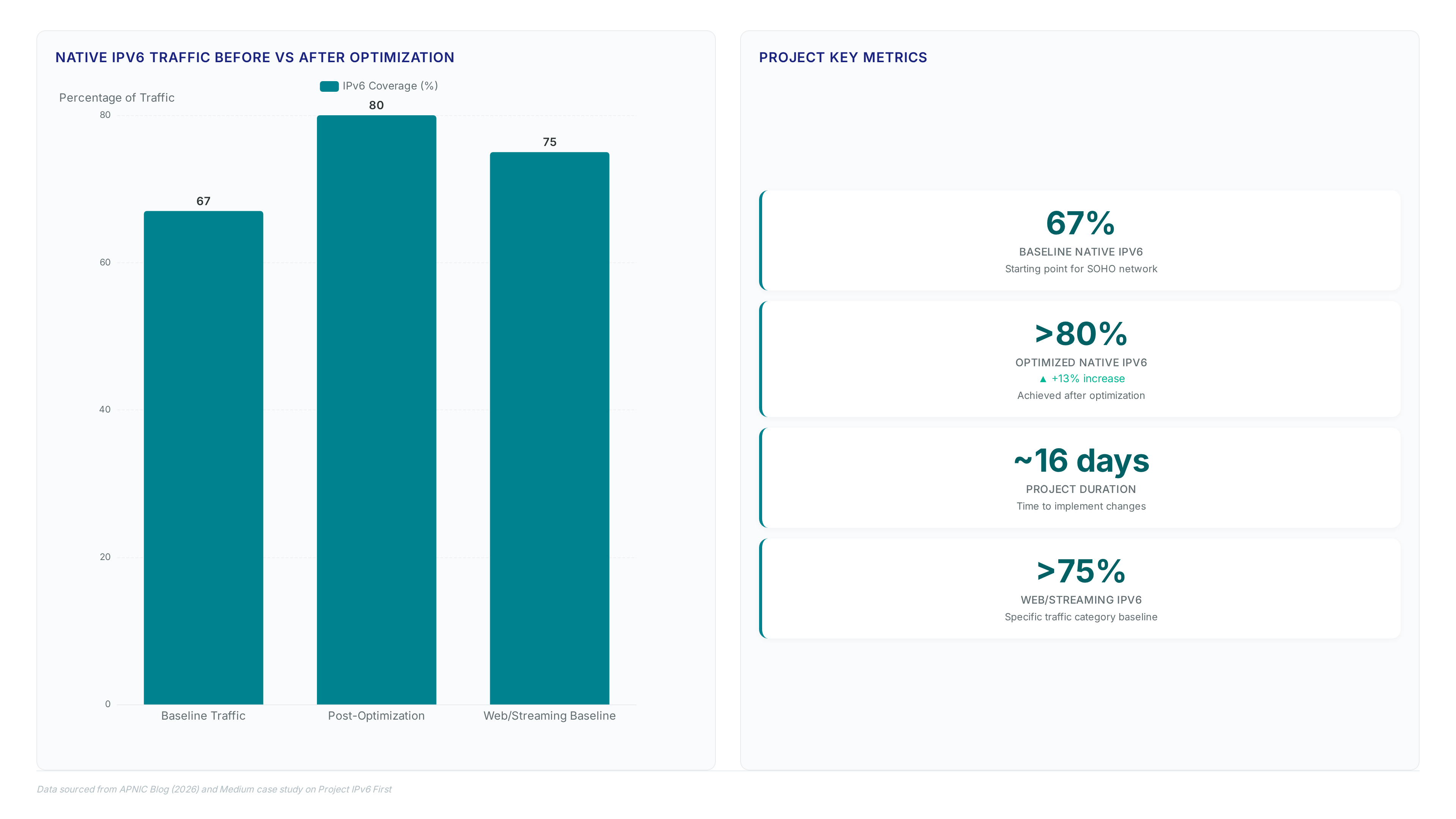
Optimizing local DNS gives IPv6 a timing advantage that significantly increases native usage. This adjustment pushes baseline traffic from 67.7% to over 80% native IPv6 without replacing existing hardware.
Legacy internet of things devices often force continued reliance on older networking protocols. In tested home environments, these specific devices accounted for the remaining 10% of total network traffic volume.
Density methods count responses but miss subtle aliasing patterns where response rates stay low. This limitation causes high false-negative rates when scanning sparse networks with complex allocation strategies.
Fingerprint analysis validates candidates by examining packet headers rather than simple response volumes. This approach yields a low false positive rate when rich signatures are available for comparison.
Recent data confirms that most large organizations are actively modernizing their infrastructure now. Over 75% of global enterprises are currently updating systems to meet new native reliance realities.