IPv6 routing loops: Fixing the 34k router bug
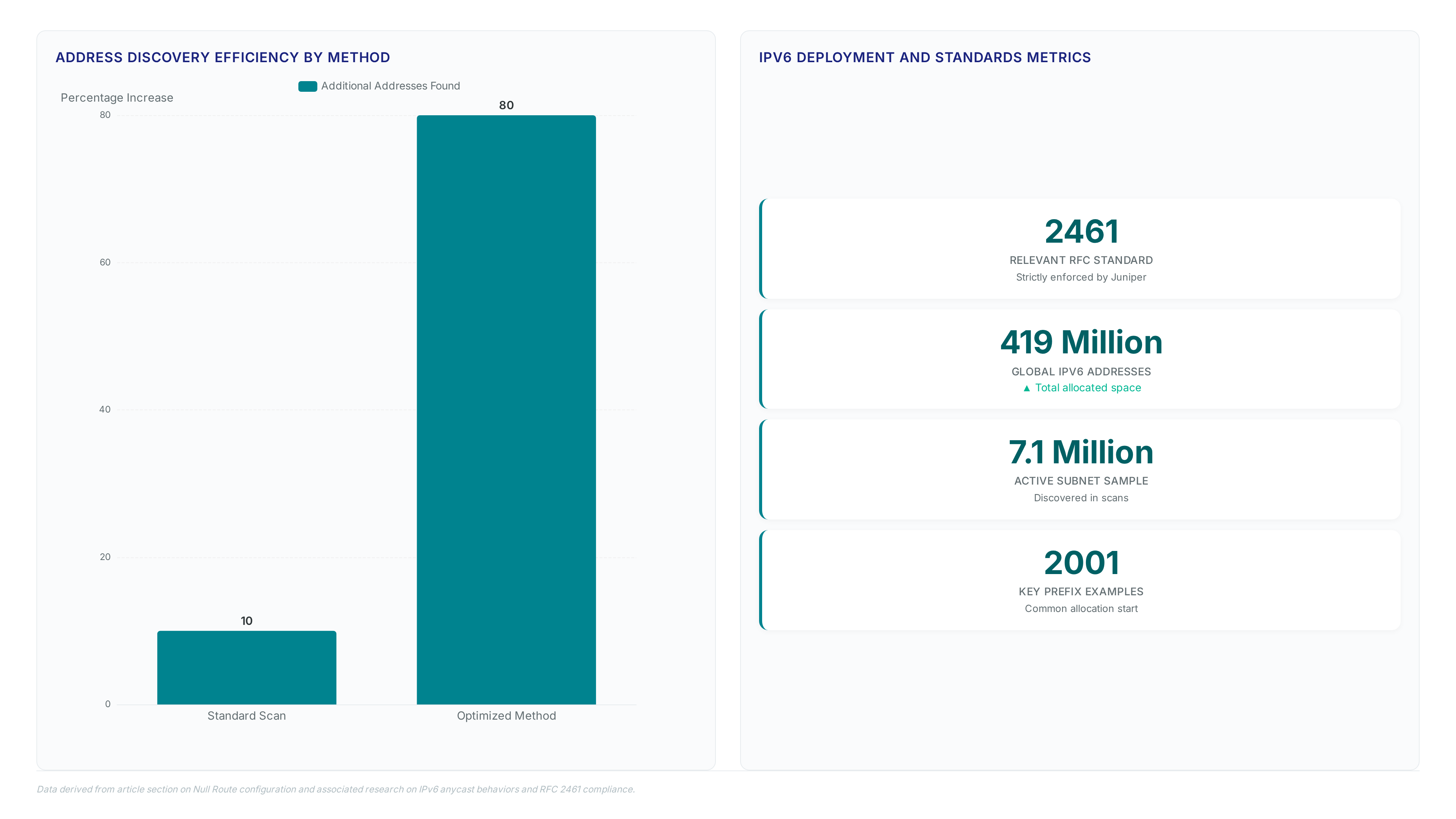
419 million /64 subnets trigger IPv6 routing loops that amplify traffic exponentially across the global internet.
While providers distribute massive blocks of provider-aggregatable address space, customers frequently apply only fractions of these assignments without configuring necessary drop policies. This misconfiguration forces packets destined for unused ranges into infinite circulation between upstream providers and customer edge routers. Recent measurement studies confirm these loops affect 7.1 million router addresses across 163 economies, proving the network operator community has deprioritized basic hygiene despite the ease of remediation.
Readers will examine the specific mechanics where default routing collides with sparse address utilization to create amplification vectors. We analyze global impact statistics revealing how firmware bugs in common vendor equipment exacerbate these loops, turning minor misconfigurations into significant DDoS amplifiers. Finally, the discussion outlines strategic mandates for implementing null routing on unused subnets to break the cycle. With Subnet-Router Anycast probing now offering a 10% higher discovery rate than random scanning, there is no excuse for leaving these vulnerabilities active in production environments.
The Mechanics of IPv6 Routing Loops and Amplification Vulnerabilities
How Downstream Default Routes Create IPv6 Routing Loops
A routing loop forms when a provider's downstream covering route and a customer's default route collide on unused address space. The provider advertises a large provider-aggregatable block, yet the customer uses only specific prefixes within that range. Packets destined for the unused portions match the provider's broad route and forward downstream. The customer router, lacking a more specific match, sends these packets back upstream via its default path. This cycle repeats until the hop limit expires, consuming bandwidth and CPU resources at every step. Recent measurements identified 419 million /64 subnets triggering this exact failure mode globally. The scale extends to 7.
Operators must recognize that standard rate limiting often fails to stop this specific firmware defect. The cost of inaction Mitigation requires isolating the faulty hardware or applying vendor-specific patches rather than simple configuration tweaks.
Routing loops function as force multipliers that exponentially increase the cost of mitigating DNS-based DDoS attacks.
Attackers exploit these firmware defects to generate traffic volumes that overwhelm standard scrubbing centers, turning a minor misconfiguration into a catastrophic financial event. The ability of routing loops. This excess capacity requirement drives up operational expenditures for ISPs attempting to honor strict service level agreements. Failure to absorb these amplified floods results in immediate revenue loss and contractual penalties that vary significantly by provider contract terms.
The global IPv6 market, valued at a substantial sum, faces disproportionate risk because sparsely populated address space hides these defects until active exploitation occurs. Unlike IPv4, where dense allocation limits loop potential, IPv6 allows attackers to target unused subnets with high precision.
| Risk Factor | IPv4 Profile | IPv6 Profile |
|---|---|---|
| Address Density | High | Low |
| Loop Prevalence | Declining | Increasing |
| Amplification Potential | Moderate | Extreme |
Operators ignoring null route configurations expose themselves to Denial-of-Service vectors that bypass traditional botnet detection. The financial consequence is not merely downtime but the permanent erosion of customer trust during high-visibility outages.
Defining Provider-Aggregatable Address Space and Null Routes in IPv6 Loops
Provider-aggregatable (PA) address space assignments often exceed immediate customer needs, leaving vast unused ranges that trigger loops when covered by broad downstream routes. Operators frequently delegate these large blocks to maximize routing table efficiency, yet customers typically activate only sparse prefixes within the assigned range. This gap between the assigned covering route and active specific prefixes creates a vacuum where packets to unused addresses circulate indefinitely between provider and customer edges. A null route instructs the router to discard traffic matching a specific prefix if no more precise path exists, breaking the return cycle to the upstream provider. Without this configuration, the customer's default route sends unused traffic back upstream, perpetuating the loop until the hop limit expires. Measurement data confirms that a tiny number of routers are responsible for over 1,000,000 Most affected devices involve only one misconfigured subnet, yet the aggregate effect disrupts connectivity across the internet.
| Configuration State | Packet Behavior | Outcome |
|---|---|---|
| Missing Null Route | Unused PA traffic matches default route | Packet returns to provider, creating loop |
| Active Null Route | Unused PA traffic matches discard entry | Packet dropped, loop prevented |
The tension lies in operational simplicity versus safety; while sparse delegation policies reduce global prefix counts, they increase the risk of accidental loops if null routes are omitted. ### Using SRA Dataset Methodology to Identify.
Subnet-Router Anycast probing discovered 10% more router IPs than random scanning techniques. This efficiency gain stems from targeting the specific anycast address format embedded within every allocated /64 subnet rather than guessing host identifiers. Random probing wastes cycles on empty space, whereas SRA hits the deterministic router interface directly. The method reveals the true scale of misconfiguration by mapping unused provider-aggregatable space to active forwarding loops. Operators access the public dataset to cross-reference their assigned blocks against known routing loop triggers. The verification process isolates specific customer edges failing to install null routes for unused prefixes.
- Query the dataset using the organization's assigned PA prefix. 2.
Null Route Configuration Mechanics for Unused IPv6 Prefixes
Deploying a single null route statement on edge hardware prevents Layer 3 loops by dropping traffic to unused provider-aggregatable space. Operators configure this blackhole on access routers to stop packets from circulating between customer defaults and provider covering routes. Cisco IOS accepts the command `ipv6 route 2001:db8::/32 Null0` to discard all unmatched subnets within the assigned block immediately. This approach avoids the operational burden of defining individual prefixes for every unused /34 segment like `2001:db8:4000::/34`. The mechanism relies on longest-match precedence, ensuring active services remain reachable while voiding empty address ranges. Configuration syntax varies across platforms, yet the underlying logic remains consistent for routing loop prevention. Juniper Junos OS uses aggregate routes to achieve similar discard behavior without explicit null interface binding. Administrators must verify that Subnet Router Anycast addresses do not conflict with intended null targets during implementation. Cisco IOS triggers a specific warning if an interface configuration accidentally matches the anycast range, preventing silent misconfiguration errors. Failure to apply these filters allows a single ICMPv6 request to generate exponential reply traffic through firmware defects. The cost of omitting this line is measurable in lost bandwidth and unstable peering sessions during attack events.
Operators holding a 2001:db8::/32 assignment but using only specific /34 subnets must deploy aggregate null routes to prevent Layer 3 forwarding loops. Traffic targeting unused intermediate blocks like 2001:db8:4000::/34 otherwise circulates indefinitely between the customer default route and the provider covering route. This configuration gap allows single packets to trigger exponential amplification via firmware defects, turning idle address space into attack vectors. The mechanism relies on longest-match precedence where the router discards packets lacking a more specific entry. Cisco IOS executes this via `ipv6 route 2001:db8::/32 Null0`, while Juniper Junos OS uses `set aggregate route` statements to achieve identical discard behavior.
Failure to implement these aggregates leaves networks vulnerable to exploitation as mega amplifiers for DNS-based DDoS attacks.
Operator Checklist for Null Route Deployment and Validation
Ripe. Operators must then configure null routes for every unused segment within their provider-aggregatable assignment. A single statement on edge hardware often suffices to drop traffic targeting empty space, preventing Layer 3 circulation.
| Vendor | Configuration Command | Scope |
|---|---|---|
| Cisco IOS | `ipv6 route Null0` | Entire Block |
| Juniper Junos OS | `set aggregate route ` | Covering Prefix |
This approach eliminates the need to define individual prefixes for unused /34 slices manually. Failure to implement this drop policy allows packets to trigger firmware amplification bugs that generate exponential reply storms. The cost of omission is measurable: a single echo request can yield over 250,000 responses from vulnerable devices. Operators should verify that longest-match precedence correctly directs unused traffic to the blackhole rather than the default gateway. Neglecting this step turns idle address space into a potent vector for distributed denial-of-service attacks. Final validation requires testing that packets to unused subnets receive no forwarding response.
Step-by-Step Configuration of Null Routes on Cisco and Juniper Platforms
Implementation: Null Route Mechanics for Unused IPv6 Prefixes on Edge Routers
This single statement prevents Layer 3 loops by dropping traffic destined for unused provider-aggregatable space before it circulates between customer defaults and provider covering routes. Operators must configure this blackhole
- Identify the full assigned block, typically a /32, and map all currently utilized /34 subnets.
- Apply the aggregate null route command to cover the entire assignment, letting specific routes override the drop action.
- Verify that RFC 2461 compliance on Juniper platforms prevents accidental subnet-zero conflicts during this process.
Defining individual prefixes for every unused segment creates unnecessary operational burden. A single misconfigured default route exposes the network if the null route lacks proper specificity. Unfiltered traffic to empty space acts as a force multiplier for denial-of-service attacks.
Executing Single-Line Null Route Commands on Cisco IOS and Juniper
Single-line aggregate commands discard unused provider-aggregatable space to break Layer 3 circulation loops instantly.
- Identify the full assigned block, such as 2001:db8::/32, versus active subnets like 2001:db8::/34.
- Apply a discard route covering the entire assignment to catch traffic destined for voids.
- Verify that specific active prefixes take precedence via longest-match lookup rules.
Cisco IOS implements this protection using `ipv6 route 2001:db8::/32 Null0`, which drops packets lacking a more specific entry. The operating system provides safety checks by issuing warnings when configurations accidentally match the Subnet Router Anycast range, preventing misassignment of reserved addresses. Juniper Junos OS enforces stricter compliance with RFC 2461 by blocking subnet-zero configuration entirely, though aggregate routes still function for broader blocks. Linux implementations differ notably, often auto-injecting leading zero addresses into local tables as anycast types, which can inadvertently cause communication failures if not manually overridden.
| Platform | Command Syntax | Safety Mechanism |
|---|---|---|
| Cisco IOS | `ipv6 route Null0` | Warns on anycast conflict |
| Juniper Junos OS | `set aggregate route ` | Blocks subnet-zero config |
| Linux Kernel | `ip -6 route add blackhole` | Auto-injects anycast entries |
A single missing aggregate route exposes the entire unused block to amplification bugs. InterLIR recommends validating configurations against global datasets before enabling default routes on edge hardware. Aggregate null routes do not protect against loops within active subnets, requiring separate prefix-list filtering for granular control.
- Cross-reference assigned provider-aggregatable blocks against the published measurement results
- Calculate the exact unused address space remaining after allocating active prefixes like 2001:db8::/34.
- Deploy a single null route statement on edge hardware to discard traffic targeting these voids.
This configuration forces the router to drop packets lacking a more specific match, breaking the loop between customer defaults and provider covering routes. Failure to implement this check allows a single ICMPv6 echo request to trigger over 250,000 replies from vulnerable firmware, acting as a massive amplifier for denial-of-service attacks. Vendor implementations vary notably; scans reveal that Arista and Cumulus Linux Operators relying solely on vendor defaults risk inconsistent network responses during scanning events. InterLIR mandates that administrators manually configure these discard paths rather than assuming OS-level protections suffice. Exponential traffic growth results from omission, while the fix requires only one command line per assignment.
About
Georgy Masterov, a Customer Support Specialist at InterLIR, brings a unique perspective to the critical issue of IPv6 forwarding loops. While primarily focused on business analytics and IP resource management, his daily work involves ensuring the security and stability of network assets for InterLIR's global clientele. This role requires a deep understanding of how routing integrity directly impacts IP reputation and service reliability. At InterLIR, a Berlin-based leader in IPv4 address marketplace solutions, maintaining clean BGP routes is paramount to their mission of transparent resource redistribution. Masterov's experience troubleshooting customer network challenges allows him to identify how seemingly minor configuration errors can lead to exponential traffic amplification and DDoS vulnerabilities. By connecting his practical support background with technical network analysis, he highlights why operators must prioritize fixing these loops to ensure the long-term stability of internet infrastructure and protect valuable IP assets from congestion and failure.
Conclusion
Scaling IPv6 infrastructure reveals that aggregate null routes fail to stop loops originating within active subnets, creating a hidden operational debt that grows with every new customer assignment. The reliance on vendor defaults is a critical vulnerability; as Subnet-Router Anycast probing becomes the industry standard for discovery, networks lacking granular prefix-list filtering will face disproportionate exposure to amplification attacks regardless of their market size. This is not a future theoretical risk but an immediate vector where 34,000 routers currently participate in feedback cycles that bypass standard blackhole configurations. Operators must shift from reactive patching to proactive topology validation before the next substantial firmware update cycle renders legacy anycast handling obsolete.
Deploy a covering aggregate route for every unused /64 block within your assigned provider-aggregatable space by this Friday. Do not wait for a security audit to identify these gaps; calculate your remaining address space immediately and inject the discard statement on edge hardware tonight. This single action breaks the loop between customer defaults and provider covering routes, neutralizing the amplifier before external scanners map your specific topology. Manual configuration of these discard paths remains the only reliable method to ensure consistent behavior across heterogeneous environments involving Arista, Cumulus, or Cisco devices.
Frequently Asked Questions
Approximately 419 million /64 subnets currently trigger routing loops that amplify traffic exponentially. This massive scale indicates a systemic configuration error affecting the global internet rather than just isolated incidents.
Brazil and India host the highest concentration, containing 28% and 19% of affected routers respectively. These 34k devices duplicate looping packets, turning minor misconfigurations into significant denial-of-service vectors.
While 87% of observed amplification factors remain below ten, specific firmware defects can generate exponentially higher loads. A single request may trigger over 250,000 replies, saturating links and overwhelming router CPUs.
Subnet-Router Anycast probing discovers 10% more routers than random scanning methods. This improved discovery rate reduces the bandwidth and time resources required for effective network audits and vulnerability identification.
The remaining 16% of affected infrastructure resides in other global regions beyond the primary hotspots. These distributed vulnerabilities still contribute to the 7.1 million affected router addresses found across 163 economies.