IPv6 scan surge: Why passive monitoring fails now
IPv6 scan traffic surged one hundred times between 2022 and 2023. Passive observation is dead.
Traditional monitoring cannot track modern adversaries. We need proactive network telescopes that broadcast decoy signals, luring scanners out of the $2^{128}$ address space. A February 2026 study by CAIDA and the Technical University of Munich confirms attackers no longer waste cycles on silent subnets. They hunt active address lists and DNS records. With IPv6 Traffic Dominance projected to overtake IPv4 globally by March 2026, relying on incidental background noise leaves enterprises blind.
This analysis kills the myth that IPv6 scale provides security by default. We must deploy signal-based attraction systems that force scanners to reveal themselves via BGP route advertisements. Below is the blueprint for strategic deployment of honeyprefixes, detecting the diverse array of malicious actors now using sophisticated Target Generation Algorithms to navigate the IPv6 internet.
The Critical Role of Proactive Network Telescopes in Modern IPv6 Security
IPv6 Network Telescopes and Honeyprefix Mechanics
Sweeping the entire IPv6 Internet is mathematically impossible; the address space is $2^{128}$. A standard network telescope captures unsolicited traffic in unused space, but modern detection demands /32 scales. Scanners ignore random ranges, targeting specific hints instead. Small /56 prefixes offer no broad visibility. The study introduced a ground-breaking IPv6 network telescope deployed in a production ISP network occupying a /32 prefix. This massive scale contrasts sharply with earlier passive darknets monitoring notably smaller blocks.
Operators must shift from passive listening to proactive honeyprefix advertising via BGP, DNS, and TLS lures. There is a catch: announcing too many prefixes overwhelms logging systems or invites denial-of-service attacks. The proactive telescope validated that selective visibility generates richer data than static monitoring. This approach captures diverse scanner behavior without compromising core stability. Active signaling turns invisible darknets into high-visibility traps.
Implementation costs involve coordinating route announcements across multiple upstream providers. Failure to synchronize these advertisements yields partial visibility and skewed samples. Relying on substantial CDN Deployment data confirms passive methods cannot track the hundred-fold increase in activity. Defenders must architect systems to actively announce honeyprefixes. Passive listening is obsolete for thorough IPv6 threat intelligence.
Advertising specific IPv6 prefixes via BGP transforms silent /32 blocks into global targets. Scanners read routing tables; they ignore unannounced addresses. The experimental setup included 27 instrumented subnets. Over 90% of captured scan packets were ICMPv6 echo requests used to test for alive hosts. Ping sweeps remain the primary discovery mechanism before deeper probing.
| Signal Method | Scanner Reaction | Detection Rate |
|---|---|---|
| BGP Announcement | Immediate sweep | High |
| Silent Prefix | Ignored | None |
| DNS Only | Delayed probe | Low |
Attackers use flexible target generation algorithms, adapting to network responses rather than static lists. The cost of visibility is noise that overwhelms standard logging pipelines without filtering. Operators must balance lure granularity against the load of millions of unsolicited packets. Modern tools skip unadvertised space to maximize efficiency. Only active route advertisement guarantees exposure to the full scanning spectrum.
Differentiating Dedicated Internet Scanners from Opportunistic Ping Sweeps
Dedicated research scanners apply ZMap to transmit 1.389 million packets per second. This distinguishes them from basic ICMP sweeps. Opportunistic cloud actors lack this throughput, sticking to simple echo requests rather than complex port enumeration. Aggressive probes target specific TCP and UDP ports; opportunistic sweeps rarely advance beyond layer three.
Defenders must recognize that insufficient scanner diversity in monitoring creates blind spots against specialized reconnaissance. A surging, diverse ecosystem complicates defense strategies relying on static signatures. High-volume research traffic can mask low-and-slow opportunistic probing if filters focus only on rate. Deploy deep packet inspection to separate legitimate census taking from malicious host discovery. Conversely, allowing all ICMP traffic admits vast noise from compromised cloud instances performing basic ping sweeps. This distinction prevents accidentally blocking academic scanning while mitigating opportunistic mapping.
Scale Disparity Between /32 ISP Telescopes and Legacy /56 Darknets
A /32 prefix exposes vastly more address space than a legacy /56. This forces scanners to reveal diverse origins rather than concentrated bursts. Passive darknets relying on silent blocks fail because modern target generation algorithms ignore unadvertised space entirely. Researchgate. Scanners reacting to these lures generated 654 million packets from 259,000 unique sources across 1,900+ ASNs. This volume dwarfs smaller deployments, which capture only a fraction of the global scan environment.
| Prefix Size | Visibility Method | Scanner Diversity |
|---|---|---|
| /56 Legacy | Passive Silence | Low |
| /32 Proactive | Multi-Signal Lures | High |
Operational costs rise with prefix size, yet the data yield justifies the routing overhead for substantial ISPs. Limiting observation to small subnets creates a blind spot where low-rate scanners operate undetected. The Substantial CDN Deployment proved scale correlates directly with the ability to distinguish research tools from malicious probes. Silence is no longer a viable strategy for IPv6 network telemetry.
Strategic Deployment of Honeyprefixes for Enterprise Threat Detection
Exponential IPv6 Scan Volume and Source Diversity Trends
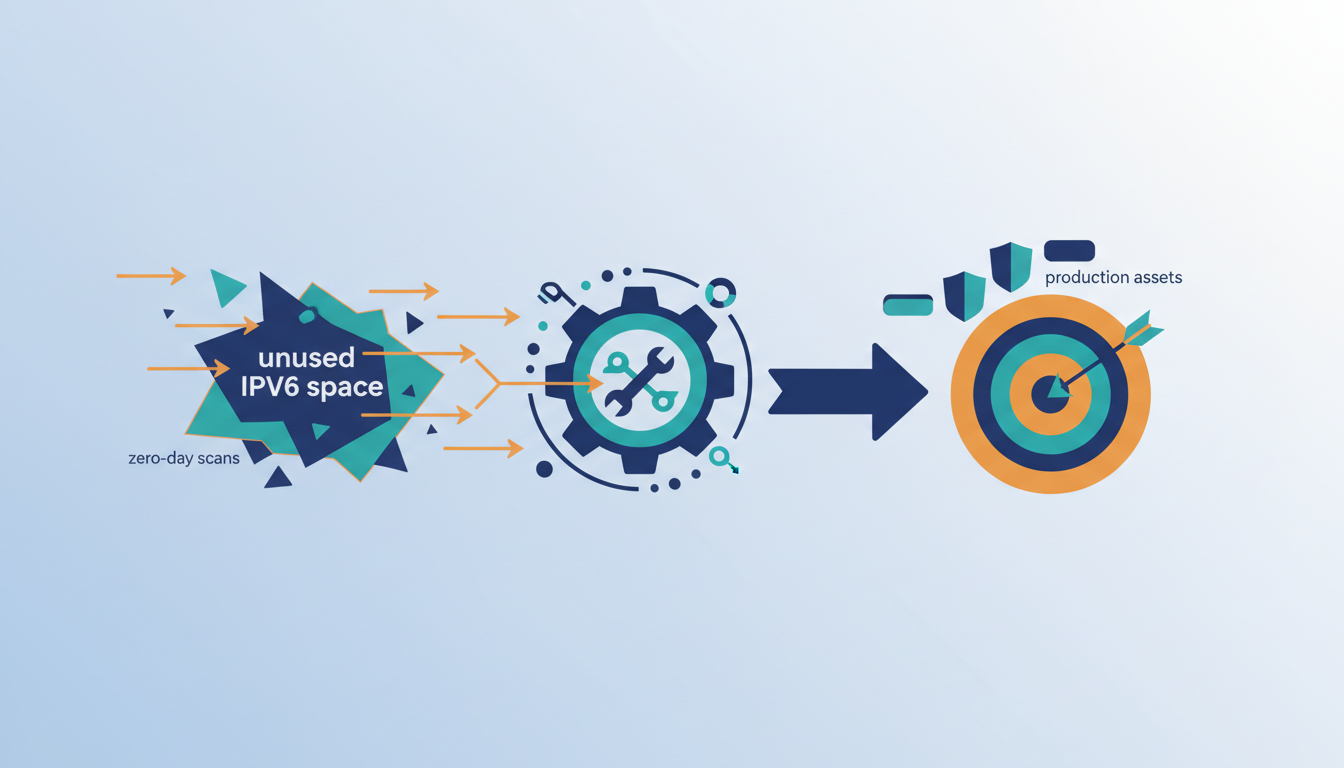
Weekly IPv6 scan packet volume rose one hundred times from early 2022 to late 2023. This surge transformed the environment from a few dominant actors into a surging, diverse system. Hosting and cloud providers now constitute over half of all unsolicited IPv6 traffic, using compromised instances for distributed probing campaigns. Defenders observing only concentrated bursts miss the broader reality of fragmented, low-volume scans emerging from legitimate infrastructure.
Scanners increasingly rely on routing announcements and DNS hints, ignoring truly dark prefixes. Cloud platforms have become the primary launchpad for reconnaissance, complicating traditional IP-based blocking. Manual analysis cannot scale to meet the velocity of emerging scanner networks. Security teams relying on static allow-lists face immediate obsolescence as attacker origins fragment across thousands of networks. Proven defense requires correlating signal lures with ingress traffic to distinguish research noise from malicious enumeration. Ignoring this volume growth leaves enterprise perimeters exposed to undetected mapping efforts preceding targeted exploitation. The era of IPv6 obscurity has ended, replaced by a hyper-active scanning environment demanding proactive visibility tools.
Implementing Stratified Honeyprefix Experiments for Threat Detection
Operators must deploy honeyprefixes when passive darknets fail to capture the surging, diverse system. Stratification requires advertising distinct signal lures across isolated /48 subnets to differentiate scanner classes. The mechanism couples BGP announcements with specific DNS records to trigger varied probe responses. High-volume sources like Amazon AWS dominate this stream, necessitating granular filtering policies.
Deployment demands careful selection of instrumented subnets to avoid polluting production routing tables. A Proactive Telescope Experiment. The limitation involves increased control-plane churn if route dampening timers are misconfigured for rapid prefix cycling. Operators risk attracting unwanted DDoS backscatter if honeyprefixes overlap with legitimate customer space. This strategy exposes whether attackers apply hitlists or rely purely on routing table sweeps. Blindly announcing large blocks dilutes forensic value by merging distinct attacker behaviors into a single data stream. Precision in subnet instrumentation allows defenders to map scanner tooling to specific discovery vectors. Failure to stratify results in monolithic data lakes that obscure emerging threats from cloud-based botnets. Confusion arises when multiple lure types share the same address block. Clear separation yields actionable intelligence.
Financial Exposure from Ignoring IPv6 Traffic in zero-trust Architectures
Excluding IPv6 from intrusion detection creates a blind spot where attackers bypass controls to trigger $7.42 million healthcare breaches. zero-trust models relying on static IP allowlists fail because scanning volume now originates from thousands of distinct cloud sources rather than single actors. Proactive signals become mandatory; quiet networks attract negligible traffic while advertised honeyprefixes reveal hidden probing campaigns. The financial implication is stark: organizations ignoring these diverse entry points face catastrophic liability without early warning systems.
| Risk Factor | Passive Monitoring | Proactive Signaling |
|---|---|---|
| Visibility Scope | Limited to direct hits | Captures targeted lures |
| Threat Diversity | Misses fragmented scans | Identifies 1,900+ ASNs |
| Detection Latency | High (post-breach) | Low (pre-exploitation) |
Defenders must shift from reactive logging to active risk signals validating device behavior in real-time. A substantial drawback remains the operational cost of maintaining decoy infrastructure across multiple cloud providers. Silence in IPv6 space no longer guarantees safety; it merely hides the attacker until the bill arrives. Legacy /56 darknets fail because modern scanners ignore unadvertised space, necessitating active route injection via BGP announcements. Operators must configure border routers to advertise specific honeyprefixes rather than relying on silent blocks capturing negligible traffic.
- Allocate a dedicated /32 block within the ISP routing table to isolate instrumented traffic from production flows.
- Inject detailed BGP routes for smaller /48 subnets to signal active address space to global routing tables.
- Deploy honeypot servers on these subnets to respond to connection attempts and validate scanner intent.
This architecture uses a dual approach demonstrating that such scale across thousands of machines captures traffic volumes impossible for smaller university telescopes. However, advertising routes increases the attack surface, potentially drawing denial-of-service floods alongside reconnaissance probes. Network operators using InterLIR solutions must balance visibility gains against the operational cost of filtering high-volume noise. Without this proactive signaling, defenders remain blind to the fragmentation of scanning activity across cloud providers.
- Deploy a listener on the honeyprefix that generates immediate echo replies to validate host liveness without revealing OS fingerprints.
- Distinguish cloud-hosted opportunistic scanners from dedicated services by analyzing packet rates against known thresholds for tools like ZMap.
- Route verified probe traffic through a reverse proxy performing static 6-to-4 translation to a T-Pot IPv4 address for deeper inspection.
Cloud-based actors typically stick to basic ping sweeps, whereas research networks apply complex Target Generation Algorithms to probe specific hitlist entries efficiently. The data processing pipeline logs DNAT mappings to correlate original IPv6 destinations with containerized analysis engines. This separation prevents high-volume noise from overwhelming stateful inspection modules designed for TCP handshakes. However, responding to every ping risks amplifying reflection attacks if rate limits are too permissive. The drawback is measurable: excessive replies consume egress bandwidth that could otherwise store full packet captures for forensic review. Unlike TCP services requiring three-way handshakes, ICMP responses are stateless and instant. Blindly accepting all probes allows attackers to map network topology quicker than defenders can ingest logs.
Validation Checklist for Multi-Signal Telescope Data Integrity
Validate attribution accuracy by cross-referencing captured ASNs against the diverse ecosystem.
1.2. Verify TLS certificate transparency logs contain the exact decoy domains, as scanners increasingly parse these public records for targets.
- Deploy honeypot servers on isolated /48 subnets to distinguish between cloud-based ping sweeps and dedicated ZMap probes.
- Audit DNS records pointing to telescope addresses to prevent accidental resolution collisions with production infrastructure.
| Signal Lure | Validation Metric | Expected Outcome |
|---|---|---|
| BGP Routes | Global RIB Presence | Visible in >700 ASes |
| CT Logs | Certificate Indexing | Indexed within 24 hours |
| DNS Records | Resolution Latency | <50ms from diverse resolvers |
| Honeypots | Protocol Response | Distinct TCP/UDP fingerprints |
Operators must stratify lures across distinct subnets; mixing signals obscures source classification. A single subnet advertising both DNS and BGP lures prevents operators from determining which mechanism triggered the scan. This limitation forces a trade-off between deployment simplicity and forensic granularity. InterLIR recommends isolating each signal type to maintain clear attribution lines during incident response. Separation ensures clean data. Muddied sources lead to false positives.
About
Alexander Timokhin, CEO of InterLIR, brings critical industry perspective to the analysis of proactive IPv6 network telescopes. While his daily work at InterLIR focuses on optimizing IPv4 address redistribution and ensuring clean BGP routing, this operational reality makes him uniquely qualified to discuss the urgency of IPv6 adoption. As the global supply of IPv4 addresses tightens, understanding scanning dynamics and security threats in the vast IPv6 space becomes necessary for infrastructure leaders. Timokhin's experience managing international IP resources allows him to connect theoretical research on network visibility with practical challenges faced by organizations transitioning protocols. By bridging the gap between marketplace efficiency and emerging security monitoring techniques, he highlights how tools like large-scale telescopes are vital for maintaining the integrity and availability of future internet infrastructure as the system evolves beyond legacy addressing limitations.
Conclusion
Scaling a proactive IPv6 telescope reveals a critical fracture point: stateless ICMP floods will soon overwhelm ingestion pipelines as global traffic tips toward IPv6 dominance in early 2026. The operational burden shifts from merely capturing packets to filtering massive volumes of noise generated by automated mappers ignoring traditional boundary controls. Relying on small /56 prefixes offers negligible visibility because modern scanners prioritize advertised ranges over random guessing, leaving unannounced blocks effectively invisible to threat intelligence gathering. You must transition from passive observation to active signal stratification immediately to maintain forensic utility.
Deploy a dedicated /32 block within your ISP routing table by Q4 2027 to isolate telescope traffic from production infrastructure. This specific allocation prevents resource exhaustion while transforming silent space into a high-fidelity sensor for global scanning dynamics. Do not mix signal types within the same subnet, as this obfuscates the trigger mechanism and corrupts attribution data. Start this week by auditing your current BGP announcements to ensure no production prefixes overlap with planned telescope ranges, then submit a request to your upstream provider for a distinct /32 allocation specifically assigned for security telemetry.
Frequently Asked Questions
Small prefixes miss most activity because intelligent scanners ignore silent subnets entirely. Research shows over 90% of captured scan packets were ICMPv6 echo requests targeting larger, actively advertised address blocks instead.
The large-scale deployment collected over 600 million unsolicited IPv6 packets during its operational period. This massive dataset proved that broadcasting decoy routes drives detection volume far higher than passive listening.
Broadcasting BGP routes transforms silent blocks into visible targets that scanners actively probe for hints. Without these signals, quiet networks attract negligible traffic while active lures reveal diverse scanner sources globally.
Over 90% of the captured scan packets consisted of ICMPv6 echo requests targeting the decoy prefixes. This indicates scanners primarily use basic connectivity checks rather than complex application-layer probes during initial reconnaissance phases.
The collected traffic originated from nearly 2,000 different Autonomous System Numbers across the global internet. This wide distribution confirms that scanning activity is no longer dominated by just a few specific sources.