IPv6 Truth: 10x Collision Nightmares Explained
NANOG archives from April 2026 confirm a stubborn truth: address space collisions in merged networks remain a critical operational bottleneck. Decades of IPv6 availability haven't fixed this. Instead, we see a futile push toward IPv8 proposals-attempts to patch legacy architecture rather than execute the network renumbering or NAT translation strategies proven in Fortune 500 environments.
Gartner predicts that by 2030, agentic AI will dominate network runtime activities, shifting operations from reactive troubleshooting to autonomous remediation. You cannot achieve this transition while clinging to fragmented IPv4 segments. The April 2026 NANOG thread featuring Gary Sparkes and Jamie Thain exposes the reality: organizations acquiring multiple entities annually face documented 10. X collision nightmares. New protocol drafts like draft-thain-ipv8-02 fail to resolve these efficiently. Sparkes argues that gradual segment renumbering coupled with strategic NAT translation offers a superior, less infrastructure-heavy solution compared to deploying unproven BGP8 variants.
This analysis dissects the technical mechanisms behind address collision in consolidated corporate infrastructures. We evaluate why IPv6 standards outperform emerging alternatives and examine the specific failures of IPv8 proposals against established IPv6 deployment data. Network renumbering remains the only viable path for eliminating legacy v4 edge access complexity in an era demanding autonomous network reliability.
Let's re-evaluate.
The Reality of IPv8 Proposals Versus Established IPv6 Standards
IPv8 Draft Architecture and 64-Bit Dotted-Decimal Format
The IPv8 draft architecture defines a theoretical 64-bit system using an `r.r. R. R. N. N. N. N` dotted-decimal structure. Published as Internet-Draft draft-thain-ipv8-00 in April 2026, this proposal locks the first four octets to an Autonomous System Number to mathematically bound the global BGP table. Proponents claim this native backward compatibility eliminates the need for dual-stack migrations or complex NAT policies during corporate mergers. The design retains familiar IPv4 tooling while asserting that zero changes to existing applications are required for participation.
Reality checks this optimism hard. The protocol remains a non-standardized concept discussed primarily on the NANOG mailing list rather than an implemented reality.
Jamie Thain's 127... Floor concept allocates 10 billion local addresses using the 127. X. X. X range to solve merger collisions. The mechanism treats the third and fourth octets as department and region identifiers, creating isolated segments without external routing dependencies. Proponents argue this yields secured, isolated environments where university students Thain asserts the approach remains managed, auditable while avoiding the dual-stack complexity inherent in IPv6 migrations.
Here is the dealbreaker: standard IPv4 rules reserve 127.0.0.0/8 for loopback functions. Routers drop these packets at the interface level before reaching any segmentation logic. Deploying this scheme requires overriding kernel network stacks on every endpoint, a modification that breaks compliance with existing RFCs and voids vendor support contracts. The 127. X. X. X proposal lacks a set path for inter-segment traffic, forcing operators to build custom translation gateways that reintroduce the very NAT complexity the design aims to eliminate.
Network operators facing address conflicts should adopt IPv6 to avoid collisions rather than attempting to repurpose reserved loopback space. IPv6 provides a globally routable hierarchy that eliminates the need for overlapping private ranges during acquisitions. The cost of retraining staff on non-standard addressing outweighs any theoretical benefit of retaining dotted-decimal familiarity.
IPv6 saturation in substantial economies reduces the incentive to adopt an alternative addressing scheme. The limitation of IPv8 remains its absence from vendor roadmaps, forcing reliance on custom software for any backward compatibility claims. The cost of maintaining a parallel experimental stack exceeds the marginal benefit of avoiding NAT during corporate integrations. Unlike IPv6, which sees 50.10% adoption, IPv8 offers no such traction.
Mechanisms of Address Collision in Merged Corporate Networks
Defining 10.x Address Collision in Merged Corporate Networks
Jamie Thain identified the 10. X collision problem as a frequent failure mode when Company A acquires multiple entities using identical private ranges. Overlapping private IP ranges cause immediate routing blackholes because routers cannot distinguish between two distinct subnets claiming the same 10. X. 0.0 prefix. This mechanism forces traffic intended for a specific acquired subsidiary into the wrong internal segment, breaking application connectivity across the merged enterprise.
Larry Brower challenged the utility of replacing these collisions with a 127. X. X. X scheme. He noted that segmenting by internal ASN offers no convenience over current 10. X. 0.0 or 172.16. X. 0 practices. Deploying theoretical architecture costs more than running temporary NAT rules during merger phases.
Applying NAT and Gradual Renumbering for F500 Merger Integration
Gary Sparkes labeled additional infrastructure for merged networks a complete non-starter in F500 organizations, prioritizing immediate connectivity over architectural purity.
Network operators deploy Network Address Translation between conflicting domains A through E to bypass the 10. X collision problem without hardware procurement. This approach isolates overlapping private IP ranges while engineering teams execute gradual segment renumbering on a per-site basis. The alternative requires massive capital expenditure, where a core NaaS team carries a fixed overhead of a substantial sum annually. Vendors like Alkira promise 40% savings in Total Cost of Ownership, yet even optimized deployments demand significant upfront coordination compared to simple NAT rules.
| Strategy | Hardware Impact | Timeline | Risk Profile |
|---|---|---|---|
| Immediate NAT | Zero new devices | Days | Temporary complexity |
| Full Renumbering | Minimal | Months | High operational load |
| NaaS Overlay | New edge nodes | Weeks | Vendor lock-in |
Maintaining translation layers indefinitely increases packet latency and obscures end-to-end visibility for security auditing. Some organizations accelerate IPv6 plans during this interim, eventually running v6-segments internally to eliminate legacy v4 edge access entirely. This transition renders NAT obsolete for the majority of traffic flow, leaving only minority legacy systems behind translation boundaries. The economic reality dictates that a CTO salary of a substantial sum cannot justify months of network downtime when a simpler workaround exists.
This method balances immediate uptime requirements against long-term architectural hygiene without forcing premature infrastructure replacement.
Counter-Argument: IPv6 Adoption Renders 127.x.x.x Segmentation Obsolete
Global IPv6 capacity x vs 127. X. X. X conflicts without new protocols. Larry Brower questioned the utility of replacing private IP ranges with experimental schemes when IPv6 deployment already solves the 10. X collision problem through vast namespace availability. The mechanism relies on native unique addressing rather than overlapping 127. X. X. X segments that require complex translation layers or renumbering projects.
Forecasts indicate 30% of enterprises will automate over half their network activities by 2026, reducing the manual burden of gradual segment renumbering. This shift renders the IPv8 value proposition obsolete because automation handles IPv6 migration quicker than building a new protocol stack. The limitation remains that legacy IPv4 dependencies persist at the edge, forcing continued NAT usage regardless of internal segmentation strategy. Operators prioritizing network automation find existing standards sufficient for merger integration without adopting unproven dotted-decimal extensions. The drawback is that full IPv6 purity remains elusive while legacy application support demands IPv4 continuity.
Strategic Comparison of NAT Translation Versus Network Renumbering
Defining NAT Bridging Versus Segment Renumbering in M&A
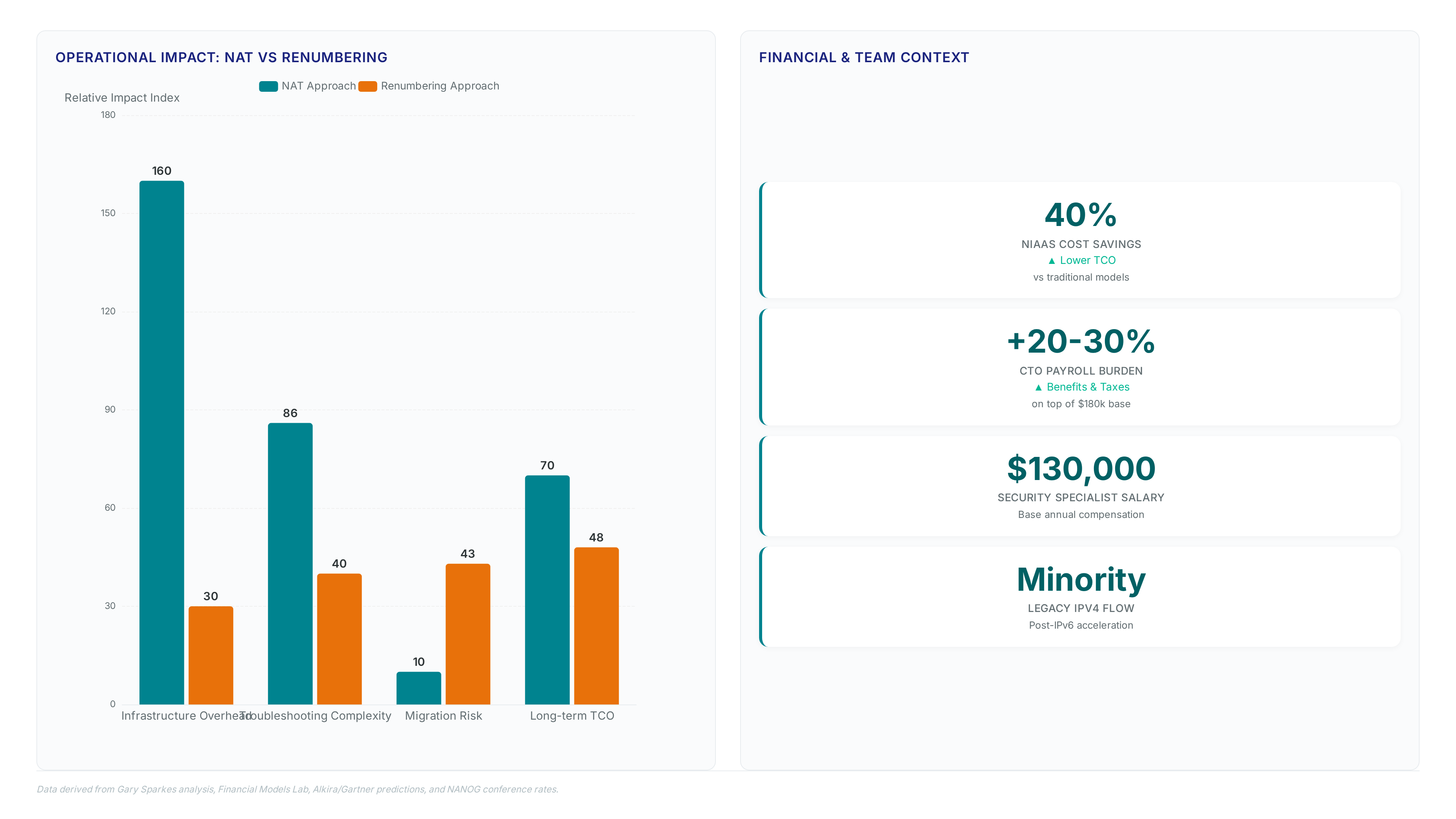
Gary Sparkes identified NAT between conflicting domains as a temporary bridge requiring far less infrastructure than immediate renumbering during mergers. This mechanism isolates overlapping private IP ranges while engineering teams execute gradual segment changes, avoiding the capital expenditure of a full Network Monitoring Tools overhaul. Renumbering addresses the root cause by eliminating address collisions permanently, yet it demands extensive planning and risks service disruption if routing tables are not updated synchronously across all sites. Some organizations accelerate IPv6 plans to remove NAT entirely, leaving legacy v4 edge access as a minority traffic flow.
| Dimension | NAT Bridging | Segment Renumbering |
|---|---|---|
| Deployment Speed | Immediate (hours) | Gradual (weeks/months) |
| Hardware Overhead | Minimal existing gear | Significant new investment |
| Long-term Stability | Low (technical debt) | High (clean architecture) |
Operational complexity competes directly with technical debt in these scenarios. NAT introduces stateful translation layers that complicate troubleshooting, whereas renumbering requires upfront coordination but yields a cleaner topology. Accelerating automation efforts helps mitigate renumbering risks, as network automation reduces manual configuration errors during large-scale migrations. Operators must weigh the immediate stability of a NAT stopgap against the permanent resolution of renumbering, noting that delaying the transition often increases total cost of ownership over time. Gary Sparkes recommended NAT between conflicting domains A through E to avoid immediate hardware procurement during mergers. A core five-person network team carries a fixed overhead that strains budgets, making temporary translation preferable to instant architectural purity.
Stateful failures occur if translation tables overflow during peak traffic bursts. Operators must monitor session limits closely using dedicated infrastructure health platforms to prevent silent drops. Some organizations accelerate IPv6 plans to remove translation entirely, leaving legacy v4 edge access as a minority flow. Gary Sparkes argued that proposed additional infrastructure renders theoretical segmentation schemes a complete non-starter in F500 organizations. Operators frequently choose NAT translation over immediate renumbering to preserve capital while resolving 10. X collision conflicts between acquired entities. The cost of maintaining specialized engineering squads often exceeds the temporary inefficiency of stateful packet inspection.
| Strategy | Team Overhead | Hardware Requirement | Risk Profile |
|---|---|---|---|
| Full Renumbering | High | Significant | Service Disruption |
| NAT Bridging | Low | Minimal | Latency Increase |
| IPv6 Migration | Medium | Moderate | Dual-Stack Complexity |
Shifting toward Experience-Driven NetOps strategies can yield reported ROIs of 160% by prioritizing user metrics over device uptime. This approach reduces the manual burden on internal staff during integration phases. NAT introduces latency, whereas renumbering eliminates the translation layer entirely.
Implementation: Defining NAT Bridging Versus Segment Renumbering in M&A
Kentik.
- Configure stateful translation rules on edge routers to map conflicting 10. X. 0.0 subnets to unique temporary ranges.
- Verify connectivity between merged entities without altering host configurations or DHCP scopes.
- Schedule phased renumbering windows to migrate segments to native addressing over subsequent quarters.
Temporary translations obscure topology visibility and complicate troubleshooting until full migration occurs. Operators must weigh the speed of NAT deployment against the long-term benefits of native backward compatibility.
Gary Sparkes confirmed that NAT between conflicting domains A through E requires notably less infrastructure than immediate renumbering during mergers. Operators prioritize stateful translation at the edge to maintain connectivity while backend systems shift to IPv6-only architectures.
- Deploy stateful NAT64 gateways to translate legacy IPv4 traffic from acquired entities into the core IPv6 fabric.
- Configure routing policies to prefer native IPv6 paths for internal services, relegating IPv4 to edge access only.
- Execute gradual renumbering of backend segments during maintenance windows, reducing the 10. X collision surface area incrementally.
- Decommission NAT rules once the final segment migrates, leaving legacy v4 access as a minority flow.
This workflow eliminates the need for massive hardware procurement, a constraint that renders theoretical segmentation schemes a complete non-starter in F500 organizations. Some merger scenarios have accelerated IPv6 plans, resulting in networks where NAT exists solely for legacy edge access. The strategy uses native backward compatibility. Global IPv6 capacity continues to expand, yet immediate operational relief comes from temporary translation layers.
- Deploy stateful gateways to isolate overlapping address spaces without expanding the Network Specialist headcount.
- Prioritize gradual segment migration to avoid the salary burden of hiring extra Security Specialist roles at $130,000 each.
- Use flexible pricing.
Manual routing policies create human error risks when automation delays extend the integration window. InterLIR recommends stabilizing connectivity via NAT before committing to architectural purity. Uchmakes/networkinfrastructure roles at $130,000 each.
About
Vladislava Shadrina serves as a Customer Account Manager at InterLIR, a Berlin-based marketplace specializing in IPv4 address redistribution. While the industry debates theoretical protocols like IPv8 to solve address exhaustion, Shadrina addresses the immediate reality of IP address collisions through practical resource management. Her daily work involves facilitating the secure transfer and leasing of clean IPv4 blocks, ensuring clients avoid the routing conflicts and reputation issues that arise from poorly managed address space. At InterLIR, she applies rigorous verification standards to guarantee clean BGP announcements and valid route objects, directly mitigating collision risks for network operators. By connecting customers with verified, unused IP resources, she provides a tangible solution to scarcity that complements ongoing technical discussions. Her expertise in client relations ensures that organizations navigate complex network availability challenges with transparency and efficiency, bridging the gap between theoretical network architecture and operational stability.
Conclusion
Scaling merger integrations reveals that architectural purity often fractures under the pressure of immediate uptime requirements. While theoretical models suggest clean slates, the operational reality dictates that maintaining specialized engineering squads for full renumbering creates a financial bleed that outweighs temporary translation inefficiencies. The true breaking point occurs not at the protocol layer, but when manual routing policies introduce human error during extended migration windows, causing outages that no CTO salary can justify. Organizations must accept that NAT bridging serves as a critical stabilizer rather than a permanent flaw, allowing teams to isolate overlapping address spaces without expanding headcount or risking service disruption.
Commit to a hybrid stabilization strategy immediately if your integration timeline exceeds six months or involves more than two distinct legacy domains. Do not attempt full renumbering until user metrics stabilize and automation tooling matures enough to remove manual intervention risks. This approach caps operational expenditure while preserving capital for future architectural shifts. Start by auditing your current NAT gateway capacity against projected merger traffic volumes before Friday's leadership sync. Identify specific segments where stateful inspection introduces unacceptable latency and flag those for priority hardware upgrades. This concrete assessment prevents the common pitfall of assuming existing infrastructure can handle doubled load without performance degradation.
Frequently Asked Questions
Standard routers drop these packets immediately because the range is reserved for loopback functions. Deploying this scheme requires overriding kernel stacks on every endpoint, breaking RFC compliance and voiding vendor support contracts entirely.
Thain asserts his structure yields 10 Billion IP addresses by treating octets as department and region identifiers. However, this approach lacks a defined path for inter-segment traffic without custom translation gateways.
Unlike IPv8 which lacks vendor support, IPv6 sees 50.10% user adoption on major platforms with known operational characteristics. Operators face a distinct choice between deploying unproven drafts or utilizing these established standards.
NAT translation requires much less infrastructure and hardware to execute than the additional aspects proposed in IPv8 drafts. This approach allows for gradual segment renumbering while avoiding complex new protocol deployments.
The current draft expiration date signals a complete lack of active working group progression within the IETF standards body. It remains a non-standardized concept discussed primarily on mailing lists rather than an implemented reality.