Local registry access: real costs and rules
Misaka.io has operated as a RIPE NCC member since 2017, charging exactly 100 USD for ASN applications. Becoming a Local Internet Registry requires navigating strict regional mandates and specific financial obligations rather than simply filling out forms.
The RIPE NCC community supports over 20,000 organizations acting as Local Internet Registries to deliver services globally. However, direct access to resources like Provider Independent space is vanishing, as the governing body no longer assigns new blocks. Operators must now rely on transfers or secure Provider Aggregatable allocations while adhering to rigid upstream provider rules.
This article details the technical mechanics of ASN registration and IPv6 allocation across different jurisdictions. Readers will learn the precise fee structures, such as the 70 USD annual maintenance for ASNs in Europe versus 100 USD in Asia. We also examine the strategic selection between RIPE NCC and APNIC jurisdictions, highlighting why credit cards fail for EUR payments and why hourly cloud providers cannot serve as upstream references.
The Role of Local Internet Registries in Global IP Governance
Defining the LIR Role in RIPE NCC and APNIC Regions
A Local Internet Registry operates as an intermediary allocated number resources by a Regional Internet Registry for subsequent distribution to customers. The RIPE NCC governs distribution across Europe, maintaining a community of over 20,000 member organizations that act as Local Internet Registries. Misaka.io has been a member of the RIPE NCC since 2017, facilitating direct access to IPv4 blocks and ASNs. In the Asia-Pacific region, APNIC serves as the governing body responsible for distributing addresses and numbers throughout Asia.
This structure creates an abstraction layer where the registry retains legal responsibility while the client consumes the resource. Organizations apply this arrangement to bypass upstream provider constraints for critical infrastructure. Direct resource acquisition demands strict adherence to regional documentation rules and valid upstream proofs. Operational costs involve distinct application and maintenance fees that vary notably by region and resource type.
Networks must verify upstream provider status before applying because providers must locate within the specific RIR service region. RIPE NCC upstreams cannot function as hourly-billing cloud providers. This constraint prevents resource fragmentation while impacting deployment strategies for cloud-native startups. Tension exists between rapid provisioning requirements and the governance needed to prevent IPv4 exhaustion. Direct membership offers long-term stability but demands administrative overhead that smaller entities often lack.
Provider Independent vs Provider Aggregatable Address Space Differences
Provider Independent space allows networks to retain IP blocks regardless of upstream connectivity changes. This contrasts sharply with Provider Aggregatable space, which remains tied to a specific ISP and requires return upon provider migration. Portability defines the fundamental distinction: PI assignments enable smooth transitions between carriers without renumbering, whereas PA allocations bind the organization to the original service provider's infrastructure.
RIPE NCC policy currently restricts new PI allocations, limiting availability to transfers of existing stock, as the registry no longer allocates or assigns new PI address space. Operators seeking fresh assignments must navigate this constraint by acquiring legacy space or relying on PA blocks. This regulatory shift forces networks to weigh the long-term stability of PI against the immediate accessibility of PA resources.
| Feature | Provider Independent (PI) | Provider Aggregatable (PA) |
|---|---|---|
| Portability | Fully portable between ISPs | Tied to original provider |
| Availability | Transfer market only | Direct assignment available |
| Return Policy | Retained indefinitely | Returned on provider change |
| Governance | RIPE NCC transfer rules | Provider-specific policies |
Operational costs of choosing PA space often exceed initial estimates due to mandatory renumbering events. Migrating a production network to a new upstream provider necessitates updating firewall rules, DNS records, and BGP configurations across the entire infrastructure. PI space eliminates this disruption but introduces complexity in securing the initial block through channels designed for uncooperative sponsor scenarios.
Network architects must evaluate whether the risk of future provider lock-in outweighs the scarcity premium of portable addresses. Experts recommend prioritizing PI acquisition for critical infrastructure where uptime during carrier switches is non-negotiable. The scarcity of IPv4 resources makes the decision between temporary accessibility and permanent portability a defining strategic choice for modern network design.
ASN Registration Requirements and Fee Structures for APNIC and RIPE
Registering an Autonomous System Number requires valid identity documentation, two upstream providers, and specific regional fees.
Operators must submit a current company certificate or ID copy alongside proof of planned IP prefix usage. Misaka.io mandates that both upstream providers possess valid AS-Numbers and operate within the correct service region. Applications citing upstream providers outside the assigned service region face rejection under strict regional compliance policies enforced by local intermediaries.
| Region | Application Fee | Annual Maintenance |
|---|---|---|
| RIPE NCC | 100 USD | 70 USD / 60 EUR |
| APNIC | 350 USD | 100 USD |
Payment for RIPE NCC applications accepts only USD, while maintenance allows EUR via SEPA or Wise. APNIC invoices require settlement within 30 days, and the initial fee remains non-refundable without prior agreement. The higher entry cost in the Asia-Pacific region reflects the distinct operational overhead of that registry compared to European counterparts.
Providers recommend verifying upstream provider eligibility before document submission to avoid processing delays. Organizations outside the primary service regions must provide invoices from local upstreams to satisfy geographic constraints. This verification step prevents immediate application failure due to non-compliant peering arrangements.
Technical Mechanics of ASN Registration and IPv6 Allocation
4-byte ASN Structure and Legacy 16-bit Limitations
The RIPE NCC, the organization responsible for distributing IP addresses and ASNs in Europe, enforces specific constraints on Autonomous System Number (ASN) registration to ensure resource validity. As part of the registration process through Misaka.io, all issued ASNs are 4-byte variants. This format supports a significantly larger range of identifiers compared to the legacy 16-bit space, accommodating global network growth.
| Feature | 16-bit ASN | 4-byte ASN |
|---|---|---|
| Max Range | 65,535 | 4,294,967,295 |
| Notation | Decimal only | Dot or Decimal |
| Status | Legacy | Current Standard |
Operators must ensure their infrastructure supports these values to maintain BGP session stability. Specific upstream requirements apply within the service region: providers must possess valid AS-Numbers and cannot be hourly-billing cloud providers. Upstream providers must be located within the service region. If an applicant operates outside this region, they must provide invoices from their upstream providers located within the region to validate connectivity.
Documentation Checklist for Justifying Large IPv6 Allocations
Requests for IPv6 blocks exceeding a /48 prefix trigger a mandatory justification process to prove technical need. Operators must submit specific evidence demonstrating why the standard allocation size is insufficient for their infrastructure design.
| Requirement | Regional Evidence |
|---|---|
| Connectivity | Invoices from regional upstreams (if outside region) |
| Upstream Type | Non-cloud provider ASNs in region |
| Documentation | Company certificate (<3 months) |
The submission workflow requires distinct proofs based on the regional registry governing the resource pool.
- Provide two upstream providers with valid AS-Numbers located within the service region.
- Submit invoices proving connectivity if operating outside the primary geographic zone.
- Include a technical justification for allocations larger than a /48 prefix.
For registrations, documents such as company certificates or certificates of good standing cannot be older than 3 months. Applicants must be a connectivity customer of Misaka.io to request IPv6 allocations larger than a /48. The standard initial allocation typically remains a /48 prefix, and exceeding this threshold demands rigorous validation. Preparing these documents before initiating the application helps avoid processing delays.
Transfer Restrictions and Payment Default Risks in RIR Agreements
A 24-month lock-up period strictly prohibits moving IPv4 blocks or 16-bit ASNs immediately after allocation within the service region. This constraint applies to resources received directly, via transfer, or following a change in business structure. This ensures resource stability and prevents immediate speculation on newly allocated assets.
Financial exposure extends beyond fixed fees through strict payment enforcement mechanisms. Payment is due within 30 days of the invoice date. Defaulting on invoice obligations triggers the statutory rate of interest on all unpaid amounts starting from the day payment obligations are defaulted. Extra-judicial collection costs may apply. The application fee remains non-refundable unless the Local Internet Registry explicitly agrees otherwise.
| Risk Factor | Consequence |
|---|---|
| Time Lock | Assets illiquid for 24 months (IPv4/16-bit ASN) |
| Payment Default | Statutory interest accrues; collection costs may apply |
| Documentation | Upstream invoices required for validation |
Operators must ensure all upstream contracts and documentation are verified before submission. All fees cover a full calendar year regardless of when the agreement enters into effect. Missing required documentation, such as valid upstream details or identity verification, prevents the completion of the registration process.
Strategic Selection Between RIPE NCC and APNIC Jurisdictions
Geographic Mandates Defining RIPE NCC and APNIC Jurisdictions

Regional Internet Registries allocate resources based strictly on physical network infrastructure location rather than corporate headquarters. The RIPE NCC manages distribution across Europe, the Middle East, and parts of Central Asia, while APNIC governs the Asia Pacific region. This geographic division creates distinct operational constraints for organizations seeking Provider Independent space.
Operators must verify that their upstream providers reside within the specific service region to satisfy registration criteria. Research indicates that some intermediaries explicitly reject upstreams located outside the RIPE NCC service region, imposing stricter technical boundaries than general policy texts suggest. Certain providers forbid using hourly-billing cloud instances as upstream partners, forcing a choice between flexible cloud architectures and registry compliance.
| Feature | RIPE NCC Region | APNIC Region |
|---|---|---|
| Primary Geography | Europe / Middle East | Asia / Pacific |
| Upstream Rule | Must be regional | Must be regional |
| Cloud Upstreams | Often prohibited | Case-by-case basis |
The cost structure reflects these regional economic differences, with application fees ranging from 70 USD to 100 USD depending on the specific resource class and currency conversion at the time of invoicing. Selecting the wrong jurisdiction based on business address rather than network topology results in immediate application rejection.
Operational Decision Framework for RIPE NCC Versus APNIC Selection.
Select the registry matching your physical infrastructure location to avoid immediate rejection of ASN applications. Operators in Europe benefit from lower entry costs, while Asian deployments face higher initial fees but gain regional routing authority. The choice fundamentally dictates your upstream provider eligibility and long-term fee structure.
Requests for IPv6 allocations exceeding a /48 trigger a mandatory justification process to prove technical need to the RIR justification. This constraint forces operators to document precise subnetting plans rather than hoarding unused space. A critical tension exists between fee sensitivity and geographic reality; choosing a registry based solely on cost while lacking local upstream diversity guarantees application failure. Organizations must be aware that the RIPE NCC no longer allocates new PI address space, limiting options to transfers or PA assignments tied to specific carriers.
Financial discipline remains paramount as payment is due within Immediate of invoice date, and defaulting triggers statutory interest on unpaid amounts. The non-refundable nature of application fees unless agreed by the LIR creates a sunk cost risk for incomplete applications. InterLIR recommends verifying upstream invoices and company certificates are current before submission to prevent avoidable delays.
Financial Risks of Non-Refundable Fees and PI Space Limitations
Application fees for registry resources represent a sunk cost with no recovery path if technical validation fails.misaka.io documentation confirms the application fee is not refundable unless the Local Internet Registry explicitly agrees, creating immediate financial exposure for applicants lacking proper upstream diversity. This risk compounds because the RIPE NCC no longer allocates new Provider Independent address space, limiting operators to transfers or temporary Provider Aggregatable assignments.
Organizations facing these constraints often encounter hidden operational costs when forced to redesign networks around PA space rather than owning permanent assets. Alternative sponsorship models exist, such as specific 2026 pricing schemes listing annual fees of €1,800 that bundle PI space and legacy services, though these require careful vendor selection.
Operators must validate all technical prerequisites before payment to avoid wasting capital on rejected filings. InterLIR assists networks in navigating these fiscal constraints by optimizing existing IPv4 resources and ensuring strict adherence to upstream provider requirements before submission.
Executing LIR Service Requests and Maintenance Procedures
Defining LIR Service Request Triggers and Payment Terms
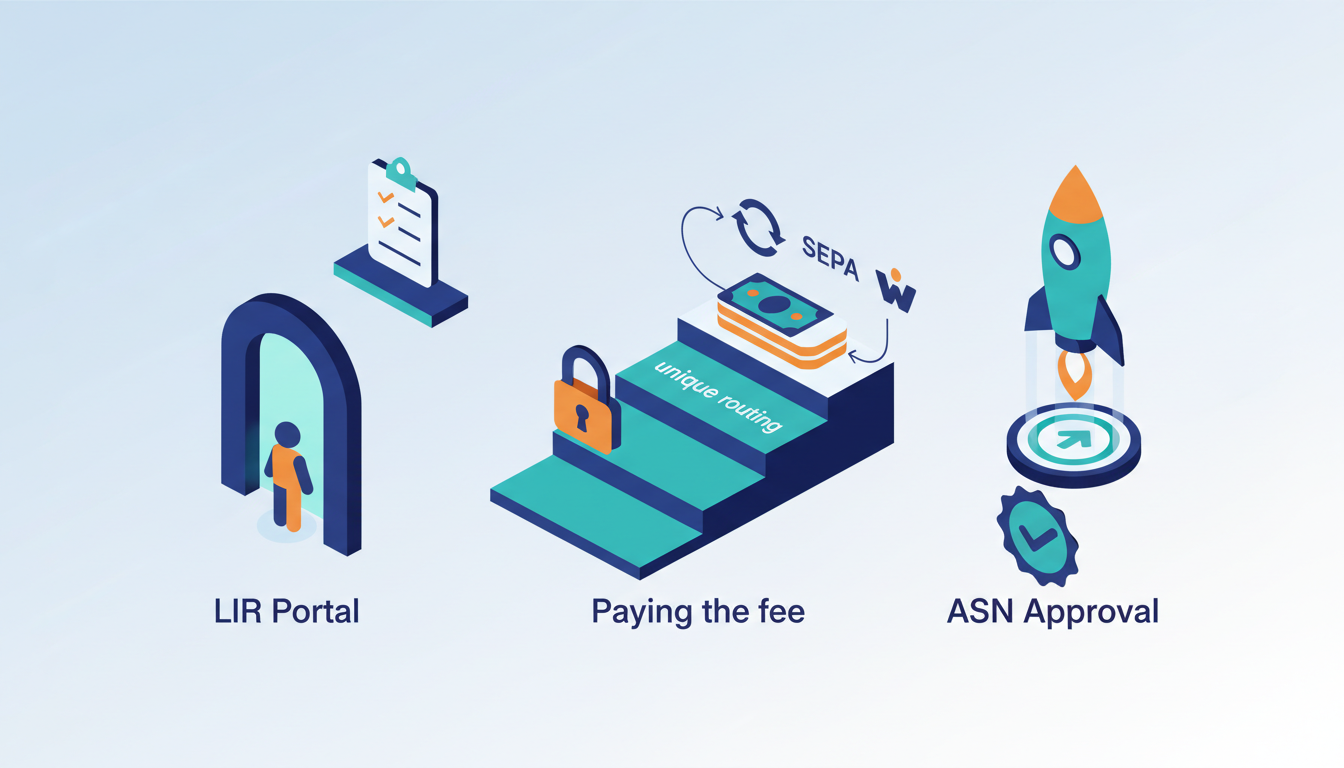
Service initiation occurs strictly upon submission of valid identity documentation and confirmed upstream AS-Number details.misaka.io requires two distinct upstream providers with active ASNs to validate any new ASN application, ensuring the requesting entity possesses genuine multi-homing capability before registry submission. This technical gate prevents frivolous requests that waste regional registry processing capacity.
- Submit a current company certificate or passport copy not older than three months.
- Provide contact emails and IP prefixes intended for immediate operational use.
- Settle the non-refundable application invoice to activate the membership file.
Membership file. Payment is due within 30 days of the invoice date. The governing agre. The registry. 3. Settle invoices within 30 days to avoid statutory interest on unpaid a ments. Operators must note that fees cover a full calendar year regardless of the specific activation date, creating a fixed cost basis for budget planning.
Extra-judicial collection costs may apply to unpaid amounts. Standard Service Agreement activation remains pending until both financial clearance and document verification complete successfully. Organizations should treat the application fee as a sunk cost, as refunds are unavailable unless the LIR explicitly agrees otherwise.
Executing ASN Registration with Upstream Provider Verification
Successful ASN registration demands two verified upstream providers located strictly within the target regional service area. Operators must gather a company certificate issued within the last three months alongside valid identity proofs before submission. The technical gate requires these upstream providers to hold active AS-Numbers, ensuring the applicant possesses genuine multi-homing capability rather than single-homed cloud dependency. Intermediaries like iFog GmbH enforce strict policies where upstreams cannot be hourly cloud providers, rejecting applications relying on transient infrastructure. This constraint creates a tension between rapid deployment desires and the stability requirements of global routing tables.
- Submit current identity documentation and proof of corporate existence.
- Provide contact emails and the specific IP prefix intended for use.
- Confirm two distinct upstream connections with valid routing policies.
Misaka.io enables this process by validating technical prerequisites before registry interaction, preventing costly rejections. The financial implication is clear: the application fee represents a sunk cost if documentation fails validation, as these funds are generally non-refundable.
ASNs issued are 4-Byte ASNs, and usage of allocated resources is subject to prohibited usage clauses as outlined in the Terms of Service.
Implementation: Financial Risks of Non-Refundable Application Fees and PI Space Limits
Applicants forfeit capital immediately if upstream provider validation fails, as the application fee remains non-refundable without explicit LIR consent. This financial exposure exists because the RIPE NCC ceased new Provider Independent allocations, restricting operators to secondary market transfers or temporary assignments.
- Submit identity documentation and verify two distinct regional upstreams before invoicing.
- Confirm PI space transfer eligibility, as new assignments are unavailable from the registry.
- Settle invoices within 30 days to avoid statutory interest on unpaid amounts.
Changing a sponsoring LIR requires coordinating this transfer, as the RIPE NCC no longer allocates or assigns new PI address space. Maintaining valid documentation is necessary, as company certificates cannot be older than three months. Organizations ignoring these constraints risk paying application fees twice if they must re-apply due to rejected upstream proofs.misaka.io advises verifying all technical prerequisites before triggering any non-recoverable payment obligation.
About
Evgeny Sevastyanov serves as the Customer Support Team Leader at InterLIR, a specialized IPv4 marketplace headquartered in Berlin. His daily responsibilities directly align with the complexities of Local Internet Registry (LIR) operations, making him uniquely qualified to discuss this topic. Evgeny routinely manages technical database entries within RIPE NCC and APNIC systems, ensuring accurate IP resource allocation and maintenance for clients. Through his work, he oversees the creation of route objects and verifies IP reputation, critical components of the LIR services outlined in this article. At InterLIR, the company strives to solve network availability issues by redistributing unused IPv4 resources with transparency and efficiency. Evgeny's hands-on experience guiding customers through these precise regulatory frameworks allows him to explain LIR mechanics with practical clarity. His background ensures that the discussion on IP assignments and fees reflects real-world application rather than just theoretical knowledge.
Conclusion
Scaling network infrastructure reveals that the 24-month lockup period creates immediate illiquidity for IPv4 blocks and 16-bit ASNs, trapping capital in assets that cannot be moved or sold. This operational rigidity means a single documentation error, such as submitting a company certificate older than three months, forces an organization to wait years before correcting the allocation through a new Local Internet Registry. The financial risk extends beyond the initial non-refundable fee; defaulting on the 30-day payment window triggers statutory penalties that compound the cost of entry. Operators must treat the application process as a binding financial commitment rather than a simple administrative step.
Organizations should mandate a pre-submission audit of all corporate documents and upstream routing policies before engaging any registry workflow. Do not initiate the transfer process unless your legal entity verification is current and your dual-homing setup is technically proven. Start by requesting a fresh copy of your corporate registration certificate today to ensure it meets the strict recency requirements. Verifying these specific constraints prevents the forfeiture of application fees and avoids the long-term asset immobilization that follows a failed submission. Securing your ASN or IP block requires precise adherence to these procedural windows, as the window to correct errors without penalty closes the moment the invoice is generated.
Frequently Asked Questions
Company certificates must be current to succeed. You must submit a company certificate that is less than 3 months old to meet strict documentation requirements.
Hourly billing providers cannot serve as upstream references. Your two required upstream providers must have AS numbers and cannot be hourly-billing cloud providers.
Credit cards are not accepted for Euro payments. You must use SEPA or Wise payment methods because credit cards are unavailable for EUR maintenance fees.
A strict lockup period prevents immediate resource transfers. You cannot move IPv4 blocks or 16-bit ASNs for 24 months after allocation or changing your business structure.
Statutory interest applies immediately upon payment default. You must pay invoices within 30 days of the date to avoid extra-judicial collection costs and interest.
References