Network automation: Why 80% success needs funding
Only 18% of IT professionals rate their automation programs as fully successful. Tool selection alone cannot fix broken strategies. The real differentiator for enterprise network success is not the software brand, but the presence of dedicated funding and a clear architectural blueprint. Gartner predicts that by 2027, 30% of enterprises will automate over half their network activities, yet most will fail without addressing the underlying operational model. Azhar Khuwaja's analysis reveals that organizations with specific budget allocations achieve an 80% success rate, drastically outperforming the 29% success rate seen in underfunded initiatives.
Strip away the hype surrounding network automation tools to see the mechanical realities of deployment. We must analyze the architectural mechanics distinguishing agent-based systems from agentless orchestration, specifically how each impacts scalability and Linux skill requirements.
We outline a strategic implementation roadmap designed for brownfield and multi-vendor environments where legacy constraints often derail modernization. With Market. Us reporting that 50% of enterprises will soon apply AI to maintenance, understanding these fundamental layers is critical before layering on intelligent monitoring. Evaluate trade-offs between speed and error propagation. Ensure automation serves the infrastructure rather than destabilizing it.
The Role of Declarative Infrastructure as Code in Modern Enterprise Networks
Declarative Desired End State vs Imperative Step-by-Step Execution
Declarative Infrastructure as Code defines the target topology without specifying the execution sequence. Imperative tools operate interactively, forcing operators to script every individual command in a strict linear order. This distinction dictates whether the automation engine calculates the delta or simply replays a recorded macro. Terraform excels in this declarative infrastructure definition by maintaining a state file to detect configuration drift automatically. Ansible playbooks remain easier to read for procedural tasks.
Error propagation poses a significant operational risk since a flawed declarative model can corrupt the entire fabric instantly. Imperative scripts often fail silently at step four and leave the network in a partially modified state.
Terraform Day 0 Provisioning and Ansible Day 1 Configuration Workflows
Separating Day 0 provisioning from Day 1 configuration prevents state-file corruption during initial cloud builds. Terraform constructs the underlying network topology by managing resources such as virtual private clouds and subnets before any device configuration occurs. This declarative approach relies on a persistent state file to track resource existence and detect drift automatically. Operators transition to Ansible for post-deployment tasks because its agentless SSH architecture suits existing brownfield routers better than stateful provisioners. The integration workflow dictates a sequential handoff where Terraform outputs IP addresses that Ansible consumes for device onboarding.
Complexity Pitfalls When Declarative Logic Obscures Step-by-Step Control
Complex underlying logic in declarative models obscures execution order. This forces a revert to imperative methods for the vast majority of failures involving manual processes. Operators lose visibility when the engine calculates the delta, making granular debugging impossible during active outages. Ansible playbooks help here. Pure declarative states hide the sequence of operations, which complicates troubleshooting in multi-vendor environments.
Most enterprises operate across diverse hardware silos and necessitate orchestration strategies that support complex interactions rather than single-vendor definitions. Network teams must adopt multi-vendor orchestration to prevent logic obscurity from causing widespread configuration drift. Switching to imperative flows increases human effort but reduces the blast radius of automated errors. This constraint accepts higher operational overhead to gain deterministic control over failure propagation paths. Blind adherence to desired-end-state abstraction invites catastrophic failure when the reconciliation loop cannot resolve conflicting dependencies. Production networks require explicit execution sequences during incident response to isolate faulty components effectively. Clarity trumps abstraction during critical outages.
Architectural Mechanics of Agent-Based Versus Agentless Orchestration Systems
Agent-Based Versus Agentless Communication Paths in Network Automation
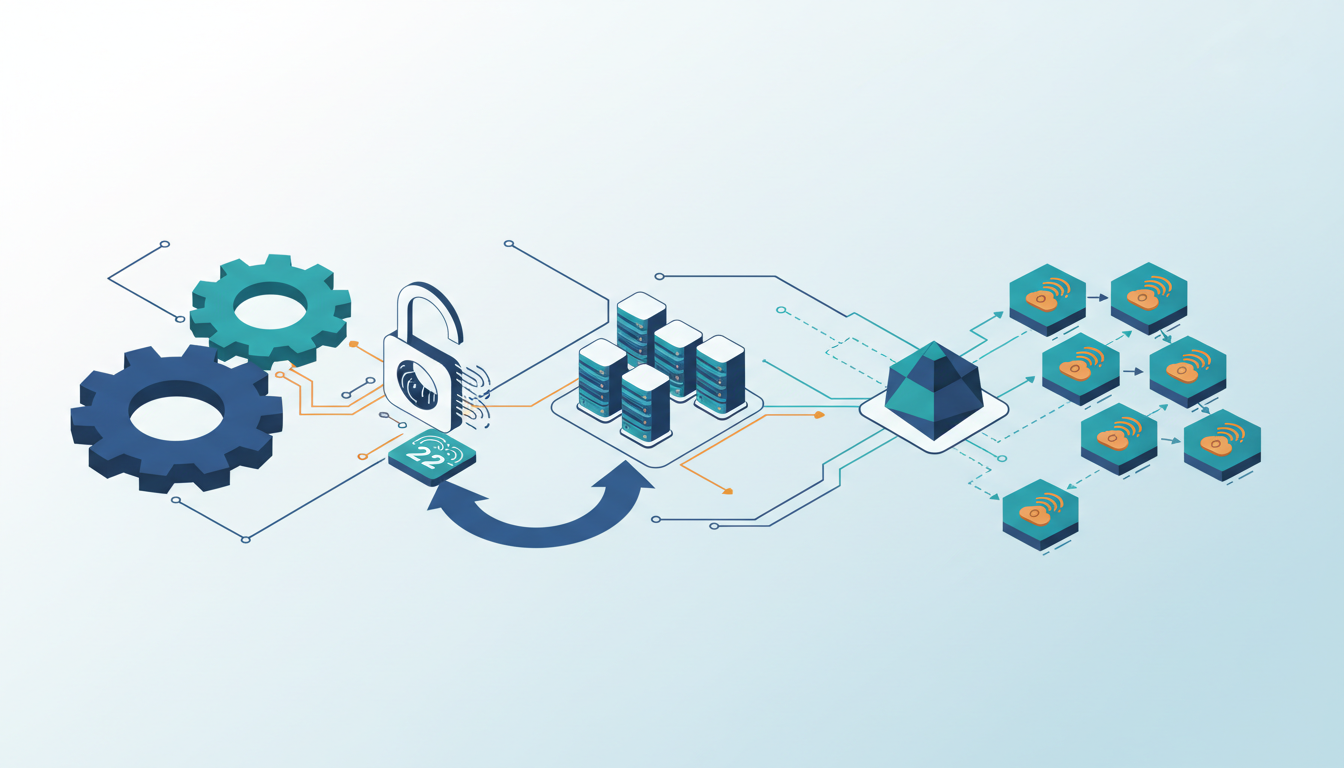
Agent-based tools require persistent daemons on target nodes, whereas agentless systems apply ephemeral SSH. This architectural divergence dictates whether the control plane maintains a constant bidirectional channel or initiates transient unidirectional pushes. Persistent daemons consume local CPU cycles continuously, creating a fixed overhead regardless of configuration update frequency. In contrast, agentless SSH architectures eliminate device-side software dependencies, simplifying brownfield integration on legacy routers. Stateful agents offer quicker reaction times for local event triggers compared to polling-based orchestrators.
| Feature | Agent-Based Architecture | Agentless Architecture |
|---|---|---|
| Connection Model | Persistent bidirectional socket | Ephemeral SSH/NETCONF session |
| Device Overhead | Continuous CPU and memory usage | Zero resident footprint between tasks |
| Deployment Speed | Requires software installation phase | Immediate connectivity via credentials |
| Scalability Limit | Controller connection table capacity | Network bandwidth and SSH handshake rate |
Operators must weigh the latency benefits of local agents against the operational friction of software distribution. State management becomes complex when agents report drift asynchronously rather than during a synchronized orchestration run. The superior choice for existing network devices often favors agentless models to bypass vendor OS restrictions. Failure to account for SSH session limits can cause orchestration timeouts during large-scale bulk updates. Network teams should test handshake concurrency limits specifically rather than assuming linear scaling behavior.
Scalability Mechanics of Terraform Provisioning Versus Ansible Configuration
Terraform AWS benchmarks show a significant speed increase over manual provisioning during initial resource creation. This performance advantage stems from parallel API calls that instantiate cloud primitives quicker than sequential scripts allow. The cost is limited applicability outside greenfield clouds, as state files struggle with legacy hardware inventory. Operators must accept that fast provisioning creates a configuration vacuum if Day 1 tasks lag behind.
Ansible fills this gap by managing existing network devices through transient SSH sessions rather than persistent agents. The agentless SSH approach eliminates daemon overhead on routers but introduces connection bottlenecks at scale. Human effort drops significantly when replacing ticket-based changes with automated playbooks for routine patching cycles. However, the lack of native drift detection forces teams to write custom validation logic for compliance.
| Feature | Terraform Provisioning | Ansible Configuration |
|---|---|---|
| Primary Phase | Day 0 Infrastructure | Day 1+ Operations |
| State Tracking | Persistent State File | Ephemeral Execution |
| Best Fit | Cloud Primitives | Brownfield Devices |
| Scaling Limit | API Rate Limits | SSH Connection Pool |
Redhat. Breaking this chain causes race conditions where configuration pushes target non-existent interfaces. Large environments often hit parallelization walls unless operators tune fork limits or adopt external orchestration layers. This separation prevents a single syntax error from halting the entire network build process. Scalability ultimately depends on matching the tool to the specific lifecycle phase of each asset.
Single misconfigured variables trigger cascading failures across the entire fleet, whereas manual errors remain isolated to one device. Automation-based errors impact systems at scale beyond a single managed node, creating a blast radius that legacy approaches inherently contain.
Operators must accept that speed introduces volatility, making gradual implementation safer than full-scale rollout in brownfield sites.
Full-Scale Automation Risks in Brownfield Infrastructure
Legacy Infrastructure blocks 24.3% of organizations from deploying thorough network control systems. Attempting Full-Scale Automation across existing hardware assumes personnel possess debugging skills that rarely exist in standard operations teams. The risk involves cascading failures where a single syntax error propagates to every managed node simultaneously. Operators must recognize that Integration Difficulties often outweigh the theoretical efficiency gains of total orchestration. Selecting the wrong tool exacerbates these risks by forcing agent-based daemons onto devices designed for manual CLI access. Agentless SSH Strategies supporting complex multi-vendor orchestration prevent the creation of isolated automation silos that fail at scale.
- Audit current device inventories to identify units lacking API support or stable SSH access.
- Isolate high-frequency change windows where manual errors occur most often for pilot scripting.
- Deploy agentless frameworks only to segments with verified credential consistency and backup procedures.
- Establish a rollback protocol that reverts changes quicker than the automation engine applies them.
The cost of ignoring these constraints is measurable in extended outage durations during failed rollouts. Partial implementation remains the pragmatic choice until staff proficiency matches the complexity of the toolchain.
Gradual Rollout Phases Using Terraform and Ansible
Princeton University achieved a 95% labor reduction through automation by separating Day 0 provisioning from ongoing configuration management.
- Deploy Day 0 infrastructure provisioning using Terraform to instantiate cloud primitives and define the initial network topology.
- Hand off control to Ansible for Day 1+ configuration management, applying policies to existing routers and switches without agents.
- Validate the desired end state against the Source of Truth before committing changes to production devices.
This sequential handoff prevents the configuration vacuum that occurs when fast provisioning outpaces policy application. Terraform creates the network skeleton, yet leaves it empty of operational logic if Ansible does not immediately follow. The agentless SSH approach ensures compatibility with legacy hardware that cannot host persistent daemons. Rapid deployment amplifies the blast radius of any single syntax error across the entire fleet. Full-scale automation remains risky because Legacy Infrastructure often lacks the standardized APIs required for declarative control. A gradual path allows teams to build debugging proficiency while containing potential failures to specific domains. This method transforms Network Complexity from a barrier into a manageable series of discrete integration tasks.
Tool Selection Checklist for Multi-Vendor Scalability
Select agentless orchestration first to bypass Legacy Infrastructure barriers affecting nearly a quarter of enterprises. Operators must validate parallel execution limits before scaling beyond pilot groups, as large environments necessitate frameworks like Nornir for true concurrency. Dedicated funding drives success rates to 80% compared to 29% without financial backing, directly correlating capital to tool maturity. Integration Difficulties remain the primary obstacle for a significant share of organizations attempting to unify disparate vendor APIs.
| Architecture | Best Use Case | Scaling Limit |
|---|---|---|
| Agentless SSH | Brownfield device config | Controller CPU bound |
| Stateful IaC | Cloud primitives | State file locking |
| Parallel Framework | Large fleet ops | Network latency |
Follow this validation sequence for playbook design:
- Audit existing hardware to confirm agentless SSH compatibility across all router models.
- Map multi-vendor API gaps to determine if specialized platforms like Apstra are required for intent.
- Define error propagation boundaries to prevent single-script failures from taking down the entire fabric.
The hidden cost of skipping step two is silent configuration drift that only manifests during outage recovery windows.
Defining Full-Scale Automation Scope Across Network Domains
Full-scale automation encompasses switches, servers, routers, and firewalls under a single orchestration umbrella, creating a unified but fragile control plane. This definition implies that any logic error propagates instantly across every managed node rather than remaining isolated to a single device. Operators must possess specialized debugging skills to manage these cascading failures, as standard network training rarely covers code-level fault isolation. The assumption of universal proficiency creates a bottleneck where only 18% of programs currently achieve full success.
The boundary of this scope demands tools capable of parallel execution. Simple scripting frameworks fail here because they cannot synchronize state updates across thousands of endpoints within acceptable maintenance windows.
| Scope Element | Risk Profile | Personnel Requirement |
|---|---|---|
| Switches | High broadcast domain impact | Layer 2/3 expert |
| Servers | Application downtime | Sysadmin + DevOps |
| Firewalls | Security policy gaps | Security architect |
| Routers | Global routing instability | BGP protocol specialist |
Attempting this breadth in brownfield environments often ignores the reality that Legacy Infrastructure lacks the API hooks required for agentless control. The cost is not merely financial but operational, as teams spend more time fixing automation-induced outages than manual configurations ever consumed.
Full-scale implementation in a brownfield environment often entails a significant upfront investment that most budgets cannot absorb immediately. Operators retain manual controls for complex logical workflows while delegating routine patching and backups to agentless SSH scripts. This split architecture prevents a single syntax error from propagating across the entire infrastructure, a failure mode inherent to monolithic designs. Legacy Infrastructure blocks nearly a quarter of organizations from adopting total orchestration due to incompatible device APIs. The cost involves maintaining dual operational models where human judgment overrides automated decisions during vulnerability exploitation events.
| Workflow Type | Execution Method | Risk Profile |
|---|---|---|
| User Provisioning | Automated Script | Low |
| Logic Changes | Manual CLI | High |
| Security Scanning | Automated Job | Medium |
Hybrid automation architectures combine the benefits of centralized and distributed approaches, offering flexibility and adaptability to meet diverse requirements of different network environments. Starting with high-frequency operational tasks allows teams to build confidence before tackling Multi-Domain Orchestration across IoT and WAN segments. The limitation remains that partial implementation does not fully realize the benefits of automation regarding predictive maintenance. Success depends on identifying bottlenecks where errors occur most frequently rather than automating stable processes first.
Financial and Operational Risks of Poorly Designed Automation Solutions
Full-scale automation in brownfield environments entails significant upfront investment and risks expensive cascading failures without adequate preparation. A single logic error in a monolithic playbook propagates instantly across every managed node, transforming a local typo into a network-wide outage. This error propagation mechanism means poorly designed solutions become expensive liabilities rather than efficiency drivers, particularly when Legacy Infrastructure lacks the APIs required for safe rollback. Research identifies these legacy barriers as a primary blocker for nearly a quarter of organizations attempting modernization. Operators rushing to automate entire networks often overlook the necessity of trained personnel capable of debugging code-level faults during crises.
About
Vladislava Shadrina serves as a Customer Account Manager at InterLIR, where she specializes in client relations within the IP resources domain. While her background includes architecture, her daily work managing customer accounts at InterLIR provides unique insight into the critical infrastructure supporting enterprise networks. As InterLIR enables the transparent redistribution of IPv4 addresses through automated processes, Shadrina directly observes how efficient resource allocation underpins modern network stability. This practical experience connects deeply to the topic of network automation tools, as reliable IP management is a fundamental prerequisite for any successful automation strategy. By ensuring clients access clean, verified IP resources quickly, she helps remove the manual bottlenecks that often hinder network scalability. Her role at InterLIR, a Berlin-based marketplace dedicated to network availability, allows her to understand the real-world challenges enterprises face when integrating automation into their existing architectures, making her well-qualified to discuss practical implementation strategies.
Conclusion
Scale exposes a critical fracture where AI-driven maintenance meets rigid legacy hardware. While predictive models promise to handle half of enterprise upkeep by 2027, these systems fail catastrophically when underlying devices lack the telemetry depth required for machine learning inference. The operational burden shifts from writing scripts to curating the massive, clean datasets necessary for AI accuracy, creating a hidden tax on engineering time that most budgets ignore. Organizations attempting to overlay intelligent orchestration on fragmented infrastructures will find their mean-time-to-resolution increasing, not decreasing, as algorithms struggle to interpret incomplete state data.
Commit to a hybrid automation model only after achieving 95% API coverage on core switching fabrics within the next eighteen months. Do not deploy autonomous remediation loops until your team can manually trace every decision path the AI proposes. This delay prevents the compounding of algorithmic hallucinations into physical outages. Start by auditing your current network telemetry granularity against specific AI vendor requirements this week. Identify exactly which device classes return insufficient data for predictive analysis and isolate them from any planned intelligent workflows immediately. This targeted exclusion protects your production environment while you build the data maturity required for true autonomy.
Frequently Asked Questions
Only 18% of IT professionals rate their automation programs as fully successful today. Most initiatives fail because they lack dedicated funding and a clear architectural blueprint to support the complex deployment strategies required.
Organizations with specific budget allocations achieve an 80% success rate for their automation projects. This drastically outperforms the 29% success rate seen in underfunded initiatives that attempt to modernize without proper financial support.
Most enterprises navigate complexity because 87% of multi-vendor environments require flexible orchestration strategies. Rigid tools often fail in these settings, necessitating approaches that can handle diverse hardware and varying configuration requirements effectively.
Gartner predicts that 30% of enterprises will automate more than half their network activities by 2026. However, most of these organizations will likely fail without first addressing their underlying operational models correctly.
Market.us reports that 50% of enterprises will soon apply AI to maintenance tasks. Understanding foundational automation layers remains critical before layering on intelligent monitoring to ensure stability and prevent system destabilization.