Network supercycle demands new IP strategies now
AI workloads will hit 50% of enterprise traffic by 2027. Standard broadband cannot carry that load. It breaks. The network supercycle driven by artificial intelligence demands a shift from best-effort delivery to guaranteed performance. Recon Analytics data from late 2025 reveals that 78% of organizations deployed AI in 2024, creating a "Connectivity-Cognition Flywheel" where superior access directly correlates with higher adoption rates. This surge has turned redundant connections from a luxury into a business-critical requirement, particularly as legacy infrastructure buckles under new loads.
We must dissect the mechanics of this transformation. The network supercycle fueled by exploding AI workload demands now dwarfs traditional data flows. Incremental upgrades are dead. You need direct cloud interconnects and evolved SD-WAN architectures to handle the deterministic needs of modern machine learning models. Companies ignoring these physical layer realities face immediate operational degradation.
The Network Supercycle Driven by AI Workload Demands
Defining the AI-Driven Network Supercycle and Reliability Stakes
Connectivity is no longer secondary. The AI-driven network supercycle means 78% of organizations now depend on it for core operations. Internet reliability has shifted from a convenience to a mandatory operational constraint. Enterprises must abandon best-effort public paths for dedicated infrastructure with redundant links. Traffic composition drives this urgency. AI workloads are projected to represent more than 50% of enterprise data traffic by 2026, a massive increase from just 15% in 2021.
Workloads have evolved from text-based models to complex 8K computer vision systems that consume optical capacity at the edge. Small firms often lack the capital for immediate upgrades, relying instead on best-effort paths that collapse under sustained inference loads. Operators can mitigate this friction by deploying Network as a Service models, allowing clients to scale capacity without upfront hardware investment. Data compression techniques offer temporary relief, but traffic prioritization remains necessary to prevent AI bursts from starving legacy applications. Current small-business offerings lack granular QoS controls, leaving these networks vulnerable to packet loss during peak training windows.
The AI Connectivity Chasm splits enterprises. Connection type dictates whether teams execute image generation or merely perform web searches. Fiber and high-speed cable users dominate bandwidth-intensive workflows, while DSL and satellite subscribers remain clustered around lightweight tasks. This bifurcation forces a hard operational ceiling on organizations lacking upgraded last-mile infrastructure. Network reliability now determines cognitive output capacity rather than simple uptime availability. Agents generate traffic spikes of 7,851% annually, overwhelming legacy circuits designed for steady-state HTTP requests. Legacy links introduce latency that breaks real-time inference loops required for modern model training.
Fixed-capacity contracts fail under bursty AI loads, yet variable pricing exposes budgets to runaway compute costs during peak training windows. Operators must classify traffic patterns to distinguish between interactive search queries and sustained generative streams. Failure to upgrade physical media locks businesses into a lower tier of AI capability permanently.
| Connection Type | Dominant Workload | Limitation |
|---|---|---|
| Fiber/Cable | Video editing | Cost volatility |
| DSL/Satellite | Web search | Throughput cap |
Bandwidth and Latency Mechanics for Real-Time AI Inference
Real-time AI inference fails when uplink latency exceeds 50 milliseconds. Packet drops occur during token generation. Interactive agents demand a hybrid cloud-edge model to maintain state consistency across distributed nodes rather than relying on batch processing hosted in neoclouds optimized for throughput. High uplink performance serves as the primary bottleneck because request payloads containing context windows must reach the model before the user timeout threshold triggers. Survey data indicates 49% of midsize respondents prioritize increased bandwidth, yet only 30% explicitly cite lower latency as a requirement. This gap reveals a dangerous misalignment where operators provision pipe size while ignoring round-trip time constraints necessary for agentic AI workflows. The economic cost manifests as a tangible loss of productivity and trust when services stall during critical decision loops.
Deploying redundant paths without measuring upstream jitter creates a false sense of reliability for latency-sensitive applications.
Large enterprises deploy direct cloud connections at 47% adoption, outpacing midsize rivals by a 15-point margin to secure deterministic paths. This architectural shift bypasses public internet congestion, routing inference requests through private interconnects that guarantee consistent uplink performance. Real-time applications like predictive maintenance demand a hybrid cloud-edge model. Traffic optimization requires more than raw capacity; operators must implement data compression techniques that reduce file sizes without compromising model accuracy. Pairing compression with strict Quality of Service policies ensures AI workloads receive necessary resources during peak contention. The constraint emerges in geographic placement, as neoclouds built for available power often sit far from metro users, increasing physical latency for interactive sessions compared to traditional substantial metropolitan data centers.
Midsize businesses lag in backup connection deployment at 43%, creating a single point of failure for agentic workflows. A severed primary link halts token generation entirely, causing immediate productivity loss. Reliability now dictates cognitive output capacity rather than simple uptime availability. This statistical tie indicates that scaling inference throughput without parallel path diversity exposes the organization to total workflow collapse during primary link outages. The economic consequence manifests as a measurable loss of productivity and trust, halting critical business functions dependent on continuous data streams.
While 46% of large businesses pursue access type changes, many neglect the physical layer diversity required to make those changes proven. The drawback of a non-redundant architecture is absolute: no amount of local buffering compensates for a severed WAN edge during real-time agent interactions.
Direct Cloud Connection Set as an AI Access Requirement
Direct cloud connection bypasses public internet congestion to deliver deterministic paths required for real-time AI inference workloads. This architecture shifts traffic from best-effort routing to private interconnects, ensuring consistent uplink performance during token generation bursts. Data indicates 32% of midsize businesses now prioritize this access type, trailing large enterprise adoption rates notably. The Connectivity-Cognition Flywheel trend confirms superior access causes higher AI utilization rather than merely correlating with it. Organizations lacking these links face operational ceilings where agent traffic spikes trigger packet drops before model context windows fully transmit. Neocloud providers offer an alternative cost structure by allowing organizations to purchase access to specialized infrastructure without building private data centers. The limitation remains that 45% of firms changing access types still rely on public peering, exposing latency-sensitive agents to jitter. Operators must provision backup circuits alongside primary interconnects to prevent total workflow collapse during fiber cuts. Failure to implement private interconnects results in measurable productivity loss as inference requests timeout during peak utilization windows.
Fiber deployment remains the prerequisite for heavy AI loads, as users on legacy DSL connections cluster around lightweight tasks like basic web search rather than generative image creation. The shift toward Network as a Service models allows firms to bypass rigid capex cycles, paying only for the burstable high-speed connectivity. Failure to secure these dual-homed paths before agent traffic spikes will result in unacceptable latency variance.
Provider Evaluation Checklist for Premium AI Support Networks
Enterprises must validate provider SLAs against the 80% faster deployment benchmarks seen in purpose-built AI-ready infrastructure. Generic broadband fails specific agentic workloads that require deterministic paths rather than best-effort delivery. Operators should demand proof of redundant uplink capacity and verified low-latency routing before signing contracts.
Providers lacking these capabilities risk losing contracts as buyers shift toward specialized neocloud providers offering alternative cost structures. Marketing narratives alone cannot substitute for physical path diversity during outage events. The market bifurcation demands distinct products for different business sizes rather than one-size-fits-all packages. Failure to address path diversity creates operational fragility that standard bandwidth upgrades cannot fix.
Deploying Redundant Backup Connections to Prevent AI Outages
Defining Backup Connection Intent Signals for AI Readiness
Large enterprises report a 37% demand for lower latency, creating a specific threshold where single-link architectures fail real-time inference tasks. This metric separates strategic intent from actual deployment, as many midsize firms lag in executing necessary upgrades despite recognizing the risk. The survey data covering 53,000 business respondents confirms that intent does not automatically translate to infrastructure investment without clear operational triggers.
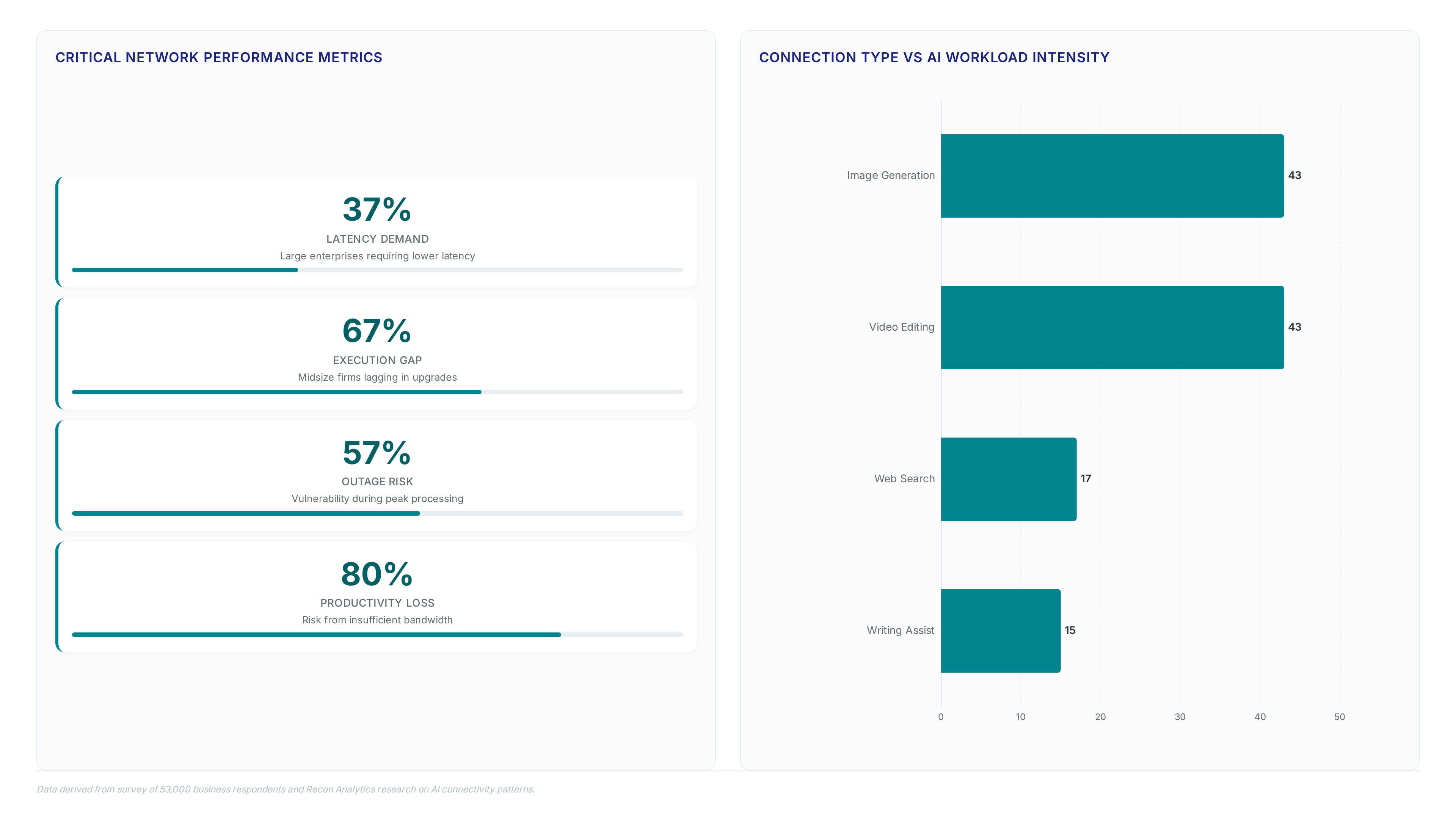
Operators must evaluate distinct signals to justify redundant paths before committing capital. Small businesses often ignore these signals until a catastrophic outage occurs, leaving them vulnerable during peak processing windows. Ignoring this gap between the needs and deployed redundancy exposes organizations to total workflow paralysis during primary link failures.
- Audit current hybrid architectures to locate bottlenecks where on-premises GPUs starve for cloud data.
- Provision a secondary diverse circuit using fiber or high-speed cable, avoiding legacy DSL that cannot support image generation workloads.
- Configure policy-based routing to fail over automatically when primary latency exceeds acceptable thresholds for real-time inference.
- Adopt Network as a Service.
Skipping the second circuit creates a hard ceiling on agentic workflow reliability, regardless of primary pipe capacity. The cost of this omission is total productivity loss during ISP outages, a risk unacceptable when AI drives core revenue. This shift prevents the connectivity chasm from widening between intent and actual operational capability. Generic broadband fails specific agentic workloads requiring deterministic paths rather than best-effort delivery.
- Deloitte.
- Provision a secondary diverse circuit using fiber, avoiding legacy DSL that cannot support image generation workloads.
- 3.4. Validate that the provider supports intent-based networking frameworks to align technical objectives with business goals.
| Evaluation Criteria | Large Enterprise Need | Midsize Gap |
|---|---|---|
| Backup Connection | Critical requirement | Often omitted |
| Access Type Change | Frequent upgrade | Moderate adoption |
| Cloud Directness | High priority | Lower focus |
The economic implication of insufficient bandwidth manifests as a measurable loss of productivity and trust, halting critical business functions. InterLIR recommends prioritizing providers who demonstrate positive commercial results from new AI-driven access requirements. Skipping this evaluation exposes the organization to total workflow collapse during primary link outages.
About
Alexander Timokhin, CEO of InterLIR, brings critical expertise to the discussion on evolving Internet access requirements driven by AI adoption. As the leader of a specialized IPv4 address marketplace founded in Berlin, Timokhin manages the fundamental network resources that underpin reliable connectivity. His daily work involves solving complex network availability problems by redistributing unused IP assets, directly addressing the infrastructure bottlenecks highlighted in recent industry surveys. With deep experience in IT infrastructure and international business relations, he understands how scaling AI operations demands reliable, scalable addressing schemes. InterLIR's mission to ensure access to critical network resources aligns perfectly with the article's thesis that AI is raising the operational stakes for Internet reliability. Timokhin's strategic oversight of clean BGP routes and secure IP reputation provides a factual foundation for analyzing how businesses must adapt their network foundations to support next-generation artificial intelligence workloads.
Conclusion
Scaling agentic systems exposes a critical fragility: single-threaded dependency on commodity broadband. As AI traffic composition shifts toward burst-heavy, synchronous model updates, the operational cost of even millisecond-level jitter compounds into rejected tokens and stalled decision loops. This is not merely a bandwidth shortage but a latency reliability gap that standard SLAs fail to address. Organizations relying on best-effort delivery will find their automated workflows throttled by unpredictable routing changes, rendering high-throughput pipes ineffective for real-time inference.
Leaders must mandate diverse physical path redundancy for all mission-critical AI clusters by Q2 2026, specifically requiring fiber-based secondary circuits rather than cable or wireless backups. Treat any provider unable to guarantee sub-20ms failover times as unsuitable for production agentic workloads. This timeline aligns with the projected surge in autonomous data flows, ensuring infrastructure matures ahead of demand spikes.
Start by auditing your current ISP contract's failure detection metrics this week to verify if automatic switchover occurs within ten seconds under load. If your vendor cannot demonstrate this capability in a controlled test, initiate RFP processes for a dedicated Ethernet alternative immediately. Securing deterministic routing now prevents the silent degradation of AI efficacy later.
Frequently Asked Questions
Large businesses lead adoption with 67% confirming changed access requirements for AI operations. In stark contrast, only 17% of small firms report similar shifts in their internet connectivity needs.
Increased bandwidth serves as the primary mitigation strategy, selected by 58% of large enterprises to ensure reliability. This focus on capacity helps prevent catastrophic failures during critical real-time inference workflows.
Small firms focus almost exclusively on raw throughput, where 54% cite increased bandwidth as their primary requirement. They often lack the capital reserves necessary to invest in complex redundant backup connections.
Data indicates 32% of midsize businesses now prioritize direct connections to data centers for better performance. This shift helps them bypass public internet congestion that severely impacts real-time AI inference speeds.
The limitation remains that 45% of firms changing access types still rely on inadequate legacy systems. These organizations risk immediate operational degradation as their current networks cannot handle exploding AI traffic loads.