NIST secure deployment: Stopping the 87% ransomware surge
An 87% surge in ransomware using DNS confirms that operators must immediately treat domain resolution as an active security control plane. (NIST's secure domain name system dns deployment guide fin...) The revised NIST Secure DNS Deployment Guide asserts that DNS is no longer passive plumbing but a critical durability dependency requiring dedicated, high-availability infrastructure to enforce policy and alter attacks.
This 2026 update, authored by Dan Fidler and Scott Rose, demands a fundamental architectural shift where recursive resolvers and firewalls actively block malicious domains before connections establish. You will learn how to deploy Protective DNS mechanisms that integrate threat intelligence directly into the resolution path, transforming your namespace into a primary defense layer against command-and-control traffic.
The guide further details the operational mechanics of encrypted protocols like DoH and DoT, moving beyond theoretical benefits to specific implementation strategies for modern zero-trust environments. Finally, the article outlines concrete steps for hardening authoritative infrastructure, ensuring your organization survives the inevitable targeting of this critical attack surface.
DNS as a Strategic Security Control Plane in Modern Infrastructure
Protective DNS as a Policy Enforcement Point in NIST SP 800-81r3
Dan Fidler published the 14 Apr 2026 revision defining Protective DNS as an active security control plane instead of passive naming infrastructure. This architectural shift positions recursive resolvers to enforce policy and filter queries before connections establish, directly addressing the 87% increase in ransomware attacks using DNS for payload delivery. Operators integrate threat intelligence feeds into Response Policy Zones (RPZs) to block known malicious domains in real-time without endpoint agents. Commercial filters often target acceptable use violations, yet this specific approach disrupts command-and-control channels to stop malware callbacks. Encrypted protocols protect query privacy while creating visibility gaps for defenders.
Mechanics of Encrypted Protocols and Namespace Validation
DoH, DoT, and DoQ Protocol Mechanics and Port Usage
NIST SP 800-81r3 mandates DoT for internal resolvers while directing remote workforce traffic through DoH on port 443. These protocols encapsulate standard DNS queries within distinct transport layers to prevent eavesdropping and manipulation on untrusted links. DoT establishes a persistent TCP tunnel over port 853, isolating resolution traffic from general web browsing streams. DoH merges DNS requests into standard HTTPS sessions, making query filtering indistinguishable from other TLS traffic without deep packet inspection. DoQ uses the QUIC transport protocol to reduce connection establishment latency compared to TCP-based alternatives.
| Protocol | Transport | Default Port | Visibility Profile |
|---|---|---|---|
| DoT | TCP + TLS | 853 | Distinct flow, easily blocked |
| DoH | HTTP/2 + TLS | 443 | Blended with web traffic |
| DoQ | QUIC + TLS | 853/443 | Low-latency, UDP-based |
External DoH endpoints bypass local policy enforcement entirely. User privacy clashes with organizational visibility here. Operators must configure endpoint policies to force resolution through trusted internal recursive servers rather than allowing arbitrary upstream selection. Failure to restrict DoH destinations renders network-side filtering ineffective against malicious domains.
Enforcing DNSSEC Validation Defaults to Prevent Silent Degradation
Resolvers must reject unsigned responses by default to prevent silent security degradation across the namespace. Leading 93% of enterprises adopting advanced filtering protocols achieved a documented risk reduction of 76%, proving validation scales effectively. The mechanism requires recursive servers to verify cryptographic signatures on every record set before caching, treating validation failures as hard errors rather than warnings. This approach transforms DNSSEC into a dependable control instead of an optional enhancement.
Applications bypassing local infrastructure for external encrypted DNS services strip organizations of query visibility and policy enforcement capabilities. This behavior shifts resolution authority away from enterprise-controlled recursive servers to public resolvers outside the administrative domain. The rising trend in the adoption of protocols like DoH and DoT enables endpoints to establish direct, encrypted tunnels that firewalls cannot inspect without breaking TLS sessions. Operators lose the ability to apply Response Policy Zones or detect command-and-control callbacks buried within standard port 443 traffic.
NIST SP 800-81r3 addresses this gap by mandating strict endpoint configuration management rather than relying on network-side interception alone. The guide specifically recommends configuring DoH for remote workers to ensure queries travel over port 443 while maintaining alignment with corporate security objectives. Failure to enforce these policies locally allows data sovereignty concerns to emerge as geopolitical tensions influence where resolution traffic terminates.
| Local Resolver | Full | Complete |
|---|---|---|
| External Encrypted | None | Bypassed |
| Managed DoH | Partial | Configurable |
The cost of unmanaged bypass is total loss of telemetry. Operators must treat endpoint policy as the primary control plane for encrypted resolution.
Operational Steps for Deploying Protective DNS and Encryption
Response Policy Zone (RPZ) Mechanics for Threat Intelligence Integration
Recursive resolvers cross-reference domain queries and returned IP addresses against threat intelligence feeds to obstruct malicious sites prior to connection establishment. This mechanism uses Response Policy Zones to rewrite answers for known-bad domains, effectively sinking traffic destined for command-and-control infrastructure. Operators deploy this by configuring resolver software to pull zone updates from trusted providers, enabling real-time policy enforcement without manual intervention.
- Define the RPZ source URL in the resolver configuration file.
- Enable policy action `NXDOMAIN` to return non-existent domain errors for matches.
- Log all policy triggers to feed security monitoring platforms.
The logic intercepts resolution requests and matches them against specific record types like `CNAME` or `IP` addresses within the policy zone. Flawed implementations in some open services mistakenly block benign domains like YouTube, creating operational friction for end users. This risk highlights why the NCSC's PDNS service distinguishes itself by blocking only identified malicious domains rather than broad content categories. A limitation is reduced visibility if attackers shift to fast-flux networks that evade static IP-based rules.
Configuring Agentless DNS Monitoring for OT and IoT Networks
Deploy agentless architecture solutions to secure OT and IoT networks where endpoint agents cannot install.
- Redirect all port 53 traffic from constrained devices to a dedicated recursive resolver enforcing policy.
- Configure the resolver to pull threat feeds via Response Directive Zones for real-time blocking.
- Forward blocked query logs to SIEM platforms like Microsoft Sentinel for correlation.
- Enable DNSSEC validation on the resolver to reject unsigned responses from upstream authorities.
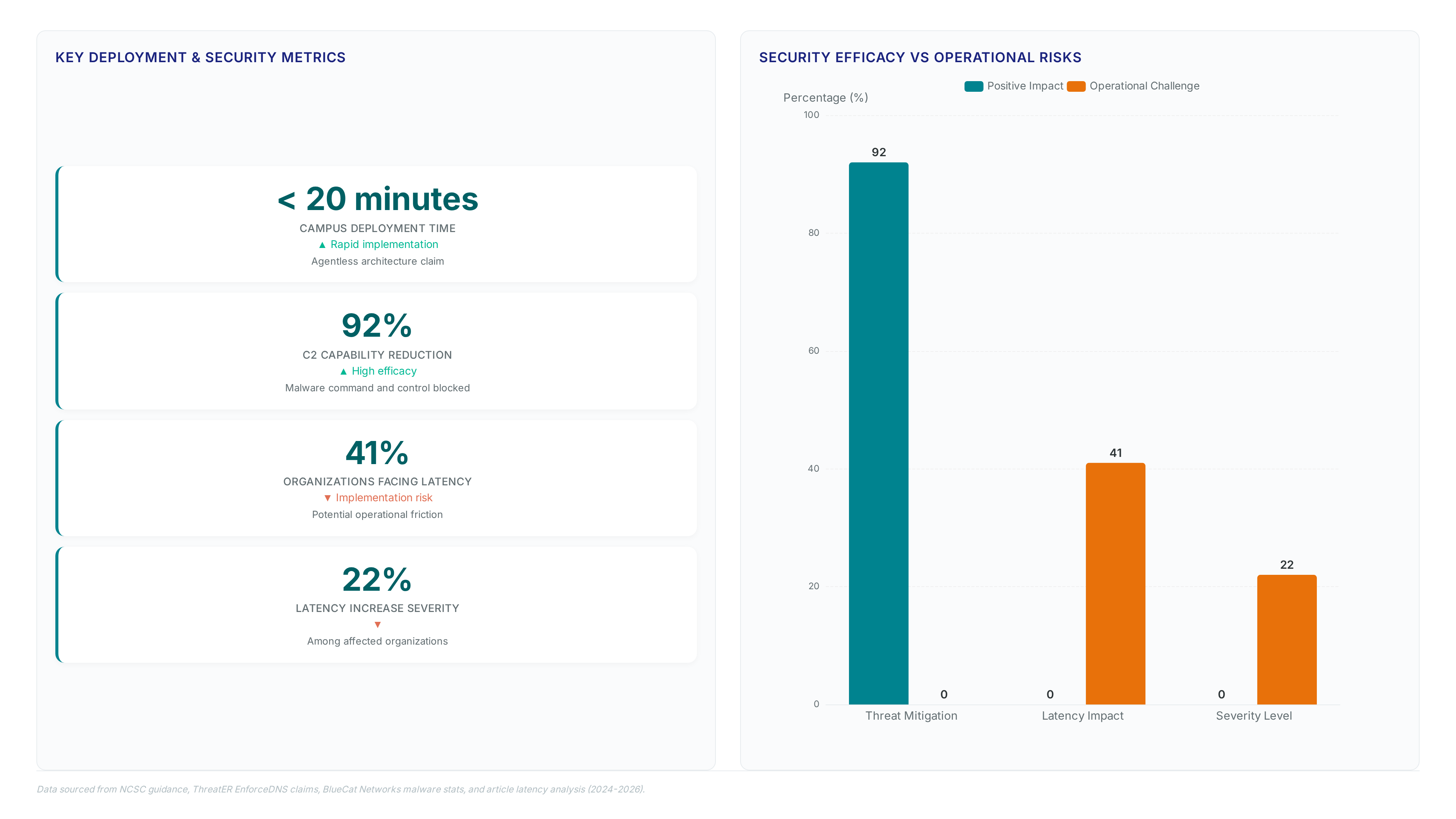
This approach transforms DNS into a lightweight control layer without touching fragile legacy firmware. Solutions like ThreatER's EnforceDNS claim full campus deployment in under 20 minutes, bypassing the need for individual device configuration. Directing traffic through a central resolver introduces a single point of failure if high-availability pairs are not staged. Operators must balance the speed of same-day implementation against the risk of concentrator bottlenecks during peak industrial polling cycles.
DoT protects queries on internal links, yet unmanaged IoT sensors often hardcode external nameservers to evade inspection. Local decryption or forced redirection becomes necessary because agentless architectures lose their telemetry advantage otherwise, leaving blind spots in critical infrastructure monitoring.
Endpoint Configuration Checklist to Prevent Encrypted DNS Bypass
Administrators must lock down DoH and DoT settings on endpoints to stop direct connections to external resolvers that evade local policy.
- Disable application-level DNS overrides in browser group policies to force reliance on system stacks.
- Block outbound traffic on port 853 and non-standard 443 flows to unauthorized IP addresses at the firewall edge.
- Configure local agents to trust only corporate root certificates, preventing flawed implementations from intercepting traffic.
- Enforce DNSSEC validation strictly on the local recursive resolver to reject unsigned responses before caching.
| Setting | Action | Risk if Ignored |
|---|---|---|
| Browser DNS | Disable Auto | Loss of query logs |
| Firewall Port 853 | Deny External | Policy bypass |
| Certificate Store | Remove Public CAs | Man-in-the-middle |
| Resolver Logic | Validate All | Cache poisoning |
Failure to restrict these protocols allows malware to apply data sovereignty loopholes by routing queries through foreign infrastructure. Relaxed policies restore speed but blind security teams to exfiltration attempts. Operators accepting this constraint lose the ability to correlate DNS telemetry with SIEM alerts during incident response.
Real-World Application of DNS Security in IoT and Enterprise Environments
Application: Agentless DNS Monitoring Architecture for OT and IoT Constraints
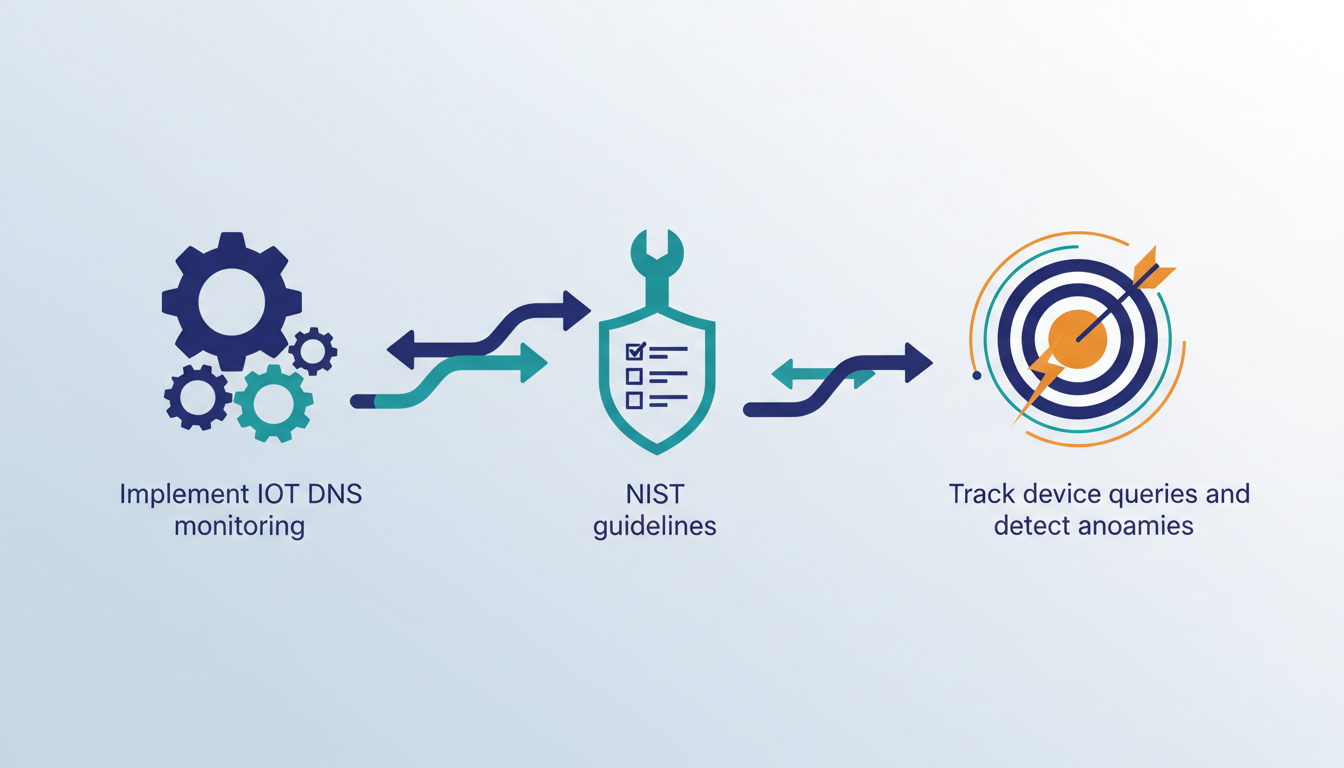
Redirecting all port 53 traffic from constrained devices to a dedicated recursive resolver removes the requirement for local software installation. This architecture uses ThreatER's EnforceDNS Recursive resolvers act as the primary enforcement point by validating DNSSEC signatures and filtering malicious queries before they reach vulnerable sensors. The Agentless architectures model contrasts sharply with endpoint-specific controls that often fail on specialized industrial hardware. Operators forward blocked query logs directly into SIEM platforms like Microsoft Sentinel to correlate threats across the facility without adding latency to the control loop. Centralization creates a single point of failure since IoT devices lose all name resolution capability if the recursive layer goes down. Unlike agent-based models, this approach does not consume device CPU cycles, preserving performance for real-time operations. Total dependence on network path integrity replaces host-based assurance as the primary constraint.
Balancing Full Query Logging Visibility with Operational Storage Costs
Full query logging creates immediate storage exhaustion in high-volume IoT deployments where device count scales exponentially. Operators facing these constraints often shift toward structured logging approaches that capture only anomalous patterns rather than every resolution event. This selective method preserves detection capability while avoiding the performance degradation seen when legacy systems attempt full telemetry ingestion. Recording every query demands substantial disk I/O, frequently overwhelming the buffering capacity of standard recursive resolvers during traffic spikes. The cost of maintaining complete archives grows linearly with network size, making total visibility financially unsustainable for large sensor fleets.
About
Alexander Timokhin, CEO of InterLIR, brings critical infrastructure expertise to the analysis of the updated NIST Secure DNS Deployment Guide. While his daily work focuses on the IPv4 address marketplace, effective IP resource management is fundamentally dependent on a secure and resilient DNS architecture. As InterLIR ensures clean BGP routes and high IP reputation for its clients, Timokhin understands that DNS vulnerabilities can directly compromise network availability and trust. His background in IT infrastructure and international public policy allows him to interpret these NIST operational standards through the lens of global network stability. By connecting strict deployment policies with the practical realities of IP redistribution, he highlights why operators must prioritize these security updates. This perspective ensures that organizations using InterLIR's resources also maintain the reliable DNS foundations necessary for modern internet reliability.
Conclusion
Scaling encrypted DNS often breaks legacy monitoring stacks that rely on clear-text inspection, creating blind spots where exfiltration hides behind valid certificates. The operational cost of maintaining hybrid decryption gateways frequently exceeds initial budget projections, especially when latency-sensitive industrial protocols fail under added cryptographic overhead. Organizations must shift from treating DNS security as a perimeter fix to viewing it as a continuous data integrity challenge. Deploying behavioral analytics alongside encryption is the only viable path forward, as static blocklists cannot catch algorithmically generated domains targeting unpatched endpoints.
Mandate a full architecture review by Q4 2027 to replace any resolver lacking native DoQ support or flexible sampling capabilities. Legacy systems causing the observed latency spikes must be retired before the March 2026 NIST compliance deadline to avoid regulatory friction. Do not wait for the final standard publication to begin this migration; early adopters gain critical time to tune false-positive rates in production. Start by auditing your current recursive resolver logs this week to identify exactly which IoT sensors are bypassing your dedicated security namespace. This immediate inventory reveals the specific gaps in your telemetry stream before attackers exploit them.
Frequently Asked Questions
You can complete full campus deployment in under 20 minutes using modern solutions. This rapid setup bypasses the need for installing individual agents on every single endpoint device within your infrastructure.
Advanced algorithms successfully identify 91% of zero-day malicious domains by analyzing query patterns. These models detect anomalous entropy that static blocklists miss, providing crucial protection against rapidly rotating threat infrastructure.
About 41% of legacy systems experience latency increases when modern security protocols are applied. This degradation poses tangible risks for time-sensitive applications running on older infrastructure stacks.
The UK NCSC service successfully shields 7.2 million users across emergency services and schools. This large-scale adoption demonstrates how recursive resolvers can actively enforce policy without requiring complex endpoint configurations.