Origin validation: Why 60% of routes now use RPKI
Over 60% of global IPv4 routes now possess Route Origin Authorizations. RPKI adoption has hit critical mass. By using cryptographic proofs, network operators can definitively verify if an Autonomous System is authorized to announce specific IP prefixes.
The IETF sidr Working Group standards enable Regional Internet Registries to issue resource certificates that validate holdership. We will detail the operational mechanics of creating ROAs to define authorized origin AS numbers and maximum prefix lengths. Routers apply these records to classify announcements as valid, invalid, or unknown based on cryptographic attestation.
Current data aggregation platforms monitor this environment across more than 5,000 vantage points. Local validation remains efficient, requiring only approximately 13 MB of memory to store over 400,000 records. Despite roughly 550,000 route announcements on the Internet today, the primary threat remains unintentional mis-origination rather than malicious attacks. Implementing these checks allows operators to reject invalid paths before they propagate, neutralizing common routing errors without complex hardware upgrades.
The Role of RPKI and ROAs in Secure Internet Routing
RPKI Resource Certificates and ROA Cryptographic Proof
A resource certificate provides validatable proof that an entity holds an IP allocation assigned by a Regional Internet Registry. This digital credential acts as the cryptographic anchor allowing network operators to construct Route Origin Authorisations (ROAs) without ambiguity. Operators use these certificates to generate cryptographically validatable statements confirming which Autonomous Systems may originate their specific prefixes.
Routing security shifts from a trust-based model to a proof-based framework where authorization becomes mathematically verifiable. Open standards developed within the sidr Working Group drive this process to prevent accidental mis-origination of address space. Signing a ROA explicitly authorizes an AS to announce a prefix up to a set maximum length. Peers then validate these announcements against the RPKI infrastructure to determine route validity. Data indicates that over 60% of global IPv4 routes now possess ROA coverage, notably reducing the risk of hijacking. The system currently validates only the origin AS while leaving the full AS path unchecked until future IETF standards mature. Unauthorized origins get blocked, yet path manipulation remains a potential vector for disruption. BGP Origin Validation serves as a core step rather than a complete solution for secure inter-domain routing.
BGP Origin Authentication Mechanics and Router Memory Footprint
BGP Origin Verification answers whether a specific route announcement is authorized by the legitimate holder of that address space. This mechanism relies on cryptographic statements called Route Origin Authorisations to distinguish valid paths from accidental mis-origination events. Operators configure routers to prefer announcements matching these signed records while deprioritizing unknown or invalid claims.
Implementing local validation requires minimal hardware resources despite the growing global routing table size. A sample router configuration displayed 367,569 BGP entries using memory for standard network entries. In the same observed setup, the system stored 407,525 BGP SOVC record entries consuming just 13 MB of memory for validation data. This memory footprint proves negligible on modern aggregation routers but warrants attention for legacy hardware deployments.
Strict rejection policies create friction during RPKI outages. If a validator loses connectivity to RIR repositories, routers lack current data to verify new announcements accurately. Network engineers must balance immediate traffic flow against long-term integrity goals when tuning local preference values.
Current RPKI Origin Validation Versus Future Secure BGP Path Validation
BGP Origin Checking currently verifies only the originating Autonomous System against signed records. This mechanism effectively blocks accidental mis-origination but leaves the intervening path unprotected from manipulation. The upcoming evolution toward true Secure BGP aims to validate the entire AS path rather than just the source. Standards for this path validation are actively being developed within the IETF to close this specific security gap.
Future protocols will cryptographically bind every hop in the route unlike the current model which accepts any path from a valid origin. Operators relying solely on current origin checks remain vulnerable to sophisticated route leaks where the origin is correct but the path is compromised. InterLIR Marketplace advises networks to maintain strong origin validation today while preparing infrastructure for these extended path checks. The transition ensures continuity as the system shifts from partial to complete routing integrity.
How RPKI Validates Route Announcements Against Cryptographic Proofs
RPKI Validity States: Valid, Invalid, and Unknown Logic
Cryptographic matching against published Route Origin Authorisations assigns every single route announcement a specific validity state. This logic dictates whether a router accepts, rejects, or questions an incoming prefix announcement pulled from the global table. The validation engine compares the announcing Autonomous System and prefix length against signed records to assign one of three statuses:
| State | Cryptographic Condition | Operational Outcome |
|---|---|---|
| VALID | The route announcement is covered by at least one ROA | Route is accepted as authorized |
| INVALID | Origin AS is unauthorized or prefix exceeds max length | Route is rejected to prevent hijacking |
| UNKNOWN | No covering ROA exists for this prefix | Route is treated per local policy |
A VALID result confirms the route announcement is covered by at least one ROA. An INVALID flag indicates the prefix is announced from an unauthorised AS, or the announcement is more specific than is allowed by the maximum length set in a ROA that matches the prefix and AS. The UNKNOWN state arises when the prefix in an announcement is not covered (or only partially covered) by an existing ROA. Configuring routers to drop INVALID routes immediately hardens the network against accidental mis-origination events that plague the current infrastructure. Relying solely on origin checks leaves the path itself vulnerable until full path validation standards mature. InterLIR Marketplace encourages optimizing these resources by registering missing authorizations to achieve full cryptographic visibility across your portfolio.
Applying Maximum Prefix Length to Prevent Over-Specific Announcements
The maximum length field in a Route Origin Authorisation acts as a strict ceiling, marking any announcement more specific than allowed as INVALID. When a legitimate holder publishes a ROA for 192.0.2.0/24 with a maximum length of /24, a subsequent /25 announcement from the same Autonomous System immediately fails validation checks. This specific mismatch triggers an INVALID state because the prefix exceeds the authorized specificity, regardless of the originator's identity.
| Condition | Validation State | Router Action |
|---|---|---|
| Prefix matches ROA max length | VALID | Accept |
| Prefix exceeds ROA max length | INVALID | Reject |
| No covering ROA exists | UNKNOWN | Policy Dependent |
Operators must define this limit carefully, as omitting it defaults authorization to the exact prefix length only. A common deployment error involves creating ROAs without explicit maximum lengths, leaving legitimate sub-allocations stranded in an UNKNOWN state where routers cannot cryptographically verify them. This gap forces networks to rely on local policy rather than cryptographic proof for those specific routes. Granular traffic engineering competes with strict security here. Overly permissive maximum lengths reduce hijack detection precision, while restrictive ones risk dropping legitimate traffic during maintenance. Proper configuration prevents accidental self-sabotage while maintaining a strong security posture against prefix hijacking attempts.
Risks of Partial ROA Coverage and Unintentional Mis-Originations
Partial ROA coverage creates UNKNOWN validity states where the prefix is not covered by an existing ROA. With approximately 550,000 route announcements circulating globally, the most frequent routing incident remains an operator unintentionally announcing a prefix they do not hold. When a specific sub-prefix lacks cryptographic authorization, routers cannot distinguish between a legitimate new deployment and a potential hijack attempt based solely on origin validation. This ambiguity forces networks to rely on legacy policies rather than definitive cryptographic proofs found in RPKI infrastructure.
The operational risk manifests clearly when coverage is incomplete:
- Routes in the UNKNOWN state are not covered by cryptographic proof, requiring reliance on traditional routing policies.
- Accidental mis-origination events persist unchecked in gaps where no ROA exists.
- Partial coverage means the collective security posture of the global routing table is not yet universal.
- Unverified segments increase the likelihood of traffic hijacking during convergence events.
- Network stability suffers when legitimate updates compete with unauthorized claims in the absence of clear records.
InterLIR Marketplace emphasizes that optimizing existing IPv4 resources requires full cryptographic visibility to prevent these errors. Operators must audit their announcements to ensure every active prefix matches a signed record. Leaving any segment without coverage invites confusion during convergence events. The industry cannot claim full security while significant portions of the routing table remain cryptographically invisible. Increasing coverage reduces the UNKNOWN state, ensuring more announcements are either explicitly authorized or rejected.
Operational Steps for Creating ROAs and Enabling Origin Validation
Defining the ROA Creation Workflow via RIR Portals

Accessing your Regional Internet Registry portal initiates the cryptographic binding of prefixes to Autonomous Systems. Network operators must log into their specific RIR interface to generate Route Origin Authorisations using valid resource certificates. This process replaces unverified text databases with signed data that routers trust implicitly.
- Navigate to the RPKI management section within your RIR account dashboard.
- Select the specific IPv4 prefix and enter the authorized origin Autonomous System number.
- Define the maximum length to prevent accidental over-specific announcements from invalidating your route.
- Sign and publish the object to distribute it across the global validation infrastructure.
Unlike legacy registries, this workflow ensures that only the legitimate holder can authorize route announcements for their space. Proper setup prevents the most common routing errors, such as accidental mis-origination, while securing the network edge against hijacking attempts.
Configuring Router Origin Validation Policies and Memory Allocation
Configure your router to pull updates from the cache server on TCP port 3323. Apply route maps that drop INVALID routes while accepting VALID and UNKNOWN states based on policy.
Memory allocation for this process remains efficient on modern hardware. A sample router configuration displaying BGP SOVC statistics showed a table containing 367,569 BGP entries using approximately 58.8 MB of memory. This lightweight footprint allows even legacy-capable aggregation routers to enforce strict filtering without performance degradation. However, operators must recognize that current RPKI functionality solely offers origin validation, leaving path attributes unverified until true Secure BGP standards mature within the IETF.
| Configuration Step | Technical Requirement | Operational Impact |
|---|---|---|
| Validator Deployment | Local cache server | Reduces RTR load |
| Memory Allocation | Efficient resource usage | Negligible on modern gear |
| Policy Enforcement | Drop INVALID | Prevents accidental mis-origination |
Securing your infrastructure requires optimizing these existing resources rather than waiting for future protocol upgrades. Thorough coverage reduces the risk of accidental mis-origination events that alter global traffic flow. Regular audits ensure your cryptographic statements remain current as network topologies evolve.
Validation Checklist for ROA Coverage and Prefix Specificity
Secure your BGP origin confirmation posture by verifying that every announced prefix matches an existing Route Origin Authorisation. Operators must confirm their specific Autonomous System number aligns exactly with the authorized origin listed in the registry data.
- Audit all active announcements to ensure no prefix exceeds the maximum length set in your published ROA.
- Cross-reference your routing table against the cache to identify any routes falling into an UNKNOWN state due to missing coverage.
- Apply strict filtering policies that reject INVALID routes while monitoring VALID signals for stability.
Overly broad ROAs prevent necessary traffic engineering, yet excessive specificity risks accidental invalidation. This limitation requires balancing operational flexibility with cryptographic strictness to maintain connectivity. Thorough coverage reduces the risk of accidental mis-origination events that alter global traffic flow. Regular audits ensure your cryptographic statements remain current as network topologies evolve.
Strategic Value of BGP Security for Modern Network Operators
Strategic Value of RPKI Origin Validation for Network Integrity
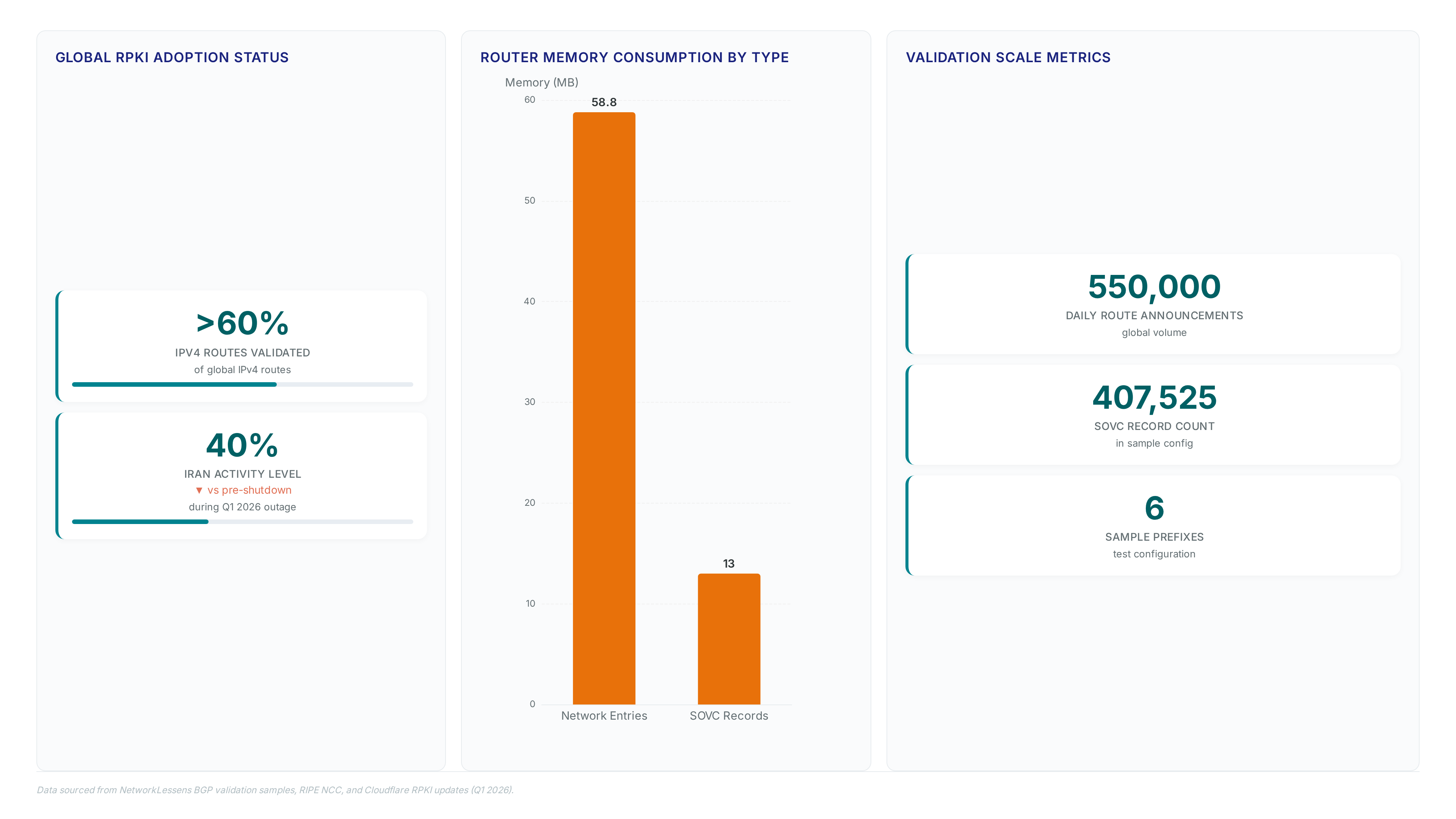
Answering whether a legitimate holder authorized a specific route announcement defines the core function of RPKI. Approximately 550,000 route announcements traverse the global Internet today, yet accidental mis-origination persists as the most frequent routing error observed in production networks. Network operators use Route Origin Authorisations to cryptographically bind prefixes to specific Autonomous Systems, replacing fragile trust assumptions with mathematical proof. This mechanism filters invalid paths before they alter customer connectivity or trigger broader instability.
Implementing such a validation layer fundamentally changes how networks manage uncertainty during regional outages. When network activity in a region drops to just 40% of normal levels due to external disruptions, distinguishing between legitimate policy changes and malicious hijacks becomes impossible without cryptographic signals. The strategic imperative involves converting UNKNOWN states into verified data points, ensuring routing decisions reflect actual ownership rather than transient visibility.
Rejecting all UNKNOWN routes maximizes security instantly but penalizes neighbors who have not yet adopted the standard. Balancing these factors preserves connectivity while incentivizing the broader community to publish missing ROAs for their assets.
Operationalizing Route Origin Authorizations to Prevent Prefix Hijacking
Crafting Route Origin Authorisations that bind an IPv4 prefix to a single authorized Autonomous System fixes invalid BGP routes effectively. This cryptographic statement explicitly defines the maximum prefix length allowed, preventing accidental over-specific announcements from triggering rejection filters. Routers mark a path as INVALID when a mismatch occurs between the announcement and the ROA, effectively stopping hijacks before propagation. Operators should implement strict filtering policies that drop these invalid signals while accepting valid traffic. The validation process relies on checking the origin AS against a local cache of signed records.
- Valid routes match an existing authorization and origin pair.
- Invalid routes fail due to wrong AS or excessive specificity.
- Unknown states indicate missing coverage rather than malicious intent.
Security strictness often conflicts with operational flexibility. Rejecting all unknown paths improves safety but risks disconnecting peers who lag in RPKI adoption. Most networks today accept unknown states while dropping invalid ones to balance safety with reachability. Deploying this logic requires minimal resources because modern routers handle the validation load efficiently without impacting forwarding performance. Teams can inspect these states directly using standard `show route validation-state` commands on edge devices. This approach allows verification that maximum length settings do not inadvertently block legitimate sub-prefix advertisements during maintenance windows.
Application: Current RPKI Origin Validation Versus Emerging BGP Origin Attestation Standards
Immediate implementation of RPKI remains advisable while awaiting stronger protocols. Current RPKI deployment secures the majority of IPv4 space against accidental mis-origination today. The industry shifts toward proactive prevention, yet existing mechanisms still rely on transitive trust or unverified text data until cryptographic proof replaces them entirely. Network operators now use cryptographically signed authorizations to validate that an Autonomous System legitimately holds a prefix.
The emerging standard for BGP Origin Attestation aims to evolve this model from simple origin checks to full path validation. This shift moves routing from reactive filtering to proof-based routing where every hop carries verification. Operators must rely on the current origin validation layer to mitigate the most frequent routing errors until these attestation drafts mature.
Delaying RPKI adoption for future attestation standards leaves networks vulnerable to immediate hijacking risks. Perfect path validation is not available yet, but origin protection is available now. InterLIR recommends implementing strict ROA coverage immediately to secure IPv4 assets. The cost of inaction exceeds the effort of configuring current validators.
About
Vladislava Shadrina, Customer Account Manager at InterLIR, brings necessary frontline perspective to the critical topic of BGP Origin Authentication. While her background spans architecture, her daily work at InterLIR focuses on managing client relations within the complex IPv4 marketplace, where secure resource transfer is paramount. At InterLIR, a Berlin-based leader in IPv4 address redistribution, Vladislava ensures clients understand that acquiring IP space involves more than just transactions; it requires maintaining clean BGP routes and valid Route Objects. Her role directly connects to RPKI adoption because she guides customers through the necessity of cryptographically validating route announcements to prevent hijacking. The operational breaking point is not hardware capacity but the persistence of legacy filtering policies that ignore cryptographic proof. Waiting for BGP Origin Attestation to mature before acting is a strategic error, as current drafts do not mitigate the immediate threat of prefix hijacking available today. Networks must prioritize securing the origin layer now rather than deferring protection for hypothetical path validation features.
Organizations should mandate strict ROA creation for all announced prefixes within the next 30 days, treating any unvalidated announcement as a policy violation. This timeline aligns with the rapid pace of global adoption while leaving room for future integration of proof-based routing standards. Do not let the promise of perfect path verification paralyze current defense mechanisms. Start by running `show route validation-state` on edge routers this week to identify any valid routes currently marked as invalid or unknown due to missing local configuration.
Frequently Asked Questions
Local validation requires only 13 MB to store over 400,000 records efficiently. This small footprint ensures modern routers handle [BGP Origin Validation](https://www.ripe.net/manage-ips-and-asns/resource-management/rpki/bgp-origin-validation/) without needing complex hardware upgrades or significant resource allocation.
Standard network entries utilize approximately a large number while validation data needs just 13 MB. This disparity shows operators can enable security checks with minimal impact on existing router memory resources.
Over 60% of global IPv4 routes now possess Route Origin Authorizations for verification. This critical mass means most accidental mis-origination events can now be detected and rejected by participating network operators globally.
Routers may lack current data to verify new announcements accurately if connectivity is lost. Operators must balance immediate traffic flow against long-term integrity goals when tuning local preference values for unknown states.
The system currently validates only the origin AS while leaving the full path unchecked. Future IETF standards aim to validate the entire AS path rather than just the source to stop path manipulation.