Path length traps: Why short routes risk security
75% of enterprises will modernize infrastructure by 2027. Many will stumble on the same rock: treating AS path length as a trust signal. It isn't. Shorter paths do not equal safer paths. They just equal shorter paths.
Real security demands validating origins against cryptographic proofs, not counting hops. This article dissects the deterministic role of RFC 4271 standards. We confirm that AS path evaluation happens fourth-only after Weight, Local Preference, and Origin type have already filtered the candidate set. Attackers know this ordering. They exploit it via BGP hijacking, manipulating attributes to bypass naive length filters while legitimate traffic gets stranded by artificial prepending.
Theory ends where mitigation begins. We detail how Juniper Networks implementations like `as-path-ignore` and broader RPKI validation frameworks provide the actual guardrails.
The urgency here is real. In January 2026, author bogdancyber issued a correction on the NANOG mailing list, retracting claims that short paths guarantee proven propagation. The retraction clarifies a hard truth: route survival depends on operator filtering policies and peer relationships, not attribute counts. Shift your focus from superficial metrics to reliable route filtering strategies. That is how you build durability against interception attempts that game legacy algorithms.
The Deterministic Role of AS path Length in RFC 4271 Route Selection
AS path Length as the Fourth Criterion in RFC 4271 Route Selection
Stop treating AS path length as a primary decision maker. It functions as the fourth criterion within the BGP best path selection algorithm. It activates only after Weight, Local Preference, and locally originated routes undergo evaluation. RFC 4271 Section 9 mandates removing routes not tied for having the smallest number of AS numbers. This strictly limits the metric to a tie-breaker role.
Operators frequently misinterpret shorter paths as indicators of higher credibility. Propagation depends entirely on filtering policies and peer relationships rather than hop count alone. The standard BGP path selection sequence confirms that AS path prepending artificially lengthens paths to influence inbound traffic only after higher-priority attributes fail to resolve the decision.
Here is the operational reality: manipulating path length for traffic engineering yields no effect if a competitor advertises a superior Local Preference value. Network engineers must recognize that AS path optimization remains secondary to policy-based controls within the autonomous system boundary. Ignoring this order leads to ineffective routing adjustments where expected traffic shifts never materialize due to upstream preference overrides.
AS path prepending artificially lengthens paths to steer inbound traffic when Local Preference cannot reach external peers. This technique inserts duplicate AS numbers into outbound updates, triggering remote routers to deprioritize the route based on the fourth criterion of the selection algorithm. Prepending directly manipulates how external neighbors perceive path cost, whereas Local Preference remains confined within a single autonomous system boundary. Operators deploy this method to balance load across multiple entry points without altering internal routing policies. A large content provider successfully used path manipulation to distribute incoming flows evenly, proving efficacy in multi-homed architectures.
The limitation remains strict. Prepending fails if upstream filters strip duplicate entries or if Weight overrides the decision locally. Shorter paths do not guarantee propagation, as filtering policies often supersede length metrics entirely. Engineers must verify that remote peers honor the inflated count before relying on this for traffic engineering. The cost involves reduced path efficiency for improved ingress distribution control.
Shorter AS paths do not guarantee propagation because Local Preference and filtering policies dominate the decision tree before length evaluation. Stating path length directly affects origin credibility was a mistake in expression; actual route adoption relies on operator trust relationships rather than hop counts. The standard BGP best path algorithm evaluates Weight and Local Preference prior to considering AS path size, rendering short paths irrelevant if higher-priority attributes differ. RPKI-enabled routers insert an Origin Validation state check before Local Preference. This fundamentally alters the decision tree by explicitly tagging invalid routes for rejection regardless of length.
Mechanics of BGP Hijacking and the Limitations of Path Length Analysis
Over 50% of BGP prefixes hold Route Origin Authorizations, yet only a quarter of systems enforce strict validation. This disparity creates a compliance without security state where registered resources remain vulnerable to origin hijacks. Operators incur the administrative burden of creating ROAs but fail to realize the protective benefit because they do not enable filtering policies that reject invalid announcements. The result is a false sense of safety; the registry data exists, but the router ignores it during best-path selection.
| Validation Mode | Traffic Protection | Risk Profile |
|---|---|---|
| No ROV | None | Full exposure to hijacks |
| Permissive ROV | Partial | Accepts invalid routes |
| Strict ROV | 56.4% | Rejects invalid origins |
Enabling strict mode introduces operational fragility alongside security gains. Misconfigured RPKI/ROA validation records cause immediate connectivity blackouts for dependent customers. Data indicates 3.1% of such configuration errors result in full connectivity loss, forcing a trade-off between security posture and availability guarantees. Network teams must audit local operator filtering policies before flipping the enforcement switch to avoid self-inflicted outages. You must balance the vast majority of invalid routes caused by human error against the need to block malicious activity. This approach mitigates the risk of dropping legitimate traffic due to stale or incorrect registry data while closing the enforcement gap.
Modeling Hijack Risk Through AS path Length and Internal Route Selection
Shorter AS path lengths signal higher probability of internal selection rather than inherent origin credibility. The BGP best path algorithm evaluates Weight and Local Preference before considering hop count, rendering short paths irrelevant if higher-priority attributes differ. Risk modeling treats unusually short paths from unexpected peers as potential hijack indicators requiring immediate scrutiny. Experimental data shows 7.1% of misconfigured prefixes experience degraded routing with added latency, highlighting the operational cost of false positives.
| Path Characteristic | Selection Likelihood | Risk Indicator |
|---|---|---|
| Unexpectedly Short | High internally | Potential hijack |
| Artificially Long | Low externally | Traffic engineering |
| Standard Length | Variable | Normal operation |
Operators must distinguish between legitimate traffic engineering and malicious announcements mimicking short paths. The processing time for validation logic introduces latency that complicates real-time detection systems. Relying solely on path length ignores the reality that operator filtering policies dominate actual propagation outcomes. A short path from an untrusted peer carries more risk than a longer path from a validated source. This approach shifts focus from deterministic metrics to probabilistic risk assessment based on peer trust. Substantial carriers like NTT and AT&T now drop announcements based on validity status, turning configuration mistakes into outages. The validation outcomes define three states-Valid, Invalid, and Not-Found-yet only a fraction of systems actively reject the Invalid category. This gap exposes networks to hijacks while simultaneously risking self-inflicted blackholes when ROAs mismatch live configurations.
| Validation State | Operator Action | Consequence |
|---|---|---|
| Valid | Accept | Normal propagation |
| Invalid | Drop | Full connectivity loss |
| Not-Found | Accept | Potential exposure |
Implementing tooling approaches reveals that passive monitoring differs significantly from active rejection logic deployed at the edge. The operational burden increases as the system grows more complex, requiring precise coordination between registry data and router policy. A single typo in an AS number triggers the Invalid state, causing routers to discard legitimate traffic instantly. This fragility demands rigorous change management processes before enabling strict filtering.
The tension between security and availability forces a choice: tolerate potential hijacks or risk outage from internal errors. Most teams lack the automation to detect ROA mismatches in real-time, leaving them vulnerable during updates.
Implementing RPKI Validation and Route Filtering for Secure Intelligence
Defining RPKI Validation and ROA Coverage Metrics
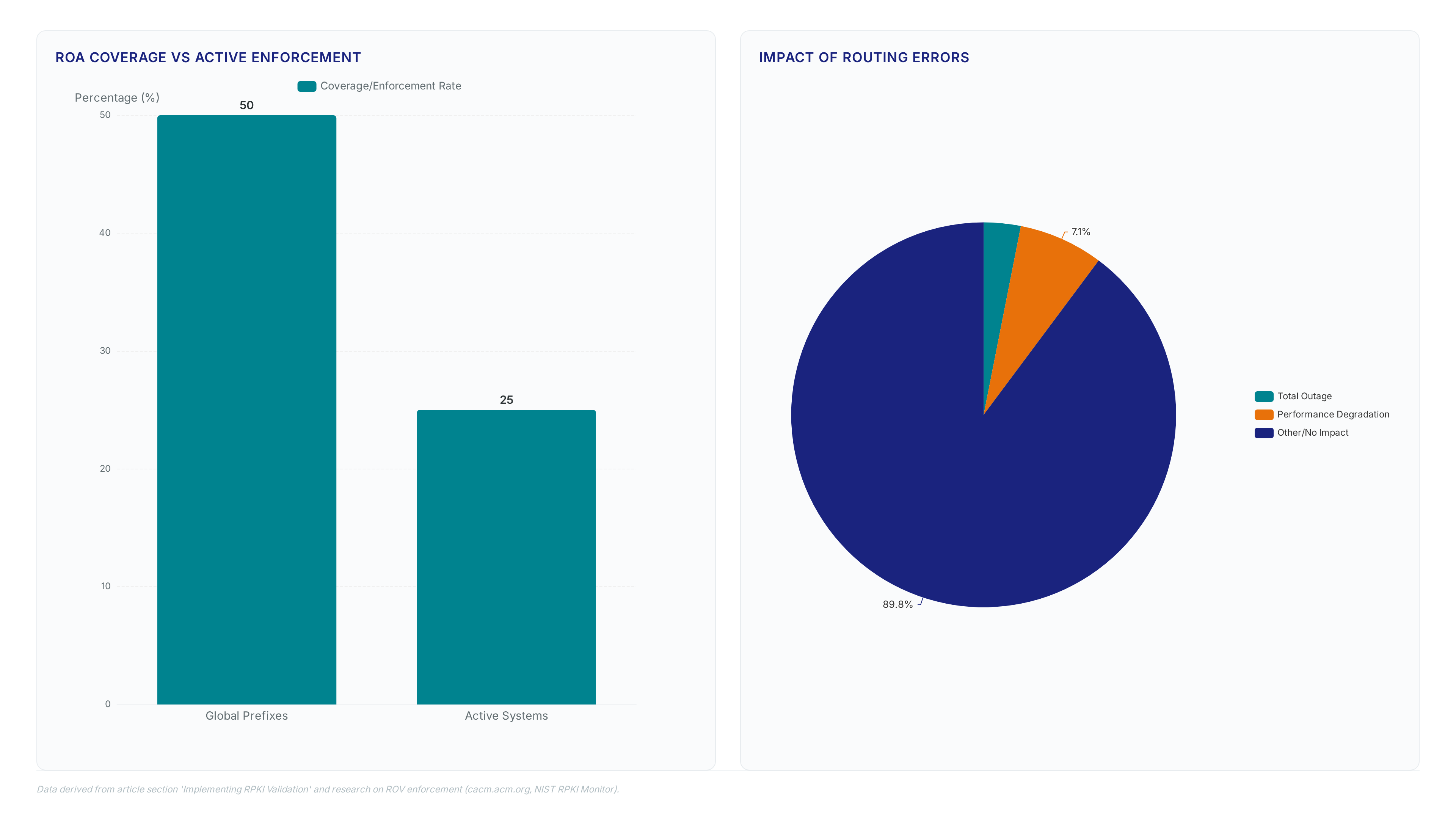
Route Origin Validation compares announced paths against signed Route Origin Authorizations to determine legitimacy. Distinguishing between mere prefix registration and active enforcement closes the security gap. Over half of global prefixes hold valid ROAs, yet a significant majority of routers accept invalid announcements without filtering. Networks remain exposed despite available cryptographic data. A small fraction of prefixes prone to degraded routing before enforcing hard drops.
Implementation follows a strict sequence to integrate validation into the decision process:
- Establish a trust anchor connection to fetch the RPKI repository data.
- Configure the router to evaluate the validation state before applying local preference rules.
- Apply drop policies specifically to routes marked as invalid to prevent hijack propagation.
- Monitor rejection logs to identify misconfigurations before they cause traffic loss.
Immediate security conflicts with operational continuity during rollout. Enabling strict rejection too quickly risks blackholing legitimate traffic due to stale registry data. Passive measurement tools like Cloudflare's safety checker reveal that many peers still originate invalid routes accidentally. This method captures the human error patterns responsible for most invalidations without triggering immediate outages.
Configuring Route Filtering Policies at Internet Exchange Points
Strict route filtering at IXPs maps RPKI states directly to drop actions before best-path selection evaluates AS path length.
- Ingest the full RPKI dataset into the route server cluster to enable real-time validation state tagging for every received announcement.
- Apply policy rules that immediately reject Invalid routes, mirroring the strict enforcement now standard among substantial transit providers like NTT and AT&T who drop invalid announcements at majority of Internet Exchange Points.
- Analyze the AS path attribute in security telemetry to identify patterns where human error creates Invalid states, which account for the vast majority of rejected prefixes rather than malicious hijacks.
Security hygiene conflicts with availability. Enabling strict rejection risks blackholing legitimate traffic if operator filtering policies lag behind ROA creation rates. Prefix registration exceeds active enforcement across the industry. Networks incur administrative costs for ROA creation. This "compliance without security" state leaves systems vulnerable while offering false confidence in path integrity. Failure to align filtering logic with actual ROA coverage creates a false security perimeter that attackers bypass easily. Operators must distinguish between creating Route Origin Authorizations and actively filtering invalid announcements to avoid self-inflicted blackholes.
Deploy validation in stages to prevent total connectivity loss:
- Enable RPKI validation in monitor-only mode to log Invalid states without dropping traffic.
- Audit local prefix configurations against fetched ROA data to identify mismatches before enforcement.
- Switch to strict drop policies only after confirming ground-truth datasets show zero local errors.
| Deployment Mode | Traffic Impact | Security Posture |
|---|---|---|
| Monitor Only | None | Low visibility |
| Strict Drop | High risk if misconfigured | Maximum protection |
| Graduated Filter | Degraded performance | Balanced risk |
Lost revenue during outage windows measures the cost of skipping the audit phase. A phased approach mitigates the risk of self-inflicted outages while transitioning toward the global standard where over half of internet bits flow to valid routes.
Operationalizing BGP Security Intelligence to Prevent Route Hijacks
Defining BGP Security Intelligence and Rapid Response Logic
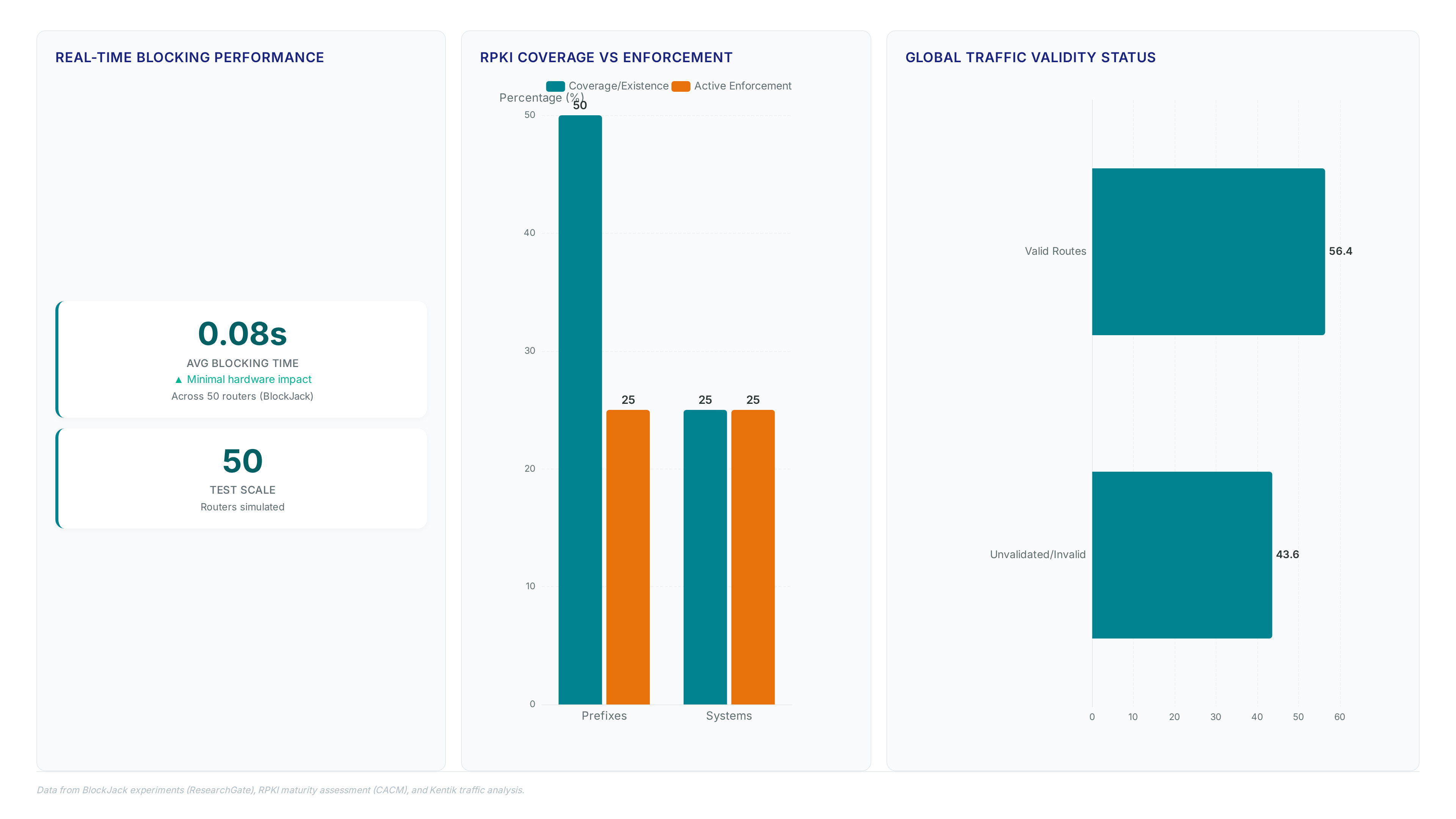
BGP security intelligence platforms ingest route data to detect anomalies quicker than manual analysis allows. These systems distinguish between passive monitoring, which logs events for post-mortem review, and active blocking mechanisms that intervene in real-time. Experimental validation of the BlockJack system demonstrated an average blocking time of 0.08 seconds across 50 routers during simulated hijack events. This performance metric confirms that rapid response logic requires minimal hardware upgrades to deploy effectively in production environments. Operators must recognize that passive visibility alone fails to stop propagation before damage occurs.
Active intervention introduces a tension between speed and accuracy that demands precise tuning. Tools like the RPKI Monitor analyze BGP table dumps to categorize prefixes, providing the baseline data necessary for automated decision engines. However, relying solely on path length heuristics without cryptographic validation risks false positives. Shorter paths often win best-path selection, yet they may represent sophisticated hijacks rather than legitimate optimizations. The cost of incorrect blocking is total connectivity loss for affected prefixes.
| Passive Monitoring | Minutes to hours | High exposure window |
|---|---|---|
| Active Blocking | Sub-second | Potential false positive |
Networks ignoring this distinction remain vulnerable despite having full visibility into routing tables.
Applying AS path Length Analysis to Model Hijack Risk
RFC 4271 mandates selecting the route with the fewest AS numbers, making artificially short paths a primary hijack indicator. Operators model risk by flagging announcements where the AS path length deviates sharply from historical baselines for that prefix. Malicious actors often rely on this selection criterion, knowing routers prefer shorter paths over longer, legitimate ones. A large content provider previously manipulated AS path attributes via prepending techniques. However, relying solely on path length ignores origin validity, creating blind spots where short but authorized paths mask deeper propagation issues. The cost of this narrow focus is measurable: without cryptographic validation, networks cannot distinguish between efficient engineering and active interception. Proven intelligence platforms must correlate path metrics with origin data to reduce false positives.
Rapid intervention remains feasible, as experimental systems like BlockJack processed blocking decisions in 0.08 seconds across 50 routers. This speed confirms that rapid response logic imposes negligible latency on modern forwarding planes. Yet, deploying such logic requires distinguishing between human error and malicious intent, a nuance pure path analysis misses.
RPKI validator CPU consumption rose sharply in 2025, forcing operators to upgrade hardware before enforcing strict ROV policies. Large transit providers managing thousands of sessions face disproportionate latency when validating full tables against expanding cryptographic material. Infrastructure costs escalate because phased activation becomes mandatory to prevent customer impact during resource exhaustion.
| Validation Mode | Resource Impact | Deployment Risk |
|---|---|---|
| Monitor Only | Low | Minimal |
| Strict Reject | High | Connectivity Loss |
| Hybrid | Medium | Configuration Drift |
Rapid response logic like BlockJack proves proven blocking requires negligible compute compared to full path validation. According to experimental data, such systems process decisions in 0.08 seconds, suggesting minimal hardware upgrades. Operators ignoring this thermal threshold risk dropping valid routes when validators stall under load. InterLIR recommends sizing validation clusters for peak load rather than average daily volume to maintain stability.
About
Evgeny Sevastyanov serves as the Support Team Leader at InterLIR, a specialized IPv4 marketplace based in Berlin. His daily responsibilities involve managing critical network resources, including the precise creation and maintenance of RIPE and APNIC database objects. This hands-on experience makes him uniquely qualified to discuss AS path mechanics, as he routinely verifies route object integrity to ensure clean BGP announcements for clients. At InterLIR, where security and transparency are core values, understanding how path attributes influence route propagation is necessary for preventing hijacks and ensuring reliable IP leasing. Sevastyanov's direct involvement in troubleshooting connectivity issues and optimizing BGP configurations allows him to provide factual, practical insights into how AS path lengths impact global routing stability. His work bridges the gap between theoretical routing protocols and the real-world demands of enterprises modernizing their network infrastructure today.
Conclusion
Scaling RPKI validation exposes a critical fragility: CPU exhaustion during global table updates creates windows where malicious routes slip through before mitigation logic engages. While experimental blockers like BlockJack demonstrate sub-second reaction times, the underlying validator infrastructure often bottlenecks at scale, turning cryptographic rigor into a denial-of-service vector against the defender. The industry shift toward SONiC-based architectures in 2026 offers a necessary escape hatch, allowing operators to offload heavy validation tasks to specialized containers rather than choking the control plane. However, simply upgrading hardware without architectural segmentation will only delay the inevitable collision between expanding prefix tables and finite processing cycles.
Organizations managing over 5,000 prefixes must migrate to a decoupled validation model by Q4 2027, separating the trust anchor processing from the forwarding decision engine. Do not wait for a stall event to justify this capital expenditure; the latency spike during peak routing churn is predictable and preventable. Start by auditing your current validator cluster's CPU headroom during the next global RPKI refresh cycle this week. If utilization exceeds a high threshold during these windows, immediately provision a dedicated validation node isolated from your primary route reflectors. This specific isolation ensures that cryptographic verification delays never degrade your data plane's ability to react to active hijacks.
Frequently Asked Questions
No, shorter paths do not guarantee propagation because filtering policies dominate. Actual adoption relies on operator trust relationships rather than simple hop counts alone.
The router evaluates AS_PATH length only as the fourth criterion after other checks. It acts strictly as a tie-breaker when prior attributes fail to resolve the decision.
Yes, attackers manipulate path attributes to bypass naive length-based filters easily. Legitimate traffic often suffers from artificial prepending while malicious routes gain preference upstream.
Prepending inserts duplicate numbers to make paths appear longer to external neighbors. This technique steers inbound traffic effectively when Local Preference cannot reach outside peers directly.
About 75% of enterprises modernizing infrastructure by 2026 face this operational blind spot. Misinterpreting path brevity as a trust signal ignores the actual BGP decision hierarchy.