PeerLock Debate: Session Locking vs Standards
With 65% of enterprises now running generative AI, the cost of a single BGP leak has never been higher. Standardized validation via ASPA promises universal protection, yet proprietary session locking remains the only viable stopgap for securing critical infrastructure today. This isn't a theoretical debate; it's a clash between immediate operational necessity and long-term legal compliance. Substantial operators continue deploying exclusive filters despite expanding antitrust scrutiny because the alternative-waiting for universal adoption-leaves them exposed right now.
The friction ignited at NANOG 96. Saku Ytti challenged the ethics of peerlock mechanisms that grant "preferential treatment" to big tech firms while locking out smaller networks. Job Snijders fired back: locking specific autonomous systems to dedicated sessions shrinks the global blast radius of routing incidents. It's responsible corporate citizenship, even if the club is exclusive. You need direct interconnection to prove session locking works, but that exclusivity creates legal vulnerabilities under antitrust laws. Operators face a binary choice: maintain flexible, open peering or adopt rigid session constraints to shield the shared internet substrate from congestion and leaks. As AI workloads demand unprecedented stability, picking a side is no longer optional.
The Role of Peerlock and ASPA in Modern BGP Routing Security
Peerlock slams the door on route leaks by restricting specific ASNs to assigned BGP sessions. It's immediate. It's proprietary. Saku Ytti framed the dilemma starkly: choose peerlock lists nanog org/message/LRHVGV2FSE6RFC5BS5YVPSNTLK72LDCT/) today or ASPA in the future. There is a gap, and it's wide. This mechanism locks large peers to stop path manipulation, but the exclusion of smaller players creates antitrust exposure. No standardized mechanism exists for universal enrollment, leaving the system open to challenge.
ASPA fixes the access problem. It validates the entire AS path through standardized RIR objects, ditching manual session binding. ARIN announced full ASPA availability (ARIN's peering market glance) com/2026/02/25/aspa-the-next-layer-of-routing-security/) in January 2026. Now, automated distribution of routing intentions happens without bilateral contracts. Any ASN can publish upstream relationships. The exclusivity barrier evaporates.
| Feature | Peerlock | ASPA |
|---|---|---|
| Access Model | Proprietary Invitation | Open Standard |
| Validation Scope | Session-Level | Full AS Path |
| Deployment | Manual Configuration | RIR Object Publication |
| Legal Risk | High (Antitrust) | None |
Relying on peerlock costs you in fragmentation. Operators protecting 74% of traffic via ROA still face path validation gaps. Standardization ensures every network participant enforces path compliance without begging for direct interconnection agreements.
Peerlock binds specific ASNs to fixed BGP sessions, rejecting announcements on unauthorized ports. Job Snijders argues this protects the shared substrate of global IP networks. Large peers can't accidentally propagate invalid paths. Locking a substantial content provider keeps access congestion-free for downstream customers, even when leaks hit elsewhere. This treats AS path compliance as a session-level attribute, not a cryptographic signal.
Smaller operators get shut out. They can't meet strict interconnection requirements. Peering arrangements demand direct physical presence, forcing many networks onto less secure transit options. We have a two-tier security model: select entities get maximum protection; everyone else gets leftovers. Cloudflare manages 500 Tb of external capacity. At that scale, session locking is operationally complex yet vital.
Immediate leak prevention battles long-term standardization. Peerlock offers instant mitigation but lacks the automated distribution of routing intentions found in ASPA. Manual configuration invites human error. Cryptographic solutions eliminate it.
Antitrust Risks of Bigtech Preferential Treatment in Peerlock
Peerlock creates exclusive BGP session bindings. Saku Ytti argues this violates antitrust statutes by denying universal access. Preferential treatment for bigtech is literally illegal unless every operator can demand inclusion through a standardized mechanism. The current environment offers no such path. Excluded parties rely on less proven prefix-list filtering while hypergiants secure superior stability. This contradicts the open nature of the global routing system. ASPA aims to provide automated, non-discriminatory path validation for all.
Manual operationalization inherently favors entities with direct interconnection capabilities. Job Snijders defends the practice as protecting the shared substrate, but the absence of a public application process invites regulatory scrutiny. Operators deploying these policies walk a tightrope between immediate leak mitigation and competition law compliance. Without a transition plan toward standardized protocols, networks risk legal challenges that could invalidate existing session configurations. Security tools requiring selective enrollment create systemic fragility, not durability.
Peerlock Session Constraints and Direct Interconnection Requirements
Peerlocking is a session-level constraint. It demands direct interconnection via physical links, not shared exchange fabrics. Job Snijders calls it a sharp tool requiring rigorous geometric redundancy to prevent partitions during link failures. The model binds specific ASNs to fixed ports, rejecting announcements outside pre-set circuits. This secures the AS path by eliminating lateral route leaks from locked peers.
Deployment is exceedingly hard without an existing direct relationship. Operators managing thousands of sessions face significant overhead when manual constraints replace flexible filtering logic. Dedicated physical infrastructure excludes participants relying solely on public peering points.
| Feature | Peerlock Constraint | Standard Peering |
|---|---|---|
| Link Type | Direct Physical | Shared Switch Fabric |
| Access Model | Exclusive Invitation | Open Registration |
| Validation | Session Port Binding | Prefix Filter Lists |
| Scalability | Low (Manual) | High (Automated) |
The barrier is tangible. Only well-resourced entities achieve optimal routing security. Networks unable to fund multiple geographic interconnections remain vulnerable to upstream instability. Smaller ASes accept higher risk profiles while hypergiants consolidate stability. Standardized alternatives are the only way to resolve the tension between immediate security gains and equitable access.
Job Snijders explicitly mandates interconnection across separate geographies. Bind a peer to a single physical circuit, and you invite fragility. Geometric redundancy counters this. Operators managing large BGP environments with thousands of sessions face severe disruption if a locked session resets without alternative paths. The mechanism demands direct interconnection, not the shared switch fabrics found at public exchange points. Private links offer control but eliminate diverse path options.
Operational costs rise sharply. Not every AS possesses the infrastructure for multi-site presence. Smaller networks lack the capital to establish redundant physical links, rendering them ineligible for this security model. We have a tiered system where only well-funded entities achieve maximum path stability. Strict security clashes with universal accessibility.
| Deployment Mode | Redundancy Level | Accessibility |
|---|---|---|
| Single-Site Peerlock | Low | High |
| Multi-Geo Peerlock | High | Low |
| ASPA Validation | Medium | Universal |
Relying on a single geography turns a link failure into a total partition for locked prefixes. The sharp tool of session binding requires precise engineering. Networks must weigh leak prevention against the risk of isolated nodes.
ASPA Automated Distribution Versus Manual Peerlock Rigidity
ARIN enabled full ASPA availability. This standardized mechanism distributes routing intentions automatically. Peerlock requires operators to hard-code specific neighbor relationships into router configurations. The manual approach creates rigid dependencies, excluding smaller networks lacking direct physical interconnection.
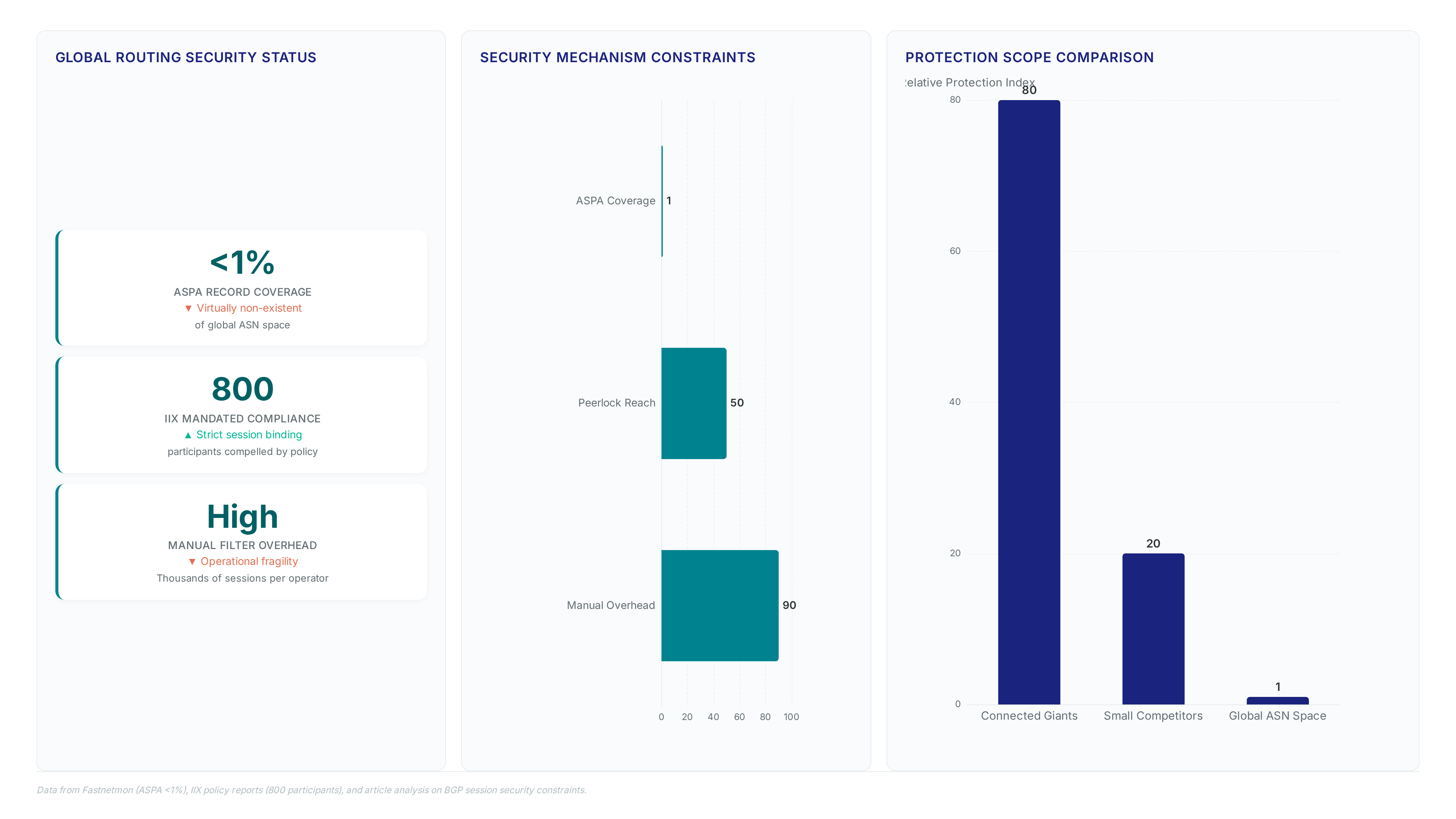
Operators at technical forums note that quite some ASes prefer flexibility over the absolute security guarantees of locking. Manual rigidity breeds operational fragility; a single link failure partitions the network if geometric redundancy is absent. Automated distribution allows rapid policy changes without touching individual router CLI sessions. Published records currently represent under one percent of the global ASN space, with only 0.001% of systems using the protocol. Complexity of RIR coordination drives this low adoption compared to simple prefix-list application. Waiting for universal ASPA coverage means continued exposure to route leaks from unlocked peers. The trade-off is clear: immediate, exclusive protection versus delayed, universal stability.
Strategic Trade-offs Between Proprietary Locking and Standardized Validation
Operational Immediacy of Peerlock Versus ASPA Standardization Timeline
Peerlock provides immediate leak containment today. ASPA availability arrived in production only during January 2026. This temporal gap forces a choice: manual rigidity now or automated standardization later. Peerlock functions as a session-level constraint requiring physical port binding, effectively creating a private circuit for specific AS path segments. It demands direct interconnection, excluding networks relying on public exchange fabrics. ASPA distributes routing intentions through RIR databases, enabling any router performing Route Origin Validation to reject invalid paths without prior bilateral agreements.
| Dimension | Peerlock Implementation | ASPA Standardization |
|---|---|---|
| Deployment Speed | Immediate manual config | Dependent on RIR sync |
| Access Scope | Direct peers only | Global system wide |
| Maintenance | High operational overhead | Automated database updates |
| Legal Risk | Potential antitrust violation | Compliant open standard |
The sharp nature of peerlocking introduces significant legal exposure when applied selectively to bigtech entities without universal access mechanisms. Saku Ytti argues this exclusivity may violate antitrust laws unless every network can demand inclusion. Operators mitigating leaks via manual filters face a binary choice: maintain fragile manual states or await full system adoption. Cloudflare now tracks object creation via deployment statistics, showing gradual but incomplete global coverage. Waiting costs you in continued exposure to route leaks that standardized validation would eventually prevent automatically.
The Indonesian Internet Exchange forced nearly 800 participating ASNs to action by implementing a strict drop invalid policy within its route reflector logic. This mechanism rejects Bogon announcements at the fabric edge, forcing members to sign their routes or lose connectivity. The approach mirrors peerlock principles by removing operator discretion and enforcing a binary security state across the exchange. Data indicates that nearly 800 autonomous systems corrected their configurations to maintain traffic flow. Centralized enforcement drives quicker compliance than voluntary adoption. However, this rigidity risks fragmenting connectivity for operators lacking resources to implement RPKI immediately. The blast radius of a misconfiguration shrinks, yet the operational burden shifts entirely to the edge customer.
| Policy Mode | Enforcement Point | Compliance Driver | Risk Profile |
|---|---|---|---|
| Drop Invalid | IX Route Reflector | Connectivity Loss | High immediate disruption |
| Peerlock | Physical Port | Contractual Obligation | Geographic single point of failure |
| ASPA | Global RIR | Cryptographic Validation | Coordination latency |
Job Snijders framed such reduction of incident impact as an act of responsible corporate citizenship, suggesting that defendable security postures outweigh flexibility concerns. While proven regionally, this model requires a dominant exchange operator capable of mandating terms, a condition absent in fragmented markets. The Verified Peering Provider program illustrates how large entities can extend these stability guarantees beyond single exchange points. Forced action improves regional hygiene but creates a barrier for smaller players unable to meet strict cryptographic requirements instantly.
Comparison: Antitrust Liability When Bigtech Receives Preferential Peerlock Treatment
Exclusive peerlock access for bigtech creates immediate antitrust exposure. No universal mechanism exists for other ASes to demand equal treatment. Saku Ytti argued this preferential model rewards monopolies with superior products unavailable to smaller competitors, potentially violating jurisdiction-specific competition laws. The legal risk intensifies as transport prices S. -Peering-System. Html) into exchange points drop dramatically, lowering barriers for customers to access peering infrastructure while security tools remain gated. Operators face a dichotomy where ASPA offers standardized access but peerlock enforces physical exclusivity.
Infrastructure logistics costs currently consume 40% of revenue, projected to fall to 30% by 2030, yet the upfront capital intensity remains prohibitive for many seeking private links. A theoretical business model highlights this strain, projecting Year 1 revenue of $13,350,000 against a minimum cash requirement of $69,308,000, illustrating why exclusive physical locking favors only the wealthiest entities. This economic reality means peerlock effectively segments the market by balance sheet size rather than technical merit. Waiting for universal peerlock access is futile since Ytti noted such a mechanism does not exist.
Implementing Strong BGP Session Security to Reduce Incident Impact
Application: Peerlock Operational Constraints and Direct Interconnection Requirements
Physical links define the boundary where peerlocking functions. The mechanism binds BGP sessions to specific router ports, rendering the technique useless without private peering connections. Networks depending on shared switch fabrics at public exchange points cannot apply this security layer. Adoption remains restricted to entities owning dedicated fiber interconnects. Job Snijders characterized peerlocking as a sharp tool requiring geographic redundancy to avoid total partition when links fail. Operational expenses surge because duplicate hardware must span separate facilities. Many autonomous systems cannot clear this financial barrier even when security outweighs flexibility in their priorities.
Strict session binding produces a binary security state resembling the Indonesian Internet Exchange IIX compelled nearly 800 participants to comply through route reflector policies. Peerlock stays out of reach for operators lacking direct physical relationships. Selective access granted by large providers creates antitrust exposure while smaller competitors remain unprotected. This constraint forces a decision between immediate, narrow protection for connected giants or waiting for standardized ASPA distribution.
Application: Preventing Network Partitions Through Multi-Geography Peerlock Deployment
Job Snijders mandated interconnection across multiple separate geographies to stop single-link failures from partitioning peerlock sessions. Operators managing complex environments with thousands of eBGP sessions face severe stability risks if a session reset triggers routing table flaps across a single site. Deploying this architecture requires physical diversity, often using metro routed optical networking platforms to terminate carrier-neutral facilities without consuming excessive ports. The mechanism binds BGP updates to specific physical interfaces, meaning a fiber cut isolates the locked AS unless redundant paths exist in distinct locations.
Application: ASPA Automated Distribution Versus Manual Peerlock Rigidity
ARIN announced full ASPA availability in January 2026, enabling automated distribution that manual peerlock cannot match. Peerlocking demands direct interconnection and bilateral agreements, making it exceedingly hard to operationalize for networks lacking physical proximity. This rigidity excludes many ASes that prefer flexibility over the strict binary security state enforced by session binding. ASPA offers a standardized alternative where routing intentions propagate automatically through the RPKI system without requiring point-to-point coordination. Four key advantages distinguish the automated approach from manual configuration.
Operators managing complex BGP environments with thousands of sessions face significant overhead when applying manual filters to each neighbor. However, ASPA records still represent a tiny fraction of the global ASN space despite recent tooling improvements. The drawback of manual peerlock is operational fragility; a single link failure can partition locked networks without geographic redundancy. InterLIR recommends transitioning to ASPA for broad coverage while retaining peerlock only for critical, physically diverse interconnects. Six specific use cases justify keeping manual locks in place alongside automated records.
About
Vladislava Shadrina serves as a Customer Account Manager at InterLIR, where she directly enables secure access to critical IPv4 resources. While her background spans client relations, her daily work at InterLIR requires a deep practical understanding of BGP routing security to ensure successful IP transfers. InterLIR distinguishes itself by guaranteeing clean BGP histories and valid Route Objects for every address block, making routing integrity central to their mission. Shadrina guides clients through these technical prerequisites, verifying that policies align with global standards to prevent hijacking or reputation issues. This hands-on experience managing the intersection of IP marketplace transactions and network stability qualifies her to contextualize community discussions on AS-PATH policies. By bridging the gap between commercial IP acquisition and technical implementation, she ensures that customers not only obtain addresses but also integrate them securely into their existing routing architectures.
Conclusion
Manual peerlocking fractures under the weight of flexible AI workloads. Traffic patterns shift too rapidly for bilateral session binding. As generative AI adoption surges, the operational debt of maintaining rigid physical constraints becomes unsustainable. Engineering hours vanish into filter maintenance instead of capacity planning. The bottleneck isn't technical capability; it's the inability to propagate policy changes globally without manual intervention at every hop. Treat peerlocking as a legacy exception, not a primary defense strategy.
Deploy ASPA records across your entire ASN portfolio by Q3 2026. Reserve manual peerlocks strictly for high-value, physically diverse interconnects where legal contracts mandate explicit session binding. Do not attempt to hybridize these approaches without first auditing your current route server policies for conflicting attributes. Start by exporting your current BGP neighbor table to identify all non-RPKI validated sessions before Friday's change window. This audit provides the baseline data required to prioritize which peers need immediate ASPA object creation versus those requiring renegotiated peering agreements. Waiting for tooling to mature further exposes your infrastructure to preventable hijacking events during this critical transition period.
Frequently Asked Questions
Peerlock grants preferential treatment to big tech while excluding smaller networks. This exclusivity creates legal risk because no standardized mechanism exists for universal enrollment across the industry.
ASPA allows any ASN to publish upstream relationships through RIR objects. This open standard removes the exclusivity barrier that currently limits security postures for many operators.
Cloudflare manages 500 Tb of external capacity, illustrating where session locking becomes vital. Locking major content providers at this scale prevents accidental propagation of invalid paths globally.
Operators protecting 74% of traffic via ROA still face path validation gaps. Reliance on peerlock causes measurable fragmentation that standardized validation methods aim to resolve completely.
Peerlock binds specific ASNs to fixed sessions, requiring direct physical presence. This prerequisite excludes smaller operators who cannot meet strict interconnection requirements or afford dedicated ports.