Predictive BGP security stops malformed crashes now
A single malformed update message recently crashed Cisco IOS XR routers. That event proves reactive BGP monitoring is dead on arrival for 2026. We cannot afford passive observation any longer. The industry needs predictive routing-risk intelligence that spots propagation failures before they destabilize the global internet. U.S. CISA mandates and the EU's NIS2 Directive are driving a projected $380 million surge in federal security spending. Yet mere compliance with RPKI deployment by December 2026 ignores the mechanics of route leaks and ASN vulnerability.
This piece dissects the architecture of machine learning-driven analysis designed to score origin-side risks and model real-world permissiveness. We compare these emerging platforms against legacy solutions. Operators can no longer rely on static IRR records or basic validation. In an era where 34% of CEO cybersecurity concerns now focus on unintended data exposure, static defenses are negligence.
You need to understand how these systems rank high-risk ASN–prefix combinations using live control-plane data. We also address the friction between theoretical models and operator reality, including valid skepticism regarding path length credibility raised within the NANOG community. Moving beyond simple "up/down" status checks allows organizations to prioritize filtering policies that actually mitigate vectors exploited in recent incidents like the Venezuela route leak.
The Role of Predictive Intelligence in Modern BGP Security
Defining the BGP Security Intelligence Platform and Its Data Inputs
The BGP Security Intelligence Platform eats live control-plane data, RPKI validation states, and CAIDA relationship maps to score origin risks. It kills static filtering. Instead, it uses predictive analytics to correlate five distinct input streams: live BGP updates, cryptographic validation results, IRR registry records, autonomous system topology graphs, and multi-view prefix visibility metrics. Open-source validators like Routinator strictly verify cryptographic signatures. This architecture goes further. It calculates prefix structural risk based on propagation likelihood rather than simple validity.
Integrating an 18-model ML pipeline similar to RoutePulse allows the platform to identify patterns in how malformed announcements traverse the global Internet.
Speed alone fails. Operators relying solely on fast feeds miss the nuance of prefix structural risk analytics that identify vulnerable paths before exploitation. High-speed feeds cannot correlate CAIDA relationship data with vulnerability scores without additional processing layers. This dual approach fixes the blind spot where fast data arrives too late to prevent initial propagation of malformed routes.
Inside the Architecture of ML-Driven Routing Risk Analysis
Prefix structural risk analytics calculate malformed announcement probability by evaluating AS path consistency against known topology constraints. The mechanism scores origin-side vulnerability by correlating IRR record mismatches with historical hijack patterns. It flags unstable prefixes before propagation occurs. This approach identifies that 59% of ARIN routes operate without ROA coverage. That creates a vast attack surface for prefix fabrication. Operators must weigh the precision of ML classification against the computational cost of processing live control-plane updates from diverse collectors.
The scoring engine ingests data streams similar to those utilized by BGPStream to observe anomalies. It extends functionality by predicting future risk states rather than merely logging current deviations. A key limitation involves the reliance on accurate AS relationship data. Incorrect CAIDA mappings skew vulnerability scores and generate false positives during peak traffic shifts.
| Risk Factor | Detection Method | Mitigation Action |
|---|---|---|
| Missing ROA | Cryptographic validation gap | Apply strict RPKI invalid reject policy |
| Path inflation | AS path length deviation | Deprioritize routes with abnormal hop counts |
| Origin mismatch | IRR registry inconsistency | Filter announcements lacking object alignment |
Enterprise deployments demand capital. Solutions like Kentik command pricing starting at ~$50,000/year for full feature access. The implication for network engineers is clear: without predictive scoring, operators react to incidents only after malicious prefixes achieve global visibility.
Operators apply risk rankings to filtering policies by mapping high-risk ASN–prefix pairs against live control-plane data feeds. The mechanism translates permissiveness modeling scores into actionable router configurations. It prioritizes blocks where structural risk predicts malicious propagation. Feeding this engine requires low-latency inputs. SAIC's Global Cyber Intelligence (GCI) demonstrates the necessity of sub-two-minute delivery windows for proven mitigation. Without such speed, filtering decisions target historical anomalies rather than active threats. The platform ingests these streams to calculate prefix structural risk, flagging inconsistencies before they stabilize in the global routing table. The cost of over-blocking legitimate traffic often exceeds the risk of temporary leak exposure for non-critical prefixes.
- Ingest real-time updates from collectors like those powering BGPStream to establish baseline visibility.
- Correlate origin-side vulnerability with path length anomalies to generate risk scores.
- Apply flexible prefix filters only to combinations exceeding a set probability threshold.
- Monitor rejection logs to adjust model weights and reduce collateral damage.
This workflow shifts operations from reactive cleanup to proactive defense. It demands continuous tuning of the underlying classification logic.
Failure Modes in ML-Based Classification and Data Latency Constraints
Data latency exceeding 90 seconds renders predictive scoring obsolete against fast-flux malicious prefix announcements. Machine learning classifiers fail when input streams lag behind active BGP path propagation changes. An 18-model ML pipeline requires fresh control-plane state to accurately weight origin-side ASN vulnerability scores. Stale data causes the system to miss emerging threats. It generates false negatives in risk ranking. Operators face a hard choice: analytical depth or ingestion speed. Deep correlation takes time. Threats propagate in seconds. The table below contrasts latency tolerance across solution tiers.
| Solution Tier | Max Latency | Threat Detection Mode |
|---|---|---|
| Government Intelligence | 90 seconds | Real-time stream |
| Enterprise Analytics | Minutes | Near-real-time batch |
| open-source Collectors | Hours | Historical replay |
Fixing inconsistent BGP path propagation demands sub-minute updates that many commercial platforms cannot guarantee. RoutePulse ingests 39 threat feeds to mitigate this. Yet integration overhead often delays actionable intelligence. The cost of delayed classification is measurable: unfiltered hijacks traverse multiple hops before ML models flag the anomaly. Without this architectural adjustment, even sophisticated models react to history rather than current network state.
Comparing Predictive Platforms Against Traditional Monitoring Solutions
RPKI Validation Versus IRR Records in Modern BGP Security
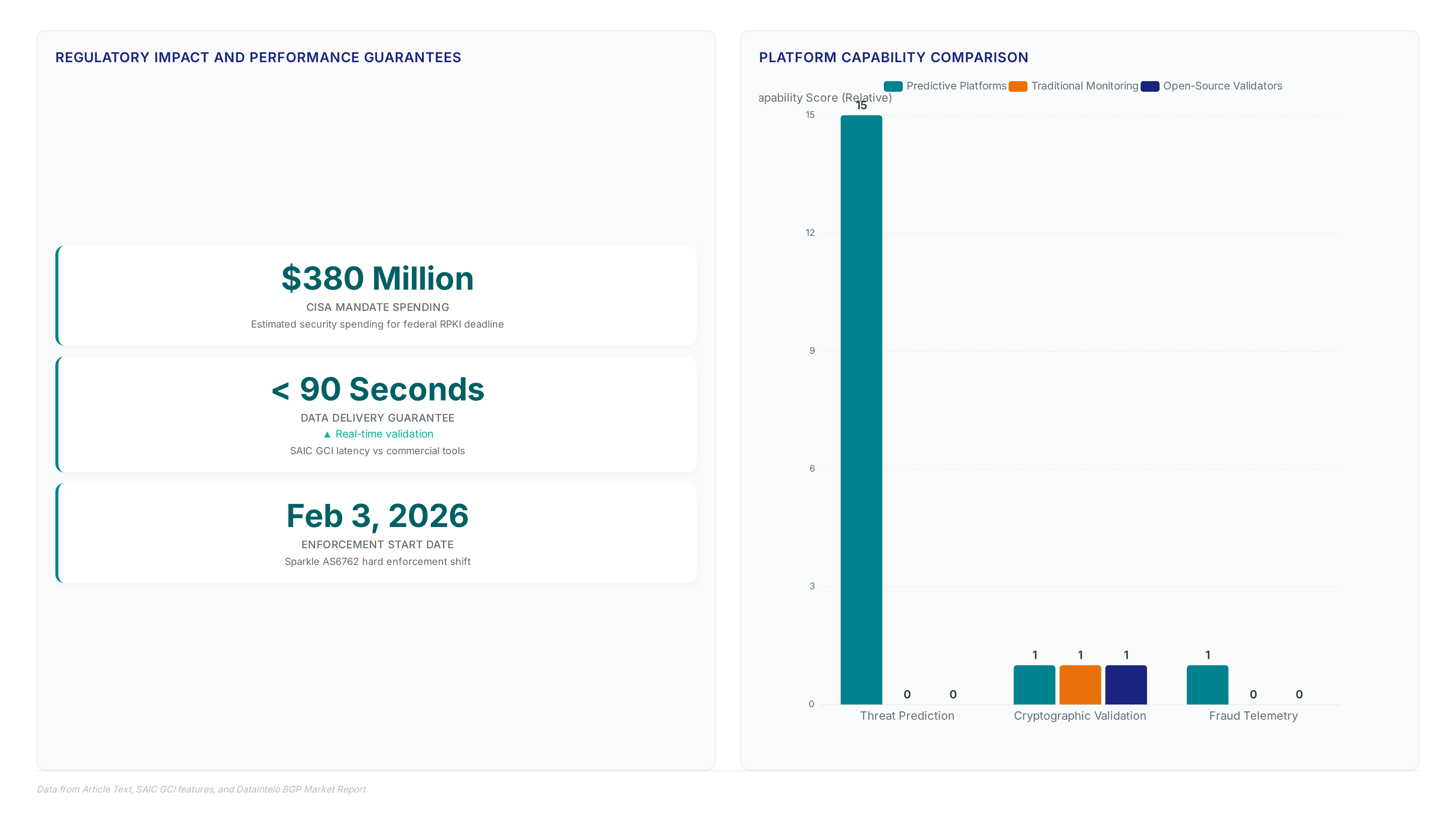
Sparkle (AS6762) began rejecting RPKI-invalid prefixes on February 3, 2026. This marks a hard enforcement shift away from voluntary IRR filtering. The mechanism relies on cryptographically signed Route Origin Authorizations to validate announcements. IRR records remain unsigned text entries susceptible to typosquatting. This cryptographic foundation enables routers to drop invalid paths automatically. IRR requires manual policy maintenance and trust in database maintainers. The transition incurs operational friction because legacy systems lack native support for validating these signatures without external software.
Adopting Predictive BGP Risk Tools for Federal Compliance Spending
The U.S. CISA mandate drives an estimated $380 million in security spending to meet the December 2026 federal RPKI deadline. Agencies shift from passive logging to active predictive risk scoring to satisfy these strict regulatory windows. Traditional monitoring tools only record events after propagation occurs. Predictive platforms fill that gap by modeling origin-side ASN vulnerability before routes stabilize. This capability allows operators to block malformed announcements proactively rather than reacting to outages. Market confusion between basic validators and intelligence suites complicates procurement decisions for compliance officers. Basic validators verify cryptographic signatures but lack the fraud telemetry required for thorough threat hunting. Commercial solutions integrate dark web data and structural analytics that simple validators cannot process. The table below contrasts operational dimensions for federal buyers evaluating these distinct technology classes.
| Dimension | Traditional Monitoring | Predictive Intelligence |
|---|---|---|
| Data Latency | Minutes to hours | Seconds |
| Threat Scope | Reactive anomaly detection | Proactive risk modeling |
| Compliance Fit | Partial | Full |
Meanwhile, the broader BGP sector projects growth toward a substantial market value by 2034 as adoption accelerates. Operators ignoring this shift face audit failures when static filtering policies miss flexible hijack vectors. The cost of inaction exceeds the license fees of modern routing-risk intelligence systems. Traditional monitoring systems rely on static thresholds that fail against flexible BGP path manipulation tactics used by modern attackers. The 18-model ML pipeline correlates diverse signals to predict malicious propagation before traffic blackholes occur. Operators gain visibility into prefix structural risk that simple volume-based alerts cannot surface during active hijacks.
Defining Actionable Outputs for Routing Policy Decisions
Raw ML scores convert directly into filtering rules by mapping risk thresholds to specific prefix-level structural risk actions. Operators prioritize mitigation by targeting high-risk ASN–prefix combinations identified through predictive routing-risk intelligence. This mechanism translates abstract vulnerability data into concrete BGP policy updates. It distinguishes between structural weaknesses and active propagation threats. Continuous intelligence generation ensures security teams receive actionable outputs before malformed announcements stabilize in the global table. Relying solely on cryptographic validation ignores the predictive layer needed for emerging threats.
Operators update filtering policies by targeting high-risk ASN–prefix combinations ranked through predictive routing-risk intelligence. Security teams prioritize mitigation by mapping ML scores directly to filtering rules that block specific paths before malformed announcements stabilize in the global table. Continuous intelligence generation ensures actionable outputs reach engineers quicker than manual validation cycles allow. Traditional monitoring systems lack the 18-model ML pipeline found in advanced tools like RoutePulse, which processes 39 distinct threat feeds to classify risks autonomously. The table below contrasts how different approaches handle policy prioritization.
| Approach | Data Source | Action Speed | Coverage Scope |
|---|---|---|---|
| Static RPKI | ROA Signatures | Post-announcement | Origin Only |
| IRR Filtering | Manual Entries | Delayed | Path Attributes |
| ML Risk Scoring | Live Control Plane | Pre-propagation | ASN + Prefix |
The cost of this depth is computational overhead that legacy hardware often cannot sustain without performance degradation. Bogdan Pantelimon noted community recommendations to add ASPA and OTC metrics. This signals a shift toward path-validation beyond origin checks. Operators must balance immediate filtering needs against the latency introduced by complex analysis engines. This approach prevents malicious propagation while reducing the manual burden on network operations centers.
Integration Checklist for Aligning with RPKI Rejection Milestones
Sparkle (AS6762) enforced RPKI-invalid prefix rejection on February 3, 2026. This forces immediate policy audits for transit customers. Operators must align predictive risk scoring updates with this hard deadline to prevent sudden traffic loss from invalid routes. A four-step validation sequence ensures compliance before the U.S. CISA mandate triggers federal enforcement in December 2026. First, deploy open-source RPKI validators to establish a cryptographic baseline distinct from commercial threat feeds. Second, layer ML-driven analytics like the 18-model ML pipeline to identify structural risks that cryptographic checks miss. Third, map high-risk ASN–prefix combinations to filtering rules prior to propagation events.
| Step | Action | Tool Type |
|---|---|---|
| 1 | Cryptographic Validation | Open-source Validator |
| 2 | Predictive Risk Scoring | ML Analytics Platform |
| 3 | Policy Mapping | Automation Script |
| 4 | Compliance Verification | Audit Report |
Skipping the predictive layer leaves networks vulnerable to sophisticated hijacks that pass basic ROA checks. InterLIR recommends integrating these milestones now rather than waiting for downstream providers to enforce stricter filtering. Maintaining permissive peering relationships while adhering to rigid rejection timelines imposed by tier-1 carriers creates friction. Failure to update origin-side ASN vulnerability scores before these dates results in unmitigated exposure to route leaks.
About
Evgeny Sevastyanov serves as the Support Team Leader at InterLIR, a Berlin-based IPv4 marketplace dedicated to secure network resource redistribution. His daily responsibilities extend beyond standard customer service. He handles the technical creation and management of RIPE and APNIC database objects. This places him at the forefront of BGP routing integrity. (APNIC's bgp updates in 2024) This hands-on experience makes him uniquely qualified to discuss BGP protection intelligence. He routinely verifies clean BGP announcements and ensures IP reputation for clients leasing address space. At InterLIR, where security is a core value alongside transparency and efficiency, Sevastyanov directly observes how path inconsistencies and routing anomalies impact network availability. His practical work managing these critical infrastructure elements provides the factual foundation necessary to analyze emerging tools and debates surrounding BGP propagation and credibility in the evolving 2026 cybersecurity environment.
Conclusion
Scaling predictive defense fails when data freshness slips beyond the 90-second threshold. High-confidence scores become historical artifacts rather than actionable shields. The operational burden shifts from simple filtering to maintaining a continuous, low-latency feed. Commercial tools often cannot guarantee this without significant infrastructure investment. Relying on batched updates or delayed commercial feeds creates a critical window. Sophisticated hijacks bypass static defenses undetected in that gap. Treat latency as a primary security metric, not just a performance statistic. Stale intelligence actively misleads automated policy engines.
Commit to a hybrid architecture by Q4 2027. Couple open-source cryptographic validation with a dedicated, low-latency scoring engine specifically for federal or high-value transit paths. Do not wait for the December 2026 CISA mandate to validate this pipeline. The window for gradual integration closes once tier-1 carriers enforce rigid rejection policies. This approach ensures your network survives the transition from voluntary best practices to mandatory cryptographic enforcement without sacrificing peering relationships.
Start this week by auditing your current threat feed ingestion timestamps against live BGP update streams. Quantify your specific latency gap. If your data exceeds 60 seconds age during peak propagation events, immediately prototype a direct stream connection to a low-latency source. Do this before layering any additional ML analytics.
Frequently Asked Questions
The system correlates five distinct input streams including live BGP updates and RPKI states. This synthesis allows the platform to monitor over 1.28 million prefixes effectively using machine learning approaches for anomaly detection.
Operators receive a ranked list of high-risk ASN–prefix combinations instead of simple binary flags. This dynamic prioritization helps security teams focus on the most critical vulnerabilities before traffic hijacking occurs globally.
Critics argue that assuming shorter paths propagate more effectively is a flawed premise for credibility. This skepticism highlights the friction between theoretical models and the complex reality of actual network permissiveness and routing policies.
Data latency exceeding 90 seconds renders predictive scoring obsolete against fast-moving routing incidents. Real-time validation requires sub-90-second delivery guarantees to ensure operators can adjust policies before malicious routes achieve global propagation.
The tool targets unintended data exposure, which now represents 34% of CEO cybersecurity concerns. By modeling real-world permissiveness, it identifies structural risks that static validation methods often miss in modern enterprise network environments.