Private DevOps Agent: Secure VPC Routing Logic
AWS DevOps Agent hit General Availability in March 2026. Out of the box, it cannot touch private VPC resources.
The industry is sprinting toward agentic SRE, where AI correlates data across microservices to slash Mean Time To Repair. That autonomy crashes into a wall when critical tools like GitHub Enterprise or self-hosted Grafana sit behind strict Amazon VPC boundaries with no public access. The solution isn't punching holes in firewalls. The agent provisions service-managed resource gateways to build secure tunnels, keeping elastic network interfaces off the public internet. AWS handles the routing logic; you keep granular control via security groups. Below is the concrete implementation for the AWS Management Console and AWS CLI so your operations teammate actually reaches the internal systems it needs.
The Role of AWS DevOps Agent and Private Connections in Secure Cloud Operations
AWS DevOps Agent and Service-Controlled Resource Gateways
AWS DevOps Agent reached General Availability (GA) in March 2026 as an always-available operations teammate built on Amazon Bedrock AgentCore. It acts as an active operator, not a passive dashboard, handling on-demand SRE tasks to reduce Mean Time To Repair (MTTR). Secure access to internal tools leans on Amazon VPC Lattice, which carves a private network path between the agent and target resources without public IP addresses. The architecture spins up requester-managed Elastic Network Interfaces (ENIs) inside user-specified subnets. These interfaces serve as the entry point for all private traffic. Local security groups control the interfaces; the agent manages the routing.
This design hinges on the service-controlled resource gateway, a read-only object in your account. No other service or principal routes traffic through it. Connectivity stays exclusive to the agent. AWS DevOps Agent uses a service-linked role scoped strictly to resources tagged with AWSAIDevOpsManaged, blocking unauthorized access to unrelated assets. This least-privilege model kills the risk of lateral movement if agent credentials leak. Operators still foot the bill for data transfer fees during these private sessions-a cost factor often missed in initial planning.
The deployment creates a service-managed resource gateway that appears as a read-only asset, restricting routing capabilities strictly to the agent. Traffic targeting self-hosted observability tools hits a specific dependency: DNS resolution. Names must remain publicly resolvable even if the underlying IP is private. Break the public DNS record, and the connection dies, regardless of correct VPC peering.
Enhanced security here costs flexibility in DNS management. Operators must maintain public zone records for purely internal services. Most teams swallow this overhead to achieve zero-trust compliance without stacking extra encryption layers. Direct private routing simplifies the network path while enforcing strict boundary controls around critical monitoring data.
Prerequisites for Agent Spaces and Multi-AZ Subnet Configuration
Establishing private connections demands an active Agent Space and specific subnet selection for high-availability. Operators must identify one subnet Zone to host the Resource Gateway ENIs, ensuring secure private connections function across failure domains. The maximum time for private connection creation is 10 minutes, a hard limit dictated by the underlying Amazon VPC Lattice A service-linked role with least privilege manages these gateways, scoped strictly to resources tagged `AWSAIDevOpsManaged`.
| Requirement | Configuration Detail | Operational Impact |
|---|---|---|
| Agent Space | Must exist prior to setup | Blocks connection wizard if missing |
| Subnet Strategy | One subnet per AZ | Prevents single-AZ outage propagation |
| Target Service | Private IP or DNS | Eliminates public internet exposure |
Subnet selection dictates durability. Pick only one AZ, and you create a single point of failure for the entire agent pathway. The service-linked role automates gateway creation but cannot touch untagged resources, enforcing a strict boundary around the always-available operations teammate. This configuration ensures the resource gateway Teams targeting 2026 compliance deadlines should verify their subnet topology before initiating the 1-minute setup wizard. Skip multi-AZ coverage, and regional outages isolate the agent completely.
Inside the Architecture of VPC Lattice and DNS Resolution for Private Paths
The service-managed resource gateway provisions Elastic Network Interfaces (ENIs) in user-specified subnets to route traffic without managing underlying infrastructure. AWS DevOps Agent creates these interfaces automatically, establishing a secure network path between the agent and target resources using Amazon VPC Lattice This mechanism eliminates public IP requirements while maintaining strict isolation within the AWS network backbone.
Traffic flow follows a deterministic four-step sequence:
- The agent initiates a request destined for a private service.
- Routing logic directs packets through the service-managed resource gateway.
- An ENI within the VPC receives the traffic and forwards it locally.
- Security groups govern which packets traverse the interface boundary.
From the target service perspective, the request originates strictly from private IP addresses of ENIs within the VPC. No public internet exposure occurs during transmission. Operators retain full control over egress rules via their own security groups, yet the gateway itself remains read-only.
| Component | Management Plane | Data Plane Control |
|---|---|---|
| Resource Gateway | AWS DevOps Agent | Service-Managed |
| Elastic Network Interface | AWS DevOps Agent | User Security Groups |
| Traffic Path | Amazon VPC Lattice | Private AWS Network |
Fixed topology creates the bottleneck: subnets must be pre-identified Zone, preventing flexible shifting during failures. While the private connections ensure security, this rigidity demands careful initial planning for high-availability scenarios.
In practice, the provided host address requires public DNS resolution even when the underlying IP targets remain strictly private. This constraint forces operators to maintain public zone records for internal services, creating a dependency on external resolvers that contradicts pure air-gapped designs. The specified endpoint URL functions solely as the Host header and Service Name Indicator (SNI) during the TLS handshake, decoupling routing logic from name resolution. Such separation enables multiple service integrations to share a single private connection while presenting distinct endpoint hostnames to the backend application. Traffic targeting VPC-hosted MCP servers Competitors often mandate complex VPN tunnels to bridge this gap, yet this architecture uses Amazon VPC Lattice A critical tension exists between DNS hygiene and operational reality: maintaining public records for private IPs increases the attack surface for reconnaissance scans. Security trends increasingly favor this zero-trust model despite the DNS exposure, prioritizing encrypted private paths over perfect name secrecy. Operators must accept that the DNS layer remains visible while the data plane stays isolated within the AWS network backbone. Failure to configure the SNI correctly results in certificate validation errors, as the backend expects the internal hostname found in the TLS extension rather than the public resolver name.
Service-Managed Versus Self-Managed VPC Lattice Resource Configurations
Self-managed mode requires operators to supply the Amazon Resource Name of an existing Amazon VPC Lattice This approach grants full lifecycle control for organizations running complex hub-and-spoke topologies where central teams manage networking policies. Access logs become available for detailed traffic monitoring, a capability absent in the read-only service-managed variant. The trade-off is operational overhead; engineers must manually provision and maintain the underlying gateway resources.
| Feature | Service-Managed | Self-Managed |
|---|---|---|
| Lifecycle Control | Automatic | Manual |
| Access Logs | Unavailable | Enabled |
| Cross-Account | Restricted | Supported |
| Setup Speed | Fast | Slow |
Dual-stack IP addressing becomes necessary when legacy systems require IPv4 connectivity alongside modern IPv6-only MCP Server Requirements. Operators choosing self-management gain the ability to share configurations across accounts, facilitating centralized governance models. However, this flexibility demands rigorous validation of security group rules attached to the requester-managed ENIs. Misconfigured policies here expose the private path to unauthorized lateral movement within the VPC. The choice ultimately balances automation speed against granular visibility needs.
Step-by-Step Implementation of Private Connections via Console and CLI
Defining Private Connection Parameters and Security Group Limits
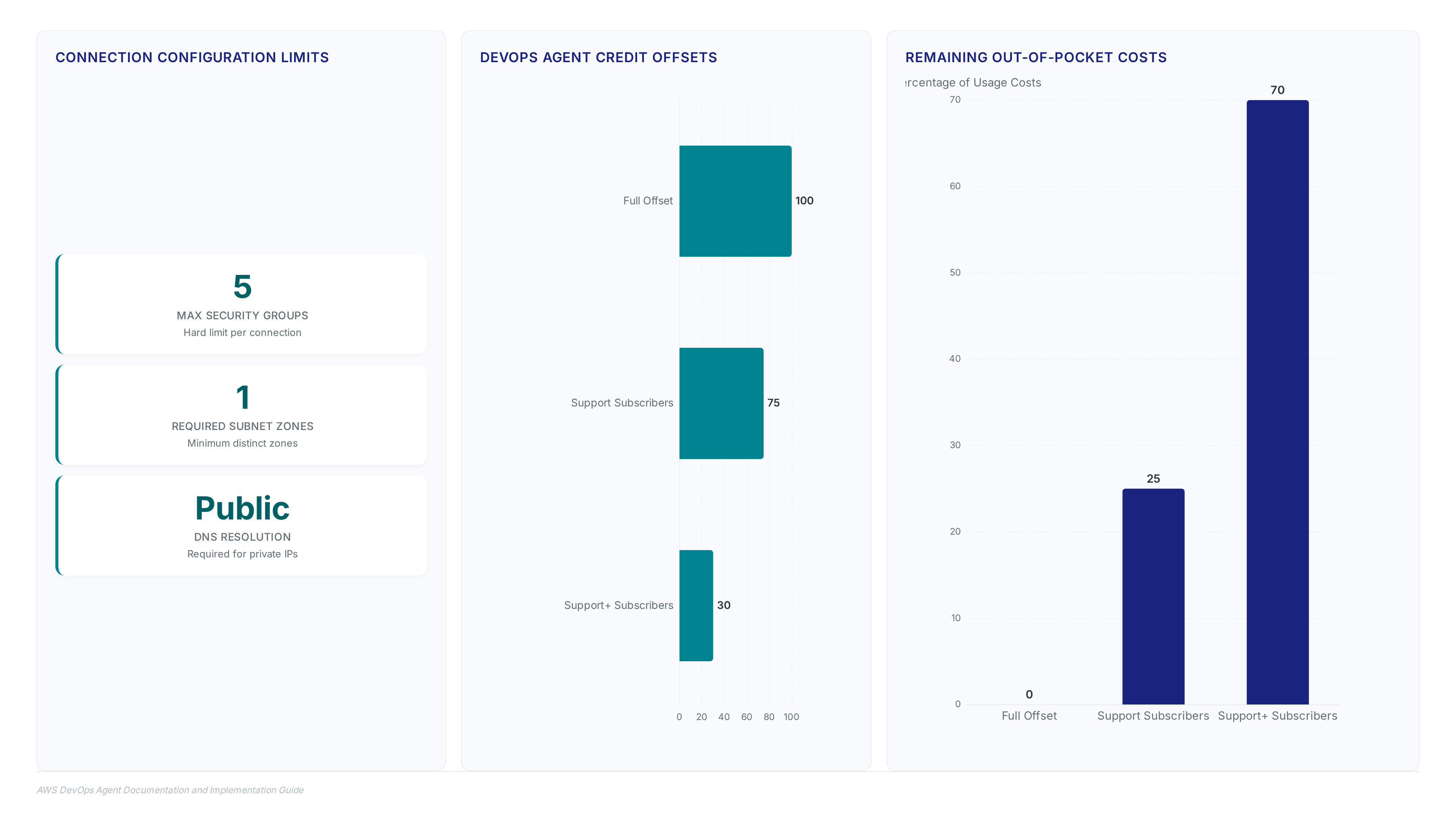
Operators must configure exactly one subnet Zone while attaching a maximum of 5 security groups to each connection. This hard limit forces consolidation of inbound rules, requiring engineers to audit existing group policies before assignment. The Network Interface Implementation relies on these groups to govern egress from the provisioned elastic network interfaces. A contradictory requirement mandates that the target service DNS name remains publicly resolvable, even when the resolved IP address exists solely within a private range. This design ensures the specified endpoint URL functions correctly as the Host header and Service Name Indicator (SNI) during the TLS handshake. Traffic flow remains isolated on the AWS backbone, eliminating public internet exposure for internal tools like Grafana. The tension between public resolution requirements and private routing creates a dependency on external DNS infrastructure that pure air-gapped environments cannot satisfy without split-horizon configurations.
Configuration via the AWS CLI requires explicit definition of these parameters:
Failure to include the Resource location subnets prevents the agent from establishing the initial secure private connections
Operators must select distinct subnets across multiple Availability Zones to ensure the resource gateway survives single-zone failures. The AWS Management Console workflow requires navigating to Capability providers, selecting Private connections, and choosing Create a new connection. Engineers define the Name and Resource location by picking one subnet per zone, a step critical for maintaining uptime during regional outages. This manual selection directly maps to the Network Interface Implementation where elastic network interfaces instantiate within the chosen boundaries.
Command-line automation bypasses graphical latency but demands precise syntax for subnet identifiers. The following command establishes the link using the Connectivity Mechanism
Verification occurs via the `describe-private-connection` call until the status returns Completed. A hidden tension exists between speed and durability; skipping the second Availability Zone reduces setup time but exposes the agent to total isolation if that specific zone loses power. Teams coordinating incident response through Slack channels often find that multi-AZ deployments prevent communication blackouts during localized infrastructure events. Neglecting this distribution creates a single point of failure that contradicts high-availability architectural goals.
Beyond this, verification begins by confirming outbound rules on ENI security groups permit traffic to the target service port. Default security groups often block all egress, requiring custom groups for specific TCP ranges. Operators must verify that route tables contain explicit entries allowing subnet-to-subnet communication if the target resides outside the gateway subnet. Relying on default VPC routing frequently causes silent drops when peered VPCs lack propagated routes.
- Inspect the security group attached to the provisioned ENI for allowed outbound ports.
- Validate inbound rules on the target service instance match the gateway subnet CIDR.
- Test connectivity using a temporary diagnostic pod within the same subnet.
Custom security groups provide granular control compared to permissive defaults, reducing the attack surface for lateral movement. The connectivity mechanism Misconfigured egress rules remain the primary failure mode post-provisioning, overshadowing DNS resolution errors.
| Configuration Type | Egress Control | Inbound Validation Required |
|---|---|---|
| Default Security Group | Blocks all outbound | Yes |
| Custom Security Group | Allows specific ports | Yes |
Real-World Application Patterns for Connecting Observability and Source Control Tools
Defining the Grafana MCP Server Integration Workflow
AWS DevOps Agent hosts the official open-source Grafana MCP server to connect directly with self-hosted instances running version 9.1 or later. Operators must generate a service account with the Viewer role inside the target dashboard to enable read-only access for incident correlation. This configuration prevents the agent from modifying alert rules while allowing full visibility into telemetry data. The integration supports Grafana Cloud, Grafana Enterprise, and on-premises deployments without requiring public IP addresses. Traffic flows through requester-managed Elastic Network Interfaces that the service provisions in user-specified subnets. These interfaces act as the secure entry point for all private observability queries. Enterprises apply this path to correlate incidents with recent code changes by connecting to internal tools without exposing logs to the public internet. A critical constraint requires the target DNS name to remain publicly resolvable even if it maps to private RFC1918 addresses. This design choice forces operators to maintain split-horizon DNS records rather than relying solely on private hosted zones. The limitation creates operational friction for teams lacking external DNS infrastructure, as resolution failures block connection establishment entirely. Security groups attached to the ENIs must permit outbound TCP traffic on port 443 to reach the dashboard.
The CLI command `create-private-connection` fails immediately if the `portRanges` parameter omits the specific TCP port listening on the Grafana instance. Operators must define this array explicitly, such as `["443"]`, to match the service configuration before the agent attempts handshakes. This strict validation prevents ambiguous firewall rules but demands precise knowledge of the target application's listening state. Amazon. Traffic flow remains entirely within the AWS network, eliminating public exposure for the internal systems like Grafana or GitLab.
| Parameter | Required Value | Constraint |
|---|---|---|
| `host-address` | Private DNS or IP | Must resolve internally |
| `portRanges` | `["443"]` or `["3000"]` | Single port only |
| `subnet-ids` | Multi-AZ list | Minimum two subnets |
A common deployment error involves specifying a port range instead of a single port, which the API rejects outright. The limitation is that flexible port allocation protocols cannot function through this static definition. Engineers must hard-code the exact port, creating maintenance overhead if the service port changes later. Successful execution returns a connection ID that transitions to Completed status within minutes. Verification requires invoking a chat command to summarize alerts, confirming the path traverses the private link correctly.
Connection timeouts occur when ENI security groups block egress or route tables lack paths to the target subnet. Operators must verify that requester-managed Elastic Network Interfaces possess explicit outbound rules for the service TCP port, as default configurations frequently deny all traffic. Silent drops happen when route tables in peered VPCs fail to propagate entries for the gateway subnet CIDR. AWS CloudTrail logs record all VPC Lattice API calls to confirm the resource gateway instantiated correctly within the specified availability zones.
| Failure Symptom | Likely Configuration Gap | Verification Step |
|---|---|---|
| TCP handshake timeout | Missing outbound rule on ENI group | Inspect egress rules for target port |
| ICMP unreachable | Missing route table entry | Check propagation to peered VPCs |
| DNS resolution failure | Private IP without public record | Validate public resolvability of hostname |
For reverse traffic flows like webhooks, engineers should apply AWS PrivateLink interface endpoints. This architecture enforces a read-only posture for MCP servers, preventing bidirectional script execution by the agent. InterLIR recommends validating both security group egress and subnet routing simultaneously during initial deployment. Most connection issues stem from assuming default VPC routing suffices for cross-subnet communication.
About
Evgeny Sevastyanov serves as the Support Team Leader at InterLIR, a Berlin-based IPv4 marketplace specializing in secure network resource redistribution. While his daily work focuses on managing RIPE database objects and ensuring clean BGP routes for private IP allocations, this expertise directly translates to the complexities of securing AWS DevOps Agent connections within private VPCs. Sevastyanov's deep understanding of network availability and infrastructure security allows him to articulate how organizations can safely integrate autonomous agents without exposing critical assets. At InterLIR, where transparency and security are core values, he oversees the technical integrity of customer networks, making him uniquely qualified to explain the nuances of connecting operational tools to isolated environments. His practical experience in maintaining reliable, private network architectures provides the necessary foundation for guiding readers through the secure deployment of AWS DevOps Agent in hybrid cloud scenarios.
Conclusion
Scaling agentic SRE operations exposes a critical friction point: the 10-minute hard limit for private connection establishment creates a bottleneck during mass incident correlation. When AI agents autonomously investigate hundreds of microservices simultaneously, this fixed latency compounds, delaying root cause analysis precisely when speed matters most. The operational cost shifts from manual troubleshooting to managing queue backlogs where agents wait for network handshakes rather than processing data. Organizations must recognize that current VPC designs assume sequential human intervention, not parallel agent bursts.
Adopt a hybrid connection strategy within the next two quarters for any environment expecting more than fifty concurrent agent investigations. Pre-provision persistent private links for high-traffic service meshes while reserving on-demand connections for sporadic legacy tools. This approach balances cost efficiency with the latency requirements of autonomous remediation. Do not wait for a substantial outage to test these limits; simulate high-concurrency scenarios now to identify saturation points.
Start by auditing your peak incident volume against the ten-minute creation window this week. Calculate the maximum theoretical delay if every alert triggered a new private link simultaneously, then map this gap against your actual recovery time objectives to prioritize pre-provisioning candidates.
Frequently Asked Questions
Enterprise Support subscribers pay out-of-pocket for twenty-five percent of usage costs. The primary cost mitigation mechanism provides a seventy-five percent credit offset against their existing support bill expenditures.
Business Support+ subscribers receive a thirty percent credit offset toward their total bill. This leaves seventy percent of the actual usage costs to be paid directly by the customer.
Unified Operations plan subscribers effectively receive full offsetting credits against their usage. They get one hundred percent credit based on the previous month's support bill, eliminating extra charges.
The time for private connection creation is ten minutes, a hard limit. This duration is dictated by the underlying infrastructure provisioning required for secure network paths.
Names must remain publicly resolvable even if they map to private addresses. This design choice forces operators to maintain valid public DNS records for purely internal services.