Regional routing shifts: 7 NIRs drive security
TWNIC reports 98% IPv6 routing prefix validity. National Internet Registries now drive the bulk of global security posture. The NIR operational model has shifted from simple address distribution to the primary enforcement layer for routing integrity and IPv6 migration. At APNIC 61, seven regional bodies synchronized policies against rising IPv4 scarcity. JPNIC documented a 17% year-over-year increase in ROA adoption among Japan's 549 Local Internet Registries. VNNIC targets 2030 for full IPv6-only deployment, currently supporting 65% user availability.
A comparative analysis reveals stark contrasts. IDNIC manages over 5,000 members with 89% ROA coverage across Indonesia's mobile-heavy environment. These disparate national efforts coalesce into a unified defense against route hijacking. Future internet durability depends entirely on these regional coordinators maintaining strict resource validation.
The Strategic Role of NIRs in Regional Internet Governance
The NIR SIG coordinates seven regional registries under APNIC governance. Chaired by Oanh Nguyen and Zhen Yu, the group mandates explicit experience sharing rather than limiting scope to administrative alignment. This shift addresses the complexity of managing resource delegation across 56 distinct economies within the Asia-Pacific region. Operators must distinguish this operational forum from the Policy SIG, which handles policy development instead of implementation mechanics.
Governance structures vary significantly. APNIC grades members by holdings yet maintains universal voting rights for the Executive Council, unlike the flat fee models seen elsewhere. Tiered participation influences how rapidly new charter language gains traction during reviews. The proposed draft explicitly targets networking gaps that previously slowed joint responses to routing incidents.
| Feature | NIR SIG | Policy SIG |
|---|---|---|
| Primary Goal | Operational coordination | The policy creation |
| Output | Shared practices | Policy proposals |
| Scope | Seven NIRs only | Open community |
Expanding the charter creates friction if boundaries remain undefined. Overlap risks diluting focus on urgent technical tasks like RPKI rollout. Clear separation ensures operational updates do not stall behind procedural debates.
Route Origin Authorization validity defines routing security posture, yet adoption varies wildly across the seven regional NIRs. TWNIC achieves 97% IPv4 and 98% IPv6 validity, establishing a high bar for prefix integrity. Indonesia follows with 89% IPv4 ROA coverage, driven by regulatory mandates for electronic system providers. Korea lags significantly at 2% IPv4 coverage, forcing operators to rely on a national testbed before production rollout. Data shows Japan's Local Internet Registries increased ROA adoption by 17% last year through community events. Low coverage in Korea creates a vulnerability window where hijacks remain undetected by upstream filters. Networks without ROAs risk traffic interception during BGP convergence events. Operators must prioritize publishing ROAs to match the 50% IPv6 adoption threshold now crossed in the region. Without universal adoption, the AS path remains vulnerable to manipulation despite partial deployment.
Charter Ambiguity Risks Between NIR SIG and Policy SIG
Unclear mandates between the NIR SIG and Policy SIG create governance friction when operational updates drift into policy development territory. Participants supported increased engagement but questioned scope clarity, fearing duplicate discussions that stall the ICP-2 review. The voting period for proposed APNIC By-law reforms ran from January 29 to February 12, 2026, setting a hard deadline for resolving these jurisdictional overlaps before new council terms begin. Speakers suggested deeper discussion via the mailing list to separate technical coordination from legislative voting rights.
Without distinct charters, the NIR SIG risks becoming a shadow policy forum, diluting the authority of the official Policy SIG. This tension complicates strategic planning, especially as the 2026 APNIC Survey seeks input on future resource management. Operators must distinguish between sharing deployment experiences and defining regional rules.
- Overlapping agendas waste limited engineering hours during quarterly meetings.
- Duplicate mailing list threads fragment community consensus on critical updates.
- Delayed charter ratification blocks funding for joint technical initiatives.
- Confusion over voting eligibility undermines trust in the governance process.
Mechanics of IPv6 Transition and Routing Security Implementation
RPKI Architecture and ROA Creation Mechanics
ROA creation binds a prefix to an ASN using cryptographic signatures, preventing path manipulation before traffic flows. Operators generate these authorizations within their LIR portal, specifying the maximum prefix length to stop more-specific hijacks. CNNIC released an RPKI deployment guide in collaboration with research institutions and operators to standardize this workflow across large-scale networks. The process requires careful validation of the AS path integrity, as invalid signatures trigger immediate route rejection by upstream peers. Unlike simple origin validation, this architecture secures the delegation chain itself.
Deployment follows a strict sequence to maintain routing stability during the transition:
- Generate a key pair within the RPKI trust anchor.
- Select the target NIR from the new dropdown menu.
- Enter the prefix or ASN to load the resource card.
- Verify the green ROA matching indicator before advertising routes.
- Export the view for compliance records if the status is valid.
REx now filters by individual NIR to compare delegation trends and validate routing status. Operators access the beta resource page to inspect holder details, transfer history, and ROA matching data for specific prefixes. This interface replaces manual WHOIS lookups with visual confirmations of routing status before traffic engineering changes occur. The tool exposes gaps where IPv6 adoption rates exceed security coverage, highlighting unsigned paths in high-growth economies. Validation requires cross-referencing the displayed ASN against the signed AS path to prevent origin spoofing. However, the beta page lacks historical snapshotting, forcing engineers to archive screenshots for audit trails. This limitation creates operational friction during incident response when proving prior state becomes necessary. Deployment success depends on correlating visual data with local BGP tables rather than trusting the dashboard alone.
| Feature | Legacy WHOIS | REx Beta |
|---|---|---|
| Registry Filter | None | Per-NIR |
| ROA Status | Text-only | Visual Match |
| Transfer History | Limited | Full Chain |
| Performance Metrics | None | User-perspective |
Blind trust in delegation data without local verification invites route leaks despite visible green indicators.
Regulatory Mandates Driving IPv6 and RPKI Adoption
Indonesian regulations force electronic system providers to implement IPv6, while Vietnamese directives target an IPv6-only state by 2030. These mandates change routing security from an optional best practice into a legal compliance requirement for CDN operators. The mechanism binds specific prefixes to authorized ASNs, preventing hijacks before traffic flows through the national exchange. Operators must generate cryptographic signatures within their LIR portals to validate the AS path integrity against upstream filters. Failure to publish these records results in immediate route rejection by peers enforcing strict ROV policies.
| Country | Mandate Type | Target Scope |
|---|---|---|
| Indonesia | Regulatory Order | ESPs and CDNs |
| Viet Nam | Ministerial Directive | National Infrastructure |
| Korea | Voluntary Roadmap | Awareness Building |
Enterprises face added expenses operating dual-stack arrangements during the transition. Mobile networks lead the shift, with substantial carriers like T-Mobile reaching an 88.4% deployment rate to drive global adoption. The limitation lies in legacy system compatibility, where Windows devices with IPv6-enabled-by-default settings may bypass legacy IPv4 controls entirely. Non-compliance risks not connectivity loss, but legal penalties for failing to secure the national routing table.
Comparative Analysis of IPv6 Adoption and RPKI Coverage Across Asia Pacific
Defining NIR Membership Scale and IPv6 User Availability Metrics
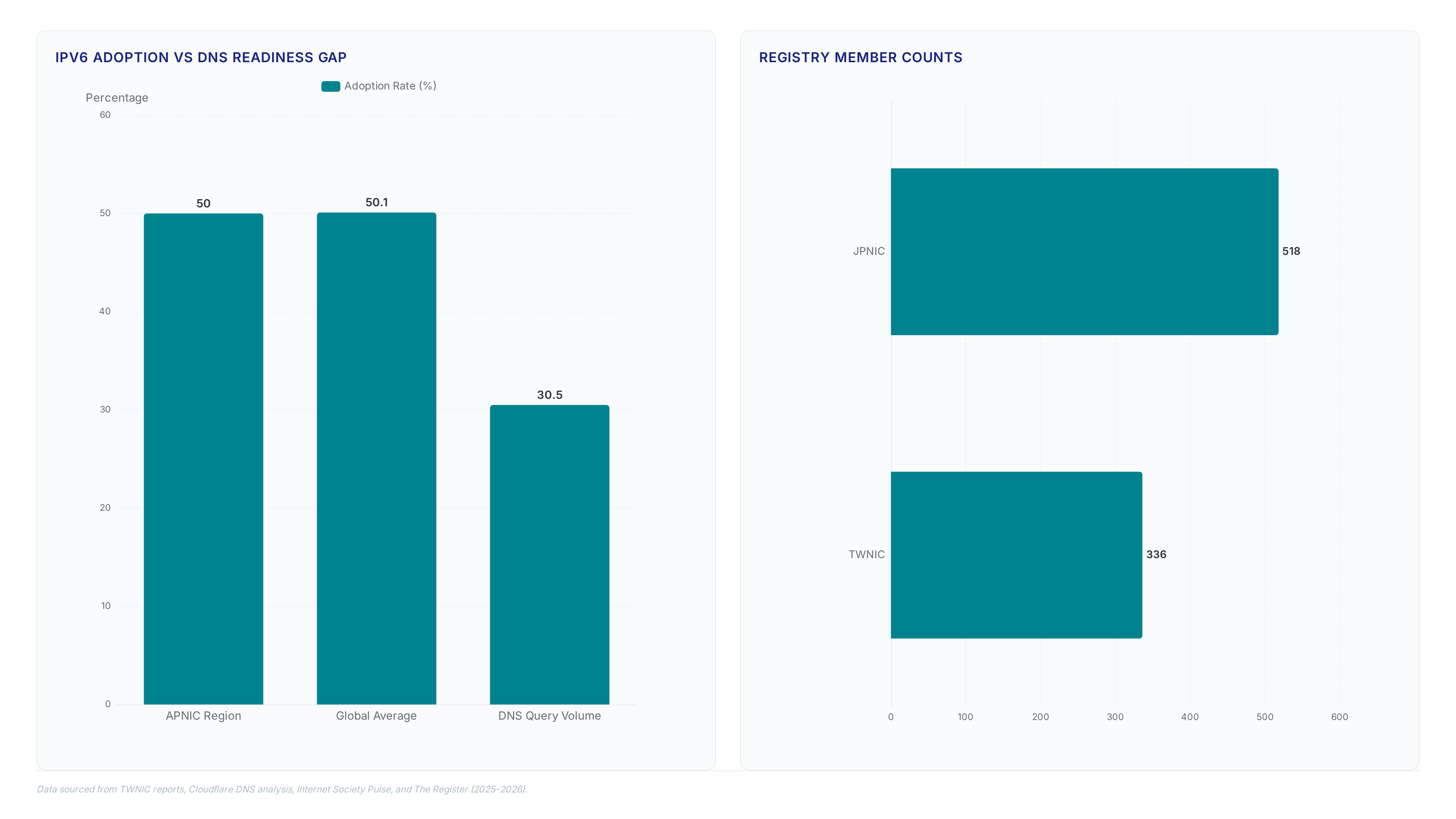
TWNIC reported 336 members while achieving 61.36% user availability, proving small registries outperform larger peers. JPNIC manages 518 IP members alongside roughly 900 legacy holders, illustrating how historical allocations complicate modern adoption metrics. Membership counts measure resource holders, whereas user availability quantifies actual endpoint connectivity across the access network. A compact member base often enables quicker policy enforcement than fragmented, massive registries struggling with legacy inertia. Operators observing DNS query volume note a 30.5% figure, revealing a gap between infrastructure readiness and application traffic. High membership numbers in some economies mask low ROA creation rates, creating false confidence in routing security posture.
This speed comes at the cost of reduced operator autonomy. Network engineers must prioritize government checklists over optimal traffic engineering paths. China's 869 million users represent a massive scale where mobile operator adoption dictates global tipping points rather than responding to them. Indonesia mirrors this trajectory by targeting CDN operators, ensuring edge delivery nodes speak the new protocol before core backbone upgrades finish. Such mandates render voluntary RPKI sign-ups obsolete; non-compliant routes face legal penalties alongside technical rejection. The APNIC region crossing the 50 percent threshold relies heavily on these two jurisdictions pulling the average upward.
Korea's phased approach carries measurable risk during the interim period before production services launch. Japan demonstrates that routing security scales effectively when operators treat it as an operational necessity rather than a future project. Networks delaying implementation bet on stability while the threat environment evolves toward automated prefix hijacking.
Actionable Roadmaps for Enterprise IPv6 Migration and Security Compliance
Viet Nam's 2030 IPv6-only mandate forces enterprise networks to separate user adoption metrics from valid ROA coverage for full compliance. Ministerial directives now bind routing security to licensing, requiring operators to publish cryptographic signatures instead of merely enabling dual-stack connectivity. Reaching this target demands more than address allocation. It requires implementing First Hop Security features like RA Guard to protect the data plane. Operators ignoring these controls face exposure even with high adoption rates because unsecured neighbor discovery allows local spoofing despite global RPKI validity. The transition often extends beyond original timelines since migrating the network without applications yields no functional gain for end users. Google's documented multi-year migration confirms that application readiness dictates success more than infrastructure upgrades alone. Enterprises must audit legacy systems before committing to the 2030 deadline. Dual-stack arrangements incur significant design expenses during the interim. A purely regulatory approach risks creating compliant but fragile networks if technical depth lags behind policy announcements.
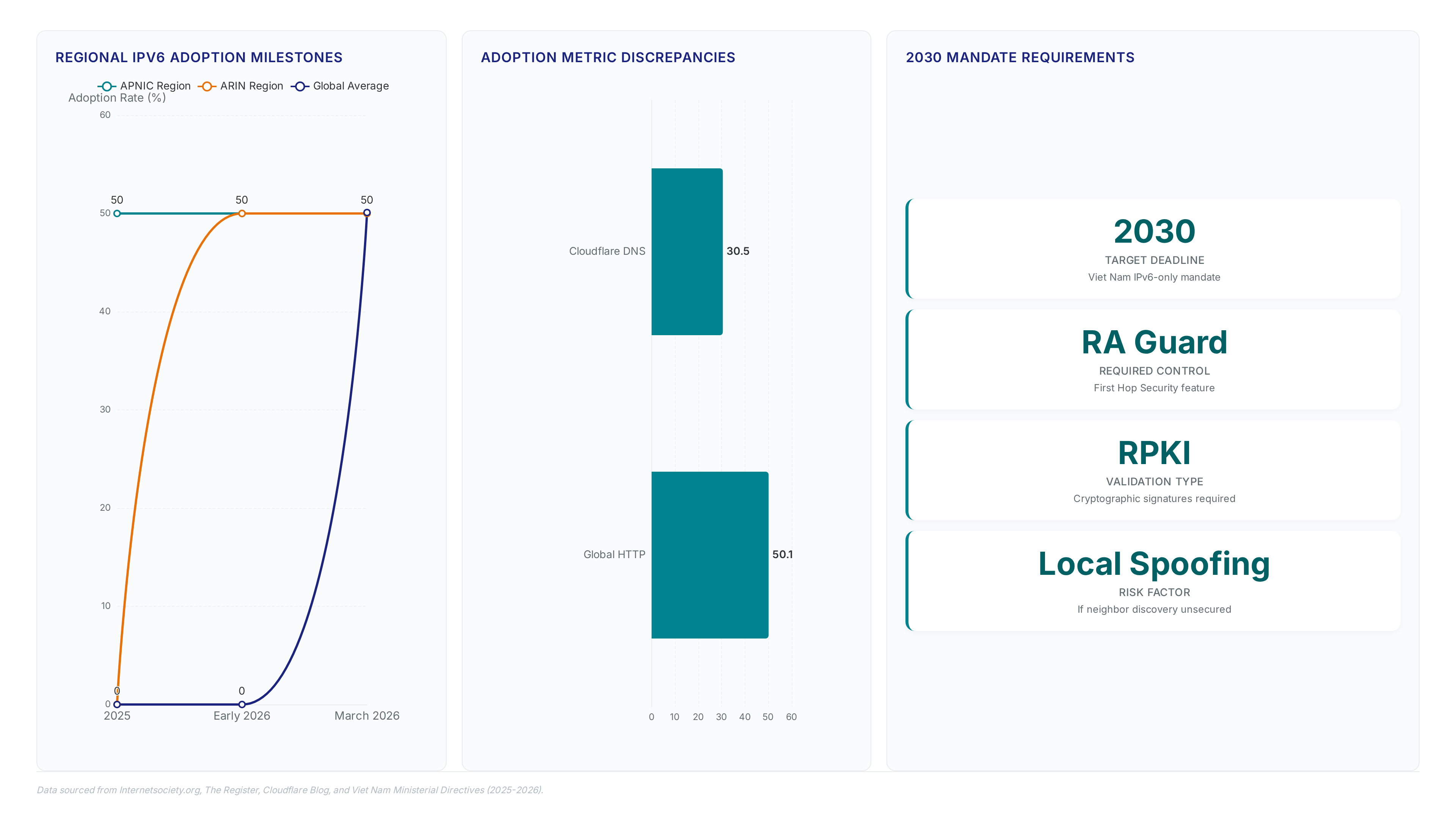
InterLIR assists organizations in aligning these technical controls with national directives to avoid operational gaps. Enterprises should mirror this sequence by engaging major cloud providers that already support dual-stack edges. Waiting for legacy fixed-line maturity delays security benefits while mobile users remain exposed to address exhaustion risks. The 464XLAT mechanism enables smooth mobile broadband translation without requiring immediate application rewrites. Operators often neglect that migrating the network layer alone fails if applications lack native IPv6 support. Google's enterprise experience confirms that projects frequently extend beyond original timelines when software stacks lag behind infrastructure changes. Security teams must deploy RA Guard and ND Inspection to prevent local spoofing during the transition phase. These First Hop Security controls protect the data plane even when global routing policies remain incomplete. A phased roadmap reduces risk by isolating mobile traffic flows from rigid legacy systems.
Rapid mobile deployment clashes with the slower pace of backend database compatibility updates. Rushing the core migration without application testing causes service outages that outweigh the benefits of early adoption. Successful transitions treat mobile networks as the primary vector rather than an adjunct to fixed infrastructure. Japan contrasts this trajectory as 453 LIRs now create ROAs. Enterprise planners often neglect that migrating just the network without applications creates a false sense of security per Google Enterprise Network lessons. Operators proceeding with IPv6-only transitions must implement First Hop Protection controls like RA Guard to prevent local spoofing that global RPKI validity cannot stop. The cost of dual-stack arrangements includes additional design expenses. Skipping route origin authorization invites hijacks during the migration window.
Delaying cryptographic signatures until a 2027 rollout date exposes traffic to route leaks that valid RPKI validation would otherwise drop immediately. Enterprise networks face a specific tension where high user adoption masks vulnerable routing tables. This situation requires operators to publish prefixes before enabling IPv6-only modes. InterLIR recommends auditing next hop reachability alongside ROA status to close gaps that regulatory mandates often overlook in favor of simple connectivity metrics.
About
Alexei Krylov serves as the Head of Sales at InterLIR, a specialized marketplace dedicated to the redistribution of IPv4 resources. His direct involvement with Regional Internet Registries (RIRs) and deep understanding of global IP scarcity make him uniquely qualified to analyze developments within the National Internet Registry (NIR) system. While the recent APRICOT 2026 session highlighted regional IPv6 adoption milestones, Krylov's daily work addresses the critical reality that many organizations still require immediate IPv4 connectivity during this transition. At InterLIR, he enables secure, transparent access to these finite assets, ensuring business continuity where native allocation falls short. This practical experience in navigating IP resource markets allows him to contextualize how NIR coordination and RPKI plans directly impact commercial network availability. His perspective bridges high-level policy discussions with the operational needs of enterprises striving to maintain reliable internet infrastructure amidst evolving registry landscapes.
Conclusion
Scale exposes a critical fracture where high mobile adoption rates mask fragile routing integrity. As user traffic shifts decisively to IPv6, the operational burden moves from simple connectivity to verifying cryptographic validity across every handoff. Relying on legacy dual-stack architectures past 2027 creates an unsustainable overhead that invites route leaks which standard filtering misses. The industry must stop treating Route Origin Authorization as a compliance checkbox and start viewing it as a fundamental latency reducer. Organizations should mandate full ROA coverage for all public-facing prefixes before decommissioning IPv4 fallbacks, specifically targeting a completion date of late 2026 to align with carrier maturity curves. Delaying this synchronization allows bad actors to exploit the gap between user availability and routing security.
Start by auditing your next-hop reachability against current RPKI data this week to identify prefixes that lack valid signatures despite active traffic. This immediate inventory reveals hidden exposure points that uptime metrics completely obscure. Prioritize signing these specific routes before expanding any IPv6-only pilot programs. Real durability demands that security policies evolve quicker than transport protocols, ensuring the control plane protects the massive data flows now dominating the network edge.
Frequently Asked Questions
New members paying via transfer must pay a AUD 500 sign-up fee. This cost applies alongside annual fees based on total address space holdings for the current year.
Account holders in the Very Small tier receive a 25% discount on renewal fees. This benefit applies specifically to economies that graduated while the holder was already a member.
Secondary market prices for IPv4 addresses typically range between $15 and $45 per IP. These figures reflect current trading values within the Asia Pacific region for 2026 transactions.
Korea currently lags significantly with only 2% IPv4 coverage by ROAs. This low rate forces operators to rely on a national testbed before attempting full production rollout of security measures.
Japan's Local Internet Registries increased ROA adoption by 17% over the past year. This growth resulted from active community engagement and events organized to promote routing security standards locally.