RIPE 2025 Data: $22 IP Lease Costs
With over 20,000 members across 76 countries, the RIPE NCC now wields influence far beyond its 1992 origins of just three employees. (Ripe 848) The 2025 Annual and Financial Reports expose how this regional registry manages critical IPv4 scarcity while funding necessary internet infrastructure through a rigid charging scheme. These documents prove that administrative bureaucracy, not just technical protocol, dictates the stability of the global network.
Readers will dissect the operational mechanics behind IP resource allocation, where RIPE NCC data reveals persistent IPv4 demand despite the theoretical shift to IPv6. As noted in industry analysis, IPv4 remains indispensable for public-facing services like APIs and payment platforms in 2026, forcing enterprises into costly dual-stack environments rather than full migration. The report details how the organization tracks these tensions through specific statistics on ASN transfers and assignment patterns.
Finally, the analysis covers the financial implications of the current charging scheme, linking revenue directly to the maintenance of platforms like RIPE Atlas and K-root nodes. The text outlines how the Executive Board, led by CEO Hans Petter Holen, aligned the 2026 Activity Plan with these fiscal realities. By examining the delivery on 2025 commitments, stakeholders can gauge whether the registry's financial health truly supports its the mission of internet governance.
The Role of the 2025 Annual and Financial Reports in Internet Governance
Defining the 2025 RIPE NCC Annual and Financial Reports Scope
The RIPE NCC Annual Report 2025 and RIPE NCC Financial Report 2025, published on 17 Apr 2026, separate operational metrics from fiscal accounting. The Annual Report documents resource allocation statistics and platform updates, while the Financial Report details the monetary execution of the organization. These documents function as mandatory transparency instruments approved by the Executive Board following the 2026 Activity Plan and Budget ratification on 11 Dec 2025.
Operators require this distinction to validate governance claims against actual delivery. The Annual Report lists commitments made in the previous cycle and verifies their completion status. It includes specific data on IPv4 leasing trends where prices range between a modest fee and a slightly higher rate per IP monthly, reflecting tactical right-sizing by region. The Financial Report confirms whether the flat-fee model sustained these operations without deficit.
| Report Type | Primary Content | Governance Utility |
|---|---|---|
| Annual Report | Resource stats, event maps, policy contributions | Validates service delivery against promises |
| Financial Report | Revenue streams, expense ledgers, audit results | Confirms fiscal stability for future planning |
Leadership under Hans Petter Holen uses these texts to demonstrate strategic alignment. A critical tension exists between the high-level adoption figures and the granular financial reality; while hyperscalers reach 82% IPv6 adoption, the majority of global websites remain on legacy protocols. This disparity forces the RIPE NCC to maintain dual-stack support services, inflating operational costs despite the push for modernization. Members must scrutinize both reports to understand if the fee structure adequately covers this transitional burden.
The RIPE NCC Annual Report 2025 provides K-root and AuthDNS node maps alongside IPv6 transfer infographics for operational planning. Network engineers cross-reference these maps against global internet traffic patterns where IPv4 still handles between a majority and a substantial majority of volume. This data reveals hidden single points of failure in authoritative DNS paths that standard BGP monitors miss. Operators in regions with only 11% adoption face distinct latency penalties compared to areas reaching 72% penetration. The report contextualizes these gaps by detailing allocation statistics across 76 countries.
| Metric Type | Data Source Utility | Planning Constraint |
|---|---|---|
| K-root Maps | Identifies physical node proximity | Limited by static map snapshots |
| Transfer Stats | Tracks IPv4 exhaustion liquidity | Ignores private lease market rates |
| RIPEstat | Validates historical assignment records | Requires manual query aggregation |
Relying solely on these visuals obscures the impact of the no-justification policy on transfer velocity. Buyers exploit this liquidity hub to acquire blocks without proving need, inflating demand signals in the infographics. The cost is a distorted view of actual organic growth versus speculative hoarding. Members must correlate these transfer figures with the withdrawn policy proposal to understand future regulatory risks. The failure of the 2024-02 IPv6 Initial Allocations proposal suggests consensus remains elusive despite clear traffic trends. Governance participation requires dissecting how delivered commitments match the initial budget promises.
Validating 2025 Activity Plan Commitments and Delivery Metrics
Cross-referencing the published commitment list against actual delivery highlights within the annual documentation validates the 2025 Activity Plan. Stakeholders locate the specific registry of promises and their fulfillment status to audit organizational accountability. This section details data storytelling outputs and new RIPE Atlas tools as primary evidence of executed strategic goals. Operators must verify that public policy consultations listed in the overview match the timing of external regulatory windows.
| Verification Target | Report Section | Governance Utility |
|---|---|---|
| Commitment Registry | Activity Plan Delivery | Validates budget execution |
| Policy Contributions | Public Policy Overview | Tracks regulatory influence |
| Tool Deployments | Highlight Pages | Confirms R&D output |
Failure to align these metrics obscures the impact of separate fees planned for early 2026. The limitation of this checklist is its reliance on self-reported delivery without third-party performance benchmarks. Members using this data gain use during the General Meeting to question Membership Engagement strategies.
AuthDNS nodes and K-root servers form the recursive validation backbone mapped explicitly in the 2025 documentation. AuthDNS nodes answer queries for reverse delegations and resource records, while K-root instances provide stable anchor points for the global DNS hierarchy during routing instability. The annual publication visualizes these assets to help operators identify geographic gaps in resolution paths.
Infrastructure expansion now faces hard physical limits rather than just logical constraints. In Ireland, data centers already consume 21% of national power, forcing a pause on new connections until 2028 that directly impacts where new data center connections can physically terminate. This energy cap means adding redundant K-root instances in saturated regions requires retiring legacy loads instead of simple expansion.
Security posture relies on cryptographic verification to prevent hijacking of these critical infrastructure labels. The organization implements Resource Public Key Infrastructure to sign route origins, ensuring that DNS traffic reaches legitimate servers rather than spoofed endpoints. Without RPKI, attackers could redirect queries away from authorized AuthDNS nodes to malicious clones.
| Component | Primary Function | Dependency |
|---|---|---|
| AuthDNS Node | Serves authoritative zone data | Upstream RIR allocation |
| K-root Server | Provides root zone trust anchor | Global BGP reachability |
Automation is shifting from human-assisted to fully agentic operations where AI agents replace manual effort in complex workflows. This transition demands new governance frameworks because automated agents might reconfigure DNS paths quicker than human operators can audit them. Operators query RIPE Atlas probes to isolate the 32% enterprise adoption rate against mobile carrier dominance. Measurement data reveals a sharp divergence where mobile networks approach saturation while corporate campuses lag behind due to legacy tunneling dependencies. Network engineers must distinguish between edge availability and core transport capacity when interpreting these gaps.
The cost of ignoring these physical limits is measurable in stranded IP blocks that lack corresponding compute resources. Operators must treat energy availability as a primary routing metric alongside bandwidth and latency. Ignoring this constraint leads to allocation plans that are theoretically sound but physically impossible to execute.
Financial Implications of the Charging Scheme and Market Dynamics
Defining the 2026 RIPE NCC Base LIR Fee and Option A Proposal
The fixed EUR 1,800 base contribution for 2026 maintains the 2025 level, while Option A proposes a rise to EUR 1,894. This specific increase targets the May 2026 General Meeting agenda where members exercise voting rights on the final budget. Historical progression shows the fee climbed from EUR 1,400 to EUR 1,550 before stabilizing at the current plateau. Ancillary costs remain distinct, including a one-time EUR 1,000 sign-up charge and per-resource assignments for new ASN blocks.
| Fee Component | 2026 Baseline | Option A Proposal |
|---|---|---|
| Base LIR Contribution | EUR 1,800 | EUR 1,894 |
| New Member Sign-up | EUR 1,000 | EUR 1,000 |
| Historical 2022 Rate | EUR 1,400 | N/A |
Flat-fee models favor large holders of IPv4 space compared to tiered structures used by other RIRs. Small registries subsidize the administrative overhead of massive legacy allocations without proportional usage. Publication of the final combined Charging Scheme is scheduled for April 2026 to allow review before the vote. Rejection of Option A locks the budget to existing reserves, potentially delaying infrastructure upgrades like RPKI validation tooling.
Total annual obligations combine the fixed EUR 1,800 base with variable charges like EUR 50 per ASN assignment. New entrants face an immediate liquidity hurdle due to the mandatory one-time sign-up fee of EUR 1,000 before receiving any resources. Failure to account for these additive fees results in unexpected deficits when expanding infrastructure footprints rapidly. The mechanism ensures predictable revenue for the RIPE NCC but removes financial disincentives for resource accumulation by dominant players.
Infrastructure Power Constraints Impacting Data Center Economics
European data center demand will triple by 2030, creating a hard physical ceiling on expansion regardless of IP resource availability. This energy scarcity forces a decoupling of logical addressing plans from actual deployment capacity. Grid operators now reject connection requests when local load exceeds thermal limits, a reality confirmed by the pause on new data center connections in Ireland until 2028.
The cost of inaction is measurable latency increases as traffic routes around constrained zones. Network architects should consult InterLIR com) for strategic guidance on navigating these geographic limitations while optimizing ASN assignments. Ignoring these physical boundaries risks stranded assets where allocated space remains unpopulated due to external utility failures.
Steps for Accessing Reports and Exercising Member Voting Rights
Defining Online Report Access and General Meeting Registration Protocols
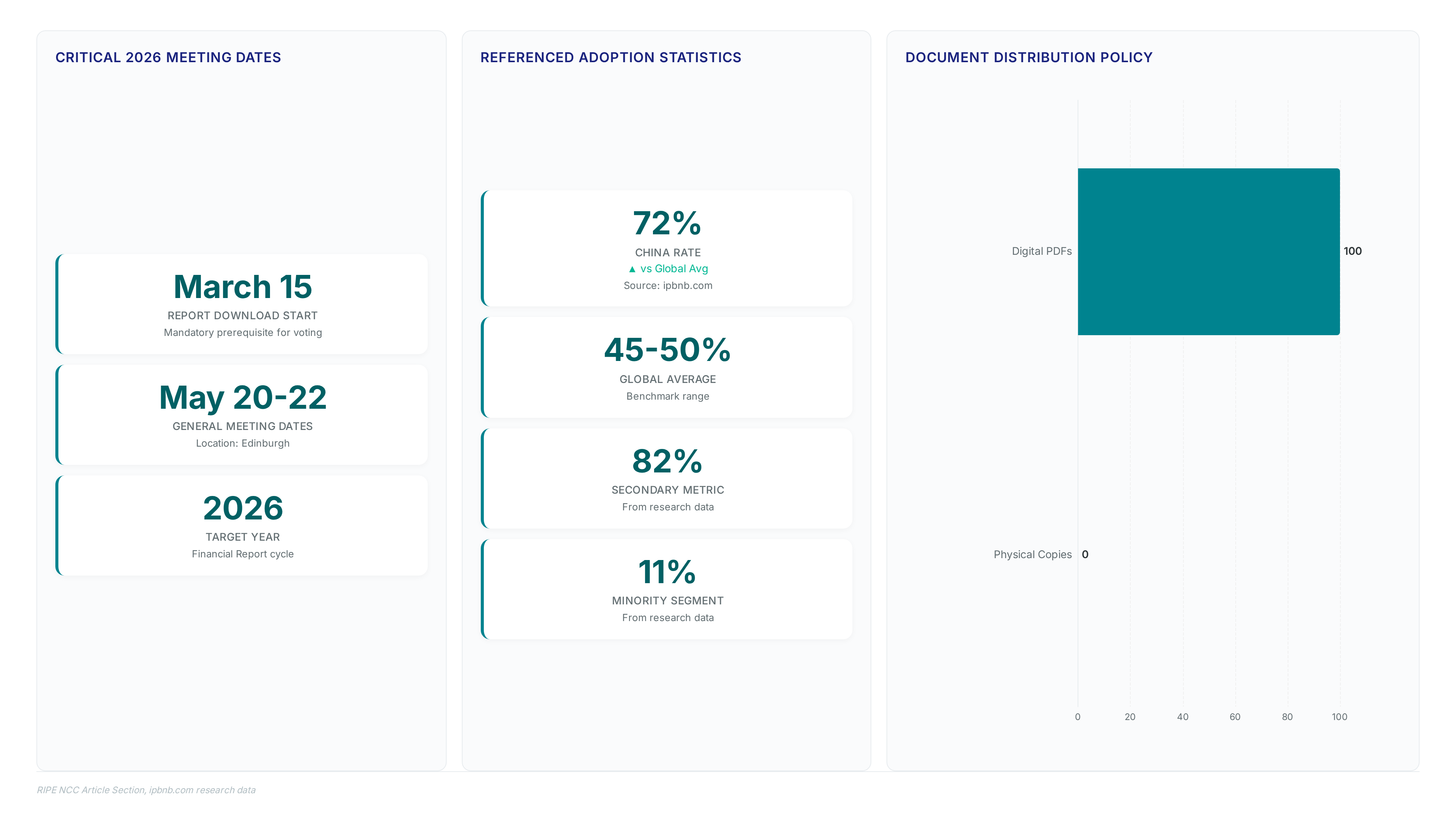
Digital downloads of the Annual and Financial Reports serve as the mandatory prerequisite for voting rights at the upcoming RIPE NCC General Meeting. These documents exist exclusively online, requiring operators to retrieve PDF assets before traveling to Edinburgh for the event scheduled from 20-22 May 2026. Physical copies are not distributed on-site, making pre-meeting access a hard dependency for informed participation.
- Navigate to the RIPE NCC publications portal to locate the 2025 Annual and Financial Reports.
- Download both files to review the Charging Scheme.
- Complete the registration form for the Edinburgh gathering to secure ballot eligibility.
- Cross-reference the downloaded financial data with the proposed fee changes prior to casting a vote.
The procedural link between document retrieval and ballot validation creates a single point of failure for unprepared delegates. Operators who skip the download step forfeit the context needed to evaluate the base LIR fee. Failure to ingest this data locally before the session renders the physical presence of a representative operationally useless during budget ratification.
Executing Voting Rights on the 2026 Charging Scheme Proposal at the Edinburgh GM
Registration for the RIPE NCC General Meeting in Edinburgh constitutes the mandatory technical prerequisite for casting a ballot on the final combined Charging Scheme proposal. The RIPE NCC Executive Board explicitly encourages all members to complete this process to exercise governance rights effectively.
- Access the online portal to download the 2025 Annual and Financial Reports, as physical copies remain unavailable.
- Submit the registration credentials before the deadline to secure voting eligibility for the May 20–22 event.
- Review the final combined proposal text published in April 2026 to identify specific fee structure changes.
- Attend the session in person or via remote link to cast a vote on the budget.
Failure to register results in automatic disenfranchisement, rendering any prior review of financial data operationally useless for decision-making. This binary access control mechanism ensures that only verified members influence the base LIR fee. Operators must treat registration as a critical configuration step rather than an administrative formality.
Operators must reconcile the South East Europe Meeting dates with the Edinburgh schedule to prevent registration conflicts. The Belgrade event on 21–22 Apr 2026 precedes the General Meeting by exactly four weeks, creating a tight window for financial review. Travel logistics often fail when teams treat regional days as optional, yet missing the RIPE NCC Days Baltics in June limits context for mid-year policy shifts. Download errors typically stem from browser cache conflicts rather than server outages during peak access periods.
| Event | Location | Strategic Focus |
|---|---|---|
| SEE 12 | Belgrade | Regional IPv6 adoption |
| GM 2026 | Edinburgh | Charging Scheme vote |
| Baltics | Riga | Network measurement tools |
- Clear local browser cache before accessing the online portal to fix report download issues.
- Verify GM registration status immediately after reviewing the Financial Report 2025.
- Block travel dates for Belgrade and Riga to avoid overlapping resource allocation.
Failure to sequence these engagements correctly leaves members unprepared for the Charging Scheme deliberation. InterLIR recommends treating the April SEE 12 gathering as a mandatory preparatory step for the May vote.
About
Evgeny Sevastyanov, Head of Customer Support at InterLIR, offers a unique operational perspective on the RIPE NCC Annual Report 2025. His daily responsibilities involve direct interaction with RIPE database objects, managing IP transfers, and ensuring strict compliance with regional registry policies for clients across Europe. This hands-on experience makes him uniquely qualified to analyze how the RIPE NCC's strategic decisions and financial health directly impact the global IPv4 marketplace. At InterLIR, a Berlin-based specialist in IPv4 address redistribution, Sevastyanov navigates the complex regulatory environment that the Annual Report details. By bridging the gap between high-level organizational reporting and ground-level resource management, he clarifies how the RIPE NCC's growth to over 20,000 members influences the efficiency and security of IP address leasing. His insights connect abstract financial data to the real-world challenges of maintaining clean BGP announcements and valid route objects in an evolving internet infrastructure.
Conclusion
The hidden cost of maintaining dual-stack infrastructure extends far beyond monthly leasing fees; it manifests as a compounding latency tax in regions with low IPv6 penetration. As power constraints force data center moratoriums in markets like Ireland, the operational expense of running legacy IPv4 traffic on inefficient hardware will soon outpace the market value of the addresses themselves. Hyperscalers have already absorbed the migration pain, leaving smaller operators exposed to widening performance gaps that directly impact user retention. You cannot wait for policy consensus to act on this physical reality.
Commit to a hard deadline of Q3 2026 to achieve the vast majority of IPv6 outbound traffic for all new service deployments. Any project initiating after this date must default to IPv6-only architecture with translation layers treated as temporary technical debt, not permanent fixtures. This timeline aligns with the inevitable tightening of energy quotas and prevents your infrastructure from becoming a stranded asset. The window to optimize before power rationing becomes universal is closing rapidly.
Start by auditing your current power-to-packet ratio for IPv4 versus IPv6 flows this week. Identify the specific racks or clusters where legacy traffic consumes disproportionate energy per gigabit and draft a migration schedule for those specific workloads immediately.
Frequently Asked Questions
Leasing prices currently range between specific tactical limits. Market data shows these rates fall strictly between $0.38 and $0.45 per IP monthly, reflecting right-sizing strategies by regional operators.
Adoption rates vary significantly depending on the operator type and location. While hyperscalers reach 82% IPv6 adoption, some specific regions still struggle with only 11% adoption rates today.
Legacy protocols continue to handle the majority of worldwide data volume. Current patterns indicate that IPv4 still handles between 55% and 70% of total global traffic volume in 2026.
Network performance suffers greatly in areas with low protocol modernization levels. Operators in regions with only 11% adoption face distinct latency penalties compared to areas reaching 72% penetration.
Both reports are available exclusively through digital channels for viewing or printing. Members must download these online files to review details before exercising voting rights at the General Meeting.