RIPE Arbiters Panel: Who Decides IP Conflicts in 2026?
The RIPE NCC needs volunteers by 6 March 2026 to staff a panel governing resources for 75 countries. (Ripe 848) Tier 1 infrastructure aims for no human in the loop operations by 2027, yet the RIPE Network Coordination Center demands manual oversight for high-stakes conflicts involving the Standard Service Agreement and Legacy Internet Resource Holders.
This panel adjudicates disputes between Members regarding Internet number resources and challenges against Executive Board decisions. We dissect the dispute settlement workflow, detailing how arbiters resolve conflicts over RIPE Policies implementation that automated systems cannot ethically navigate. The friction here is real: scalable network management tasks clash with the detailed legal interpretations required for IPv4, IPv6, and ASN allocations.
The concrete volunteer application timeline runs from the initial call on 10 Feb 2026 to the final General Meeting approval on 20 May 2026. As IoT connections swell to 21.9 billion devices, the Management Team relies on these elected volunteers to maintain legitimacy when AI automating complex network management inevitably clashes with established RIPE NCC procedures. Human judgment remains the final authority in Internet Governance.
The Role of the RIPE NCC Arbiters Panel in Internet Governance
RIPE NCC Arbiters Panel Definition and Scope
Formal dispute resolution for the RIPE Network Coordination Center falls to the RIPE NCC Arbiters Panel. This body settles disagreements between Members and the RIPE NCC regarding decisions of the Executive Board or the Management Team under the RIPE NCC Standard Service Agreement. A distinct mandate covers disputes between Legacy Internet Resource Holder entities and the registry concerning policy implementation for legacy holdings. The RIPE Network Coordination Center published a call for volunteers on 10 Feb 2026 to staff this critical governance function.
Procedural delays during arbitration can stall network expansion plans for months while decisions pend. Arbiters cannot create new address space; they only adjudicate existing supply distribution.
Governance Risks Amid Energy Constraints and Regulatory Shifts
External infrastructure limits and top-down mandates now complicate dispute resolution for the RIPE NCC Arbiters Panel. Ireland paused new data center connections until 2028 after facilities consumed 21% of national electricity, creating physical scarcity for the infrastructure hosting governance tools. This energy cap restricts the computational resources available for automated arbitration logging during peak conflict periods.
Global trends show a rise in top-down regulatory frameworks demanding state approval before AI deployment, directly challenging the bottom-up consensus model RIPE relies upon for policy formation. Arbiters face a structural problem: they must adjudicate Member disputes over resource registration while national laws increasingly override community-developed policies. The cost of this divergence is measurable; cybercrime law and security doctrine are becoming dominant vectors that potentially sideline traditional collaborative models. Operators observing these shifts note that state-mandated compliance often invalidates the very policies arbiters enforce. Arbitration outcomes based on RIPE Policies may become unenforceable if local statutes contradict them.
Arbitration Scope for RIPE NCC Standard Service Agreement Disputes
The arbitration procedure exclusively adjudicates conflicts involving RIPE Policies implementation under the RIPE NCC Standard Service Agreement. This jurisdiction covers disputes between Members and the RIPE NCC regarding decisions made by the Executive Board or Management Team. A separate mandate addresses registration conflicts between multiple Members over scarce Internet number resources. The panel also resolves disagreements between Legacy Internet Resource Holders and the registry concerning legacy service policies.
Operational consistency relies on the fixed fee structure rather than variable consumption models found in commercial clouds. Members pay a flat annual contribution for LIR accounts that covers administration of IPv4 and IPv6 allocations. Independent resources incur additional charges separate from standard dues. This financial stability supports the bottom-up consensus process, distinguishing it from top-down government mandates requiring pre-deployment approval.
| Dispute Type | Parties Involved | Governing Document |
|---|---|---|
| Service Agreement | Member vs RIPE NCC | RIPE NCC Standard Service Agreement |
| Resource Registration | Member vs Member | RIPE Policies |
| Legacy Services | Legacy Holder vs RIPE NCC | RIPE NCC Services to Legacy Internet Resource Holders |
Strict separation of these three categories prevents jurisdictional overlap during contentious hearings. Failure to categorize a claim correctly results in immediate dismissal rather than transfer. Operators must identify the specific governing document before filing to avoid procedural rejection.
Disputes between Members regarding Internet number resources registration trigger the arbitration sequence under the RIPE NCC Standard Service Agreement. The process initiates when competing claims arise over scarce address blocks returned to the pool.
- Affected Members submit a written complaint detailing the conflicting registration entries.
- The Executive Board reviews the filing to confirm jurisdiction under current RIPE Policies.
- Selected arbiters examine the RIPE Database records to verify historical allocation data.
- A binding decision resolves the conflict based on policy compliance rather than financial.
| Dispute Type | Adjudicator Focus | Primary Evidence Source |
|---|---|---|
| Member vs Member | Policy adherence | RIPE Database logs |
| Member vs RIPE NCC | Procedural correctness | Management Team notes |
| Legacy Holder | Service level terms | Legacy policy text |
Independent resources incur an additional fee of EUR 75 per resource, creating a financial stake in accurate registry maintenance. The Management Team cannot unilaterally override arbiter findings once a verdict is issued. This separation of duties prevents administrative bias during high-stakes allocation conflicts. Database transparency does not guarantee immediate resolution; the review cycle depends on volunteer availability. Delays occur when complex historical assignments require deep forensic analysis of past RIPE Policies. Rigid adherence to procedure ensures fairness but sacrifices speed compared to commercial dispute mechanisms.
The application window closes on Friday, 6 March 2026, marking the hard deadline for prospective volunteers to submit forms. Candidates must email their interest before this date to enter the nomination pool for the RIPE NCC Arbiters Panel. The Executive Board reviews submissions and selects nominees based on required legal and technical expertise. This shortlisting phase bridges the gap between initial recruitment and the ratification. Approval occurs during the General Meeting starting 20 May 2026 in Edinburgh. Members cast votes to confirm the slate of new arbiters. The draft agenda published in late April lists these resolutions for advance review. Final voting results determine the panel composition for the coming term.
| Phase | Action | Date Constraint |
|---|---|---|
| Recruitment | Call for volunteers issued | 10 Feb 2026 |
| Submission | Application form return | 6 March 2026 |
| Nomination | Board selection process | March–April 2026 |
| Ratification | Member approval vote | 20 May 2026 |
Dependency on the annual gathering creates a single point of failure for panel expansion. If the General Meeting lacks a quorum or defers voting, the Arbiters Panel cannot onboard fresh capacity despite completed applications. This bottleneck leaves dispute resolution bandwidth static while Internet number resources conflicts rise.
Email Registration and Application Form Workflow
Volunteers initiate entry by emailing [email protected] to trigger the two-step intake sequence.
- Send a statement of interest to the assigned address to register intent.
- Await the automated response containing the mandatory application form.
- Complete the document and return it before the Friday, 6 March 2026 deadline.
This manual handshake contrasts with the autonomous platforms predicted to reshape infrastructure operations, where AI agents execute complex workflows without human initiation. Reliance on email introduces latency absent in agentic AI systems capable of self-planning. While commercial governance tools automate compliance checks, the RIPE NCC maintains a human-in-the-loop model for dispute resolution. This design choice ensures arbitrators possess verified legal and technical context before joining the pool. However, the sequential nature of email registration creates a single point of failure; if the initial message filters as spam, the candidate misses the nomination window entirely. The Executive Board cannot nominate individuals who fail to complete this specific digital handshake.
Submit the completed application form before the Friday, 6 March 2026 deadline to avoid exclusion from the Executive Board nomination pool.
- Email [email protected] to request the mandatory intake document.
- Complete the form detailing legal expertise and policy familiarity.
- Return the file prior to the cutoff, which arrives one day after the Asia Pacific Internet Governance Academy opens its own nomination cycle.
This clustering of governance deadlines creates administrative friction for volunteers managing multiple internet governance responsibilities. The broader market context shows regulatory pressure driving AI platform valuations toward $492 million in 2026, yet dispute resolution here remains a manual, email-driven process. Delaying submission until the final hours risks missing the window entirely, as late arrivals receive no consideration for the RIPE NCC General Meeting. The cost of missing this single window is a full-year deferral, leaving the panel understaffed for ongoing Legacy Holder disputes.
Executive Board Nomination and General Meeting Approval Steps
The Executive Board nominates arbiters based strictly on the volume of qualified volunteers received.
- Board members review the candidate pool following the March deadline to determine slate size.
- Selected nominees advance to the final ratification phase at the RIPE NCC General Meeting.
- The membership casts binding votes during the event scheduled from 20 May to 22 May 2026.
Historical participation data indicates high engagement, with prior cycles recording over 3,000 votes on key resolutions. This volume ensures that approval reflects broad consensus rather than a quorum minimum.
| Phase | Actor | Action Required |
|---|---|---|
| Shortlisting | Executive Board | Selects nominees from volunteer pool |
| Notification | Secretariat | Publishes draft agenda by late April |
| Ratification | Voting Members | Approves slate during Edinburgh session |
A critical tension exists between the Board's discretion to filter candidates and the membership's right to reject the entire slate. If the Board nominates too few experts, dispute resolution capacity stalls; if they nominate too many without vetting, the General Meeting risks rejecting unqualified applicants. Failure to secure approval at the Edinburgh session nullifies the application, forcing candidates to wait for the next annual cycle.
Strategic Value of Volunteering for the Arbiters Panel
Strategic Value of Arbiters in Bottom-Up Governance
Volunteering as an arbiter preserves the bottom-up consensus model against rising top-down mandates like China's AI approval rules. This role resolves conflicts between Members and the RIPE NCC regarding the Standard Service Agreement, ensuring community autonomy over resource distribution. Unlike commercial entities prioritizing shareholder returns, the RIPE NCC operates as a not-for-profit rid=075577725582-66&sid=184938) supported by ISPs, aligning incentives with technical stability rather than profit.
| Governance Model | Decision Authority | Primary Incentive |
|---|---|---|
| Bottom-Up (RIPE) | Community Consensus | Technical Stability |
| Top-Down (State) | Government Decree | Regulatory Compliance |
| Commercial | Shareholder Vote | Profit Maximization |
Operators facing Resource Scarcity due to IPv4 exhaustion require neutral adjudication when waiting lists trigger disputes. The alternative involves external regulators imposing rigid frameworks that ignore technical nuance. Participation prevents this drift by maintaining a volunteer-driven check on executive power. Without active arbiters, the General Meeting loses its mechanism to enforce policy implementation independently. This action directly counters the centralization trend visible in global infrastructure markets.
Application: Resolving IPv4 Scarcity Disputes on the Waiting List
Volunteers adjudicate conflicts where returned blocks from closed organizations trigger competing claims on the IPv4 waiting list. The mechanism requires arbiters to validate whether a returned block satisfies the specific needs of the next applicant or if a senior member holds priority under legacy policy. Evidence suggests this scarcity model fuels disputes because the registry no longer issues fresh allocations, forcing all new requests into a zero-sum queue.
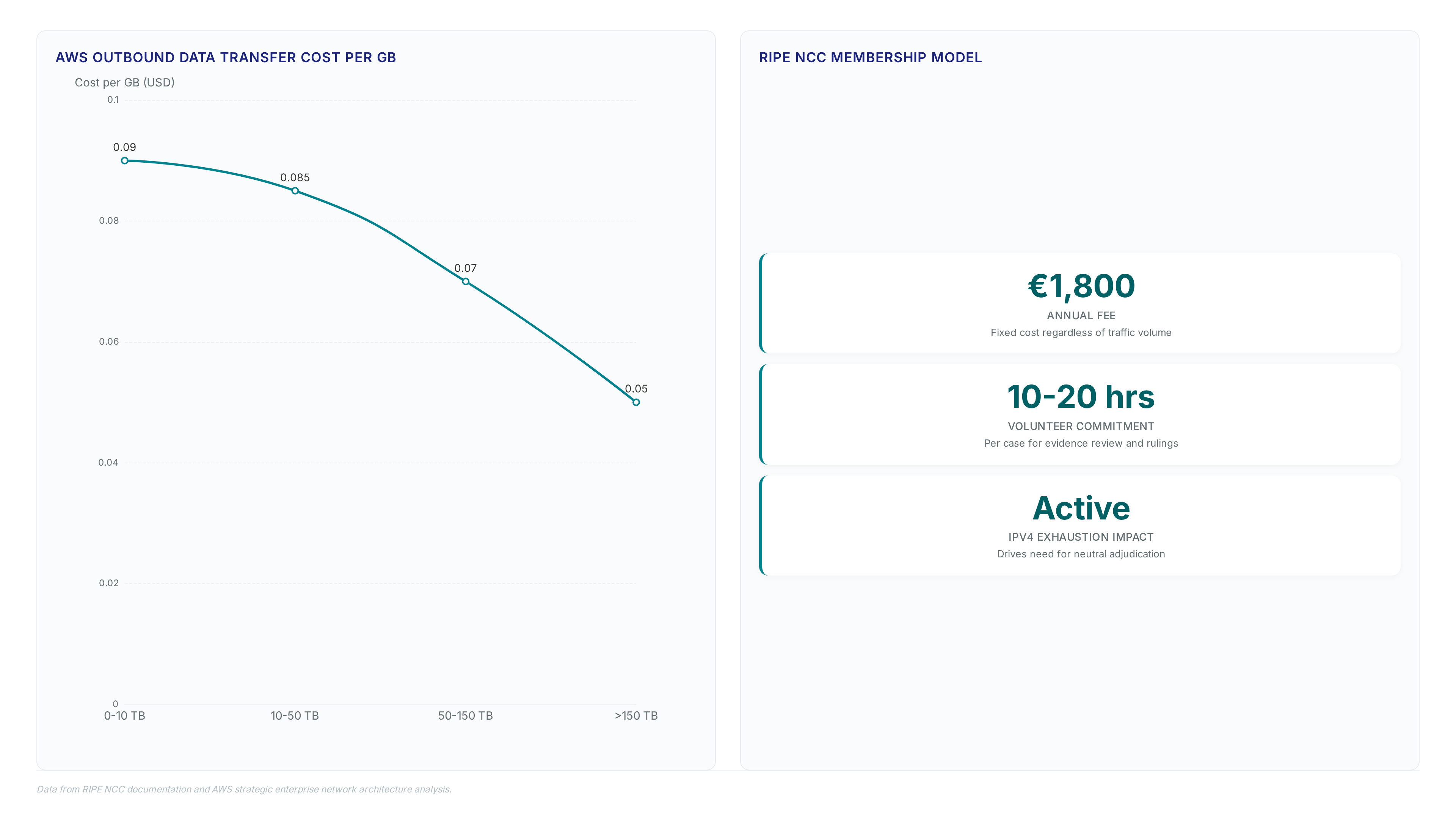
A limitation exists in the flat annual service fee of EUR 1,800 per LIR account, which remains constant regardless of the complexity or volume of arbitration cases required. This cost structure creates a tension where high-value disputes consume disproportionate volunteer hours without generating additional revenue for the dispute resolution framework.
Operators should volunteer if they possess deep familiarity with the Standard Service Agreement and can interpret policy nuances during resource exhaustion.
| Dispute Type | Parties Involved | Policy Scope |
|---|---|---|
| Allocation Conflict | Member vs. Member | Registration of Internet number resources |
| Service Decision | Member vs. RIPE NCC | Executive Board decisions on agreements |
| Legacy Status | Legacy Holder vs. RIPE NCC | Implementation of legacy services |
Without qualified volunteers, the Executive Board lacks the technical depth to resolve complex pathing or ownership arguments efficiently. Delayed rulings stall network expansion plans for applicants stuck behind contested entries.
Ireland's suspension of data center connections until 2028 creates immediate precedence for resource disputes that arbiters must adjudicate without physical expansion options. Volunteers evaluating claims between Members now face cases where electricity availability dictates technical feasibility rather than policy compliance alone. The mechanism shifts arbitration from pure registry rule interpretation to assessing infrastructure viability under national grid caps. Volunteer panels lack statutory authority to override sovereign energy moratoriums, leaving some disputes technically unresolvable. This constraint forces operators to consider variable cost structures where cloud egress fees replace capital expenditure on local hardware. High-volume traffic exceeding 150 TB sees pricing drop to $0.05/GB. Serving on the panel requires navigating conflicts where Network Automation cannot bypass physical power limits. InterLIR advises candidates to review grid capacity reports before submitting the March 6 application. The role demands balancing community policy against hard infrastructure ceilings that no amount of consensus can lift.
About
Evgeny Sevastyanov serves as the Head of Customer Support at InterLIR, a specialized IPv4 marketplace based in Berlin. His daily responsibilities involve direct management of IP resource transfers and the precise creation of objects within the RIPE database, making him uniquely qualified to discuss the RIPE NCC Arbiters Panel. Because his team routinely navigates complex disputes regarding Internet number resource registration and policy implementation, Sevastyanov possesses practical insight into why a reliable arbitration mechanism is critical for the industry. At InterLIR, where transparency and security in IP leasing are paramount, understanding the resolution processes for conflicts between Members and the RIPE NCC is necessary. His hands-on experience with RIPE Policies and the technical realities of resource allocation allows him to clearly articulate the value of this panel in maintaining stability and trust within the global networking community.
Conclusion
Scaling dispute resolution under physical resource caps reveals a critical fracture: volunteer governance cannot adjudicate infrastructure scarcity. When national grid limits override registry policy, the operational cost shifts from legal interpretation to strategic asset relocation. The current model breaks because it assumes infinite physical expandability, ignoring that energy moratoriums render standard compliance arguments moot. This forces a fundamental pivot where egress economics dictate membership value more than IP ownership history. Organizations must stop viewing arbitration as a purely procedural safeguard and start treating it as a risk assessment for physical viability.
Commit to a hybrid infrastructure strategy by Q4 2027, specifically conditioning local hardware investments on verified grid capacity rather than projected traffic growth. Do not rely on consensus mechanisms to solve physics problems; instead, integrate variable cloud pricing models immediately to buffer against regional power failures. The panel's future relevance depends on acknowledging that sovereign energy constraints now supersede community bylaws. Start by auditing your primary data center's power purchase agreements against national load forecasts before the next membership cycle opens. This specific financial review exposes hidden liabilities that procedural rulings cannot fix. Only operators who align their dispute expectations with hard infrastructure realities should engage in the upcoming selection process.
Frequently Asked Questions
The panel settles conflicts between Members over Internet number resources or against Executive Board decisions. This human oversight remains vital as IoT connections swell to 21.9 billion devices, creating complex allocation disputes automated systems cannot ethically navigate alone.
Arbitration relies on fixed membership contributions rather than variable data transfer fees. Unlike commercial models charging $0.09 per GB for outbound traffic, the panel ensures neutral dispute resolution without financial penalties tied to network volume or consumption levels.
Without volunteers, Executive Board decisions regarding service agreements remain unchallenged and unchecked. This removes a critical fail-safe against algorithmic governance errors just as global IoT connections approach 21.9 billion devices, increasing the risk of unresolved resource conflicts.
No, arbiters cannot create new address space but only adjudicate existing supply distribution. They resolve waiting list disputes among Members while managing friction caused by 21.9 billion connected devices competing for scarce, returned address blocks.
Human arbiters provide necessary legal nuance that AI-driven network automation cannot ethically navigate. As IoT connections reach 21.9 billion devices, manual oversight ensures fair interpretation of RIPE Policies during high-stakes conflicts involving legacy holders and standard agreements.