RIPE General Meeting: Voting Deadlines You Can't Miss
With 3,049 votes cast previously, the RIPE NCC General Meeting remains the critical mechanism for enforcing governance amidst looming infrastructure power constraints. (Ripe ncc member update november 2025) This assembly functions not merely as a procedural formality but as the sole authoritative body capable of directing regional internet policy while electricity availability threatens to become the primary limiter for new data center expansion by 2030.
Attendees will dissect the specific governance role of the General Meeting, analyzing how the RIPE Network Coordination Center uses this forum to manage over 20,940 Local Internet Registry accounts across 76 countries. The discussion extends to the hybrid participation mechanics facilitated by the modernized LIR Portal and Meetecho streaming, which enable simultaneous onsite engagement at the Edinburgh International Conference Centre and remote voting access.
Finally, the analysis covers the execution of voting rights through both direct digital ballots and strict proxy submission deadlines set for 6 May. Members must navigate these channels to decide on the Executive Board Election and Charging Scheme Models, ensuring that operational continuity survives the predicted tripling of European power demand. Failure to register via the portal by 20 May forfeits the ability to influence these critical resolutions.
The Role of the General Meeting in RIPE NCC Governance
The RIPE NCC General Meeting functions as the supreme governance body for 20,940 LIR accounts across 76 countries. This hybrid assembly empowers members to elect the Executive Board and approve financial schemes through strict voting protocols. Current leadership features Chair Ondřej Filip and CEO Hans Petter Holen, who manage daily operations under member oversight. Participation requires registration via the LIR Portal before the 20 May deadline to cast valid ballots.
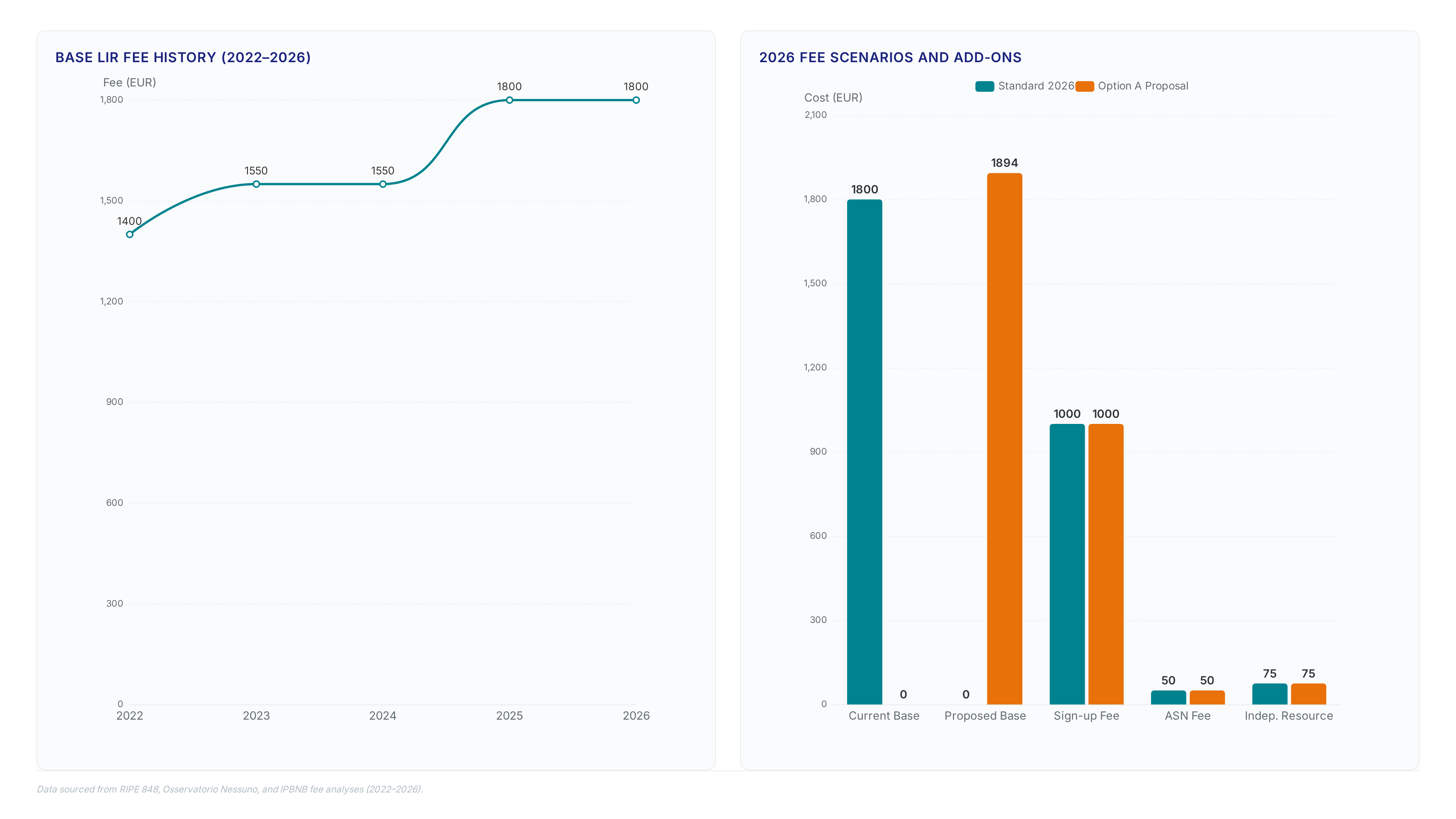
Meanwhile, the Arbiters Panel provides independent dispute resolution when internal negotiations fail between members or staff. Appointment of these arbiters remains a specific voting item on the agenda, separate from board elections. Fee structures face scrutiny, with historical data showing the base rate rising from EUR 1,400 in 2022 to current levels. A proposed Option A
| Governance Element | Function | Constraint |
|---|---|---|
| Executive Board | Strategic direction | Fixed three-year terms |
| Arbiters Panel | Conflict mediation | Ad-hoc appointment cycle |
| General Meeting | Final authority | Strict registration windows |
Failure to register by the cutoff excludes LIRs from influencing the charging scheme. This structural rigidity ensures accountability but penalizes late operational responses.
Members cast binding ballots on the Financial Report 2025 and specific fee trajectories during the General Meeting.
The primary fiscal decision involves adopting a charging model where Option A Historical context reveals the base fee climbed from EUR 1,400 in 2022 to EUR 1,550 for the 2023–2024 cycle before reaching current levels. This progression reflects broader operational costs as the organization supports IPv6 adoption across its certified membership base.
| Fee Period | Base Rate (EUR) | Status |
|---|---|---|
| 2022 | 1,400 | Historical |
| 2023–2024 | 1,550 | Historical |
| 2025–2026 | 1,800 | Current |
| Proposed 2027 | 1,894 | Pending Vote |
Approval of the financial report triggers the discharge of the Executive Board, linking fiscal transparency directly to leadership continuity. A rejected charging scheme creates immediate budget uncertainty, forcing management to operate under previous year constraints until a subsequent vote occurs. Operators must weigh the marginal cost increase against the necessity of funding modernized infrastructure and governance tools. Failure to reach a consensus on the charging model delays strategic initiatives dependent on the approved budget.
Valid voting requires LIR Portal access before the 20 May 14:00 (UTC+1) cutoff. This web interface manages resource allocation and now supports hybrid participation for the Edinburgh event. Modernization efforts rely on a 6% budget increase allocated to Information Services. Operators must distinguish between personal attendance registration and proxy form submission. The proxy deadline expires on 6 May, two weeks prior to the general cutoff. Missing this earlier date invalidates delegated voting rights regardless of portal status.
| Action | Deadline | Consequence of Failure |
|---|---|---|
| Proxy Submission | 6 May | Loss of delegated ballot authority |
| General Registration | 20 May | Inability to cast direct votes |
| Document Review | 22 April | Unpreparedness for resolution debates |
The registration process binds identity to specific LIR accounts strictly. Late entries face automatic rejection by the validation system. No exceptions exist for technical failures occurring after the 6 May limit.
Hybrid Participation Mechanics via LIR Portal and Meetecho
LIR Portal and Meetecho Integration Architecture
Authentication for the 20-22 May 2026 event flows from the LIR Portal This token exchange mechanism validates member identity before granting access to the remote voting interface. Modern implementations rely on a micro-service architecture to separate front-end user interaction from back-end credential verification, ensuring scalable delivery during peak registration windows. The system decouples resource management from live streaming sessions to prevent single points of failure.
| Component | Function | Protocol |
|---|---|---|
| LIR Portal | Identity Provider | OAuth 2.0 |
| Meetecho | Media Broker | WebRTC |
| API Gateway | Token Validator | JWT |
Operators must complete registration steps in a specific sequence to avoid authentication errors.
- Log into the.
- Navigate to the General Meeting section and select remote participation.
- Accept the generated session token which automatically redirects to the Meetecho lobby.
- Verify microphone and camera permissions within the browser before joining the main hall.
The limitation of this design is that token validity expires if the browser session idles for too long, forcing re-authentication. A missed heartbeat signal drops the user from the secure voting channel immediately.
Remote participation requires logging into the.
Operators must complete a numbered workflow to activate voting rights and chat access within the hybrid environment.
- Authenticate using LIR account credentials on the modernized web interface.
- Navigate to the General Meeting section to request a short-lived OAuth token.
- Launch the Meetecho client, which automatically ingests the token for session validation.
- Join the assigned room to view the livestream and submit ballot selections.
The architecture separates identity management from streaming delivery to prevent single points of failure during high-concurrency events. This micro-service architecture mirrors enterprise standards where global processes require strict standardization and efficiency, similar to large-scale ERP implementations. A tension exists between ease of access and security rigor; the token exchange adds a step but prevents unauthorized injection of false votes into the consensus mechanism. Failure to complete the OAuth handshake results in a read-only viewing mode where chat submission and ballot casting remain disabled regardless of registration status.
| Feature | Access Method | Requirement |
|---|---|---|
| Livestream | Meetecho Client | Valid Token |
| Chat Submission | Meetecho Interface | Authenticated Session |
| Ballot Casting | Secure Voting Module | Pre-registered Identity |
| Proxy Delegation | Web Form Upload | Submission by 6 May |
The system does not queue late votes; any ballot submitted after the chair closes the poll window is discarded immediately without appeal.
Mitigating LIR Portal Modernization Access Failures
Authentication errors spike during the LIR Portal Legacy session handlers conflict with new OAuth token generation, causing premature timeouts for remote participants attempting Meetecho integration. Operators must clear browser caches and disable aggressive ad-blockers to resolve these handshake failures. The modernization effort, overseen by CTO Felipe Victolla Silveira, introduces a stricter identity verification layer that rejects stale credentials.
| Failure Mode | Trigger Condition | Resolution Step |
|---|---|---|
| Session Timeout | Inactivity > 5 mins | Re-authenticate via main dashboard |
| Token Rejection | Cached OAuth data | Clear site data and reload |
| Access Denial | Expired LIR account | Contact InterLIR support immediately |
- Verify account status within the.
- Force-refresh the browser to discard legacy session cookies.
- Generate a fresh short-lived token explicitly for the General Meeting module.
- Launch the Meetecho client only after successful token injection.
The cost of delayed troubleshooting is total voting disqualification, as no late registrations are accepted post-deadline. This risk creates a tension between security hardening and user accessibility during the transition window.
Proxy Voting Mechanics and the 6 May Submission Deadline
Proxy voting mandates form submission by 6 May, a hard cutoff distinct from the general 20 May registration window. This mechanism delegates ballot authority to a assigned representative, bypassing the need for the account holder to access the LIR Portal Operators managing multiple jurisdictions often apply this path to consolidate influence without physical travel to Edinburgh. The process diverges sharply from direct attendance, where identity verification occurs in real-time through Meetecho integration.
| Method | Deadline | Verification Mode |
|---|---|---|
| Proxy Form | 6 May | Static document review |
| Direct Registration | 20 May | Live OAuth token exchange |
Missing the earlier date invalidates the delegation regardless of subsequent portal login success. Governance structures across the five RIRs differ, yet RIPE maintains this dual-track system to accommodate global biannual meetings . The limitation lies in the rigidity of the paper trail; digital updates after 6 May are impossible. Failure to distinguish these dates results in total voting disenfranchisement for that cycle.
Direct ballots determine the three Executive Board seats currently held by Maria Häll, Raymond Jetten, and Harald A. Summa. Proxy submission by 6 May remains the only valid path for operators unable to authenticate via the LIR Portal This method delegates authority without requiring real-time OAuth token generation, bypassing potential modernization glitches that plague remote connections.
The financial impact of Option A shifts the base LIR fee to EUR 1,894 Operators must weigh this cost against the strategic direction set by Chair Ondřej Filip. Approval of the 2026 budget dictates service expansion capabilities for the coming year.
| Voting Method | Deadline | Primary Constraint |
|---|---|---|
| Direct Remote | 20 May, 14:00 | Stable broadband required |
| Proxy Delegate | 6 May | Form submission strictness |
| Onsite Physical | 20 May, 14:00 | Travel to Edinburgh |
Relying on proxy voting eliminates technical failure modes but removes the ability to react to floor debates. Direct participation offers full context yet exposes the voter to session timeouts during peak loads. Missing the 6 May proxy form deadline permanently voids ballot authority for the Executive Board Election covering three seats. Operators relying on late submission forfeit input on fee structures, including the proposed shift to EUR 1,894. The voting docket shrunk when the IPv6 Initial Allocations proposal was withdrawn on 26 February 2026 due to consensus failure. This removal eliminates a key variable for members evaluating long-term address planning costs against current annual contribution levels.
Step-by-Step Registration and Deadline Compliance
LIR Portal Access Requirements for General Meeting Registration
Access to the modernized LIR Portal constitutes the sole entry point for General Meeting registration and voting participation. First-time registrants must navigate this interface to establish credentials before attempting to join the hybrid event alongside RIPE 92. The system enforces strict identity verification, rejecting any ballot cast without a prior successful portal login sequence.
Operators should execute the following access protocol:
- Authenticate using current LIR account credentials to bypass legacy session handlers.
- Navigate to the specific General Meeting module within the dashboard.
- Confirm participation intent before the 20 May cutoff at 14:00 (UTC+1).
- Validate that the browser accepts OAuth tokens required for Meetecho integration.
Failure to complete these steps locks the account out of the Executive Board Election entirely. The modernization effort introduces a tighter coupling between portal access and ballot validity, meaning network operators cannot rely on proxy forms alone if primary authentication fails. This dependency creates a single point of failure for the 20,940
Submit the proxy form by 6 May to preserve ballot authority for the Executive Board Election. This initial step delegates voting power before the LIR Portal Operators missing this window forfeit the ability to influence the three seats held by Maria Häll, Raymond Jetten, and Harald A. Summa. The second phase requires direct registration completion by 20 May at 14:00 (UTC+1). Failure to authenticate by this deadline results in total exclusion from deliberations on the proposed fee increase to EUR 1,894.
Execute the following sequence to guarantee valid participation:
- Verify LIR account credentials against the updated identity schema.
- Upload the signed proxy document to the secure repository.
- Confirm receipt via the automated notification system.
- Log in to the portal before the final cutoff time.
Direct registrants retain flexibility until the final hour but face higher risks of platform congestion during peak access windows.
Impact of LIR Portal Modernization on Registration Stability
Interface instability during the.
Operators must execute registration early to bypass potential session timeouts introduced by the new architecture funded through the Information Services plan. Late attempts risk total exclusion from voting on the Executive Board Election due to unexpected interface failures. The modernization effort introduces a tension between enhanced long-term usability and immediate short-term access reliability for the 20,940 existing accounts. InterLIR recommends validating login sequences weeks before the 14:00 (UTC+1) hard stop.
Follow this access protocol to mitigate technical failure:
- Authenticate using legacy LIR account credentials to test new session handlers.
- Navigate to the General Meeting module to verify dashboard rendering speed.
- Complete registration immediately to secure a slot before system load spikes.
- Capture screenshot evidence of successful submission for dispute resolution.
Delaying this process until the final 48 hours invites unnecessary risk as the system absorbs peak traffic volumes.
About
Alexei Krylov, Head of Sales at InterLIR, brings necessary industry perspective to the upcoming RIPE NCC General Meeting. With a specialized background in B2B sales and direct experience navigating Regional Internet Registries (RIRs), Krylov understands the critical impact of governance decisions on IP resource availability. His daily work involves securing clean IPv4 addresses for clients, making the modernization of the LIR Portal and voting procedures directly the to his operational success. As InterLIR strives to solve network availability challenges across Europe and Central Asia, Krylov's insight into how RIPE 92 outcomes affect market liquidity is invaluable. This article connects the logistical details of the Edinburgh event with the practical realities faced by LIRs and marketplace participants. By bridging high-level policy discussions with ground-level resource management, Krylov highlights why active community engagement remains vital for the stability and growth of the global IT sector.
Conclusion
Scaling authentication protocols during modernization inevitably creates bottlenecks that manual intervention cannot resolve once traffic spikes. The operational cost of waiting is not merely lost time but total exclusion from critical governance decisions due to rigid session handlers. You cannot rely on legacy stability when the underlying architecture shifts; the system will prioritize throughput over individual latecomers. Organizations must treat credential validation as a distinct infrastructure project, not an administrative afterthought. Start your verification process immediately, specifically targeting the new session handlers before the mid-month load tests begin. Do not wait for the final week, as queue times will exceed reasonable operational windows.
Commit to completing all proxy uploads and identity schema checks at least ten days prior to the hard stop. This buffer accounts for potential dispute resolution cycles that the automated notification system cannot accelerate. If your dashboard rendering speed lags during initial tests, escalate the ticket instantly rather than retrying later. Audit your LIR account permissions this week against the updated schema to ensure no hidden role conflicts block your submission. Capture timestamped evidence of every successful step now, while support teams are still responsive. Treating this migration as a zero-day event guarantees failure; treating it as a scheduled deployment ensures your voice counts.
Frequently Asked Questions
New members pay a one-time sign-up fee of EUR 1,000. This amount is required alongside the fixed annual contribution of EUR 1,800 for the 2026 membership cycle.
The fee for an Autonomous System Number assignment remains EUR 50 per ASN. This specific rate did not change in the 2026 charging scheme compared to previous years.
You must submit the proxy form by 6 May to vote by proxy. Missing this date prevents using the proxy method for the upcoming Executive Board election.
Delaying registration until the final 48 hours invites unnecessary system risk. You must complete the process before 20 May at 14:00 to avoid forfeiting your voting ability.
Independent resource fees are charged at EUR 75 per assignment. This cost applies specifically to each independent resource request submitted by Local Internet Registry account holders.