RIPE Labs 2026: Skip Fees, Win Edinburgh Access
The RIPE Labs article competition hands a full Edinburgh package to a single winner, sidestepping the standard EUR 1,800 LIR contribution barrier. (Ripe 848) Technical originality now outweighs financial membership as the primary currency for influence within the RIPE NCC. European data center power demand threatens to triple by 2030, forcing the organization to prioritize diverse intellectual input over traditional gatekeeping to solve looming infrastructure crises.
RIPE Labs acts as an incubator for non-member voices, decoupling community contribution from the annual fees typically required for participation. The RIPE 92 entry process demands submissions that address how power constraints dictate technical feasibility. A step-by-step guide clarifies how to structure original contributions tackling sustainable internet architecture before the 3 April cutoff.
Specialized governance is becoming mandatory. Gartner predicts that by 2027, dedicated AI governance programs will become the norm to manage risks independent of traditional security. Just as organizations must separate risk management from general IT operations, the RIPE Network Coordination Center separates idea generation from voting rights. Those who understand the power tripling threat can speak even without a membership ticket.
The Role of RIPE Labs in Supporting Internet Community Contributions
RIPE Labs as a Platform for Non-Attendee Technical Contributions
RIPE Labs serves as a publication channel for operators excluded from physical RIPE Meetings due to travel or budget constraints. On 26 Feb 2026, the RIPE Network Coordination Center announced this article competition targets community members with technical insights but no opportunity to attend scheduled gatherings. This mechanism decouples knowledge contribution from physical presence, allowing remote engineers to document original community stories without requiring a visa or travel approval.
The platform aggregates diverse perspectives that would otherwise remain siloed within individual organizations. Hisham leads engagement efforts to support these dynamics, ensuring content reflects broad member interests rather than just attendee viewpoints. Successful submissions grant authors full access to RIPE 92 in Edinburgh, converting written technical depth into meeting participation.
Selection prioritizes narrative originality over pure data density. Authors accustomed to dry operational logs must frame their technical contributions as strong stories to meet judged criteria for thoughtful analysis. This requirement filters out routine incident reports lacking broader architectural implications. The initiative addresses Infrastructure Constraints by capturing intellectual output that power shortages or regulatory delays might otherwise stifle.
RIPE 92 is the May 2026 Edinburgh meeting where winning authors present technical analyses on infrastructure constraints. Submissions must address how electricity availability limits expansion rather than generic policy opinions. European data center demand will triple by 2030, forcing operators to prioritize power efficiency over raw capacity growth. Authors ignoring this physical ceiling produce irrelevant content for the current operational environment.
New CIRCIA mandates enforce 72-hour reporting windows, creating a documentation burden small firms struggle to meet. Enterprise AI adoption sits at 19.95% across the EU, yet a gap persists between large firms at 55% and small enterprises at 17%. This disparity creates a trust wall where smaller entities cannot validate their security posture quickly enough for compliance. A strong article quantifies this readiness gap using specific adoption percentages rather than vague assertions about "digital divides."
Ireland exemplifies the power crisis, with data centers consuming 21% of national supply and facing a connection pause until 2028. Contributors should analyze how such regional moratoriums force traffic redistribution to less constrained geographies. Sovereign cloud services now require strict contract terms specifying data location, moving beyond marketing slogans into binding operational governance.
| Power | Triple demand by 2030 | Caps new build capacity |
|---|---|---|
| Regulation | 72-hour reporting | Increases compliance overhead |
| Location | Ireland pause to 2028 | Forces geographic rerouting |
Winning entries will likely dissect the tension between sovereign data requirements and the physical impossibility of building new facilities in constrained zones. Analysis must remain grounded in these specific, quantified limits to connect with the engineering audience attending RIPE.
RIPE Labs defines a publication gateway for technical operators excluded from physical RIPE Meetings due to visa or budget barriers. This platform decouples knowledge contribution from geographic presence, allowing remote engineers to document original community stories without travel approval. Authors must address structural risks like the electricity availability crisis, where data centers in Ireland consume a dominant share of national power. New connections face a moratorium until 2028, creating a hard ceiling on infrastructure expansion that generic policy opinions cannot ignore.
A parallel governance gap fractures enterprise AI deployment across the region. Large firms dominate adoption while small enterprises lag significantly behind, creating a trust wall for wider scaling. Private vendors like TrueFoundry optimize governance for specific phases, yet public resource coordinators rely on community consensus that moves slower than commercial threats.
| Power Moratorium | National Grid | 2028 |
|---|---|---|
| AI Disparity | Enterprise Tier | Indefinite |
| Reporting Rules | Cybersecurity Ops | May 2026 |
Ignoring these physical limits yields measurable content irrelevance. Articles focusing solely on protocol mechanics without acknowledging power politics fail to address the primary blocker for new internet projects. Operators submitting to the competition must integrate these Infrastructure Constraints into their technical analysis to remain viable. Failure to link logical network design with physical energy scarcity renders strategic planning obsolete before implementation begins.
Mechanics of the RIPE 92 Article Competition Entry Process
The full package prize delivers a meeting ticket, travel, and accommodation for the RIPE 92 event in Edinburgh. This award removes financial barriers for authors who cannot afford the standard EUR 1,800 annual fee paid by Local Internet Registries. Access to the concurrent RIPE NCC General Meeting usually requires membership, yet this competition opens the floor to independent voices. The winner gains entry to the 20–22 May 2026 sessions where members recently cast 3,049 votes on governance issues.
| Component | Standard LIR Access | Competition Winner |
|---|---|---|
| Entry Fee | EUR 1,800 annual | Waived |
| Travel Costs | Self-funded | Covered |
| Lodging | Self-funded | Covered |
| Eligibility | Member only | Open public |
Independent engineers often face high costs for resource assignments that total €50 per ASN plus base fees. The 3 April deadline forces early preparation before the Activity Plan details become common knowledge. Non-members gain a rare foothold in policy discussions normally restricted to paying entities. This mechanism shifts influence from budget size to technical merit, allowing novel perspectives on IPv4 exhaustion to surface without corporate backing.
Submissions must analyze IPv4 exhaustion as the primary catalyst forcing migration, a fact confirmed by data on blockers to IPv6 adoption. Technical entries should detail how legacy infrastructure delays create operational debt rather than merely listing protocol benefits. Authors ignoring this causal link produce superficial content that fails to address the root cause of delayed deployment plans.
A second viable angle examines the AI governance sector, valued at a substantial sum globally in 2026. Integration complexity remains a dominant barrier, with nearly 60% of leaders citing legacy system friction as a primary adoption challenge. This statistic implies hidden costs in modernizing infrastructure for compliance that generic policy papers often overlook. Successful articles will quantify these technical debts instead of offering high-level regulatory summaries.
| Topic Focus | Required Technical Depth | Common Submission Failure |
|---|---|---|
| IPv4 Exhaustion | Path analysis of IPv6 /48 filtering issues | Vague calls for universal adoption |
| AI Governance | Cost modeling of legacy integration pain points | Abstract discussion of ethics without engineering context |
The competition deadline of 3 April demands immediate focus on data-driven narratives. Winners gain entry to RIPE 92 by demonstrating command over specific failure modes and market realities.
Meeting the April 3 Deadline and RIPE Labs Submission Guidelines
Entries close strictly on 3 April, requiring authors to submit technical drafts before the window expires. Participants must consult RIPE Labs for thorough rules, as incomplete submissions face immediate disqualification without review. The process demands precise alignment with community needs rather than generic commentary on internet trends.
| Requirement | Standard Policy | Competition Rule |
|---|---|---|
| Submission Date | Rolling basis | Fixed 3 April |
| Eligibility | LIR members only | Open public |
| Review Criteria | Technical depth | Originality + Impact |
Authors should frame arguments around structural shifts, such as how the Service Criticality Framework determines availability requirements for registry operations. Ignoring these backend constraints renders analysis superficial for expert readers. A second viable path examines how IXP growth since 2008 continues shaping the internet by shortening paths to hypergiants. This physical topology change matters more than abstract policy debates. The winner gains access to the RIPE NCC General Meeting during 20–22 May 2026, bypassing the usual membership paywall. This single entry point transforms an individual contributor into a voting participant for one cycle.
Step-by-Step Guide to Submitting an Article for RIPE Labs
Defining the RIPE Labs Submission Portal and Entry Scope

Operators submit entries through the RIPE Labs portal before 3 April to address concrete failure modes like IPv6 tunnel breaks.
- Define the scope around measurable infrastructure constraints rather than abstract policy debates.
- Draft content proving how IPv6 /48 filtering forces traffic reversion to legacy protocols.
- Submit the final draft through the official interface before the deadline expires.
Casual blog posts miss the rigorous data validation necessary for competition eligibility. Accepted work demonstrates how multi-homing scenarios block SME migration without Provider Independent space. This requirement separates casual commentary from engineering-grade analysis suitable for the RIPE 92 audience. Authors ignoring these specific topological blockers produce content that fails the technical depth filter. The portal accepts only submissions addressing root causes of deployment stagnation.
A narrow focus on IXP growth yields stronger results than broad summaries. The winning entry will likely dissect a specific protocol interaction rather than summarize industry reports.
Implementation: Executing Submission Before the 3 April Deadline for RIPE 92
Manuscripts targeting the 3 April cutoff must align technical depth with specific infrastructure constraints to secure the Edinburgh travel package.
- Draft content analyzing IPv4 address space exhaustion by citing hereditary peculiarities found in large government network deployments.
- Frame AI governance arguments around the disparity between vendor optimization phases and public resource coordination.
- Validate claims using SafeNetIoT laboratory methodologies for secure resolution rather than generic security assertions.
- Upload the final file to the portal before the window closes to avoid automatic disqualification.
Private vendors like TrueFoundry optimize specific adoption phases, creating tension with the consensus-based model used by RIPE NCC engagement efforts. Authors who ignore this structural conflict produce superficial entries that fail to address real operational friction. Missing the deadline results in total exclusion from the event because no late submissions enter the review queue. Successful entries demonstrate how country reports inform local implementation strategies. Generic blog posts lack the rigor required for selection. The winning article provides a full package covering travel and lodging, removing financial barriers for non-members. Precise timestamping remains the single point of failure for otherwise qualified drafts. Operators must treat the submission interface as a production system with strict uptime requirements.
Validation Checklist for RIPE Labs Article Eligibility
Submissions fail immediately if they ignore specific technical blockers documented in prior community research.
- Verify the draft analyzes concrete failure modes, such as how IPv6 /48 filtering impacts routing.
- Confirm the argument addresses topological constraints like multi-homing scenarios that prevent SME migration without Provider Independent space.
- Ensure the narrative moves beyond abstract policy to measure actual infrastructure debt.
| Criterion | Superficial Entry | Eligible Technical Deep-Dive |
|---|---|---|
| Scope | General adoption trends | Specific protocol failure analysis |
| Evidence | Vendor marketing claims | Measured probe data or logs |
| Outcome | Broad recommendations | Actionable configuration changes |
Authors must locate the full submission guidelines before finalizing text to avoid disqualification on procedural grounds. Generic commentary on internet growth lacks the rigor required for the Edinburgh travel package. The competition prioritizes original contributions that solve pressing operational puzzles over broad industry observations.
Strategic Value of Winning Access to RIPE 92 in Edinburgh
Application: Defining the RIPE 92 Full Package and Membership Access Scope
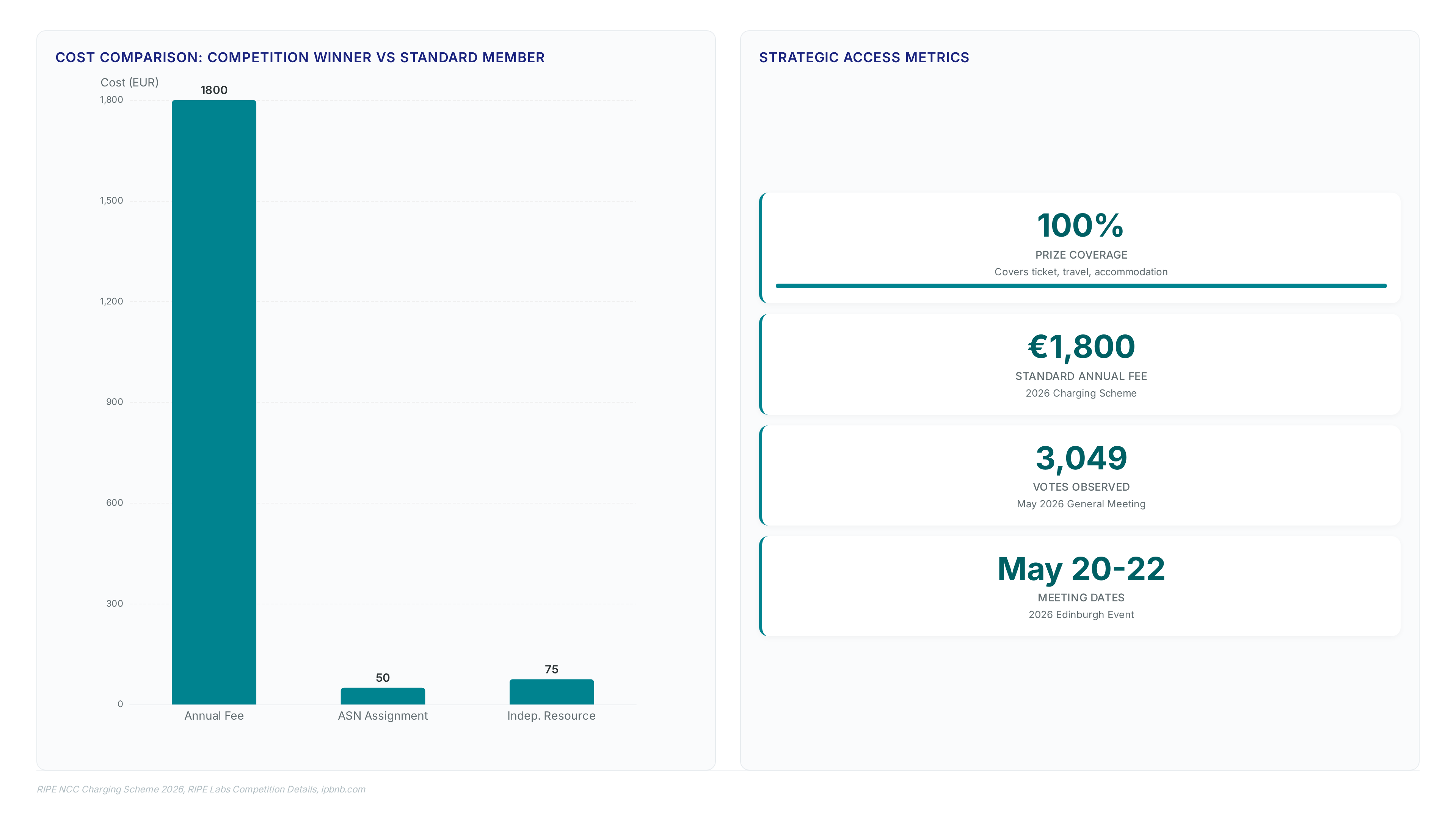
Winning the RIPE Labs competition delivers a complete attendance package for RIPE 92 in Edinburgh, covering the meeting ticket, travel, and accommodation. This award removes the standard financial hurdle where Local Internet Registries must pay an annual contribution of EUR 1,800 under the 2026 charging scheme. Attendance includes entry to the RIPE NCC General Meeting scheduled for 20–22 May 2026, permitting non-members to witness governance decisions usually restricted to paying entities. Membership fees support daily operations, yet specific resource assignments like an Autonomous System Number incur an additional €50 per assignment cost. Independent resources trigger further charges, as seen in the fee structure requiring EUR 75 per independent Internet number resource. The competition prize provides immediate value matching several years of these recurring fees without creating long-term liability.
Victory grants physical presence but not the voting privileges associated with the 3,049 votes cast in May. Observation still yields strategic intelligence on policy shifts without the capital expenditure required for full membership status. Operators gain visibility into budget approvals.
Using the Edinburgh Prize to Bypass Traditional LIR Barriers
Non-LIR engineers enter RIPE 92 in Edinburgh without paying the standard EUR 1,800 annual fee by winning the RIPE Labs competition. This access eliminates the financial gatekeeping that typically excludes independent researchers from the RIPE NCC General Meeting scheduled for 20–22 May 2026. Participants can analyze the AI governance gap where large firms dominate policy while small enterprises lack representation. The prize package covers travel and accommodation, enabling direct observation of the 3,049 votes that shape regional internet policy.
Commercial membership models frequently ignore practical deployment hurdles found in emerging markets. The Sustainable Peering Infrastructure Grant Program illustrates how targeted funding reduces costs in Least Developed Countries where commercial incentives fail. A writer focusing on these underserved regions gains a strategic advantage over generic policy submissions.
| Standard LIR Membership | EUR 1,800 + resource fees | Full voting rights |
|---|---|---|
| Competition Winner | Zero (full package) | Observer status only |
| Remote Participation | Variable travel costs | No physical presence |
Observers cannot cast ballots during budget approvals or activity plan ratifications. Physical presence allows for informal coalition building that remote attendees cannot replicate. Submitting a manuscript before the 3 April deadline offers the only viable path for non-members to influence the Infrastructure Constraints debate directly.
Strategic Topic Selection Checklist for RIPE 92 Submission Success
Validating a draft against physical Infrastructure Constraints prevents immediate disqualification from the RIPE 92 competition. Authors must confirm their analysis addresses the bottleneck where software ambition meets hardware reality, visualized in the 2026 Strategic Constraints chart. Submissions ignoring power limits fail because data center capacity cannot support unchecked AI growth. The checklist requires four specific validations before submission to InterLIR.
- Verify the topic quantifies the gap between large firm adoption and small enterprise capabilities.
- Confirm the argument references specific AI governance predictions rather than generic security postures.
- Validate that the proposed solution respects the hard limits of energy availability.
- Ensure the narrative connects technical debt to regulatory windows.
| Focus Area | Rejection Risk | Acceptance Signal |
|---|---|---|
| Power Demand | Ignores regional caps | Maps compute to grid limits |
| Adoption Rates | Cites aggregate only | Segments by firm size |
| Governance | General best practices | Specific 2026 regulatory windows |
Disparity in adoption rates creates a blind spot for regulators enforcing new rules. Winning entries will expose this tension between rapid technological deployment and static physical resources. InterLIR recommends focusing on these measurable constraints to maximize relevance for the Edinburgh event.
About
Alexander Timokhin, CEO of InterLIR, brings necessary industry perspective to the RIPE Labs article competition. As the leader of a specialized IPv4 address marketplace founded in Berlin, Timokhin manages the critical redistribution of unused network resources daily. His direct experience with IT infrastructure scarcity makes him uniquely qualified to address the competition's focus on internet sustainability. With European data center power demand projected to triple by 2030, efficient IP management becomes vital for reducing waste and optimizing existing assets. Timokhin's work at InterLIR involves solving complex network availability problems, aligning perfectly with RIPE NCC's call for technical contributions regarding future internet limits. By connecting practical business operations with broader public policy, he offers valuable insights into how the community can navigate upcoming challenges in electricity and resource allocation without needing physical attendance at RIPE Meetings.
Conclusion
Regulatory velocity now outpaces physical provisioning. While adoption gaps matter, the deeper failure point lies in the operational latency of small enterprises attempting to meet 72-hour CIRCIA reporting windows without dedicated compliance infrastructure. Large firms absorb these costs through economies of scale, but for smaller entities, the marginal cost of documentation becomes an existential barrier that pure software solutions cannot resolve. This dynamic will inevitably force a market correction where non-compliant smaller players are acquired or exit, consolidating power further unless intervention occurs immediately.
Authors must pivot their RIPE 92 entries from abstract policy critiques to quantifiable infrastructure debt models by next Tuesday. Do not merely describe the gap; calculate the specific kilowatt-hours required to bridge the compliance divide for a 50-person firm. Your manuscript must propose a tiered reporting framework that aligns regulatory burdens with actual energy availability, rather than assuming infinite compute resources. Start by auditing your local grid's peak load capacity against your proposed AI deployment scenario before drafting your executive summary. This concrete data point transforms your argument from theoretical observation into an actionable engineering constraint that the RIPE community cannot ignore.
Frequently Asked Questions
Yes, winners bypass standard membership fees to attend the Edinburgh meeting. The competition targets contributors lacking funds, unlike the 55% adoption rate seen in large EU firms with established budgets.
Submissions must analyze how electricity availability limits internet expansion rather than generic policies. Authors should reference how data centers consume 21% of national supply in regions like Ireland.
It offers a platform for smaller entities struggling with new reporting windows to share insights. This aids those lagging behind the 17% enterprise AI adoption rate common among small businesses.
Judges prioritize strong stories over routine incident reports to ensure broader architectural implications are clear. This approach helps bridge the gap between the 19.95% overall EU AI adoption and actual understanding.
The winning author receives a full package including travel and accommodation for RIPE 92. This opportunity converts written technical depth into direct meeting participation for those previously excluded.