RIPE Meeting 2026: Why 394 Signatures Block Change
The RIPE NCC General Meeting is not a town hall. It is the sole legislative body controlling the organization's financial and operational trajectory. With 3,049 votes cast by the membership, this assembly dictates critical internet infrastructure policy. (RIPE's general meeting may 2026 results) Forget the idea of a casual suggestion box. Members face a rigid proposal threshold: you need support from 394 peers just to place a resolution on the docket. This effectively gatekeeps dissent against the Executive Board.
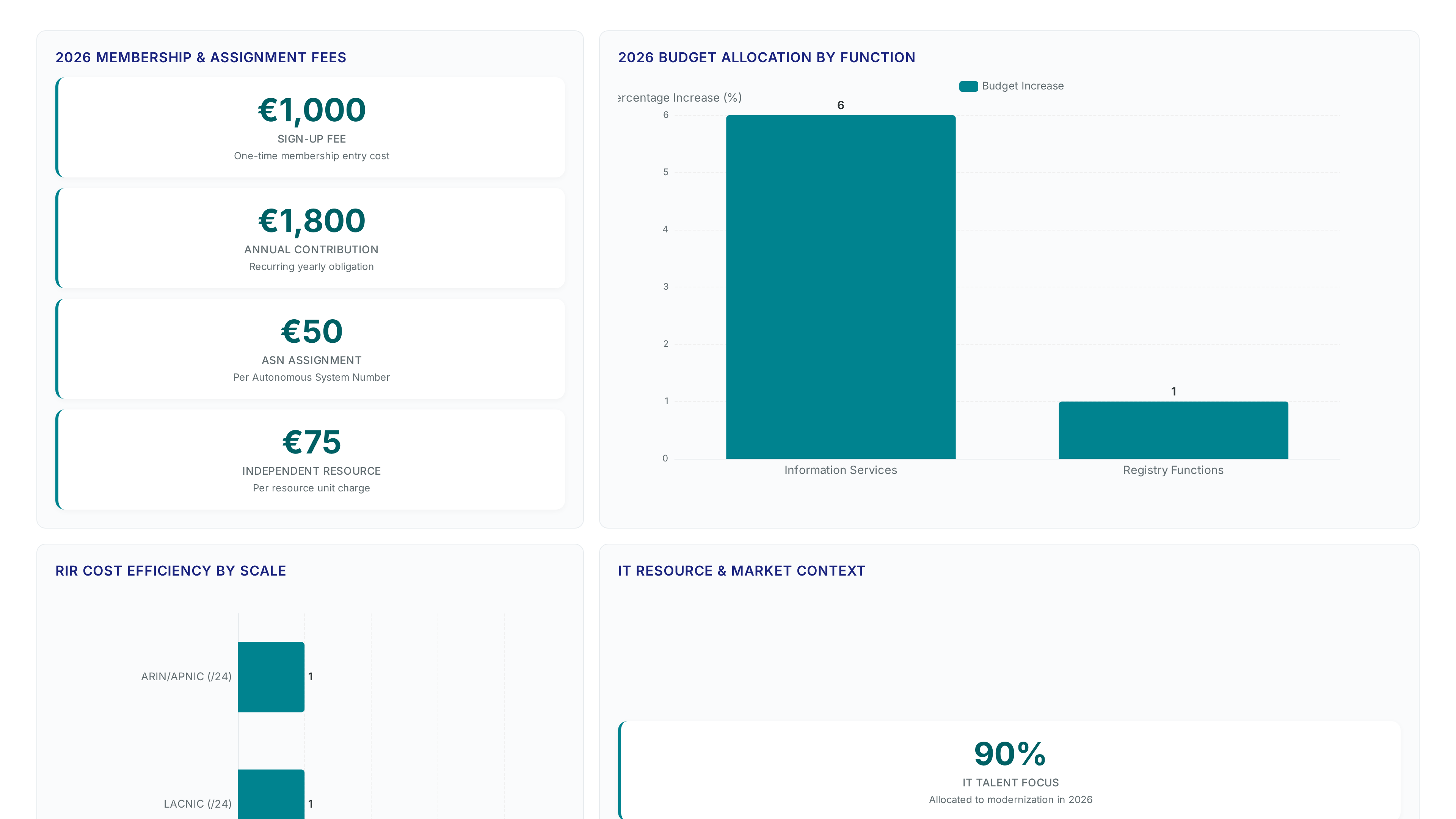
Edinburgh 2026 exposes the friction between rising operational costs and member resistance. The base LIR fee sits at €1,800, yet the agenda forces a vote on hiking this to €1,894. This move highlights the financial pressure facing the coordination center. RIPE NCC reports that the window for submitting counter-proposals closes strictly on 6 May 2026. Disgruntled Local Internet Registries have zero room for last-minute maneuvering.
You must learn to manipulate the Member Proposal Form to bypass these bureaucratic hurdles before the deadline expires. The analysis below covers the specific voting protocols that transformed the 2026 gathering into a battleground for the future of European IP address allocation.
The Role of the RIPE NCC General Meeting in Internet Governance
RIPE NCC General Meeting Structure and LIR Portal Function
Hybrid proceedings define the General Meeting, scheduled from 20-22 May 2026 at the Edinburgh International Conference Centre. Physical attendance shares space with remote access through the Meetecho platform to establish quorum and process resolutions. Access control depends entirely on the LIR Portal, acting as the single gateway for member registration and credential verification. Operators authenticate through this interface to submit agenda items or cast ballots, creating a strict dependency on portal availability during the voting window. The voting results announced on 22 May 2026 confirmed 3,049 total votes, demonstrating high participation rates across the distributed membership.
Proposal eligibility hinges on securing support from 394 distinct members before the 6 May 2026 finalization deadline. This threshold filters niche technical grievances but simultaneously raises the barrier for specialized working groups to influence charging schemes. The Member Proposal Form within the portal enforces this count programmatically, rejecting submissions that lack the requisite digital endorsements. The draft agenda locks on 6 May 2026, requiring 394 members to table a proposal before finalization. Individual operators cannot force discussion without broad coalition building. Submitting a member proposal demands coordination across the LIR Portal, as the system rejects standalone requests lacking the necessary support count. The RIPE NCC General Meeting structure enforces this quorum-like requirement to prevent agenda fragmentation, yet it introduces latency for urgent policy changes. Operators missing the 15 Apr 2026 publication window face a twelve-day blackout before the voting results are finalized.
Costs become measurable when proposals fail to hit the signature target and vanish without debate. Governance here relies on social graph density rather than protocol correctness. The Edinburgh International Conference Centre hosts the physical voting, but remote participation via Meetecho remains necessary for global reach. Failure to engage during the draft phase cedes control to established blocs.
Critical Dates for 2026 Activity Plan and Budget Approval
Executive Board approval of the 2026 Activity Plan and Budget occurred on 11 December 2025, setting the fiscal baseline before invoice generation. Resource data freezes on 31 December 2025 to calculate annual fees accurately. Missing this cutoff shifts billing liability to the subsequent fiscal year, creating cash-flow variances for large LIRs. The final agenda locks on 6 May 2026, leaving a narrow window for last-minute resolution drafting after the initial publication.
Proposal supporters face a hard constraint: the 394-member threshold must be met before the agenda solidifies. Late submissions fail automatically without exception. The charging scheme discussions often trigger a. Ce line items Agenda Finalization 6 May 2026 Blocks new proposal submissions Proposal. Ralmeeting/ discussions often trigger a. Voting outcomes announced on 22 May 2026 finalize these financial parameters for the operational year. Delayed internal reviews risk non-compliance with updated fee schedules.
Inside the Draft Agenda and Resolution Submission Workflow
Draft agenda finalization occurs on 6 May 2026, marking the hard stop for topic submission before the meeting convenes. This deadline creates a finite window where operators must secure exactly 394 endorsements to elevate a resolution from the Member Proposal Form into the official docket. The mechanism functions as a binary gate; without the requisite coalition, the RIPE NCC system automatically filters out the entry regardless of technical merit. Operators navigating this workflow face a coordination tax that scales non-linearly with proposal complexity. Securing support demands early outreach well before the 15 Apr 2026 news cycle, as last-minute lobbying rarely bridges the gap between a handful of signatures and the required quorum. The process relies on the LIR Portal for authentication, meaning any delay in credential verification directly jeopardizes the ability to cast supporting votes.
| Constraint | Mechanism | Operational Consequence |
|---|---|---|
| Support Count | 394 Members | Forces cross-organizational alliances |
| Deadline | 6 May 2026 | Eliminates reactive policy drafting |
| Interface | LIR Portal | Creates single point of failure |
Missing the submission window results in a twelve-month deferral, pushing critical infrastructure changes to the next fiscal cycle. This lag forces network architects to treat the draft agenda as a fixed constraint rather than a flexible negotiation space. Financial planning must align with this rigidity, especially the that new joiners face a €1,000 sign-up fee before gaining voting rights. The structural design prioritizes stability over agility, ensuring only broadly supported measures reach the Edinburgh International Conference Centre floor. Accessing the LIR Portal initiates the resolution submission sequence before the 6 May 2026 closure.
Resolution support mechanics function as a binary gate within the Member Proposal Form, requiring exactly 394 endorsements to advance any fiscal amendment. This threshold forces coalitions to form before the 6 May 2026 finalization date, effectively filtering out isolated financial grievances. Operators failing to secure this quorum see their resolutions rejected automatically, regardless of the technical merit regarding fee structures. A modest increase]( Budget planners must account for the cumulative effect of base hikes alongside fixed per-resource fees. Ignoring the coalition requirement risks leaving cost-mitigation proposals stuck in the draft agenda phase.
Hybrid Participation Strategies for In-Person and Online Attendees
Online attendees connect via the Meetecho platform, which relies on the Janus WebRTC Server to manage real-time media streams. This architecture implements a plugin-based model where specific modules handle text messaging and video conferencing separately from the core signaling logic. The system functions as a general-purpose endpoint, allowing the RIPE NCC to scale media handling capacity without rewriting the underlying transport layer for each event. Operators accessing the stream face a dependency on client-side JavaScript execution, which introduces latency variance not present in static livestreams.
The Janus WebRTC Server handles media streams for remote participants, yet it does not manage identity verification for the ballot. Relying on last-minute troubleshooting risks missing the narrow window where ASN assignments and fee structures are decided. The separation of media transport from authentication logic creates a single point of failure if credentials expire mid-stream. Physical presence at the Edinburgh International Summit Centre enables direct lobby negotiation, whereas the livestream option restricts interaction to moderated digital queues. Remote participants relying on the Meetecho platform experience media delivery through the Janus WebRTC Server, which introduces client-side JavaScript latency absent in physical audio systems. This architectural dependency creates a tangible delay for online voters compared to those casting ballots on the venue floor.
| Feature | In-Person Experience | Online Livestream |
|---|---|---|
| Latency | Negligible | Variable (JS execution) |
| Networking | Unstructured hallway access | Moderated chat only |
| Voting Interface | Physical hand raise | Digital click stream |
| Cost Impact | Travel plus flat fee model | Zero travel expense |
Budget allocations reveal a strategic prioritization that favors remote accessibility tools over physical venue logistics. This disparity suggests the governance body expects long-term participation to shift decisively toward virtual channels despite the current hybrid model. Operators managing tight margins might find the flat fee structure less burdensome when eliminating travel costs, yet they sacrifice the informal consensus-building found in physical corridors.
Implementation: LIR Portal Registration Mechanics and [email protected] Support Scope
The LIR Portal serves as the exclusive gateway for General Meeting registration, rejecting all unauthenticated access attempts immediately.
- Log into the LIR Portal using valid credentials to access the governance section.
- Select the attendance mode for the Edinburgh event to enable digital ballot capabilities.
- Contact [email protected] exclusively for authentication locks or voting anomalies that prevent submission.
Support via [email protected] covers only technical access failures, distinct from policy inquiries handled through other channels. This separation ensures rapid resolution for critical participation barriers. The 2026 budget allocates a dominant share of IT talent resources toward modernizing these member services, reflecting a strategic priority over pure registration volume. The Information Services team prioritizes uptime for voting systems during the May window.
Authentication failures in the LIR Portal block Meetecho entry until operators clear specific credential locks.
- Verify account status matches the Resource Certification profile to prevent synchronization errors.
- Select the online attendance flag within the governance module to activate voting tokens.
- Escalate persistent login rejections directly to [email protected] with full HTTP headers attached.
The Janus WebRTC Server requires a successful handshake from the portal before media streams initialize. A mismatch between the registered email and the membership engagement record causes silent drops during the join sequence. This architecture means network teams cannot bypass portal validation even with valid meeting links. Support channels prioritize technical access over policy questions, creating a bottleneck for non-standard cases. The reliance on client-side JavaScript introduces latency that physical attendees do not experience. Remote users face a higher probability of timeout errors during peak registration windows. This disparity forces distributed teams to attempt access well before the session starts.
Strategic Budget Shifts Impacting Information Services and Portal Modernization
Portal latency spikes during peak registration windows stem from the 2026 strategic reallocation prioritizing Information Services over legacy automation. 1.2. Submit support tickets to [email protected] only after verifying that credential mismatches are not causing the rejection. 3. Anticipate delayed patch cycles for the Janus WebRTC Server integration while development teams focus on modernization backlogs. The Registry function absorbs workload through automation with minimal funding growth, creating a divergence in service reliability between registration and member tools. Market data indicates transaction values near $1,700 for related services, raising the cost of downtime during these transition phases. Operators facing fixed registration issue in LIR Portal errors must distinguish between authentication faults and systemic capacity throttling. The limitation is clear: modernization spending temporarily reduces redundancy margins. InterLIR advises delaying non-critical profile updates until the post-meeting stabilization window opens.
About
Alexei Krylov, Head of Sales at InterLIR, brings critical industry perspective to the analysis of the RIPE NCC General Meeting. As a specialist managing B2B transactions for IPv4 resources, Krylov possesses direct expertise in navigating the regulatory frameworks established by Regional Internet Registries. His daily work involves ensuring compliance with RIPE policies while facilitating the redistribution of unused IP addresses, making him uniquely qualified to interpret how General Meeting resolutions impact market availability. The decisions made in Edinburgh directly influence the transparency and efficiency of the global IP marketplace, which is central to InterLIR's mission. By connecting high-level governance outcomes to practical resource allocation, Krylov bridges the gap between administrative voting results and the operational realities faced by network operators seeking reliable IPv4 leasing solutions. His background in legal affairs and RIR interactions ensures a factual assessment of how these meetings shape the future of internet infrastructure.
Conclusion
Modernization has eaten the safety margin. When engineering bandwidth shifts entirely to new platforms, latent capacity margins vanish. Minor authentication glitches now cascade into total access denial. Participation equity no longer depends on policy rights; it depends on timing your interaction outside peak validation cycles. The 5.2% fee volatility is merely a symptom of a deeper structural shift where legacy automation support is being actively deprioritized to fund long-term platform stability. Organizations relying on real-time portal access for critical governance votes face unacceptable risk until the post-2026 stabilization phase completes.
Delay any non-necessary LIR profile modifications until after the June 2026 service review, as the current development sprint offers zero redundancy for edge-case errors. Treat the period between agenda finalization and the general meeting as a code freeze zone for your administrative workflows to avoid triggering unpatched timeout protocols. Your immediate priority is to decouple voting readiness from last-minute portal dependencies. Audit your member contact records this week to ensure email synchronization matches the central registry exactly, eliminating the most common cause of silent join failures before the May 6 submission deadline locks the agenda. This proactive verification step bypasses the need for reactive support tickets that currently face multi-day backlogs.
Frequently Asked Questions
Discussions often trigger a specific fee adjustment requiring precise budget planning. The article states these deliberations frequently result in a 5.2% fee adjustment that members must anticipate for the upcoming fiscal cycle.
You must submit all proposals before the agenda finalization date passes. The draft agenda becomes final on 6 May 2026, which strictly blocks any new proposal submissions after that specific calendar date.
A proposal needs support from hundreds of peers to reach the threshold. Specifically, securing support from 394 distinct members is mandatory to successfully place a resolution on the official meeting docket.
Yes, eligible members can cast ballots online through the meeting platform. The hybrid format allows remote actors to influence outcomes via Meetecho while sharing space with physical attendees at the conference.
The system automatically rejects any submission missing the required support count. The Member Proposal Form enforces this programmatically, ensuring individual operators cannot force discussion without building a broad coalition first.