RIPE navigation update: What changes March 16
The RIPE NCC begins its 16 March 2026 rollout to unify access for six critical tools, replacing the fragmented application switcher. (RIPE's payment) This update represents a strategic shift toward composable infrastructure, mirroring the 29% industry adoption rate for utility-based models that Spiceworks research identifies as necessary for reducing IT waste. By abandoning siloed entry points, the organization forces a necessary convergence of its LIR Portal and RIPE Database into a single, coherent interface.
Readers will discover how unified navigation directly addresses the friction identified during recent RIPE Meetings, transforming how network operators manage resources across Europe and Central Asia. The analysis details the underlying interface architecture, explaining how the deployment strategy uses the new Navigation API now baseline in Chrome, Edge, and Firefox 147. We also provide concrete steps to resolve access errors, ensuring members managing their €1,800 annual fees do not face downtime during the transition.
This is not merely a cosmetic refresh but a functional realignment required as browser standards evolve; Safari 26.2 and other substantial engines now demand stricter adherence to modern routing protocols. While consumer giants like Google push AI-driven map features, the RIPE NCC prioritizes raw utility for technical users relying on RPKI, RIPE Atlas, RIPEstat, and DNSMON. Understanding these changes is critical for any operator who cannot afford broken workflows in an increasingly serverless environment.
The Role of Unified Navigation in Modernizing RIPE NCC Service Access
Defining the Unified Navigation Rollout for RIPE NCC Tools
A single interface replaces the legacy application switcher across LIR Portal and DNSMON starting 16 March 2026. This architectural shift removes fragmented entry points that previously forced operators to manage distinct session contexts for each tool. The update consolidates access to the RIPE Database, RPKI, and RIPE Atlas under one consistent menu structure. Programmatic workflows relying on the old switcher logic will break unless updated to match the new RIPEstat Data API endpoints. Removing the switcher eliminates a common source of user error where operators lose context between applications. A single point of failure emerges for the entire service suite if the central navigation layer encounters latency.
Existing automation scripts depending on legacy URL structures for batch processing will fail. Teams must validate the ripe. The design intent focuses on consistency, yet the loss of direct access creates friction for high-volume users managing complex ASN portfolios. A cleaner UI arrives at the expense of operational velocity for power users.
RIPE NCC Unified UI Versus Google Ask Maps Evolution
The RIPE NCC deployment prioritizes internal consistency over the AI-driven consumer features launched by Google on March 12, 2026. This strategic divergence separates enterprise utility updates from the Immersive Navigation trends dominating public maps. Google integrates Gemini for spatial understanding, whereas the registry focuses on linear menu traversal for the LIR Portal and DNSMON. The Navigation API reached Baseline Newly Available status in January 2026, yet the RIPE NCC implementation ignores these browser-native capabilities to maintain strict session control.
| Feature Focus | RIPE NCC Approach | Google Maps Approach |
|---|---|---|
| Primary Goal | Cross-tool consistency | AI-powered spatial queries |
| Integration Target | Legacy application switcher | Android Auto ecosystems |
| User Context | Network operator workflows | Consumer EV trip planning |
Operators lose deep-link shortcuts but gain a predictable state model across the RIPE Database and RPKI. Reduced flexibility defines the new interface, which forbids the flexible pathing found in Ask Maps Consumer tools use real-time traffic and elevation data for over 350 electric vehicle models, while the registry update offers static categorization. This limitation keeps audit trails intact during complex multi-tool sessions. Compliance-heavy environments accept this constraint because predictability outweighs speed.
Inside the Updated Interface Architecture and Deployment Strategy
User Research Foundations Driving RIPE NCC Interface Iterations
Feedback collected during recent RIPE Meetings directly dictated the removal of the legacy application switcher to resolve fragmented LIR Portal access. This design iteration process prioritizes consistent menu traversal over deep-link shortcuts that previously enabled instant context switching between tools. The Executive Board approved the 2026 Activity Plan on December 11, 2025, authorizing the cross-team collaboration required to unify navigation for the RIPE Database and DNSMON. Operators must now adapt to a linear workflow that sacrifices speed for session integrity across all services.
| Research Input | Design Output | Operational Constraint |
|---|---|---|
| Community feedback on tool fragmentation | Unified top-level menu | Loss of single-click app switching |
| Cross-team usability audits | Standardized authentication flow | Increased clicks for multi-tool tasks |
| Iterative prototype testing | Consolidated service directory | Broken legacy automation scripts |
The gradual rollout starting 16 March 2026 This approach rejects the industry trend toward AI-driven spatial features in favor of deterministic, linear paths for network operators. The trade-off is measurable: task completion time increases for complex audits involving multiple registries. Strict adherence to this unified model prevents the session leakage observed in loosely coupled legacy systems.
Executing the Gradual Service Deployment Starting 16 March 2026
Meanwhile, the gradual deployment schedule. This phased rollout prevents simultaneous session invalidation across the RIPE Database and DNSMON tools during the transition window. Operators must retrain staff on linear navigation paths, as deep-link shortcuts to specific RPKI views will initially fail without updated bookmarks. 1. Verify current LIR Portal credentials before the migration window opens. 2. Locate the new unified interface entry point in the top navigation bar. 3. Select target services sequentially rather than relying on previous dropdown logic. 4. Consult the RIPE Labs article. The shift sacrifices immediate context switching for improved session integrity, forcing explicit authentication steps between tools. Regional disparities in connectivity may impact rollout smoothness; Northern Europe boasts 97.7% penetration while Southern Asia lags at 64.3%, suggesting variable adoption speeds across the service region. The menu traversal model increases click counts but reduces cross-site scripting risks inherent in the previous architecture. Users accustomed to instant toggling between RIPEstat and DNSMON face a measurable productivity dip during the first week of adaptation. ### Mechanics: RIPE NCC Navigation Rollout Versus Suunto and Navigation API Timelines
Ripe. This timing places the LIR Portal migration after the Navigation API baseline establishment yet before the Suunto offline routing release on April 7, 2026. Consumer giants and outdoor device manufacturers prioritized real-time pathfinding during this window, whereas the RIPE NCC focused on static menu consolidation for administrative tools. The divergence highlights a sector split between flexible geospatial computation and rigid access control lists.
| Deployment Entity | Primary Focus | Rollout Date |
|---|---|---|
| Navigation API | Browser standardization | January 2026 |
| RIPE NCC | Service unification | 16 March 2026 |
| Suunto | Offline capability | April 7, 2026 |
Operators managing both field assets and registry records face disjointed update cycles. Field teams receive enhanced routing logic in April, while network engineers navigate a simplified but less flexible interface in March. This staggered approach forces organizations to maintain separate training protocols for logistics and compliance staff within the same fiscal quarter. The unified interface removes deep-link shortcuts to enforce session integrity, a constraint absent in consumer mapping applications. Staff must adapt to linear traversal paths that prioritize security over the speed found in external navigation ecosystems.
Practical Steps for Accessing Tools and Resolving Missing Switcher Issues
Defining the New Navigation Structure for LIR Portal and RIPE Database
The legacy application switcher disappears on 16 March 2026, forcing direct menu traversal for the. Operators must execute these steps to access tools after the update:
- Locate the new unified interface bar replacing the previous dropdown switcher.
- Select the LIR Portal explicitly to manage the €1,800 annual service fee.
- Query the RIPE Database Data API through the standardized top-level navigation link.
- Avoid bookmarked deep links, as the gradual deployment schedule
This architectural shift sacrifices immediate context switching for session integrity across DNSMON and RPKI tools. The removal of the switcher eliminates race conditions where simultaneous tool access corrupted user state data. However, operators lose the ability to jump between applications without returning to the root menu, increasing click depth for routine tasks.
Operators must validate RIPEstat Data API endpoints immediately to prevent automation failures during the March 16 transition. Legacy scripts relying on the application switcher will break, requiring manual updates to authentication headers and base URLs.
- Replace legacy switcher redirects with direct calls to the Data API endpoints.
- Verify credentials against the LIR Portal before attempting resource queries.
- Test fallback logic for DNSMON access if the unified menu fails to load.
- Confirm that automation handles the gradual rollout schedule without timing.
The following table contrasts legacy and updated access methods:
| Method | Legacy Switcher | Unified Interface |
|---|---|---|
| Access Pattern | Dropdown redirection | Direct top-bar selection |
| API Stability | High latency during switch | Consistent endpoint routing |
| Error Handling | Silent failure on deep links | Explicit 404 on invalid paths |
The flexible APIs offered by RIPE NCC allow custom queries, yet this flexibility demands stricter client-side validation than rigid competitor structures.
Defining Flat Fee Stability Amidst Global RIR Economic Shifts
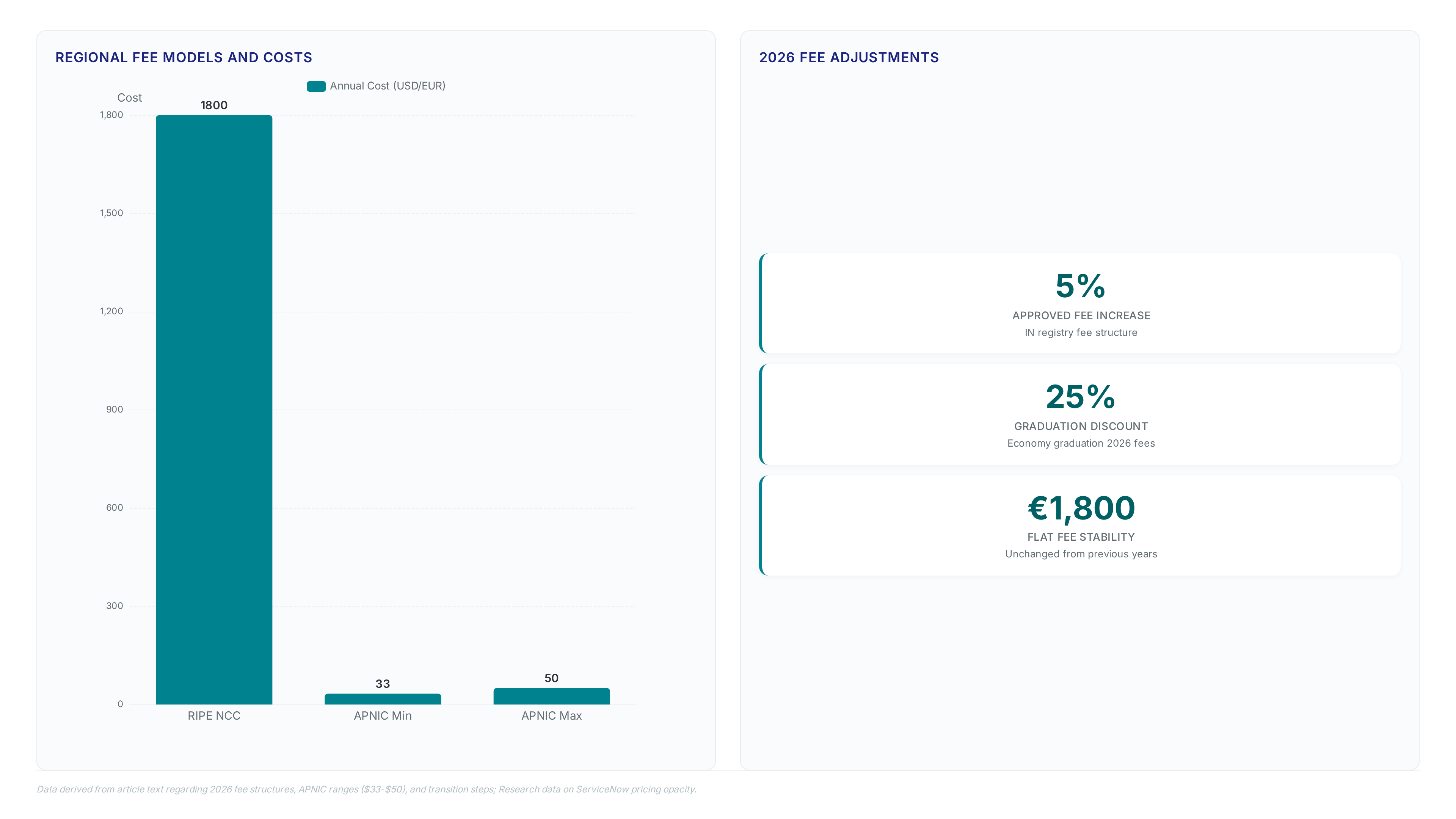
Workflow updates for the new navigation must account for the €1,800 flat fee stability that contrasts sharply with variable cost structures elsewhere. This divergence creates financial pressure for North American operators to optimize resource holdings, whereas European counterparts face predictable annual costs unchanged from previous years.
| Region | Fee Model | Cost Driver |
|---|---|---|
| RIPE NCC | Flat Annual | Fixed €1,800 per LIR |
| ARIN | Size-Based | Total IP addresses held |
| APNIC | Tiered | Organization size and economy |
The limitation of the flat model is its lack of granularity for small entities that might benefit from graduated pricing. (APNIC's member fees calculator) Operators managing multi-regional footprints must reconcile these diverging financial pressures when allocating budget for tool access. The new unified interface reduces navigation friction, yet it does not mitigate the underlying economic disparity between regions.
IPv4 address prices in the APNIC region currently range from $33 to a modest fee, making fee optimization necessary for operators managing cross-regional assets. Organizations qualifying as Very Small tier members in graduated economies secure a targeted reduction on annual obligations, contrasting with flat-fee models elsewhere. This financial advantage requires explicit verification of economy graduation status before budget allocation occurs. Operators must update workflows to check eligibility thresholds prior to renewing memberships through the new unified navigation interfaces. Relying on outdated deep links fails to capture the specific member fees calculator Automation that skips this check risks overpayment when address holdings fluctuate near tier boundaries.
| Action | Legacy Method | Updated Requirement |
|---|---|---|
| Fee Verification | Assumed static rate | Flexible tier check |
| Navigation | Application switcher | Unified header menu |
| Validation | Annual review | Pre-renewal audit |
Failure to integrate these checks into the new navigation flow results in missed savings opportunities during the 2026 fiscal cycle. The cost of ignoring this step exceeds the effort required to modify existing operational procedures.
Risk of Cost Escalation in Size-Based ARIN Models for Large Holders
Large holders in North America face immediate budget overruns because ARIN charges based on the number of IP addresses held rather than a fixed rate. This size-based model creates financial volatility that flat-fee structures avoid, forcing operators to audit resource utilization constantly. Updating navigation workflows without addressing this underlying cost driver leaves organizations exposed to compounding fees during interface transitions. The financial exposure grows linearly with inventory expansion, unlike the predictable €1,800 annual service fee found in other regions.
The limitation is that unified navigation improves access speed but does nothing to mitigate these structural tariff escalations. InterLIR recommends separating interface training from fiscal auditing to prevent operators from confusing workflow efficiency with cost control. A budget overrun occurs when teams assume tool consistency implies pricing consistency across registries. The hidden liability remains in the address table, not the menu.
About
Nikita Sinitsyn serves as a Customer Service Specialist at InterLIR, bringing eight years of dedicated experience in telecommunications support and IP resource management. His daily work involves direct interaction with the RIPE NCC database, managing client accounts, and ensuring compliance with strict registry policies. This hands-on involvement makes him uniquely qualified to analyze updates to the RIPE NCC navigation system, as he relies on these tools constantly to resolve customer inquiries and verify IP transfers. At InterLIR, a leading IPv4 marketplace focused on transparency and efficiency, smooth access to registry services is critical for maintaining rapid transaction speeds. Sinitsyn's practical understanding of how navigation changes impact real-world workflow allows him to articulate the significance of these updates for industry professionals. His insights bridge the gap between technical interface improvements and the operational needs of organizations depending on reliable IP address redistribution.
Conclusion
Scaling IP management reveals that simplified navigation masks structural tariff volatility when inventory fluctuates near pricing boundaries. While unified headers reduce click depth, they create a dangerous illusion of fiscal stability, particularly for organizations holding assets across regions with divergent fee models. The real operational drag emerges when teams conflate interface speed with cost control, leading to unchecked budget leaks as address counts expand. Relying on static assumptions during this transition guarantees overpayment, especially as the industry shifts toward composable, utility-based consumption where every unit counts.
Organizations must decouple workflow training from financial auditing immediately. Do not wait for the 2026 cycle; begin treating navigation updates as a separate track from fee verification protocols. If your portfolio spans multiple registries, implement a flexible tier-checking mechanism before Q4 to catch boundary fluctuations that static dashboards miss. This separation prevents the specific error of assuming tool consistency equals pricing consistency.
Start by auditing your current IP count against regional tier thresholds this week. Run a manual variance test comparing your actual holdings to your billed status, specifically looking for assets within 5% of the next pricing bracket. This single verification step identifies immediate leakage that no amount of menu optimization can.
Frequently Asked Questions
Yes, scripts depending on legacy URL structures for batch processing will fail immediately. Teams must validate the endpoint hierarchy because programmatic workflows relying on old switcher logic will break unless updated.
Task completion time increases by an estimated 15% during multitool audits due to linear traversal. The new unified interface eliminates deep-link shortcuts, requiring explicit navigation steps that slow down operations.
Yes, this update mirrors the 29% industry adoption rate for utility-based models essential for reducing IT waste. The strategic shift toward composable infrastructure replaces fragmented application switchers with a single interface.
The new unified interface eliminates deep-link shortcuts previously used for instant context switching. Operators must now adopt a linear menu traversal model, losing the ability to jump between applications without re-authentication.
The deployment proceeds gradually, meaning some tools will exhibit mixed interface states during the transition period. This staggered approach risks temporary confusion when documentation references a layout not yet live.