RIPE Registration: Secure Your Own AS Number
Waiting over 180 days for a /24 IPv4 subnet defines the current reality for new Local Internet Registry applicants. This delay forces organizations to treat LIR registration as a strategic asset rather than a simple administrative task. Direct RIPE NCC membership provides necessary control over AS Number allocation and database objects despite rising costs and scarcity.
You will learn how to navigate the empty IPv4 addresses pool and manage the specific mechanics of RIPE database objects like inetnums and route6 records. The guide details the step-by-step process to secure an Autonomous System, which notably requires consent from two peering partners to join the BGP. We also examine the financial commitment: while the annual fee hits €1,800 in 2026, the initial barrier includes a separate €1,000 registration charge.
The operational burden of maintaining mntner and organization objects without professional aid often exceeds the capacity of many IT teams. By understanding these constraints, entities can decide between independent management or using specialized support services to handle the complex RIPE policy environment.
The Strategic Role of LIR Registration and RIPE NCC Membership
Defining LIR Registration and RIPE NCC Membership Scope
A Local Internet Registry (LIR) acts as the primary administrative entity for assigning IP resources within a specific network region. Becoming a RIPE NCC member grants an organization direct authority to request and manage these critical internet identifiers independently.
The standard membership model requires a €1,000 sign-up fee followed by an annual contribution of €1,800 for 2026. This financial structure differs significantly from other regions, such as the approach taken by ARIN which uses a per-resource fee model without mandatory membership. Direct membership provides full control but introduces administrative overhead that many operators underestimate during initial planning phases.
Professional services like those from Voldeta simplify this complex onboarding by handling the preparation and submission of requests for an IPv4 /24, IPv6 /29, and an Autonomous System. The process includes registering necessary database objects such as mntner, person, and organization records to ensure compliance with regional policies. Operators must recognize that obtaining an IPv4 block currently involves a waiting list exceeding 180 days due to regional exhaustion.
| Service Component | Inclusion Detail |
|---|---|
| Resource Request | IPv4 /24, IPv6 /29, AS Number |
| Database Objects | mntner, person, organization, role |
| Advisory | LIR acquisition consultation |
Executing RIPE Database Object Registration and AS Assignment
Direct LIR status mandates creating mntner, person, organization, and role objects to govern resource ownership. This structural foundation enables the assignment of an Autonomous System Number for independent BGP routing. While the RIPE NCC charges €50 per ASN, operators must secure peering consent before the registry approves the request. The process requires precise database entries; errors here block address allocation entirely.
| Object Type | Function |
|---|---|
| mntner | Authorizes updates to related resources |
| person | Identifies administrative contacts |
| organization | Defines the legal entity holder |
| role | Specifies functional group contacts |
Providers like Voldeta bundle this object creation with six months of management support. New applicants face a €1,000 entry fee separate from annual dues. The operational risk lies in the waiting period; IPv4 pools are empty, forcing delays exceeding 180 days for standard /24 assignments. Direct membership grants full editing rights but demands rigorous database maintenance. To obtain an AS in the RIPE NCC, consent from two peering partners, including their ASNs and emails, is required to ensure that the AS joins the BGP.
Operational continuity hinges on strict adherence to monthly RIPE database object quotas. The standard service allowance includes creation of five inetnum, aut-num, and route objects per type monthly. Exceeding this limit incurs a fee per additional object update or creation. Unlimited RPKI record updates remain included to ensure routing security without penalty.
| Object Type | Monthly Allowance | Excess Cost |
|---|---|---|
| inetnum | 5 objects | a fee each |
| aut-num | 5 objects | a fee each |
| route | 5 objects | a fee each |
Operators often underestimate how quickly routine maintenance exhausts these limits during network expansion. Voldeta provides structured management to navigate these constraints effectively. InterLIR advises monitoring object counts weekly to avoid budget overruns.
Navigating IPv4 Scarcity and AS Number Allocation Mechanics
RIPE NCC IPv4 Waiting List and AS Consent Mechanics
The RIPE NCC IPv4 addresses pool is empty, and there is a waiting list to obtain a /24 IPv4. Waiting time currently exceeded 180 days. This scarcity forces operators to choose between patience and market acquisition. Immediate connectivity often demands purchasing an existing network rather than queuing for a free block. Secure an Autonomous System number by submitting consent from two existing peering partners. Applicants must provide specific ASNs and email addresses to demonstrate the new system will join the global BGP table. This requirement verifies that new ASNs possess active peers before assignment. The table below contrasts these distinct acquisition paths.
| Resource | Primary Constraint | Validation Requirement |
|---|---|---|
| IPv4 /24 | Time | Queue position |
| AS Number | Peer Consent | Two partner emails |
The waiting list guarantees a block eventually, yet the timeline disrupts projects with strict deadlines. Production environments prioritize immediate address availability to avoid such delays. Relying on the waiting list requires project timelines to accommodate variable wait times.
Executing Direct IPv4 Purchase Requests via Voldeta
Operators facing deployment timelines shorter than the duration required for RIPE NCC waiting list fulfillment often opt for immediate market acquisition. This approach bypasses the scarcity of the regional pool by purchasing an existing IPv4 /24 subnet directly. Send a purchase request to [email protected] specifying the required block size.
- Submit the acquisition intent to the assigned contact address.
Direct purchase offers an alternative to the waiting list for those requiring quicker deployment. The decision balances the cost of market acquisition against the time required for free allocation. Organizations requiring instant BGP presence find the waiting list timeline challenging given the current backlog.
| Factor | Waiting List | Direct Purchase |
|---|---|---|
| Availability | Delayed | Immediate |
| Cost Model | Membership fees only | Market acquisition price |
| Timeline | Variable | Days to weeks |
This path suits time-sensitive projects where address availability dictates launch success. Strategic planning must account for the reality that free resources are subject to significant waiting periods.
Validating BGP Readiness and Peering Partner Emails
Securing an AS number assignment requires verified consent from two existing peering partners. Applicants must collect specific ASN values and valid email addresses from these upstream providers before submitting requests to the registry. This validation step confirms the new system will successfully join the global BGP routing table.
| Requirement | Purpose |
|---|---|
| Two Partner ASNs | Verifies upstream connectivity paths |
| Partner Emails | Enables direct registry confirmation |
| Written Consent | Satisfies policy for independent routing |
Confirm partner availability early in the process to ensure all necessary details are ready. The registry requires these precise details, including ASNs and emails, to process the application. Gaining direct access to resources requires navigating these policy constraints effectively. Validate all contact data with upstream providers prior to filing. Accuracy in the submitted information helps maintain the standard processing timeline. Professional support assists in ensuring database objects meet technical standards.
Step-by-Step LIR Registration and RIPE Database Object Management
Defining Core RIPE Database Objects: mntner, person, and role
Registering a Local Internet Registry (LIR) involves the one-time registration of specific core RIPE database objects, including mntner, person, organization, and role entries. The mntner object acts as the primary authorization mechanism, controlling who can modify or delete resources associated with the registry entry. A person object stores contact details for individuals, while a role object defines functional responsibilities like technical or administrative contacts for the organization. These entries are prepared and submitted as part of the initial LIR registration service alongside requests for IPv4 /24, IPv6 /29, and Autonomous System (AS) allocations.
The structural integrity of these objects is necessary for the subsequent management of IP space and AS records.
Managed services can simplify this complex setup by handling the initial object creation and updates. For instance, specific packages include 6 months of management support, covering the creation of up to five inetnums and aut-nums monthly creation. Exceeding these operational limits incurs additional fees per object, making efficient database design financially prudent for expanding networks.
Executing Monthly RIPE Object Quotas: inetnum, aut-num, and route6
Operational scaling is supported by a management service that includes the creation of up to five inetnum, aut-num, inet6num, route, route6, and domain objects per month. This structured allocation supports steady network expansion without triggering variable costs. Operators managing growth beyond these baselines face a marginal fee per additional object update or creation. Unlimited RPKI records updates remain available to ensure routing security regardless of volume.
- Submit the initial batch of objects per type through the management portal.
- Monitor usage to avoid exceeding the included monthly quota.
- Authorize extra creations only when immediate deployment requirements exceed standard limits.
Aligning inet6num deployments with IPv6 adoption curves helps preserve quota headroom for critical IPv4 adjustments. While all object types serve specific functions within the RIPE database, maintaining an accurate record of route and route6 objects is vital for ensuring that the Autonomous System joins the BGP correctly, a process that requires consent from two peering partners. Operators should prioritize updates that ensure connectivity and compliance with peering requirements.
Validating Post-Quota Costs and Annual Renewal Requirements
Operators must budget for 10 EUR charges applied to every database object created beyond the monthly inclusion limits. Exceeding the standard quota for inetnum or route records triggers this variable cost immediately. The annual renewal for continued managed support settles at 350 EUR following the initial complimentary period. Direct membership fees remain distinct from these operational service charges.
| Cost Component | Amount | Trigger Condition |
|---|---|---|
| Extra Object | 10 EUR | Creation beyond 5 per type monthly |
| Service Renewal | 350 EUR | Annual continuation after 6 months |
| RIPE NCC Fee | €1,800 | Mandatory annual LIR contribution |
Sustaining LIR status requires balancing fixed registry dues against variable management expenses. Monitoring object counts closely helps maintain fiscal predictability.
This calculation model reveals that high-churn networks face significantly higher operational overhead than static allocations.
Cost Analysis and Operational Value of LIR Management Services
Defining LIR Management Service Costs and Quota Limits
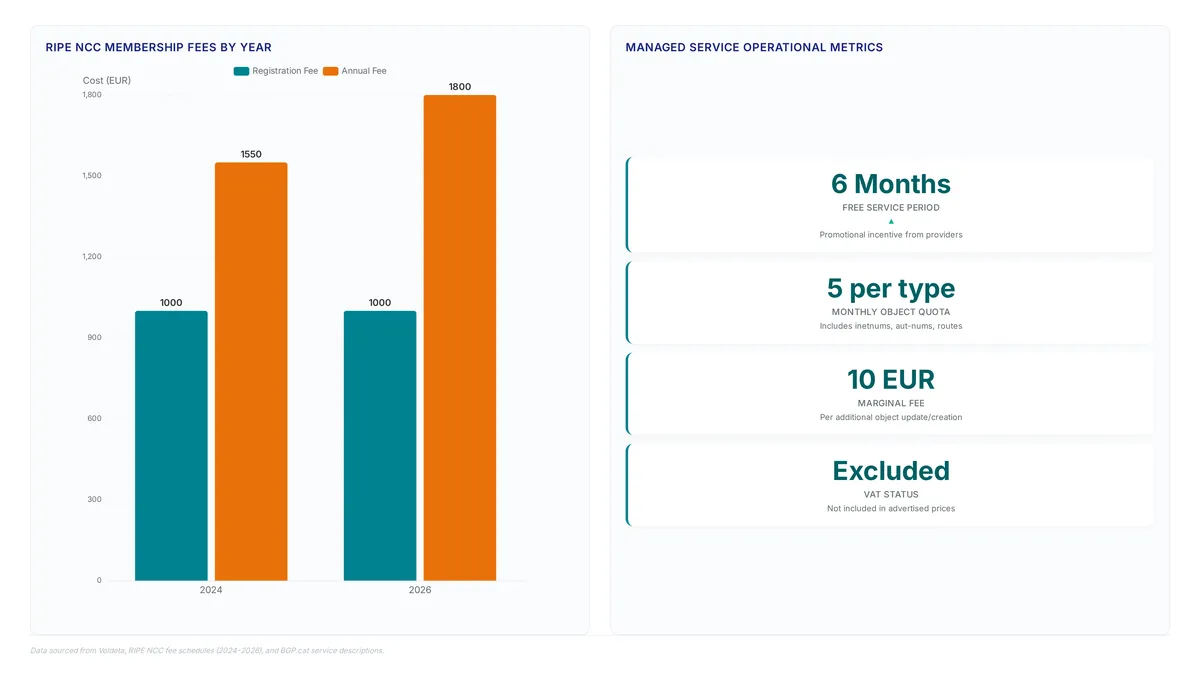
Managed LIR support requires no financial outlay during the first six months of operation. This promotional window grants operators access to a structured monthly quota allowing creation of five inetnums, five aut-nums, five inet6nums, five route objects, five route6 objects, and five domain objects without variable charges. Service providers bundle these specific limits to accommodate steady network expansion while preventing accidental overspending on administrative tasks. Operators exceeding these baselines incur a marginal fee of 10 EUR per additional object update or creation.
The advertised price does not include VAT, the RIPE membership registration fee (1000 EUR in 2024), or the RIPE membership annual fee (1550 EUR in 2024). Clients should separate these distinct regulatory costs from the operational management fees to avoid budget confusion. The primary tension lies between the low entry cost of managed services and the rigid structural caps on database modifications. Networks requiring frequent RPKI records updates benefit from unlimited inclusion, yet those needing massive inetnum proliferation face compounding marginal costs. Strategic planning around the monthly quota prevents unexpected billing events once the complimentary period concludes.
Calculating Total Ownership Cost Before and After 6 Months
Direct RIPE NCC membership requires specific fees separate from service provider charges, including a registration fee of 1,000 EUR and an annual fee of 1,550 EUR (based on 2024 rates). This baseline expenditure secures the Autonomous System and registry status but omits the operational labor required for database maintenance. During the first six months, operators using the promotional incentive incur zero management fees while accessing a structured quota for object creation. This period allows network engineers to populate inetnum and route records without triggering the marginal per object charge applied to excess updates.
| Cost Phase | Management Fee | RIPE NCC Fees | Operational Risk |
|---|---|---|---|
| Months 1–6 | No fee | Initial and annual fees | Low (quota included) |
| Month 7+ | Annual fee | Annual fee | Medium (quota limits apply) |
Operators must recognize that the transition to paid support after the complimentary window introduces a fixed annual cost. This renewal fee stabilizes budgeting compared to the volatility of paying per-object penalties for frequent RPKI updates or database modifications. Neglecting this renewal forces internal teams to absorb the full complexity of RIPE object syntax and validation logic without professional assistance. The financial advantage lies in locking predictable operational expenses early rather than reacting to administrative bottlenecks. Strategic planning ensures that the total ownership cost remains aligned with network growth trajectories rather than fluctuating manual intervention rates.
Decision Checklist for Retaining LIR Management Services
Retain the LIR management service if monthly database updates exceed five objects per type to avoid variable administrative overhead. Organizations lacking dedicated staff for RIPE database maintenance should outsource to prevent configuration errors that alter routing security. The direct RIPE NCC fees cover mandatory registry participation but exclude operational labor for object creation. Internal teams capable of managing RPKI records and staying within the monthly object limits may justify self-management despite the complexity.
| Criterion | Retain Service | Manage Internally |
|---|---|---|
| Monthly Updates | Exceeds 5 per type | Under 5 per type |
| Technical Staff | Limited availability | Dedicated engineers |
| Risk Tolerance | Low (prefer support) | High (accept DIY) |
Operators must weigh the 350 EUR renewal cost against the risk of misconfigured aut-nums or route objects. Delegating this task ensures professional handling of complex interactions while internal staff focus on core network stability.
About
Evgeny Sevastyanov serves as the Customer Support Team Leader at InterLIR, a Berlin-based IPv4 marketplace specializing in global IP resource distribution. His direct, daily involvement in managing RIPE NCC interactions and creating database objects makes him uniquely qualified to guide businesses through LIR registration. Unlike theoretical advisors, Sevastyanov actively handles the technical complexities of registering mntner, organization, and role objects within the RIPE database for clients. His expertise ensures that the transition to becoming a RIPE NCC member is smooth, covering critical steps like securing IPv4 /24 blocks and Autonomous System numbers. At InterLIR, where the mission focuses on transparency and efficiency in IP allocation, Sevastyanov's practical experience bridges the gap between complex regulatory requirements and successful network deployment. This hands-on background guarantees that the advice provided is grounded in real-world application rather than just procedural knowledge.
Conclusion
Scaling network operations reveals that the true bottleneck is no longer capital expense but administrative latency. With standard IPv4 assignments facing waits exceeding 180 days due to regional exhaustion, the operational cost of delay dwarfs the price of professional support. Organizations relying on internal teams to navigate empty service pools risk critical project slippage that no amount of technical skill can accelerate. The stability of the €1,800 annual fee structure through 2026 offers a rare window for predictable budgeting, yet this advantage vanishes if administrative errors force rework or trigger compliance reviews.
You should retain managed services if your team cannot guarantee immediate, error-free object creation during this scarcity period. Do not gamble core infrastructure timelines on DIY experiments when the waiting list for corrections is equally severe. Commit to a managed approach before your next expansion phase begins to secure priority handling. Start by auditing your current monthly update volume against the five-object threshold this week to determine if your internal bandwidth matches the urgency of the current registry environment. This specific calculation will reveal whether your staff time is improved spent on network architecture or fighting bureaucratic backlogs.
Frequently Asked Questions
Applicants face waiting periods exceeding 180 days due to empty pools. This scarcity forces organizations to plan network deployments around significant delays rather than immediate allocation timelines.
The annual membership fee is set at €1,800 for 2026. This recurring cost represents a mandatory financial commitment that organizations must budget for alongside their initial one-time registration charges.
Users pay an undisclosed amount for every object created beyond the five-item monthly limit. This fee structure means high-volume network changes can quickly increase operational costs if update quotas are not carefully monitored.
You must secure consent from two peering partners including their ASNs. Without these specific peer validations and contact details, the registry will not approve your request to join the BGP routing table.
Continued management support costs 350 EUR annually after the free period ends. This fee covers ongoing database object updates and ensures compliance with changing regional policies without requiring internal technical expertise.
References