RIPE Registry Plans: Optimizing for Grid Limits
The RIPE NCC dropped its Q2 2026 plans on 31 Mar 2026, locking in upgrades for registry services and routing security. (RIPE's activity plan and budget 2026 published)
This isn't just a roadmap; it's a survival guide for an infrastructure crisis where electricity availability dictates growth. European data center power demand is set to triple by 2030 according to Mobile System Forum analysis. The RIPE Network Coordination Center is explicitly begging for member feedback before finalizing execution because the old model-throwing hardware at problems-is dead under current grid constraints. The math is simple: optimize protocol efficiency and resource validation now, or the physical layer strangles logical network growth within months.
We need to dissect the strategic scope of these sprints. Limited power budgets force a hard pivot toward software durability over hardware proliferation. The guide below offers a practical implementation framework for network operators to weaponize RIPE Atlas and Routing Information Service data, ensuring uptime despite the energy famine described in recent industry reports.
The Strategic Scope of RIPE NCC Q2 2026 Development Plans
RIPE NCC Q2 2026 Plan Scope and Nine Operational Areas
Executive Board approval on 11 December 2025 greenlit the Q2 2026 quarterly plan, defining execution steps for nine technical domains. This scope bridges high-level budget allocation with specific engineering tasks for RIPE NCC development teams. Operators depend on these updates to maintain routing security and registry accuracy as power constraints tighten.
Stability takes priority for the RIPE Database, building on the Production environment update deployed on 4 March 2026. Business applications, including the LIR Portal, get parallel attention to support member registration workflows. The full list covers DNS, K-root, RIPE Atlas, RIPEstat, RPKI, RIS, information security, and training.
| Operational Domain | Primary Function |
|---|---|
| RIPE Database | Internet Routing Registry (IRR) for IP and AS number objects |
| Business Applications | Member portal access and registry service management |
| RPKI | Cryptographic validation of route origin assertions |
| RIPE Atlas | Global active measurement platform for network topology |
Efficient tooling is no longer optional. Compliance costs for frameworks like CIRCIA reach up to $400,000 per organization. Resource contention is the real bottleneck here; pouring effort into regulatory reporting systems inevitably delays feature requests for RIPEstat analytics.
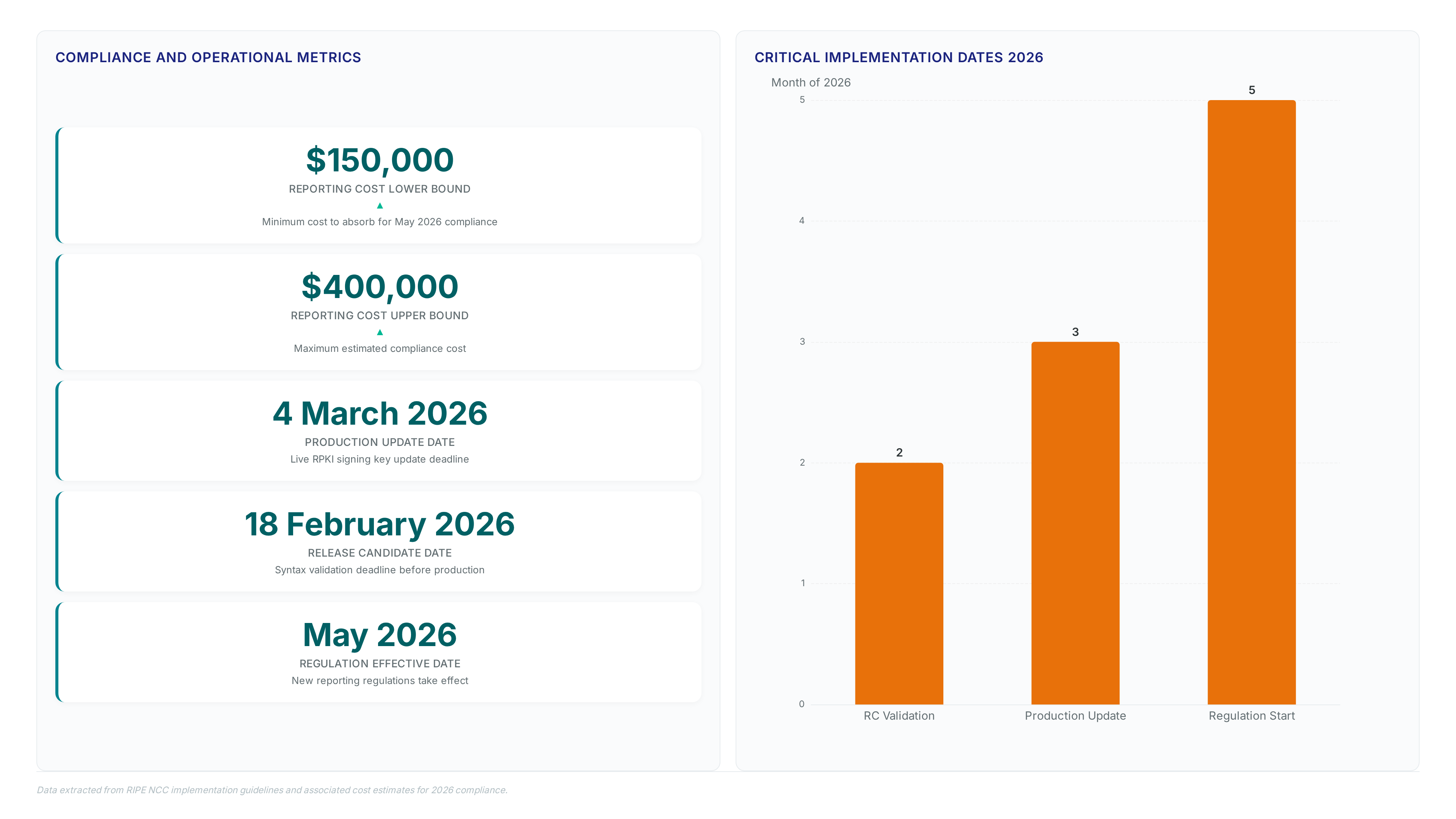
A Release Candidate deployed on 18 February 2026 lets operators validate RIPE Database schema changes before production rollout. Use this window. Test object validation logic against live traffic patterns without risking registry integrity. Business Applications supporting the LIR Portal accept community suggestions to prioritize development backlogs ahead of the next quarter. Submit functional requirements before teams lock sprint scopes. Post-execution modifications incur significant rework costs.
Feedback mechanisms target specific technical domains, not general policy statements.
- Validate attribute syntax in the Release Candidate environment.
The LIR Portal serves as the primary business application interface for RIPE NCC members, specifically ISPs and telecom organizations operating within a non-profit funded structure. This architecture centralizes resource management tasks that would otherwise fragment across disparate systems, ensuring consistent data hygiene for the RIPE Database. Global spending on AI infrastructure is forecast to reach trillions of dollars in 2026, driving unprecedented demand for accurate resource data managed through these portals.
Here is the hard constraint: maintaining rapid feature velocity for members clashes with strict energy caps that now limit European data center expansion. You cannot simply scale compute resources to handle increased login loads during peak registration windows.
- Members authenticate via federated identity providers linked to their LIR account.
- Users submit modification requests for IP address blocks or AS Numbers.
- The system validates input against current Registry Services policies before commit.
The data flow pipeline prioritizes throughput over immediate consistency. Live dashboards may display stale route origins during mass convergence events. Network teams must account for this latency when correlating measurement results with BGP table dumps from route collectors. A common failure mode involves assuming probe diversity equals path diversity. In reality, many probes share upstream transit providers. This limitation reduces the effectiveness of network monitoring for detecting localized provider outages that do not affect anchor paths. Blind reliance on aggregate metrics obscures the specific AS path segments experiencing degradation.org/html/2511.22474v1) maps with local peering topology before declaring a global routing incident.
Power politics introduce a tension between service durability and geographic distribution that previous planning cycles ignored. Centralizing infrastructure improves thermal efficiency but creates single points of failure contrary to routing security best practices. The cost of ignoring these limits is measurable: projects requiring new rack space face indefinite delays regardless of budget approval. Network architects must now validate power availability before designing redundancy schemes for critical Registry Services.
Practical Implementation of RIPE Tools for Network Operators
LIR Portal Scope for ISP Registry Management
The LIR Portal executes member-driven allocation requests for IP addresses and AS Numbers within the RIPE NCC service region. Operators initiate registry tasks through a numbered workflow that updates the RIPE Database functioning as an Internet Routing Registry (IRR). This process supports a membership base consisting mainly of Internet service providers. Energy constraints now dictate transaction throughput rather than software capability alone.
- Log into the Business Applications suite using member credentials.
- Submit resource requests via the allocation form interface.
- Validate object syntax against current policy templates.
- Confirm submission to trigger Registry Services processing.
Thermal limits cap horizontal scaling for backend processors supporting these transactions. The cost is measurable latency during peak allocation windows when grid capacity restricts compute availability. Treat power availability as a primary dependency for registry hygiene.
Executing RPKI and Database Updates via Production Environments
Apply the 4 March 2026 Production update to live RPKI signing keys only after validating syntax in the 18 February 2026 Release Candidate.
- Query RIPEstat to verify current route origin status against the global spending on AI infrastructure driving resource demand.
- Generate new Route Origin Authorizations within the LIR Portal using the updated schema.
- Push configurations to the Release Candidate environment to test propagation without affecting production traffic.
- Commit changes to the RIPE Database Production instance once anchor probes confirm stability.
Compliance with regulations taking effect in May 2026 forces operators to absorb reporting costs between $150,000 and a substantial amount. Skipping the Release Candidate step risks invalidating signed objects, causing immediate traffic blackholing for customer prefixes. The non-profit status of the registry means feature rollouts prioritize stability over speed, extending validation windows.
Verify the TLU object contains correct administrator data before resources leave the free pool to prevent orphaned allocations.
- Inspect the TLU object prototype definition ensuring it matches the new RIPE Database prototype specifications for unallocated space.
- Cross-reference IRR entries against global mirrors since most larger registries mirror each other's routing information to maintain consistency.
- Submit syntax checks via the LIR Portal using the schema deployed in the Production environment update on 4 March 2026.
| Validation Stage | Tool Required | Failure Mode |
|---|---|---|
| Object Syntax | LIR Portal | Rejected submission |
| Global Consistency | RIPE Database | Route leak risk |
| Admin Binding | TLU object | Orphaned resource |
Skipping the TLU check allows invalid admin-c handles to persist, breaking automated audit trails later. Operators often assume IRR mirroring guarantees local validity, yet regional lag creates windows where stale data passes verification.
CIRCIA regulations take full effect in May 2026, mandating strict incident reporting windows for critical infrastructure entities. Compliance demands immediate notification of substantial cyber incidents to federal authorities, creating a rigid operational timeline for network operators. The financial burden involves significant capital expenditure for reporting systems capable of meeting these federal deadlines. Hidden costs often exceed initial budget projections due to legacy system integration challenges.
- Real-time log aggregation infrastructure upgrades.
- Legal review processes for every submitted incident narrative.
- Staff training on specific federal classification criteria.
- Continuous audit trails for regulatory verification.
Critics argue these mandates divert funds from active defense measures toward bureaucratic paperwork. However, the penalty for non-compliance far outweighs the implementation costs for critical infrastructure providers. The regulation forces a shift from reactive post-mortems to proactive detection architectures. Treat regulatory adherence as a core network function rather than an administrative overlay. Failure to integrate these workflows risks severe financial penalties and reputational damage during a breach.
AI Hybrid Computing Adoption Pressuring Infrastructure Planning
Gartner forecasts 40% (Gartner identifies the top strategic technology trends fo...) techrepublic.com/article/enterprise-it-infrastructure-trends-2026/) of enterprises will adopt hybrid paradigms by 2028, up from a small fraction, forcing immediate capacity replanning.
AI transitions from experimental code to operational infrastructure in 2026, demanding built-in governance for agents within serious data platforms. This shift pressures power constraints as electricity availability becomes the primary limiter for new deployments across Europe. Edge computing now supports over a small fraction. The cost is measurable: legacy systems struggle to integrate real-time log aggregation required for modern compliance.
Hidden expenses frequently exceed initial budget projections due to integration complexity:
Most operators overlook that hybrid computing increases latency variance rather than reducing it when power throttling occurs. The limitation is physical; software efficiency cannot overcome a moratorium on new grid connections.
This moratorium functions as a leading indicator for broader power constraints across Europe, where total demand is projected to triple by 2030. Registry infrastructure expansion faces immediate stagnation because network coordination updates require physical compute capacity that no longer exists in key interconnection hubs. Operators assuming unlimited horizontal scaling encounter a hard physical ceiling rather than a budgetary one.
Critics argue that geographic diversification solves local shortages, yet continental grid bottlenecks invalidate this assumption for latency-sensitive services.
- Retrofitting legacy LIR Portal instances for extreme power-density efficiency.
- Purchasing expensive renewable energy certificates to bypass local grid caps.
- Delaying RPKI validator deployments due to unavailable colocation space.
- Increasing reliance on distant nodes, which degrades route convergence times.
InterLIR advises members to prioritize software optimization over hardware expansion immediately. Without shifting focus to Digital Services Act compliance efficiency, operators risk non-compliance simply because they cannot power the necessary logging infrastructure. The window for reactive planning has closed; proactive resource rationing is now the only viable strategy for maintaining routing security post-2028.
About
Alexander Timokhin, CEO of InterLIR, brings necessary industry perspective to the discussion of RIPE NCC quarterly planning. As the leader of a specialized IPv4 address marketplace, Timokhin manages the critical redistribution of internet resources, making RIPE NCC's development roadmap directly relevant to his daily operations. His expertise in IT infrastructure and public policy allows him to analyze how RIPE NCC's upcoming work items impact global address availability and market stability. Since InterLIR relies on transparent BGP data and clean IP reputation to serve clients, Timokhin understands the urgency of efficient registry management. The RIPE NCC serves as the fundamental registry for the European region, meaning its strategic decisions dictate the flow of resources that companies like InterLIR enable. Timokhin's background in international relations and strategic planning uniquely qualifies him to interpret these plans, ensuring the community understands their practical implications for network scalability and resource access in an increasingly constrained environment.
Conclusion
Scaling registry operations now hits a physical power ceiling that no amount of budget can bypass. As grid capacity flatlines, the operational model shifts from acquiring new IP blocks to maximizing the efficiency of existing allocations. The real risk is not regulatory fines alone, but the inability to sustain the compute density required for real-time compliance logging when energy rationing kicks in. Operators clinging to horizontal expansion strategies will face immediate service degradation as colocation providers enforce strict wattage limits per rack.
Pivot your strategy by Q3 2026: treat energy availability as the primary constraint for all network planning, superseding bandwidth or latency considerations. Delaying this shift guarantees that your routing security infrastructure becomes stranded assets when local grids hit their tripling demand limits. Do not wait for the moratoriums to dictate your architecture; the scarcity is already priced into the market.
Start this week by auditing your current LIR account dependencies against your colocation provider's 2027 power roadmap. Identify any critical validation services running on hardware scheduled for de-rating and draft a migration plan to lower-density zones immediately. This specific inventory check reveals your true exposure before the next reporting cycle forces a reactive, expensive scramble.
Frequently Asked Questions
Implementing necessary infrastructure for CIRCIA compliance costs up to $400,000 per organization. This significant expense makes efficient tooling vital for ISPs managing regulatory reporting systems alongside their core network operations.
Operators can validate changes using the Release Candidate environment deployed in February 2026. This pre-deployment window allows testing object validation logic against live traffic patterns without risking registry integrity.
Post-execution modifications incur significant rework costs if requirements are submitted late. Delayed feedback forces operators to implement local workarounds while waiting for the next release cycle to address their needs.
Electricity availability now blocks new European deployments, capping the expansion scope for the quarter. Power constraints force a strategic pivot toward optimizing existing LIR Portal throughput under strict energy caps.