RIPE tools stop BGP hijacks in real time now
With 2,956,544 IPv4 addresses transferred in December alone, the RIPE NCC region proves scarcity drives aggressive market consolidation rather than stagnation. (Ripe 848) This update argues that modern network survival depends on mastering RPKI adoption and navigating the IPv4 waiting list while legacy IRR data collapses under its own weight.
You will dissect the strategic necessity of Route Origin Authorizations, which now cover 76% of IPv4 space but lag significantly at 42% for IPv6 according to RIPE NCC reports. We also dismantle the new RIPEstat architecture following the retirement of the legacy interface, analyzing how fresh LIR service mechanics impact the 747 organizations currently stuck in a queue where the first applicant has waited 452 days. Finally, the analysis covers actionable IPv6 deployment tactics required to bypass these bottlenecks, using specific metrics on DFZ alignment and RPKI conflicts to separate usable routing data from outdated noise.
The era of passive address management ended when Circleid noted that IPv4 leasing prices remain reliable in 2026 due to AI and IoT demand. Ignoring the divergence between third-party IRR landscapes and authoritative ROA coverage is no longer an option for the 19,863 members facing a shrinking pool of routable resources.
The Strategic Role of RPKI and IRR in Modern Routing Security
RPKI Assurance and the Meaning of ROA Coverage Metrics
A Route Origin Authorization cryptographically binds an IP prefix to a specific originating AS number to prevent hijacks. Operators measure deployment maturity using ROA coverage percentages, which currently sit at 76% for IPv4 space and 42% for IPv6 space within the service region. These figures represent the proportion of address space protected by valid signatures rather than total router enforcement rates. The RIPE NCC recently updated its Certification Practice Statement to tighten validation rules and reduce the window for fraudulent announcements. High coverage metrics do not guarantee safety if downstream peers ignore invalid paths during Best Path selection.
Internet Routing Registry entries rely on voluntary maintenance, creating stale data that fails to stop unauthorized path announcements. The RIPE Database functions as a repository of intent rather than a cryptographic lock, allowing any maintainer to modify records without validating resource ownership. This structural weakness permits DFZ alignment errors where published routes diverge from actual network topology. Operators trusting IRR alone face risks because the system lacks a mechanism to reject invalid paths at the protocol level. The RIPE NCC emphasizes that preventing IP address hijacking requires moving beyond simple database matching to origin validation. While IRR data supports basic filtering, it cannot provide the non-repudiation needed for modern interconnection agreements. The limitation is operational friction: deploying ROV reject policies demands coordination with peers who may still rely on unverified lists. Networks ignoring this shift retain exposure to route leaks that signed objects would automatically discard.
The legacy RIPEstat interface ceased operations on 2 February 2026, forcing all 20,647 LIR accounts onto the modernized architecture. Operators now access a unified dashboard where RIPE Atlas probe data correlates directly with prefix ownership records. The previous separation between routing visualization and resource management created blind spots; the new LIR Portal closes this gap by integrating measurement anchors into the registration workflow.
| Legacy UI | Modernized Portal |
|---|---|
| Static prefix lookup | Flexible probe visualization |
| Separate auth systems | Single sign-on for all services |
| Manual data correlation | Automated RPKI status checks |
Migration requires updating bookmarked URLs before the hard cutoff date, as redirect rules no longer apply to deprecated endpoints. The Activity Plan and Budget 2026 confirms that automation drives this shift rather than staff expansion, limiting custom support for legacy workflows. Operators relying on scripted scrapers for the old interface face immediate failure unless they adopt the new API endpoints. Failure to migrate results in total loss of visibility into ROA coverage trends and anchor health metrics.
Operational Mechanics of the RIPE Atlas LIR Overview for Prefix Visualization
Accessing the new dashboard requires authenticating against the modernized LIR Portal to view probe density per assigned prefix block. Operators navigate to the specific organization view where anchor locations map directly to held resources rather than generic geolocation data. This mechanism correlates active measurement agents with the prefix organisation field in the registry, revealing gaps between claimed address space and physical monitoring presence. The interface aggregates these data points under the supervision of the Chief Technology Officer , ensuring that measurement metadata aligns with current assignment records. A critical limitation emerges when LIRs hold large blocks but deploy zero anchors; the visualization highlights this blind spot without enforcing probe installation. Consequently, an operator might possess valid RPKI signatures yet lack visibility into how external paths traverse their specific infrastructure.
| Data Layer | Legacy Output | New Overview |
|---|---|---|
| Probe Source | Global aggregate | LIR-specific filter |
| Ownership Link | Manual correlation | Automated join |
| Actionability | Low | High |
Assured RPKI service to validate both cryptographic and topological integrity. The financial commitment for maintaining such accounts remains fixed at the standard rate, though future voting outcomes could alter fee structures based on the Charging Scheme Model consultation results. Without this integrated view, network engineers risk trusting routing policies that lack empirical verification from within their own address range. True operational security demands confirming that the entities announcing your space also host the sensors monitoring.
Charging Scheme Phase 2 Consultation and May 2026 Voting Timeline
Phase 2 of the charging scheme consultation opened in January 2026 to define separate fees for ASNs and independent resources. LIRs must distinguish between Group 1 task force recommendations and Group 2 incentive structures before the final vote. The process requires active participation to influence whether the base fee remains at current levels or shifts under Option.
- Review Group 1 proposals for mandatory resource assignments.
- Analyze Group 2 discounts affecting smaller registry holders.
- Submit the feedback via the member portal before the deadline.
- Prepare delegates for the General Meeting in May 2026.
| Charge Category | Current Model | Proposed Option A |
|---|---|---|
| Base LIR Fee | Flat annual rate | Tiered by resource count |
| ASN Assignment | EUR 50 per unit | Potential volume discount |
| Independent Space | Fixed assignment cost | Variable incentive scaling |
A potential rise to EUR 1,894 under Option A creates financial tension for members holding large legacy blocks. This shift penalizes hoarding while potentially subsidizing new entrants with fewer resources. Operators ignoring this consultation risk facing unexpected budget variances when the new model takes effect. Failure to engage leaves the final fee structure entirely to the voting majority.
Executing IPv6 Deployment and RPKI Implementation Strategies
Defining RPKI Implementation Scope for LIRs
Holding a /32 allocation does not equal security; operators must actively sign Route Origin Authorizations to prevent hijacking. 1. Authenticate to the LIR Portal and generate a Certificate Authority key pair for the specific resource block. 2. Create ROA objects that cryptographically bind the prefix to the authorized origin AS number. 3. Publish these signed objects to the global repository so peers can validate the AS path origin. Skipping step two leaves the IPv6 address allocation hierarchy exposed despite the membership status. The distinction lies between passive ownership and active cryptographic assertion of routing rights. New members paying the one-time sign-up fee often mistake billing registration for routing security completion. This gap allows invalid origins to propagate until downstream filters intervene manually. Update as a mandatory operational checklist rather than administrative paperwork. Without these signed objects, the network relies on voluntary IRR entries that lack enforcement power. The cost of omission is measurable in traffic interception incidents where unsigned prefixes get rerouted silently. Operators must verify that every announced block has a corresponding valid ROA before enabling strict RPKI validation policies on edge routers.
Executing IPv6 Deployment via RIPE NCC Training Courses
The IPv6 Advanced Training Course in Lisbon runs 4–5 February 2026 for engineers seeking hands-on deployment skills.
- Navigate to the registration portal to secure a seat for the specific training event before capacity fills.
- Review the global adoption rate metrics showing 45% to 50% connectivity to justify the operational investment.
- Configure the router to prioritize IPv6 connections using the Happy Eyeballs mechanism for smooth dual-stack fallback.
- Validate that the assigned block meets the standard minimum allocation
Operators often mistake address assignment for readiness, yet routing security requires active Route Origin Authorization signing. The cost of skipping this step is exposure to hijacks despite holding valid resources. Without this synchronization, trained staff return to environments where 63% of web targets remain unreachable over native IPv6 paths. The limitation lies in organizational inertia rather than technical complexity.
Validating Staff Expertise Through Exam Voucher Claims
Members access their dashboard to claim three annual exam vouchers, aligning certification with the 19,863 current membership base.
- Log into the member portal to locate the voucher claim section before the fiscal reset.
- Assign codes to engineers who completed the IPv6 Advanced Training Course
- Track redemption rates against the community budget managed by external engagement leads.
- Schedule proctored sessions within the 76 countries served by the region.
| Step | Action | Required Role |
|---|---|---|
| 1 | Portal Authentication | Account Admin |
| 2 | Code Distribution | Training Manager |
| 3 | Exam Scheduling | Certified Engineer |
| 4 | Completion Logging | HR Director |
The limitation lies in the manual reconciliation required between training attendance and portal eligibility. Operators often miss the window because voucher visibility depends on updated financial resource records. Delayed claims force staff to retake courses, wasting the 1% registry efficiency gains. Certification without voucher utilization leaves the AS path validation knowledge theoretical rather than.
Maximizing Member Value Through Community Engagement and Financial Planning
The SEE 14 Belgrade Agenda and RIPE NCC Charging Scheme Phase 2 Scope defines the operational timeline for the 21–22 April 2026 meeting and the distinct fee groups facing a vote. Operators attending the event at the Crowne Plaza Belgrade gain direct access to task force members shaping Group 1 charges based on specific recommendations. This gathering precedes the final decision on the combined proposal scheduled for the General Meeting in May 2026. Phase 2 separates financial impacts into Group 1 for mandatory resource costs and Group 2 for potential discounts or incentives.
| Charge Group | Scope Definition | Operator Impact |
|---|---|---|
| Group 1 | Task force recommendations | Direct cost increase for ASN assignments |
| Group 2 | Other charges and incentives | Variable pricing for independent resources |
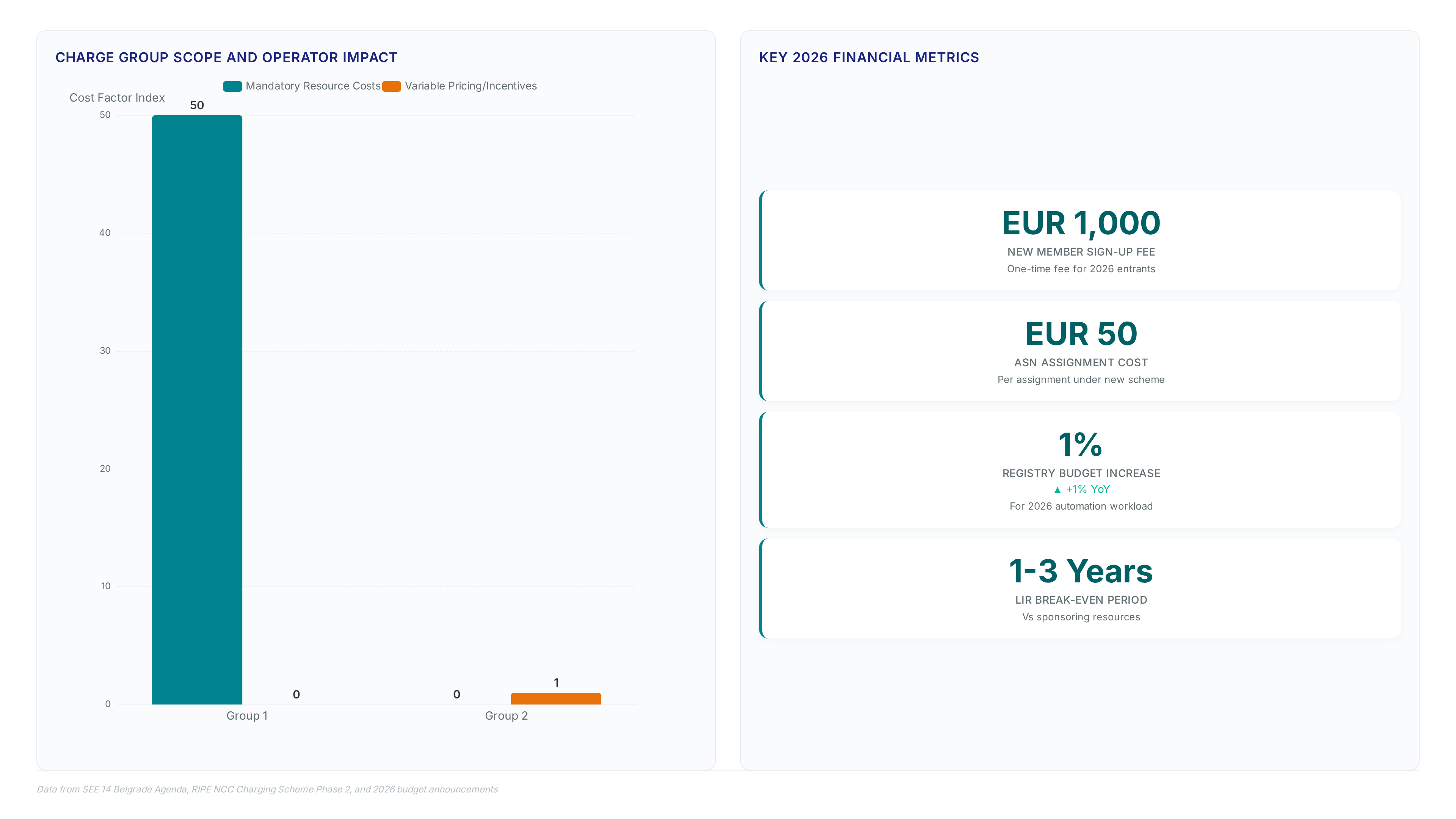
Meanwhile, the mechanism separates base fee adjustments from optional service pricing, creating a bifurcated decision matrix for members. A limitation exists in the timeline; feedback submitted after the consultation window closes cannot alter the ballot text for the May vote. This constraint forces operators to finalize their positioning on the separate fees well in advance of the physical meeting. Participation in SEE 14 provides the only remaining forum to influence delegate understanding before the binding ballot. Failure to distinguish between the two charge groups risks unintended budget exposure when the new scheme activates. ### Calculating LIR Budget Impact Under EUR 1,800 Annual Contribution and Option The baseline annual contribution remains fixed at EUR 1,800, yet Option A introduces a potential rise to EUR 1,894. This specific increase alters the total cost of ownership for operators managing tight margins. New entrants face a steeper initial barrier due to the mandatory one-time sign-up fee. The financial strain compounds when factoring in per-assignment costs like the EUR 50 charge for an Autonomous System Number . | Cost Component | Current Rate | Option A Projection | | :--- | :--- | :--- | | Base LIR Fee | EUR 1,800 | EUR 1,894 | | New Member Entry | EUR 2,800 | EUR 2,894 | | ASN Assignment | EUR 50 | EUR 50 |
Attendance at SEE 14 in Belgrade offers a strategic venue to debate these Group 1 charges before the May vote. Operators must weigh the travel expense against the potential savings from influencing the combined proposal outcome. Ignoring this engagement risks accepting higher fees without recourse. The limitation lies in the uncertainty of the final vote, making precise budget forecasting impossible until the General Meeting concludes.
Operators targeting the May 2026 vote must register for SEE 14 at the Crowne Plaza Belgrade before the 21-22 April 2026 dates to access final policy drafts. Free registration grants physical access to task force members defining Group 1 charges, a critical advantage over remote observation. Budget officers should model the EUR 1,894 New entrants face compounding pressure from the mandatory one-time sign-up fee InterLIR advises aligning engineering staff with these fiscal timelines to prevent voting disconnection.
- Secure venue access via the official portal to guarantee entry for the Belgrade session.
- Download the Phase 2 consultation document to review Group 2 discount structures prior to arrival.
- Calculate the 1% cost variance over four years using the Option A baseline data.
- Prepare the questions regarding the separation of task force recommendations from incentive models.
| Preparation Item | Operational Goal | Deadline |
|---|---|---|
| Venue Registration | Physical Presence | 15 April 2026 |
| Financial Modeling | Budget Approval | 10 April 2026 |
| Policy Review | Voting Strategy | 18 April 2026 |
| Staff Briefing | Consensus Building | 20 April 2026 |
Attendance converts passive observation into direct influence on the combined proposal. Missing this window leaves operators subject to defaults determined by others.
About
Vladislava Shadrina serves as a Customer Account Manager at InterLIR, a specialized IPv4 marketplace based in Berlin. Her daily work managing client relations and facilitating IP resource transactions provides unique insight into the RIPE NCC statistics highlighted in this update. As InterLIR actively assists organizations in navigating complex address transfers and leasing, Shadrina directly observes the market dynamics driving the recent surge in IPv4 address transfers within the RIPE service region. Her role requires constant monitoring of Local Internet Registry (LIR) trends to advise clients on acquiring clean, routed IP blocks efficiently. This practical experience allows her to contextualize the decline in LIR accounts against the expanding demand for redistributed resources. By bridging the gap between raw registry data and real-world business needs, Shadrina offers a grounded perspective on how InterLIR supports the IT sector through transparent access to critical network infrastructure across Europe and Central Asia.
Conclusion
Scaling registry participation reveals a critical fracture: high attendance rates do not guarantee functional network durability when external connectivity lags behind internal certification. Even with reliable local policy engagement, operators face operational fragility if their infrastructure cannot reach the 63% of web targets currently unreachable over IPv6 alone. The market dynamics for 2026 suggest that IPv4 leasing costs will remain elevated due to AI and IoT demand, making reliance on legacy addressing a financial liability rather than a safety net. Waiting for perfect global metrics before acting is a strategic error; the window to influence fee structures closes permanently once the May 2026 vote concludes.
Organizations must commit to physical presence at SEE 14 in Belgrade by April 15, 2026, to directly shape Group 1 charge definitions rather than accepting defaulted outcomes. Remote observation fails to capture the nuance required to separate incentive models from mandatory cost hikes. Do not model budgets based on static assumptions; instead, stress-test liquidity against the EUR 1,894 upper-bound scenario immediately. Start by auditing your current routable address exposure against projected 2026 leasing rates this week to quantify the specific premium your organization pays for delayed transition. This data drives the necessary urgency for securing venue access and finalizing voting mandates before the mid-April deadlines lock you out of the decision-making process.
Frequently Asked Questions
IPv4 space has 76% coverage while IPv6 lags significantly at 42%. This disparity suggests legacy infrastructure delays cryptographic signing in dual-stack environments.
A network with 100% local ROV coverage remains vulnerable if upstream providers accept unsigned claims. Safety relies entirely on voluntary publication by resource holders.
Current figures represent 76% for IPv4 and 42% for IPv6 space protected by valid signatures. These numbers do not measure total router enforcement rates.
IPv6 space currently sits at 42% coverage compared to 76% for IPv4 space. This gap indicates slower cryptographic signing adoption in newer protocols.
While IPv4 reaches 76% coverage, IPv6 space only achieves 42% protection via valid signatures. Much address space remains unprotected by these cryptographic bindings.