Route leak lessons: Why Venezuela's 12-hour outage happened
Eleven route leaks from AS8048 since December confirm that poor technical practices drove the January 2, 2026 Venezuela incident. This event proves that insufficient routing policies at state-run ISPs create systemic fragility far more often than deliberate malfeasance. Readers will learn how valley-free routing principles define these failures, why the CANTV propagation anomaly persisted for over 12 hours, and which operational strategies effectively detect such breaches.
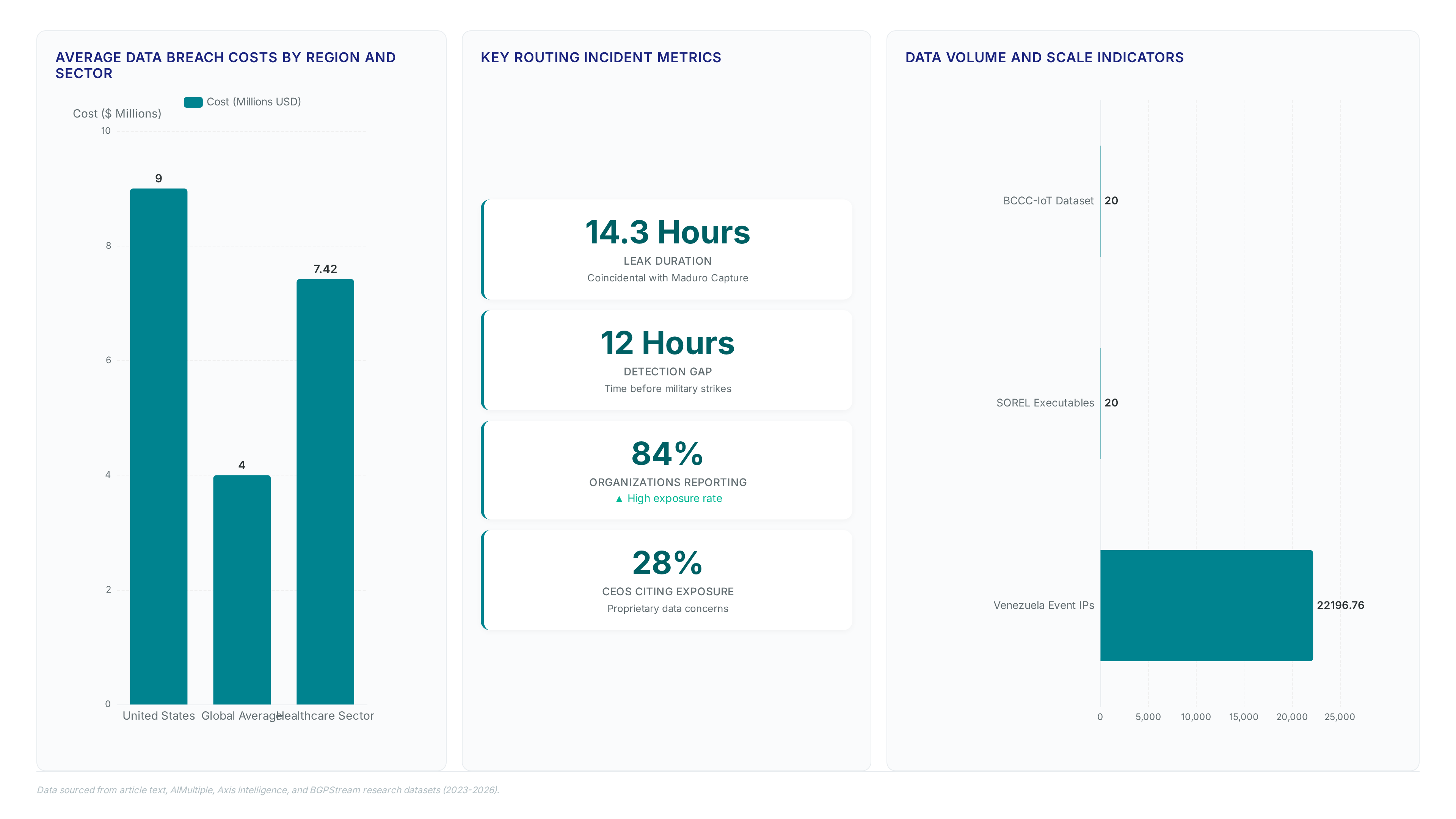
The leak, analyzed by Cloudflare Radar, violated standard business relationships by propagating eight specific IPv4 prefixes beyond their intended scope. (Cloudflare's bgp route leak venezuela) While 67% of organizations globally deploy Intrusion Detection Systems according to Market Growth Reports, many still lack the specific BGP monitoring required to catch these export policy failures. The incident disrupted traffic through Dayco Telecom's Caracas facility, illustrating how a single Autonomous System can inadvertently fracture regional connectivity without any hostile intent.
Understanding these mechanics requires dissecting the customer-provider dynamics that broke down during the political unrest surrounding Nicolás Maduro. The analysis moves beyond speculation to offer concrete methods for identifying route leaks before they cascade into prolonged outages.
Defining BGP Route Leaks and Valley-Free Routing Principles
RFC 7908 Definition of BGP Route Leak Propagation Scope
RFC 7908 defines a BGP route leak as propagating routing announcements beyond their intended scope.
This intended scope relies on pairwise business relationships, specifically customer-provider and peer-peer links. Providers announce all routes to customers, whereas customers advertise only their own prefixes or those from downstream clients. Peers exchange traffic settlement-free but restrict advertisements to their own routes and customer prefixes. Violating these constraints breaks the valley-free routing rule, causing an AS to re-advertise provider routes to other providers. Such behavior creates a Type 1 hairpin leak where a customer becomes an unintended transit path. The problem definition framework classifies these events as systemic vulnerabilities rather than isolated configuration errors. Traffic destined for distant networks floods the leaking AS, overwhelming its backbone capacity.
| Relationship | Allowed Advertisement Source | Forbidden Propagation Target |
|---|---|---|
| Customer-Provider | Own customers + Origin | Other providers or peers |
| Peer-Peer | Own customers + Origin | Other providers or peers |
Operators often miss these violations because standard BGP validation accepts any syntactically correct AS path. The methodology established in June 2016 remains the primary reference for identifying these policy breaches. Without strict export filters, a single misconfigured router can redistribute global tables through a small regional network. This exposure highlights why AS path validation alone fails to prevent leaks without relationship awareness.
Valley-free routing mandates that traffic flows upstream to providers or laterally to peers before descending to customers, never reversing direction mid-path.
In a customer-provider link, the provider announces full tables while the customer restricts advertisements to locally originated prefixes and downstream client routes. Conversely, peer-peer relationships limit exchanges strictly to each party's own assets and their immediate customers. This asymmetry prevents a network from acting as unauthorized transit between two upstream entities. Violating these constraints creates a hairpin leak where a customer like AS64505 redistributes provider routes to another provider, overwhelming limited backbone capacity. Such failures often stem from missing export filters that fail to enforce strict customer/provider relationships required by modern validation.
| Relationship Type | Allowed Advertisements | Forbidden Propagation |
|---|---|---|
| Customer → Provider | Local origins + Customer routes | Peer routes + Other Provider routes |
| Peer → Peer | Local origins + Customer routes | Other Peer routes + Provider routes |
| Provider → Customer | Full Internet table | None ( |
Operators ignoring these rules risk becoming transit points for traffic they cannot handle. The CANTV incident illustrates this failure mode where routes from Sparkle were leaked to V. Tal GlobeNet, bypassing intended routing policies that restrict propagation. While 9.4% of observed paths showed AS8048 as upstream to its customer, the leak involved re-advertising those same prefixes to a different provider. This specific configuration error turns a stub network into a congested transit hub. Implementing automated BGP route leak detection helps identify these transient artifacts before they destabilize regional connectivity. The cost of loose export policies is measurable in packet loss and latency spikes during convergence events.
Distinguishing BGP Route Leaks from Malicious Hijacks and Ephemeral Events
Route leaks differ from hijacks by preserving origin ownership while violating export policy constraints.
Malicious hijacks seize prefix ownership by announcing unauthorized origin ASNs, whereas leaks propagate valid prefixes through forbidden AS path sequences. The January CANTV incident maintained correct origin AS21980 but exposed a hairpin leak where provider routes traversed a customer link. This distinction dictates response: operators filter leaked paths temporarily but must investigate hijacks as active theft. Confusing these modes leads to unnecessary escalation during routine convergence events.
Automated detectors often flag transient artifacts that resolve without intervention. Doug Madory's analysis of Cloudflare Radar The Venezuela disruption lasted over 12 hours, exceeding typical ephemeral windows yet lacking hijack intent signatures. Differentiating requires examining RouteViews
| Feature | Route Leak | Malicious Hijack |
|---|---|---|
| Origin ASN | Valid | Unauthorized |
| AS Path | Violates valley-free | Arbitrary |
| Intent | Misconfiguration | Theft/Interception |
| Duration | Minutes to hours | Until mitigation |
The operational cost lies in false positives; treating ephemeral events as attacks wastes engineering cycles. Network teams must correlate duration against automated detection Sustained leaks indicate broken export filters requiring immediate configuration audits.
Mechanics of the CANTV AS8048 Propagation Anomaly
Loose export policies at AS8048 matched IRR lists but ignored customer BGP community tags, triggering unintended redistribution.
This failure mode occurs when a router accepts prefixes from a provider like AS6762 and re-advertises them to another upstream peer such as AS52320. The export policy logic prioritized static prefix lists over flexible relationship tags, allowing traffic to violate valley-free constraints. Evidence of this configuration error appears in the AS path, where AS8048 prepended its own ASN ten times to artificially depress route preference. Such aggressive manipulation contradicts malicious interception theories, as it renders the leaked path less attractive to global routers. Historical routing data reveals eleven similar events, indicating a systemic pattern of insufficient policy enforcement rather than a singular geopolitical exploit.
| Policy Element | Expected Behavior | Observed Failure |
|---|---|---|
| IRR List | Match authorized prefixes | Matched correctly |
| Community Tag | Restrict customer exports | Ignored by filter |
| AS Path | Reflect true topology | Prepend 10x AS8048 |
The cost of this oversight is measurable instability during critical infrastructure stress. Operators relying solely on origin validation miss these path violations entirely. Implementing ASPA records would bind specific providers to authorized paths, preventing customer ASNs from acting as transit hubs. Without this layer, networks remain vulnerable to accidental loops that degrade latency across national borders.
AS8048 redistributed provider routes from AS6762 to AS52320 with a 10-time AS path prepend sequence.
The observed propagation followed a specific chain: AS263237 sent traffic to AS52320, which passed it through the repeated AS8048 entries before reaching the Italian upstream. This excessive padding artificially inflated the route length, making the leaked path less attractive to global routers seeking optimal latency. Such manipulation contradicts theories of malicious interception, as an attacker would typically minimize hop counts to capture maximum traffic volume. The leak affected the 200.74.224.0/20 subnet, originated entirely by AS21980. Data aggregation from Cloudflare.
| Path Segment | Role | Action |
|---|---|---|
| AS6762 | Provider | Originate valid routes |
| AS8048 | Leaker | Prepend ASN 10 times |
| AS52320 | Peer | Accept forbidden transit |
The root cause lies in export policies that matched IRR prefix lists but ignored customer BGP community tags. This configuration error allowed AS8048 to treat provider routes as local assets eligible for redistribution. Operators relying solely on static prefix filters face this specific vulnerability when flexible relationship tags drift out of sync. The consequence is a persistent hairpin leak that RPKI origin validation cannot block, since the origin AS remains legitimate. Only path-aware mechanisms like ASPA can authorize the specific provider-to-customer link required here.
RPKI Route Origin Validation fails against path leaks because the origin AS remains valid while the sequence violates policy. During the January 2026 incident, Sparkle lacked validation techniques The mechanism validates only the rightmost ASN in the AS path, ignoring intermediate hops that breach valley-free rules. Operators assuming ROV guarantees full path security face a dangerous blind spot when customers redistribute provider routes upstream. This specific failure mode rendered origin checks useless against the misconfigured export policies at AS8048.
| Validation Scope | Detects Origin Hijack | Detects Path Leak | Required Extension |
|---|---|---|---|
| RPKI ROV | Yes | No | None |
| ASPA | Yes | Yes | Provider Authorization |
The cost of this limitation is measurable during infrastructure crises like the Venezuela power-grid disruption, where correct origins masked invalid propagation. Traffic destined for the Dayco Telecom facility suffered outages despite valid origin signatures because the path itself was poisoned. Preventing such anomalies requires Autonomous System Provider Authorization to cryptographically sign permitted upstream relationships. Without path validation, networks remain vulnerable to loose export filters that satisfy origin checks but break routing logic.
Operational Strategies for Detecting and Mitigating Route Leaks
RFC 9234 OTC Attribute and Business Role Coupling
RFC9234 introduces the Only-to-Customer (OTC) attribute to bind BGP announcements strictly to verified business roles. Operators detecting route leaks must first identify paths where a customer AS appears in transit between two providers, violating valley-free constraints. This detection relies on analyzing AS path sequences from aggregators like Cloudflare Radar to spot unauthorized propagation beyond intended scope. Unlike legacy IRR filters that match static prefix lists, the OTC mechanism tags routes explicitly for customer-only delivery, preventing accidental redistribution to peers or upstream providers.
Implementing this defense requires specific configuration steps to enforce relationship-based filtering:
- Ingest neighbor relationship data to classify sessions as customer, provider, or peer.
- Apply the OTC attribute to all prefixes learned from customer sessions within the router policy.
- Configure export rules to drop any route carrying the OTC tag when sending to non-customer neighbors.
- Monitor rejected updates to verify the policy blocks leaks without impacting legitimate traffic.
The limitation remains that OTC requires universal adoption to be proven; a single non-compliant AS breaks the chain of trust. While origin validation confirms ownership, it ignores path topology, leaving networks vulnerable to hairpin leaks where valid origins traverse forbidden paths.
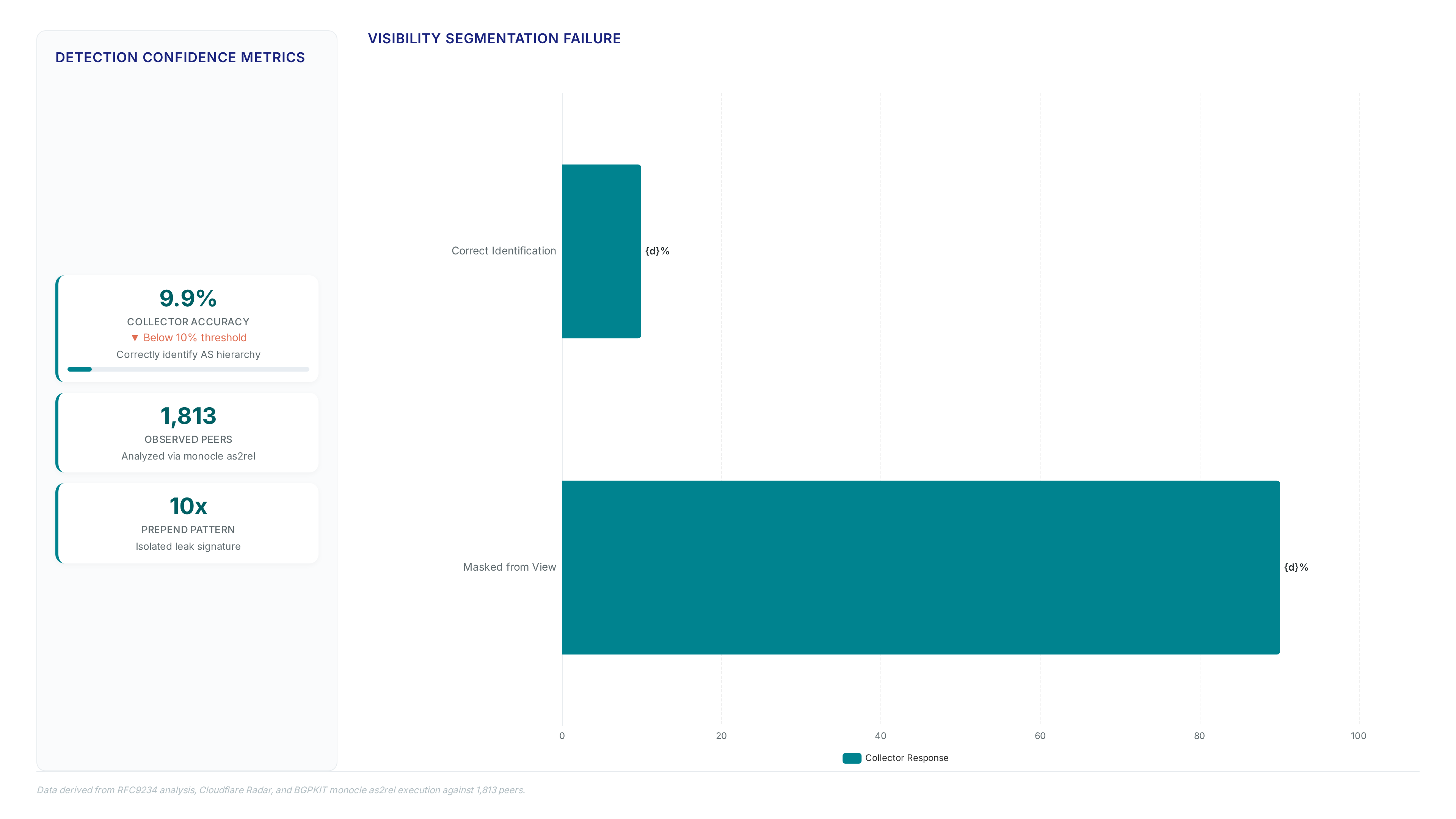
Operators isolate the 10-time prepend pattern by executing `monocle as2rel` against the 1813 observed peers to quantify relationship visibility. Only 9.9% of connected collectors correctly identify the AS8048-AS21980 hierarchy, masking the leak from most global vantage points. The low confidence score indicates a segmentation failure where export policies bypass standard community tagging constraints.
- Query the specific ASN pair using `monocle as2rel 8048 21980` to retrieve the adjacency matrix.
- Filter results where the `as1_upstream` percentage drops below a minimal threshold, signaling inconsistent path propagation.
- Cross-reference the output with BGPStream pipelines to distinguish between research anomalies and live traffic shifts.
- Validate the AS path length against historical baselines to confirm artificial inflation rather than organic growth.
Commercial platforms like NetBeez focus on peer state alerts but lack the granular historical replay needed for this specific forensic depth. The prepending mechanism intended to deprioritize the route instead created a visibility blind spot for operators relying on majority consensus. High visibility in research tools does not guarantee detection in production routing tables when the leak affects a minority of peers. Principles to verify every path change against real-time risk signals. The limitation remains that monocle identifies the symptom of misconfiguration, not the policy logic error itself.
Validating Export Policies Against IRR and Community Tags
AS8048 redistributed provider routes because export filters matched IRR lists but missed customer BGP community tags. Operators must enforce strict validation to stop similar leaks from destabilizing national infrastructure during crises.
- Generate prefix lists from IRR databases and intersect them with expected customer ranges.
- Require specific community tags on all inbound sessions to distinguish transit traffic from local origination.
- Apply explicit deny statements for routes lacking these tags before advertising to upstream providers like V. Tal GlobeNet.
- Verify path integrity using tools that detect violations of RFC 7908 Methodology definitions.
| Filter Type | Scope | Failure Mode |
|---|---|---|
| IRR Prefix List | Origin AS only | Accepts invalid paths |
| Community Tag | Relationship role | Misses untagged leaks |
| Combined Policy | Path and role | Prevents redistribution |
Relying solely on origin validation leaves networks exposed when the originating AS is legitimate but the path is. The RPKI and ASPA Mitigations framework addresses this by authorizing specific provider paths rather than just origins. A missing community tag on a single prefix can bypass layers of automated filtering if the logic assumes all IRR matches are safe. This gap allows customer networks to inadvertently become transit hubs for provider traffic, violating valley-free principles.
Assessing Routing Data Integrity During Geopolitical Instability
Defining Insufficient Routing Export Policies in State ISPs
Misconfigured filters at AS8048 triggered the redistribution of provider routes to peers, a direct violation of valley-free constraints detailed in RFC 7908 Methodology Eleven prior incidents since December confirm this technical failure mode stems from engineering debt rather than malicious intent. Distinguishing between targeted attacks and chronic configuration drift remains necessary for operators trusting routing data during geopolitical events. Historical analysis of Dayco Telecom prefixes confirms that the leak disrupted critical services hosted in a facility operating at 85% occupancy. Such outages occur when expo rt logic matches static IRR lists but ignores flexible community tags required to block transit traffic. Recurring errors suggest a systemic inability to enforce strict boundary controls on state-run infrastructure. Networks trusting routing announcements without verifying path integrity face avoidable instability during crises. Loose policies carry a measurable cost in lost connectivity for downstream customers dependent on proper AS path propagation. Operators should assume technical incompetence before attributing anomalies to adversaries when patterns show repeated configuration drift.
Forensic timing places the initial 15:40 UTC detection well before the 06:00 UTC strike window, invalidating direct causality with military action. This twelve-hour gap suggests operators treat routing data during geopolitical events as noise until temporal correlation confirms alignment with kinetic triggers. The leak window began over half a day prior to US military strikes, indicating the anomaly was an enabling condition rather than a synchronized response to the Maduro capture.
| Trigger Event | Temporal Delta | Causality Verdict |
|---|---|---|
| Leak Start (15:40 UTC) | -14.3 Hours | Coincidental |
| Maduro Capture | +4.0 Hours | Unrelated |
| Military Strikes | +14.3 Hours | Post-Facto |
Repeated incidents since December point to chronic insufficient routing export Trusting BGP telemetry without historical context risks misidentifying engineering debt as adversarial activity. The recurrence of similar leaks implies a systemic configuration failure where valley-free routing rules are routinely ignored by state ISPs.
Operators must verify if anomalies match known failure modes before attributing intent. A single data point lacks statistical power; only a pattern of historical recurrence Blind trust in real-time feeds during crises leads to false positives and wasted incident response resources.
Risk of Misattributing Technical Errors to Geopolitical Cyberwarfare
Historical records show AS8048 executed eleven Type 1 hairpin leaks before the January 2026 crisis, proving chronic misconfiguration rather than state-sponsored aggression. Analysts trusting routing data during geopolitical events often confuse these recurring technical faults with targeted cyberwarfare campaigns due to timing coincidences. The specific mechanism involves a customer AS redistributing provider routes to a peer, a violation of valley-free principles that occurs frequently without malicious intent. Data indicates that 28% of CEOs now cite proprietary data expos ure as a top security concern, creating pressure to label anomalies as attacks. However, attributing the CANTV incident to malice ignores the reality that insufficient export policies are a common operational failure mode. The limitation of this misattribution is measurable: organizations waste resources investigating phantom threats while ignoring the actual need for stricter filter enforcement. Operators distinguish between transient artifacts and genuine hostility by examining historical patterns rather than isolated snapshots. Monitoring tools like NetBeez provide the continuous peer-state visibility required to separate noise from signal in real-time.
| Indicator | Technical Fault | Cyberattack |
|---|---|---|
| Frequency | Recurrent over months | Singular event |
| Prefix Scope | Specific subnets only | Broad hijacking |
| Timing | Precedes kinetic action | Synchronized with strikes |
InterLIR recommends validating export policies against IRR databases before assuming hostile causation during international incidents.
About
Vladislava Shadrina serves as a Customer Account Manager at InterLIR, a specialized IPv4 marketplace dedicated to secure network resource redistribution. While her background spans client relations and service promotion, her daily work requires a deep, practical understanding of BGP integrity and IP reputation. At InterLIR, ensuring clean route objects and preventing routing leaks are fundamental to maintaining the security and value of the IP assets managed for clients. This operational focus makes her uniquely qualified to analyze the recent BGP route leak involving CANTV in Venezuela. By examining how insufficient export policies at substantial ISPs can destabilize global routing tables, Shadrina connects real-world network incidents to the critical importance of rigorous address management. Her perspective bridges the gap between technical routing failures and the broader necessity for transparent, secure IP markets that safeguard global connectivity against such disruptions.
Conclusion
Scaling global routing tables exposes a critical fragility: manual filter maintenance cannot keep pace with flexible peering changes, leading to silent propagation errors that persist long after the initial trigger. The operational cost here is not merely bandwidth waste but the erosion of trust in automated failover systems, forcing teams to revert to manual verification during exact moments when speed matters most. When upstream visibility drops below critical thresholds, relying on real-time feeds alone creates a dangerous blind spot that masks chronic configuration drift as acute geopolitical events.
Organizations must mandate automated IRR validation for all export policies by Q3 2026, treating any unregistered route announcement as a hard failure rather than a warning. This shift requires moving beyond reactive monitoring to preventive policy enforcement at the edge, ensuring that misconfigurations never leave the local router. Do not wait for the next international incident to test your durability; the window for passive observation has closed.
Start by auditing your current export filters against RIPE and ARIN databases this week to identify any prefixes lacking valid route objects. Remove any static allow-lists that bypass these checks immediately, as they represent the single point of failure in your convergence logic.
Frequently Asked Questions
Observations confirmed that 9.4% of paths incorrectly showed AS8048 as an upstream provider. This specific metric highlights how the state-run ISP violated valley-free routing principles by redistributing provider routes unexpectedly.
Data reveals that only 9.9% of connected collectors correctly identified the propagation anomaly. This low detection rate demonstrates the difficulty operators face when monitoring specific export policy failures in real time.
Eleven recorded leaks confirm poor technical practices drove the incidents rather than deliberate malfeasance. Insufficient routing policies at the state-run ISP created systemic fragility, proving these were configuration errors not hostile acts.
The Venezuela disruption lasted over 12 hours, significantly exceeding typical ephemeral windows for such events. This prolonged duration illustrates how a single Autonomous System can inadvertently fracture regional connectivity without any hostile intent.
While 67% of organizations globally deploy Intrusion Detection Systems, many still lack specific BGP monitoring. This gap leaves networks vulnerable to export policy failures that standard security tools often fail to catch effectively.