Route origin validation: Stop BGP hijacks today
The 2018 MyEtherWallet hijack silently stole USD 150,000 because no one verified the route origin. RPKI deployment is no longer optional for Pacific operators; it is the only cryptographic fix for a trust-based routing system prone to forgery. Border Gateway Protocol relies on unverifiable trust, allowing bad actors to forge "road signs" for internet traffic just as they did during the Amazon DNS redirection. We outline a concrete implementation roadmap for Pacific operators, using the PITA 31 summit as a critical checkpoint to move from tentative assurances to verified security.
While APNIC serves over four billion people across 56 economies, executive uncertainty at PITA 30 reveals a dangerous gap between policy and engineering reality. (APNIC's member fees calculator) With 66% of telecom organizations now using AI, manual routing management is an unsustainable vulnerability in an era of automated orchestration. The path forward requires abandoning half-measures and committing to the dual requirements of signed certificates and active filtering to secure the region's digital future.
The Critical Role of RPKI in Preventing BGP Hijacking
RPKI and ROA: Cryptographic Certificates for BGP Trust
RPKI deploys cryptographically signed ROAs to validate which ASN legitimately originates specific IP prefixes. Border Gateway Protocol functions on implicit trust, lacking inherent mechanics to verify that route announcements are legitimate. Attackers exploit this gap by forging path attributes, redirecting traffic without cracking passwords or deploying malware. The standard 19-byte keep-alive message maintains session state but carries zero cryptographic proof of ownership. ROAs bridge this deficit by binding address blocks to authorized origin ASes within a trusted hierarchy. Operators must publish these records and simultaneously enable ROV filtering to drop invalid updates at the edge.
Complete coverage requires synchronizing validator caches with every router in the forwarding plane. Latency in cache updates creates brief windows where stale data permits unauthorized announcements. Network engineers must monitor synchronization lag to ensure filtering decisions reflect current registry state.
Unfiltered BGP-4 sessions in the Pacific allow attackers to redirect traffic through forged origin claims without detection. Terry Sweetser queried executives at the Pacific Islands Telecommunications Association forum regarding forged route filtering, receiving only tentative assurances rather than confirmed deployments. BGP hijacking occurs when an unauthorized network announces IP prefixes it does not own, exploiting the protocol's inherent trust model. Publishing ROAs without enabling ROV leaves routers accepting invalid announcements, creating a false sense of security while vulnerabilities persist. The region faces acute risk because accidental leaks happen far more often than deliberate attacks, yet many networks lack local validation logic.
Inside the Mechanics of Route Origin Authentication and Authorization
BGP-4 Trust Deficit and ROA Cryptographic Signatures
BGP-4 inherits a structural vulnerability because the protocol relies on TCP sessions rather than cryptographic identity verification for route acceptance. Unlike other routing standards, Border Gateway Protocol uses TCP as its sole transport mechanism, prioritizing session stability over origin authentication. Default operations exchange 19-byte keep-alive messages every 30 seconds to maintain peering state, yet these packets contain zero proof of prefix ownership. This design creates a trust deficit where any peer can announce any prefix without technical barrier. ROAs function as the corrective layer by binding IP address blocks to specific origin AS numbers within a signed certificate hierarchy. Operators generate these records to establish legitimate announcement rights, transforming implicit trust into verifiable cryptographic claims. Deployment guidance from NIST Special Publication 1800-14 1800-14. Pdf) mandates pairing these signatures with active router filtering to block invalid paths. The mechanism validates the AS path origin field against stored certificates before installing routes in the forwarding table.
| Feature | Standard BGP-4 | BGP with RPKI |
|---|---|---|
| Verification | None (Trust-based) | Cryptographic Signature |
| Transport | TCP | TCP + Validator |
| Failure Mode | Silent Hijack | Explicit Reject |
However, publishing ROAs without enabling local validation leaves the network vulnerable to accepting forged announcements from peers. The operational cost involves maintaining a local validator instance to fetch and parse the global certificate chain. Forged road signs remain proven until routers actively check the underlying credentials against the signed registry.
Data Flow From Validator to Border Router Filtering
Validators ingest RPKI data and push validity states to border routers for immediate filtering decisions.
The operational flow begins when a local validator fetches ROAs from repositories, then exports signed prefix-origin pairs to the routing engine via a session like RTR. Routers compare incoming BGP-4 announcements against this cache, marking each route as valid, invalid, or unknown based on cryptographic matches. Traffic matching invalid signatures gets dropped before entering the forwarding plane. This mechanism prevents hijacks similar to the MyEtherWallet incident where forged road signs redirected funds. Operators configure policies to reject invalid routes while accepting unknowns during transition phases.
However, strict rejection introduces risk if local records contain errors or lag behind global updates. A single misconfigured certificate can blackhole legitimate traffic until manual intervention restores connectivity.
| Mode | ROA Status | ROV Status | Risk Profile |
|---|---|---|---|
| Blind Trust | None | Disabled | Critical exposure to forgery |
| Partial Sign | Published | Disabled | Signed routes but accepts lies |
| Partial Filter | None | Enabled | Filters others but unverifiable self |
| Full Security | Published | Enabled | Complete cryptographic enforcement |
Organizations must avoid publishing ROAs without enabling ROV, as this creates a false sense of security while vulnerabilities persist. Guidance from NIST Special Publication 1800-14 1800-14. Pdf) outlines this deployment model as essential for protecting routing integrity. Historical data shows the Border Gateway Protocol
The April 2018 MyEtherWallet incident proved that unfiltered BGP hijacks silently steal assets, costing victims 150,000 USD without cracking a single password. Attackers exploited the Border Gateway Protocol No malware deployed; the road signs were simply forged while routers accepted the lie. Publishing ROAs alone fails to stop this theft if border routers do not enforce ROV policies to drop invalid announcements. Operators must configure validators to reject unsigned paths, transforming passive records into active shields. Nist. SP. 1800-14. Pdf) mandates this dual-layer approach because cryptographic signatures provide zero protection unless the forwarding plane acts on them. A tension exists between strict rejection and availability, as aggressive filtering risks dropping legitimate traffic during ROA propagation delays. The financial stakes exceed simple fraud; accidental leaks in single-cable island nations can alter entire economies until manual intervention restores connectivity. Unverified routes remain a liability regardless of how many certificates exist in the global repository.
Step-by-Step Implementation of RPKI for Pacific Operators
MyAPNIC ROA Creation and Fee Structure Details
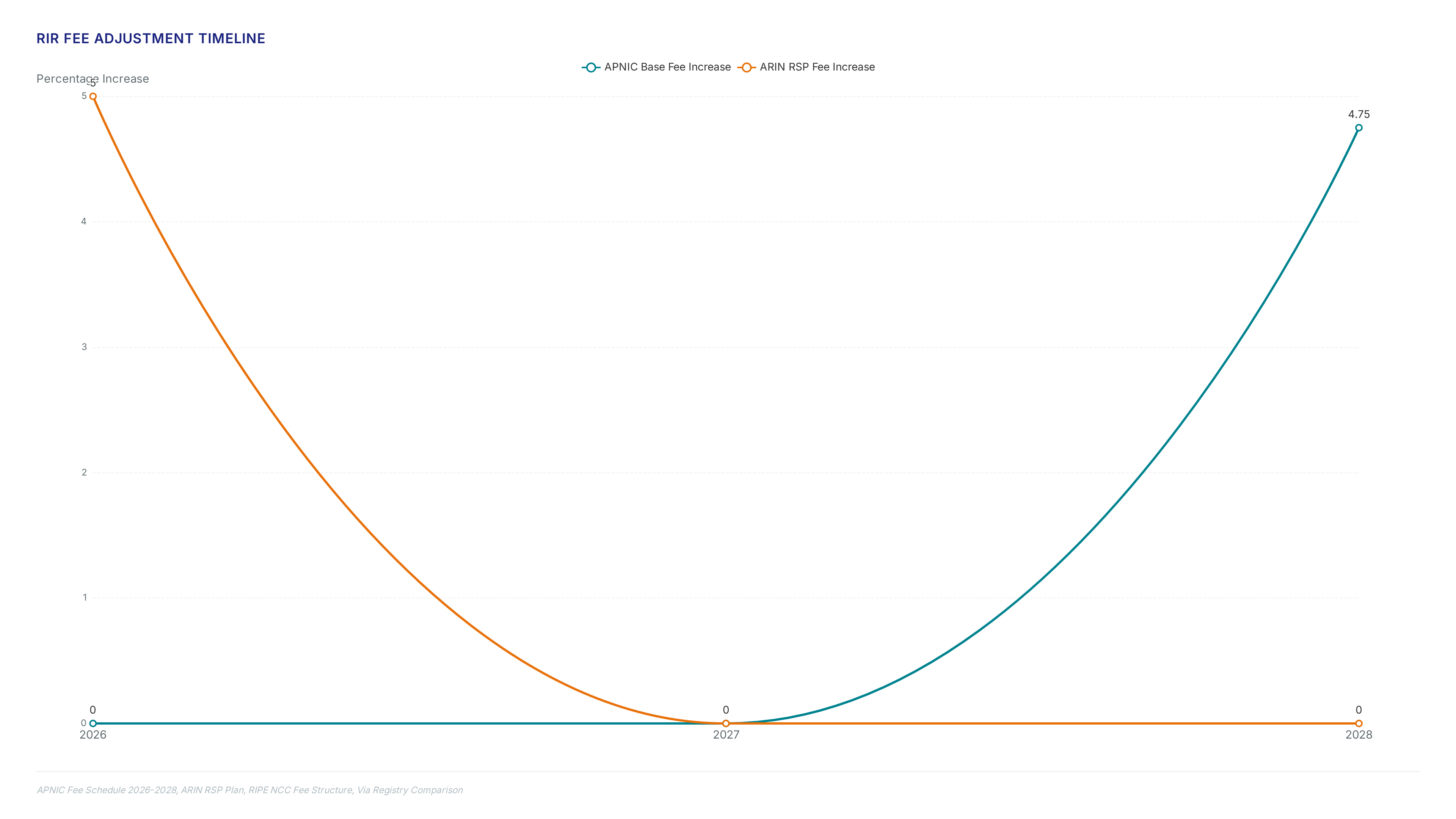
Operators generate ROA records through the MyAPNIC portal interface without paying transaction fees for signing routes. APNIC introduced a revised fee schedule effective 1 January 2026, yet the specific administrative act of creating route authorizations remains free for members. This distinction separates membership cost adjustments from the zero-cost security mechanism available to all account holders. Some Very Small tier members may even qualify for a 25% discount on their 2026 renewal fees, further offsetting operational expenses. Creating these cryptographic bindings is an administrative prerequisite distinct from the router configuration required for validation. Operators must publish records before enabling filtering policies to avoid self-inflicted traffic blackholing.
- Log into MyAPNIC and navigate to the RPKI management section.
- Select the specific IPv4 or IPv6 prefix intended for announcement.
- Define the maximum allowed prefix length to prevent more-specific hijacks.
- Enter the originating ASN that holds authority for the address block.
- Submit the form to generate the signed object in the global repository.
Publication alone does not enforce security because routers must independently fetch and apply these records. Delaying ROA creation leaves the network vulnerable to origin spoofing regardless of downstream filtering capabilities.
Deploying Validators on Cisco IOS-XR and Juniper JunOS
Border routers on Cisco IOS‑XR and Juniper JunOS require specific RTR session configurations to enforce ROV policies effectively.
- Deploy a local validator to fetch ROA records from global repositories.
- Establish an RTR session between the validator and the routing engine.
- Apply import policies that reject routes with an invalid state.
The following configuration snippet illustrates the session setup on a Cisco platform:
Operators managing multi-homed environments often apply the `bgp always-compare-med` command to ensure uniform path selection logic across different providers. This directive forces the router to compare the Multi-Exit Discriminator attribute even when paths originate from distinct Autonomous Systems, preventing suboptimal routing during validation transitions. NIST Special Publication 1800-14 outlines the architectural requirements for these deployments, emphasizing that filtering must occur before route installation in the forwarding table.
| Platform | Configuration Mode | Default RTR Port |
|---|---|---|
| Cisco IOS‑XR | `router bgp` context | 323 |
| Juniper JunOS | `routing-options` hierarchy | 323 |
| Nokia SR‑OS | `bgp` group settings | 323 |
Assuming validator connectivity guarantees immediate security gains without verifying policy application is a frequent oversight. Routers may successfully receive validity states yet continue to accept invalid announcements if the import policy remains in "observe" mode rather than "enforce. " This gap leaves networks exposed to the same trust-based exploits that facilitated the 2018 MyEtherWallet theft. The operational effort to enable ROV is minimal compared to the risk of unfiltered route leaks.
Verification Workflow Using APNIC Labs and RIPE Atlas
Validate visibility against APNIC Labs measurements before requesting a free RIPE Atlas probe to confirm local filtering behavior. Operators execute this verification through a strict four-step sequence to guarantee readiness for the PITA 31 checkpoint.
- Query the global dashboard to identify unsigned prefixes within the autonomous system number range.
- Generate ROA records via MyAPNIC, a process that typically consumes thirty minutes for small island networks.
- Deploy a local validator and configure border routers to reject invalid announcements, a task achievable within one.
- Register with MANRS to signal compliance while using updated training labs for IPv6 security refinement.
Signing routes remains free for members despite recent fee increases. The cost is operational discipline rather than capital expenditure, contrasting with the substantial investment often required for new infrastructure launches. A hidden tension exists between rapid deployment and thorough testing because skipping the probe phase leaves blind spots in path validation. Full protection demands both cryptographic signing and active filtering, as either half alone fails to stop forged announcements.
Measurable Security Gains from Regional RPKI Adoption
IEISI Audit Scope: 116 Pacific ASNs and Vulnerability Metrics

April 2026 data from the IEISI-ORG audit reveals 49 vulnerable Autonomous System Numbers out of 116 Pacific routable ASNs. Fully exposed networks accept invalid announcements from any peer without question. Protected only along certain paths implies reliance on upstream filters rather than local ROV enforcement. Upstream filtering leaves traffic susceptible to leaks if the provider changes peering policy or experiences a configuration error. Operators asking should I implement ROV must recognize that partial protection fails during regional cable cuts when traffic shifts to unvalidated alternate paths. Global trends show rising demand for Border Gateway Protocol solutions as enterprises seek to mitigate these exact trust-based exploits. Updated training labs Without local validation, a network remains dependent on the security posture of its neighbors, creating a single point of failure for national connectivity. True security requires shifting from passive trust to active cryptographic verification of every AS path entering the border router.
Using APNIC Labs Scores and Technical Assistance for ROV Deployment
APNIC Labs reports a single 0 to 100% score to quantify ROA coverage and ROV. This metric, developed by Geoff Huston, exposes networks that publish signed routes but fail to discard invalid announcements locally. A high score requires both cryptographic authorization and active router enforcement, not upstream reliance. Operators seeking hands-on support can contact [email protected] for free technical assistance tailored to Pacific infrastructure constraints. Deployment teams often mistake partial implementation for full protection, leaving Autonomous System Numbers vulnerable during path shifts. Networks scoring below a significant threshold typically lack local validator sessions, relying instead on inconsistent upstream filtering. Moving from tentative assurance to verified security demands configuring routers to explicitly drop invalid paths based on RPKI states. This shift transforms routing hygiene from an abstract concept into a measurable, binary state observable by global peers. Failure to close this gap leaves the 49 vulnerable Pacific networks exposed to the same trust-based exploits seen in historical financial thefts. Executives must prioritize set ownership of routing security initiatives to achieve the mature implementation patterns observed in regional leaders.
Upstream filtering leaves 49 Pacific ASNs exposed to path manipulation despite perceived safety. Relying on external peers creates a single point of failure where policy changes instantly disable protection. Local ROV enforcement eliminates this dependency by validating announcements at the network edge.
| Protection Mode | Failure Trigger | Recovery Time |
|---|---|---|
| Upstream Only | Peer misconfiguration | Hours to days |
| Local ROV | None (auto-reject) | Immediate |
Continuous advancements in BGP monitoring Without local checks, a provider accident propagates invalid routes directly into the core infrastructure. This fragility contradicts the capital requirements for launching telecommunications infrastructure, where a $338 million working capital bufferhttps://financialmodelslab.com/blogs/operating-costs/telecommunications-infrastructure implies a need for resilient architecture. PITA 31 serves as the deadline to shift from trust-based models to cryptographic verification. InterLIR recommends deploying validators immediately to align with global security standards. Operators ignoring this transition risk financial fraud similar to historical incidents involving DNS redirection. The cost of inaction exceeds the operational effort required to configure local rejection policies.
About
Alexei Krylov, Head of Sales at InterLIR, brings critical industry perspective to the discussion on RPKI and routing security. While the recent PITA 30 forum highlighted urgent deadlines for Pacific operators, Krylov's daily work managing IPv4 address transactions requires deep familiarity with BGP integrity and RIR policies. At InterLIR, a Berlin-based marketplace specializing in IP resource redistribution, ensuring clean route objects and valid IP reputation is fundamental to their mission of secure network availability. His expertise in navigating Regional Internet Registries allows him to connect high-level security mandates, like those presented by APNIC, to practical implementation for businesses acquiring IP assets. By bridging the gap between regulatory compliance and commercial IP leasing, Krylov demonstrates why reliable routing security is necessary for maintaining trust in the global telecommunications infrastructure that InterLIR supports.
Conclusion
Scaling RPKI adoption reveals that manual ROA management becomes the primary bottleneck once an operator manages more than fifty prefixes. The operational burden shifts from initial configuration to the continuous synchronization of validator software with global trust anchors, a process that frequently stalls without automated CI/CD pipelines integrated into network operations. Relying on upstream filtering creates a fragile dependency chain where a single peer's policy error compromises your entire edge, regardless of your internal hygiene. You must transition to local Route Origin Verification within the next six months to decouple your security posture from external volatility. Waiting for industry-wide consensus before acting leaves your specific ASN exposed to hijacks that cryptographic signatures could have instantly rejected. Start by auditing your current router firmware support for RPKI state handling against your vendor's latest release notes before Friday. If your current hardware cannot process validation states locally, submit a capital expenditure request for edge upgrades immediately rather than attempting software workarounds that introduce latency. This specific inventory check provides the data needed to build a realistic migration timeline, ensuring your network rejects invalid paths autonomously rather than hoping upstream peers filter them correctly.
Frequently Asked Questions
Publishing certificates without active validation leaves routers accepting forged claims. This partial implementation creates a false sense of security while leaving the control plane fully exposed to hijacks and accidental national outages.
Misconfigured certificates cause legitimate traffic loss, forcing teams to maintain rapid rollback procedures. Enabling filters without local ROAs causes routers to reject valid self-originated routes if upstream data lags significantly.
Signing routes usually takes around half an hour for a typical Pacific Island operator. Creating ROAs through MyAPNIC is free for APNIC Members and requires only a small number of prefixes.
With 66% of telecom organizations now utilizing AI, manual routing management is an unsustainable vulnerability. Automated orchestration requires abandoning half-measures to secure the region's digital future against forgery.
Networks scoring below 65% typically lack local validator sessions on their border routers. Complete coverage requires synchronizing validator caches with every router in the forwarding plane to ensure filtering decisions reflect current state.