Routing control stays yours during DDoS outages
Attacks hit 31.4 Tbps. Retaining customer-controlled BGP is the only way to guarantee traffic authority during provider outages. (Cloudflare's ddos threat report 2025 q4)
Resilient network architectures must strictly separate attack mitigation functions from routing policy decisions. Cloud services offer the elastic capacity needed to absorb massive volumetric strikes, but conflating security enforcement with path selection creates dangerous dependencies. When a protection vendor originates your prefixes and manages return paths, their internal control plane failure instantly becomes your total blackout. You cannot reroute traffic if you do not hold the keys to the routing table.
Treating DDoS defense and traffic steering as identical problems is a fatal architectural error. We must distinguish between letting a vendor scrub packets and letting them dictate where those packets travel. Independent BGP announcements enable organizations to steer traffic away from broken providers without waiting for external support tickets. Decoupling protection services from core routing logic ensures that a vendor's multi-hour outage remains a manageable routing event rather than a business-stopping catastrophe. The goal is not to abandon cloud mitigation, but to ensure it operates under your command, not instead of.
The Critical Distinction Between DDoS Mitigation and Traffic Control Authority
Defining Customer-Controlled DDoS Protection via BGP Separation
Customer-controlled DDoS protection separates attack scrubbing from routing authority to eliminate single points of failure. Volumetric threats have escalated from 1–2 Tbps in 2020 to exceeding 20 Tbps in 2025, while Cloudflare mitigated a record 31.4 Tbps attack in late 2025. Resilient architectures deploy cloud-based DDoS protection at the network edge to filter malicious packets before they reach customer infrastructure. The Border Gateway Protocol serves as the Internet's routing protocol to enforce this separation, determining exactly how traffic directs between autonomous systems. Providers absorb volumetric floods, yet customers retain final say over path selection during incidents.
| Function | Authority Holder | Failure Impact |
|---|---|---|
| Attack Mitigation | DDoS Provider | Scrubbing capacity loss |
| Traffic Routing | Customer Network | Total connectivity blackout |
Conflating these roles creates dependency where provider outages block customer recovery actions. Most organizations adopt cloud-based mitigation services for elastic capacity but neglect to decouple the control plane. The limitation is clear: if a provider originates customer prefixes, routing changes require vendor intervention during an outage. Retaining routing authority ensures outages remain manageable routing events rather than total service blackouts.
Implementing Resilient Architecture with Cloudflare and Akamai Providers
Traffic control authority remains with the customer network while DDoS providers absorb volumetric floods to prevent single points of failure. Static path routing creates dependency, forcing organizations to wait for provider recovery during multi-hour outages despite Cloudflare blocking tens of millions of network-layer attacks in 2025. Separating functions allows operators to shift prefixes via BGP when mitigation planes stall, turning service failures into manageable routing events. Prolexic distinguishes its approach with a zero-second SLA for stopping known vectors, yet this speed matters little if the customer cannot withdraw traffic. The cost of integrated control is measurable: loss of egress options during orchestration failures traps legitimate flow behind broken scrubbing centers.
| Function | Controller | Risk if Integrated |
|---|---|---|
| Attack Mitigation | Provider | Single point of failure |
| Routing Policy | Customer | Loss of egress control |
| Prefix Origination | Customer | Dependency on vendor API |
Fastly offers one-switch activation for existing users, reducing activation time but not solving the underlying architectural coupling. Operators must verify that their DDoS vendor does not originate customer prefixes by default. Retaining BGP ownership ensures that mitigation becomes a replaceable component rather than a critical bottleneck.
Static path routing in cloud security creates a hard dependency where provider orchestration failures block customer traffic recovery. These incidents appear to be increasing in frequency, paralleling a massive surge in attack volume that strains shared control planes. Organizations increasingly prefer elastic capacity to absorb large volumetric attacks, shifting away from on-premise hardware dependency as cloud adoption accelerates. However, this shift introduces risk when mitigation and routing authority conflate within a single vendor domain. Prolexic distinguishes itself with a zero-second SLA for stopping known vectors, yet speed matters little if the provider cannot accept route updates during an internal outage. Cloud-based services are witnessing the fastest adoption rates Imperva guarantees a mitigation start time of 3 seconds, a metric that becomes irrelevant if the control plane stalls. The cost of this architecture is measurable: recovery depends entirely on provider-side changes when the customer lacks independent BGP authority. Network teams lose the ability to reroute traffic independently, turning a localized fault into a total availability blackout. Separating traffic control from attack mitigation ensures that routing decisions remain executable even when scrubbing centers experience multi-hour disruptions.
BGP as the Final Decision Layer for Traffic Steering
BGP serves as the Internet's routing protocol. This mechanism prevents a single vendor failure from collapsing total network availability. Operators originate prefixes independently, ensuring the customer network retains final say over the AS path during incidents. Cloud providers often absorb floods, yet static path configurations trap traffic if the provider control plane stalls. Decoupling these functions turns a service outage into a manageable routing event.
The financial impact of bundled services varies significantly across the market. Some vendors like AppTrana avoid burstable traffic costs by charging flat fees for unmetered protection. This contrasts with models where attack volume drives unpredictable billing spikes. A10 Networks tracks approximately millions of DDoS weapons globally, creating a environment where botnet scale can overwhelm any single mitigation engine. Retaining independent routing authority allows operators to switch providers instantly when primary defenses saturate.
| Architecture Model | Routing Authority | Failure Consequence |
|---|---|---|
| Conflated Platform | DDoS Provider | Total traffic blackout during vendor outage |
| Separated Design | Customer Network | Redirected traffic flows via alternate peers |
However, implementing this separation requires precise BGP policy configuration that many teams neglect during initial onboarding. The limitation lies in the operational complexity of managing multiple peer sessions versus a single static route. Control of routing dictates control of availability.
Rerouting Traffic During DDoS Provider Outages Using Customer Prefixes
Short-burst attacks lasting 2 to 3 minutes now dominate, specifically designed to complete before manual response teams intervene. Customer-owned BGP session activation allows immediate prefix withdrawal from a failing DDoS provider to restore flow. Operators must originate their own prefixes rather than relying on provider-originated static paths that lock traffic during control-plane stalls. This separation turns a total service blackout into a manageable routing event where the customer network retains authority.
Automated defenses counter rapid strikes when providers cannot act fast enough. Some vendors like Fastly offer one-switch activation models that align with this need for instant customer control. Billing structures also influence durability decisions, as AppTrana The limitation remains that many organizations still treat mitigation and routing as a single problem, creating hidden dependencies.
| Failure Mode | Static Path Dependency | Customer BGP Control |
|---|---|---|
| Provider Outage | Total traffic loss | Instant prefix withdrawal |
| Recovery Time | Provider-dependent delay | Immediate operator action |
| Blast Radius | Global service impact | Isolated routing event |
The cost of conflated control is measurable in lost availability during the brief window before provider automation triggers. Without independent steering capability, even sub-three-second mitigation guarantees fail if the provider control plane itself collapses. True durability requires designing systems where customers control the outcome when inevitable failures occur.
Mechanics: Avoiding Single Points of Failure in Conflated Security Platforms
Static path routing locks traffic behind a single vendor control plane, creating a hard dependency that stalls recovery during provider outages. Cloud-based architectures typically filter malicious traffic at the edge of the network Conflating mitigation with origination forces operators to wait for external remediation when the DDoS provider experiences a global control-plane failure. No provider is immune to these disruptions, as hyperscalers and security platforms all operate complex, distributed systems susceptible to cascading errors.
Billing models further complicate durability planning for teams managing budget constraints alongside availability SLAs. Some vendors like AppTrana Fastly provides one-switch activation. The critical limitation lies in assuming mitigation speed equals availability; a three-second scrub start time means nothing if the route to the scrubber vanishes. True durability requires treating routing authority as a separate asset from filtering capacity, ensuring traffic steering survives even when the mitigation service stalls.
Architectural Strategies for Separating Protection Services from Routing Policy
Application: Defining the Separation of DDoS Protection and Routing Authority
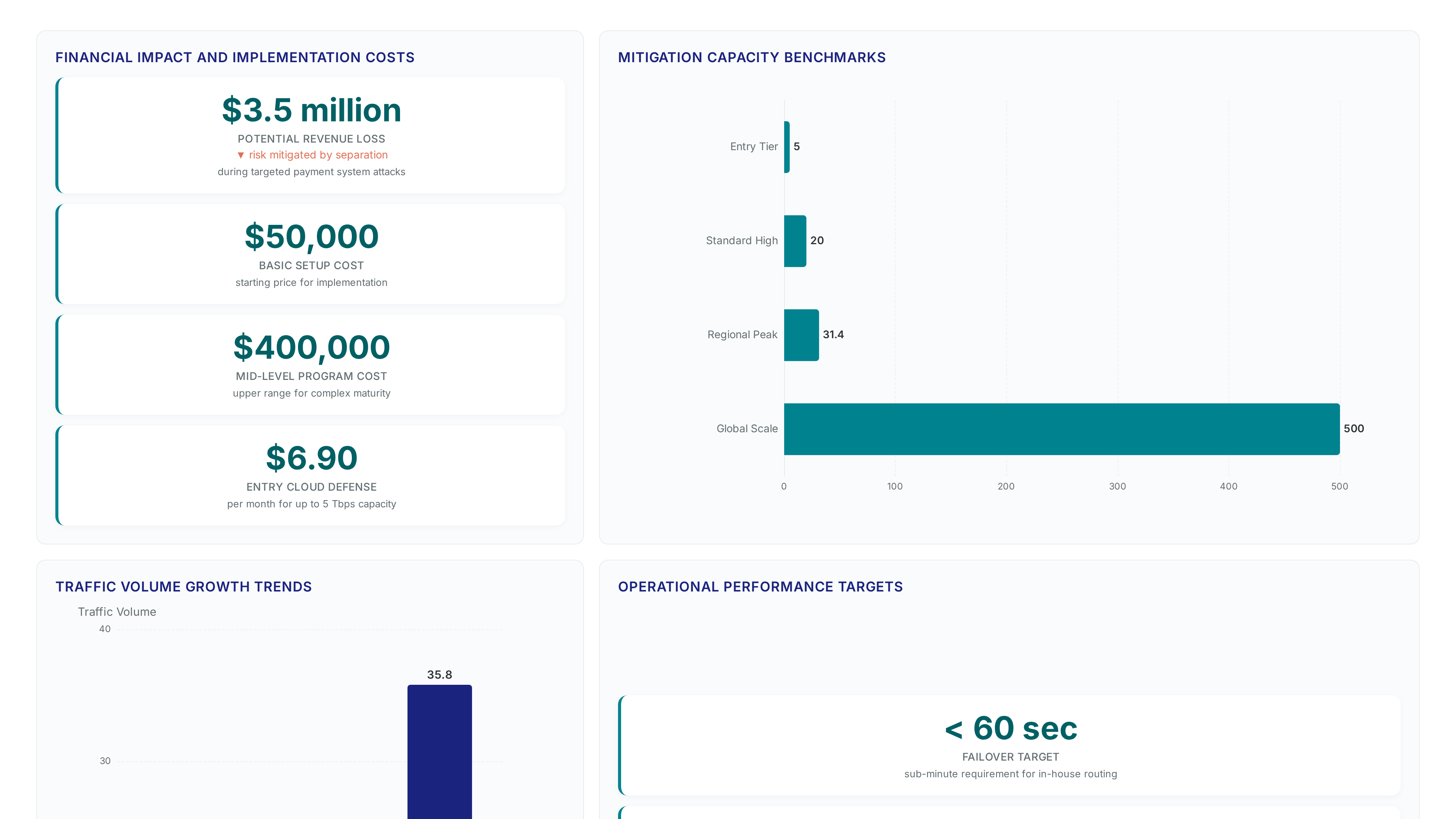
BGP functions as the Internet's routing protocol. This architectural model mandates that DDoS protection remains a cloud-delivered utility while routing authority stays customer-owned. Operators retain the AS path control necessary to steer traffic away from failed mitigation nodes instantly. Relying on a single vendor for both scrubbing and origination creates a hard dependency that stalls recovery during global control-plane failures. The financial stakes of such conflation are severe, with potential revenue losses reaching $3.5 million during targeted payment system attacks.
Alternative pricing models highlight the economic variance in protection strategies. New technical capabilities also emerge, such as Radware launching encrypted traffic blocking without requiring SSL certificate sharing. These options allow operators to diversify their defense stack without surrendering path control.
The critical limitation of separated architectures lies in the coordination overhead required between security and network teams. Misaligned policies can cause route flapping if the mitigation provider withdraws prefixes while the customer attempts to reroute. True durability emerges only when the customer network holds the final decision layer for traffic steering.
Executing Architectural Reviews to Validate Prefix Origination Control
Architectural reviews begin by asking which entity originates prefixes today, as provider-originated routes create hard dependencies during outages. Operators must verify if they can reroute traffic independently when a mitigation vendor stalls, a capability often missing in bundled cloud-based mitigation services Dependency mapping reveals whether mitigation availability dictates network availability, a flaw that turns local incidents into global blackouts.
Teams evaluating separation strategies face a tension between operational simplicity and durability autonomy.
- Who originates your prefixes today?
- How quickly can you reroute traffic if a provider is unavailable?
- What dependencies exist between mitigation availability and network availability?
- Does your BGP policy allow immediate prefix withdrawal without vendor approval?
The Border Gateway Protocol serves as the only mechanism to enforce this separation, ensuring routing authority remains customer-owned even when protection is cloud-delivered. Basic cybersecurity implementations typically cost $50,000 to $150,000, yet the expense of downtime far exceeds this investment when routing control is lost.
| Control Domain | Recommended Owner | Risk if Conflated |
|---|---|---|
| Attack Mitigation | DDoS Provider | Minimal if isolated |
| Traffic Routing | Customer Network | Total availability loss |
| Prefix Origination | Customer Network | Unable to reroute during outage |
A service provider environment using Radware DefensePro in AWS reported benefits from behavior-based detection, yet automated protection still requires independent routing triggers to function during vendor outages. This approach prevents the creation of new single points of failure while preserving cloud-scale mitigation benefits.
Short-burst attacks lasting 2 to 3 minutes exploit the gap between provider detection and customer rerouting authority. Conflating mitigation services with prefix origination creates a single point of failure where network uptime depends entirely on vendor control-plane health.
Implementation: Architectural Review Questions for Prefix Origination Control
Defining prefix origination authority starts by asking which entity currently advertises routes to the global table. Teams must audit whether their DDoS mitigation provider originates these prefixes or if the customer retains independent advertisement rights. Conflating scrubbing with origination creates a hard dependency where network availability hinges on vendor control-plane health. Operators often treat these distinct functions as a single service bundle, yet recovery during an outage requires separating them immediately.
- Identify the current owner of prefix origination rights.
- Measure the time required to reroute traffic if the primary provider fails.
- Map dependencies between mitigation uptime and overall network reachability.
The answers to these queries reveal structural risks that post-mortems frequently miss. Many organizations adopt cloud-oriented mitigation services. This trade-off leaves networks vulnerable when short-burst attacks outpace manual response teams.
Deploying such configurations ensures routing authority remains customer-owned while using external scrubbing. Failure to separate these planes turns a localized incident into a total blackout.
Designing Cloud-Delivered Protection with Customer-Owned Routing Authority
Operators must originate their own prefixes to retain traffic steering authority during provider outages.
- Verify prefix origination rights remain with the customer rather than the mitigation vendor.
- Configure BGP sessions to withdraw routes automatically upon detecting upstream control-plane failure.
- Deploy Kubernetes-native architecture to isolate detection logic from the routing decision layer.
- Test failover scenarios where the scrubbing center becomes unreachable while the customer network stays online.
Separating mitigation from routing prevents a single vendor failure from causing total blackout. Cloud providers like those offering 500 Tbps network capacity absorb volumetric strikes, yet the customer decides when to bypass them. Recent innovations enable blocking encrypted attacks without SSL certificate sharing, reducing dependency on vendor decryption keys. Relying on bundled services simplifies operations but creates a hard dependency where network availability hinges entirely on vendor control-plane health.
Short-burst attacks lasting 2 to 3 minutes now dominate threat vectors, specifically engineered to conclude before human operators can initiate manual rerouting. Manual response teams cannot intervene quickly enough, necessitating automated defense mechanisms that trigger immediately upon detection without human approval. This speed gap allows attackers to exhaust resources while security staff remain stuck in escalation chains.
Operators must implement three specific controls to counter this evasion technique:
- Deploy automated BGP withdrawal scripts that activate when upstream latency spikes beyond acceptable thresholds.
- Use behavior-based detection systems to identify zero-day patterns before volume thresholds are breached.
- Filter malicious traffic at the network edge using distributed cloud resources rather than waiting for on-premise analysis.
Relying solely on vendor automation creates a hidden dependency where routing control vanishes if the mitigation service stalls. Independent steering ensures traffic flows even when the primary scrubbing center fails. InterLIR recommends validating these automated failover paths quarterly to guarantee continuity during rapid strike windows.
About
Alexander Timokhin, CEO of InterLIR, brings critical expertise to the discussion on customer-controlled BGP and network durability. With a professional background spanning IT infrastructure and international business relations, Timokhin understands the vital importance of decoupling routing control from single points of failure. His daily leadership at InterLIR, a Berlin-based IPv4 marketplace, involves ensuring clean BGP announcements and secure IP reputation for global clients. This direct experience with network availability problems positions him uniquely to address the risks of centralized DDoS mitigation outages. As attack volumes surge past 20 Tbps, Timokhin's work facilitating transparent, independent IP resource redistribution directly supports the thesis that enterprises must retain autonomous routing authority. By championing security and efficiency in IP management, he highlights why separating address ownership from security vendors is necessary for maintaining uptime during increasingly severe volumetric attacks.
Conclusion
Scaling customer-controlled BGP reveals a critical fracture: automation latency becomes the new bottleneck as attack vectors shift from sheer volume to precision timing. While providers boast massive throughput capacity, the operational cost of maintaining independent routing logic often exceeds initial hardware investments when factoring in continuous script validation and third-party integration maintenance. The industry is moving toward a model where static mitigation contracts fail to protect against sub-five-minute bursts, forcing organizations to treat routing policies as flexible, living code rather than set-and-forget configurations.
Organizations handling transaction volumes exceeding $1 million daily must migrate to fully automated, vendor-agnostic BGP steering within the next six months. Relying on manual overrides or bundled provider tools creates an unacceptable exposure window during short-burst events. This transition requires decoupling detection logic from mitigation execution to ensure traffic flows even if the primary scrubbing center experiences control-plane stagnation.
Start by auditing your current BGP withdrawal scripts against a simulated 180-second latency spike before Friday's change window. Verify that your edge routers trigger failover without waiting for external API confirmation from your DDoS vendor. This specific test exposes whether your architecture truly owns its routing decisions or merely rents them during a crisis.
Frequently Asked Questions
You lose independent rerouting ability and must wait for vendor recovery. This dependency creates a single point of failure despite providers blocking 34.4 million network-layer attacks in 2025.
Threats escalated from 2 Tb in 2020 to exceeding 20 Tb by 2025. Cloudflare specifically mitigated a record 31.4 Tb attack in late 2025, proving elastic capacity needs.
No, one-switch activation reduces time but does not fix architectural coupling. Operators must verify vendors do not originate prefixes to avoid losing egress control during orchestration failures.
Conflating these roles means provider control plane failures become your total blackout. Retaining routing authority ensures outages remain manageable routing events rather than business-stopping catastrophes for your network.
No, speed matters little if you cannot withdraw traffic independently. A zero-second SLA stops known vectors but fails if the customer lacks BGP ownership to steer traffic elsewhere.