RPKI SOC 2: Why 55% of carriers now validate routes
62.5% of substantial carriers now validate routes. The RIPE NCC's new SOC 2 Type II report proves RPKI security is finally enterprise-grade. (Draft ripe ncc charging scheme 2026) This certification confirms that the Resource Public Key Infrastructure operates under rigorous, independently verified controls for data integrity and availability. We have moved past voluntary community adoption. Global routing now demands mandatory, auditable trust.
This analysis dissects how SOC 2 Type II assurance validates the specific control mechanisms protecting the RPKI architecture against manipulation. The scale is massive: millions of advertised IPv4 prefixes, a four-fold increase since 2011 according to RIPE NCC data. Network operators must leverage these certified routing standards to mitigate hijacking risks in a market where North America commands a 30–35% share of BGP traffic, per DataHorizzon Research.
Compliance is no longer a checkbox; it defines the survivability of interdomain routing. As the BGP route security sector hits a substantial valuation driven by escalating incidents, this trust framework offers the only viable path forward. Organizations ignoring these validated security controls become the weak link in an increasingly hostile routing system.
The Role of SOC 2 Type II Assurance in Validating RPKI Security
Defining SOC 2 Type II Assurance for RPKI Services
On 27 Jan 2026, the RIPE NCC announced its RPKI service obtained SOC 2 Type II assurance. This validates controls over an operational period, not just a snapshot. Unlike Type I reports, this certification verifies the effectiveness of security measures across time. Processing integrity within this framework ensures route origin data remains complete and accurate during system updates. Data confidentiality protects private key material associated with Internet Resource holdings from unauthorized access.
Efficiency matters here. The RIPE NCC hosted CA system averages 6.6 prefixes per ROA. Such density impacts how validators process path information compared to other regional registries. Operators must recognize a hard boundary: assurance covers the service platform, not the correctness of individual operator configurations. The system launched in 2011, evolving from basic certificate issuance to complex trust validation. Yet SOC 2 adherence does not prevent operators from publishing erroneous Route Origin Authorizations. Trust in the infrastructure increases, but the responsibility for accurate prefix announcement mapping stays with the network engineer.
Third-party validation resolves service compliance verification gaps by proving processing integrity across the extensive advertised IPv4 prefixes. The 2011 launch of the community-driven RPKI system established a foundation, yet scaling to current volumes introduced complex attack surfaces for data confidentiality in networking. SOC 2 Type II assurance certifies that controls protecting route origin data remained proven over time, not at a single audit point. This temporal verification matters because the RIPE NCC Validator 2.0 release on December 13, 2011, introduced architectural dependencies that require continuous monitoring to prevent silent corruption.
X.509 Certificate Chains and the RRDP Protocol in RPKI
RPKI trust flows from IANA to LIRs via a specialized Public Key Infrastructure using X. 509 certificates to sign route origins. This chain validates that only resource holders can authorize specific BGP announcements, creating a rigid hierarchy where parent CAs must sign child certificates. Silence is the failure mode. If any link in the certificate chain expires or remains unreachable during validator synchronization cycles, the mechanism fails without alerting the operator.
Data distribution has shifted from rsync to the RPKI Repository Delta Protocol (RRDP) set in RFC 8182, which uses HTTPS for efficient updates. CDNs cache these delta files to reduce latency, yet this architecture introduces a dependency on external web infrastructure not present in the original design. Operators relying solely on rsync face scaling limitations as the global table grows beyond current thresholds.
| Feature | rsync | RRDP |
|---|---|---|
| Transport | SSH | HTTPS |
| Update Method | Full/Mirror | Delta Only |
| CDN Support | No | Yes |
Validation outcomes now apply the Canonical Cache Representation (CCR) binary format introduced in 2026. This CCR Format records hash markers and validation states, allowing rpki-client version 9.8 to reconstruct cache status without re-validating the entire tree. The cost? Increased storage complexity for validators that must parse binary blobs instead of text-based lists.
Early 2026 data reveals the RIPE NCC hosted CA system yields 6.6 prefixes per Route Origin Authorization (ROA), drastically outperforming regional peers. ARIN averages only 1.1 (ARIN's fee schedule) prefixes per ROA while LACNIC reaches 1.3, creating distinct operational densities for network engineers managing bulk announcements. High prefix density reduces the total number of cryptographic objects validators must process, directly lowering CPU cycles during RPKI synchronization windows.
| Region | Prefixes per ROA | Cost Model Implication |
|---|---|---|
| RIPE NCC | 6.6 | Flat fee supports high density |
| LACNIC | 1.3 | Fragmented object management |
| ARIN | 1.1 | High overhead per prefix |
This efficiency stems from a flat annual membership fee of €1,800 per Local Internet Registry (LIR) account for 2026, removing financial penalties for aggregating resources under single Route Origin Authorizations. Operators in size-based fee regions often split announcements to minimize costs, inadvertently inflating the global RPKI database size. Consolidating prefixes improves validation speed but requires precise prefix planning to avoid accidental over-authorization. The goal is a 6.6 prefix average, ensuring processing integrity without unnecessary object proliferation.
Applying Certified Routing Security Standards to Build Network Trust
Accessing the RIPE NCC SOC 2 Type II Assurance Report
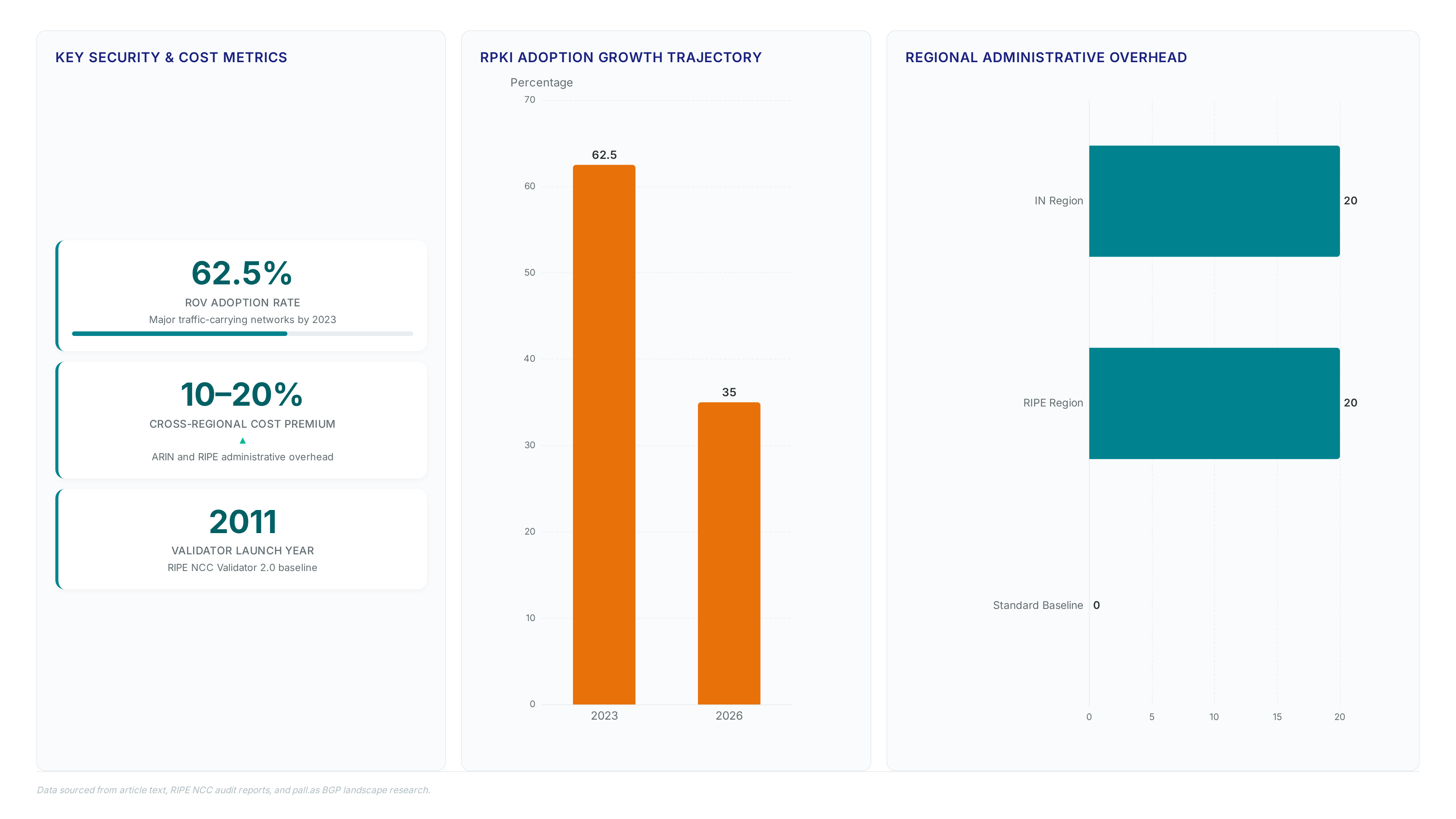
You cannot simply download the SOC 2 Type II report. Interested parties must register via the announcement link. This gated access model prevents unauthorized distribution of sensitive control descriptions while allowing verified stakeholders to review data integrity proofs. Organizations managing assets across multiple jurisdictions face distinct operational friction during this request process. Entities operating in both ARIN and RIPE regions typically budget 10–a notable share higher total costs due to administrative overhead required for cross-regional compliance validation.
Regional policy divergence complicates resource transfers. Moving records often requires deleting all ROAs and waiting for propagation to avoid connectivity loss per network operator reports.
The official release of RIPE NCC Validator 2.0 on December 13, 2011, established the baseline architecture for modern routing security workflows. Operators aligning with certified standards must deploy redundant validator instances to satisfy processing integrity requirements verified by recent audits. Migration from legacy Java implementations to Rust-based alternatives like the NLnet Routinator reduces memory footprint while maintaining synchronization fidelity with the global repository. This architectural shift supports the availability controls mandated for SOC 2 Type II compliance in production environments.
InterLIR recommends implementing the following configuration steps to achieve alignment:
- Deploy two geographically separated validator nodes to eliminate single points of failure.
- Configure local routers to fetch ROA payloads exclusively from these internal trusted sources.
- Enable strict rejection policies for any BGP announcement marked as RPKI-invalid.
- Audit certificate chain validity weekly to prevent silent expiration of X. 509 trust anchors.
Adoption timing depends on regional peering policies; networks accepting traffic from Sparkle or Bell Canada face immediate enforcement pressure. Failure to align risks route rejection at upstream handoffs where data confidentiality and origin authenticity are now prerequisites for transit acceptance.
About
Nikita Sinitsyn, Customer Service Specialist at InterLIR, brings eight years of telecommunications expertise to the critical discussion of RPKI security. His daily work managing RIPE database operations and ensuring clean BGP route objects directly aligns with the technical integrity verified by the recent SOC 2 Type II assurance report. At InterLIR, a Berlin-based IPv4 marketplace dedicated to secure resource redistribution, Nikita handles the practical implementation of routing security that RPKI services aim to standardize. This certification confirms that the infrastructure supporting global IP routing meets rigorous standards for availability and processing integrity, which are necessary for Nikita's role in maintaining trusted network resources. By bridging frontline customer support with high-level compliance frameworks, he illustrates how verified security protocols protect the IPv4 market from hijacking and fraud. His experience ensures that InterLIR clients benefit from both regulatory adherence and reliable technical safeguards in an evolving digital environment.
Conclusion
High prefix density per ROA drives efficiency but creates a fragile dependency on single points of failure within the certificate chain. As North American operators manage 30–35% of the global BGP market, the administrative overhead of maintaining granular ROAs grows linearly, often eroding the initial operational savings gained from aggregation. Legacy Java validators struggle to synchronize rapidly changing tables against Rust-based alternatives, introducing latency that undermines real-time rejection policies. You must transition to distributed, language-native validation architectures immediately to prevent routing table instability during peak convergence events.
Commit to migrating all production validator instances to Rust-based solutions like Routinator by Q3 2026, specifically if your autonomous system accepts transit from substantial cloud providers. This timeline aligns with the projected saturation of IPv4 prefix advertisements and ensures your infrastructure handles the increased verification load without degradation. Start by auditing your current validator's memory footprint and synchronization lag against a parallel Routinator instance this week. Configure this secondary node in a distinct geographic region and measure the delta in payload delivery times before decommissioning legacy Java dependencies. This concrete baseline data will dictate your hardware provisioning needs for the upcoming fiscal year.
Frequently Asked Questions
No, the assurance validates service controls but not individual operator configuration accuracy. Trust in the infrastructure increases while 62.5% of major carriers now validate routes using these verified security frameworks globally.
Higher density impacts how validators process path information compared to other regional registries globally. The system currently manages integrity across the 1.2 million advertised IPv4 prefixes with varying efficiency metrics per region.
Certification does not prevent operators from publishing erroneous Route Origin Authorizations within the global routing system. The 1.42 billion dollar market growth drives adoption, yet accurate prefix announcement mapping stays strictly with the network engineer.
Temporal verification proves controls remained effective over time rather than at a single audit point. This ensures processing integrity across the 1.2 million advertised IPv4 prefixes against silent corruption or undetected configuration drift risks.
It shifts reliance from vendor claims to independently verified controls protecting private key material. With 62.5% of major carriers validating routes, this framework mitigates insider threats and establishes mandatory auditable trust globally.