RPKI validation cuts breach risk for networks
With only 40% of networks holding valid ROAs, global routing remains dangerously exposed to hijacks despite decades of warnings. The industry's reliance on the legacy Internet Routing Registry has created a false sense of security that cryptographic validation must urgently replace. We need to move from the error-prone IRR architecture to the mathematically rigorous Route Origin Authorizations that bind prefixes to specific ASNs. Practical deployment strategies using MyAPNIC and APNIC DASH turn complex telemetry into actionable filtering policies. (APNIC's reflecting on the routing security panel at apric...)
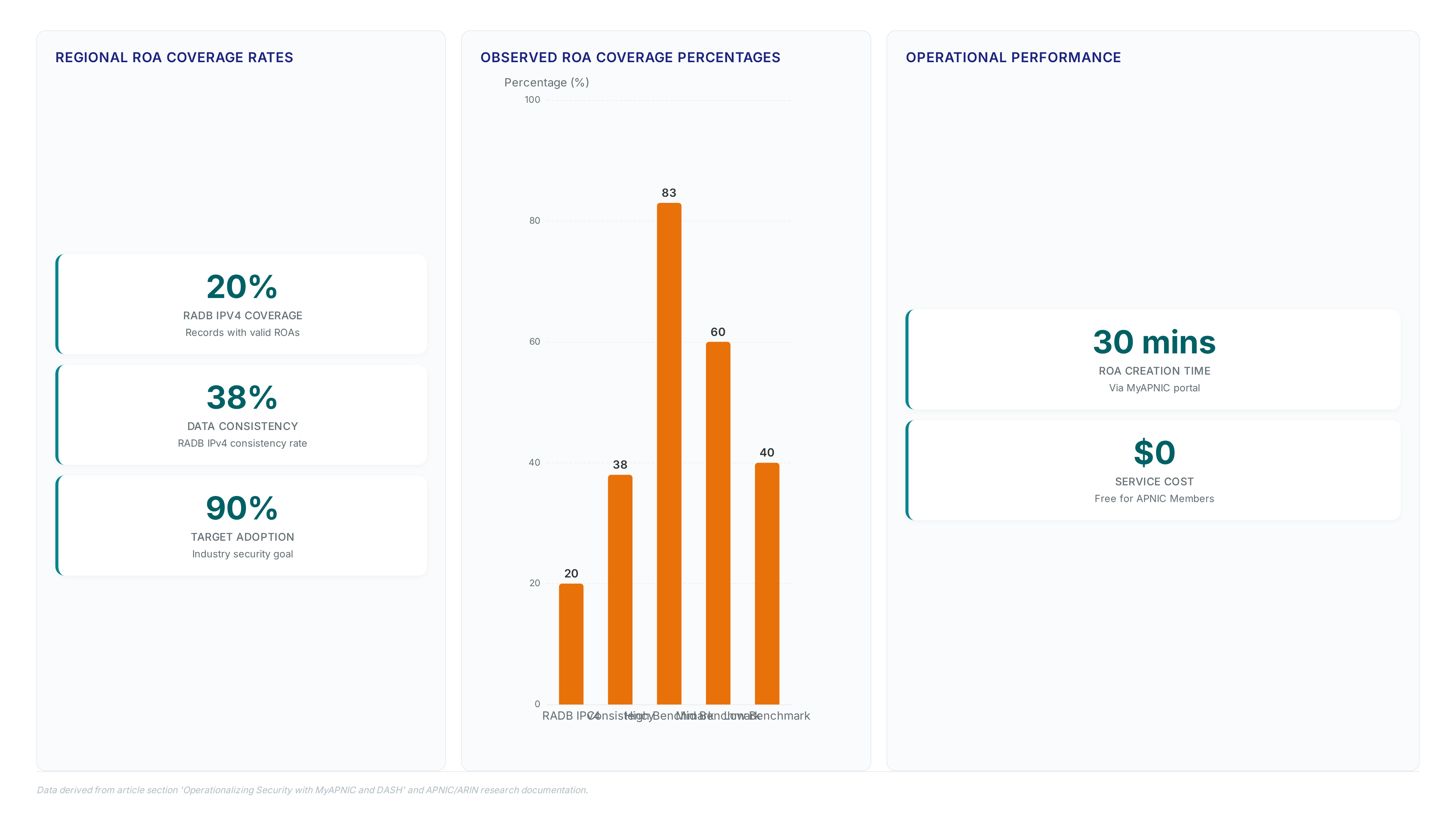
Current Cloudflare data shows that one in five users sits behind a network discarding invalid routes, leaving the vast majority unprotected against basic spoofing. (Cloudflare's rpki details) APNIC reports confirm that while 83% of Autonomous Systems document intentions in the IRR, this manual approach fails to stop malicious announcements in real-time. Until operators adopt these cryptographic tools at scale, the Internet's core stability relies on hope rather than verification.
The Evolution from IRR to Cryptographic Route Validation
RPKI Route Origin Authorizations and Cryptographic Binding
RPKI Route Origin Authorizations (ROAs) are signed objects binding prefixes to origin Autonomous System Numbers (ASNs) to eliminate manual drift. This framework addresses the inherent volatility of the legacy Internet Routing Registry (IRR) which relies on voluntary, unauthenticated data entry prone to errors. Stakeholders agreed upon the RPKI framework in 2012, establishing a hierarchical public key infrastructure where RIRs act as Trust Anchors (TAs) issuing certificates to members.
Real-time RTR sessions introduce a single point of failure if the cache connection drops. Hurricane Electric mitigates this risk by generating daily filter files as a primary defense layer rather than trusting live RTR streams alone. This hybrid approach ensures continuity when the RTR protocol session fluctuates, though it sacrifices immediate reaction to fresh ROA updates. Operators transitioning from IRR must accept that RPKI coverage has expanded notably yet remains incomplete for many legacy prefixes. Strict ROV rejection policies carry a measurable cost in lost reachability if ROAs contain errors.
| Validation State | Action Required | Risk Profile |
|---|---|---|
| Valid | Accept | Low |
| Invalid | Drop | High |
| Not Found | Accept | Medium |
IRR Manual Upkeep Versus RPKI Cryptographic Validation
Voluntary entries in the 1990s lacked strict validation, so manual IRR upkeep cannot match the cryptographic certainty of RPKI. Operators relying on legacy AS-SETs face significant risks when data drifts out of date due to human error. By October 2021, analysis revealed ROAs for only around 20% of RADB IRR records, exposing a massive consistency gap. The complexity of RPSL language often prevents accurate transcription into router configurations, leading to stale filters that permit unauthorized announcements.
| Feature | Internet Routing Registry | RPKI Validation |
|---|---|---|
| Data Source | Voluntary, unauthenticated | Cryptographically signed |
| Update Mechanism | Manual entry | Automated rpki-rtr |
| Validation Logic | Text matching | Signature verification |
| Error Rate | High (drift common) | Low (mathematical proof) |
Moving from IRR to RPKI eliminates the burden of maintaining static prefix lists while providing immediate rejection of invalid paths. RPKI validates origin only, leaving the AS path vulnerable to leaks without ASPA extensions. Networks ignoring this shift retain a fragile defense model where a single typo in a database object can hijack traffic globally. Delayed migration results in increased exposure to mis-originated prefixes that manual processes miss. Treat IRR as institutional memory rather than an active security control.
Mechanics of Origin and Path Validation Protocols
ASPA Objects and Valley-Free Path Logic
ASPA objects declare authorized upstream providers to detect path anomalies like route leaks. These signed records enable routers to verify whether an AS path follows valid business relationships rather than accepting any sequence. The mechanism identifies valleys where traffic flows from a provider to a customer and back up to another provider, signaling unintentional errors or attacks. This logic extends RPKI beyond origin validation to verify the authorized path of ASes, preventing leaks that ROAs alone cannot stop.
Hhttps://blog.apnic.net/2025/04/03/reflecting-on-the-routing-security-panel-at-apricot-2025/
Operators must publish these lists to the RIR, yet APNIC plans to deploy support for ASPA objects by the end of Q2 2025. The coordinated roadmap targets full support in 2025 to mitigate route leaks alongside origin hijacks. Validation fails if an operator omits an upstream provider from their signed object, causing legitimate traffic to be rejected as invalid. This strictness forces networks to maintain precise relationship records rather than relying on implicit trust.
ROA Origin Validation Versus ASPA Path Verification
ROA objects bind prefixes to origin ASNs, whereas ASPA records validate the legitimacy of the entire AS path sequence. Checking the source of an announcement ignores intermediate hops where leaks occur. ASPA extends this scope to verify the authorized path of ASes, specifically flagging valley-free violations that indicate policy breaches. The mechanism requires networks to declare upstream providers, enabling detection of anomalies that origin-only checks miss entirely.
Hhttps://blog.apnic.net/2025/04/03/reflecting-on-the-routing-security-panel-at-apricot-2025/
Industry consensus now identifies RPKI with ROV as the current best practice relegating legacy databases to secondary roles. ASPA adoption demands coordinated RIR publication, creating a deployment lag where path validation remains incomplete despite high origin coverage. Operators implementing ASPA must accept that partial rollout yields limited protection until a critical mass of peers publishes provider lists. Routers rejecting paths based on incomplete ASPA data may drop legitimate traffic during the transition phase. This dual-layer approach mitigates hijack risks today without introducing false positives before the system matures.
RFC 9319 explicitly advises against using the maxLength field except for specific multi-origin scenarios to avoid accidental validation failures. A single ROA structure permits multiple prefixes but restricts the object to one origin ASN, forcing careful design when splitting address space. Consider a scenario where a /23 prefix originates from one ASN while a more specific /24 announcement comes from a different peer. Creating a second, overlapping ROA object for the /24 is the required fix rather than inflating the maxLength on the parent block. This approach prevents the router from accepting unauthorized sub-prefixes that could indicate a hijack attempt.
Publishing overlapping ROAs allows operators to announce from a new ASN before removing the legacy authorization during prefix migrations. This temporary state ensures continuous connectivity while the rpki-rtr protocol propagates changes to downstream filters. Increased configuration complexity is the price of this precision compared to a single blanket maxLength entry. Operators must track these overlapping states manually to prevent stale objects from persisting after cutover completes. Failure to remove the old ROA creates a permanent conflict that breaks valid route announcements.
Operationalizing Security with MyAPNIC and DASH
MyAPNIC Portal Functions for ROA Creation
MyAPNIC allows APNIC Members to generate ROAs without mastering esoteric syntax or deploying external tooling. This interface guides users step-by-step to maintain accurate routing data, effectively lowering the barrier for cryptographic signing. Creating these objects through the portal remains completely free for all members, removing financial friction from security adoption. Operational efficiency gains are measurable. Typical Pacific Island operators with small prefix counts complete the signing process in approximately 30 minutes. Such speed demonstrates that low resource overhead does not preclude strong security postures. The platform supports both hosted and self-hosted RPKI deployment options, providing validator services at no additional cost beyond standard membership fees. Operators manage IRR objects and align Internet number resource data within a single consolidated view. This centralization reduces the risk of configuration drift common in manual workflows. Scope presents a constraint; the portal simplifies origin validation but does not yet automate ASPA object creation for path verification. Operators must still manually declare upstream providers to fully mitigate route leaks. This gap requires vigilant monitoring until full ASPA support integrates into the workflow.
Executing ROA Signing and DASH Health Monitoring
Small networks typically complete ROA creation in MyAPNIC within 30 minutes, proving that cryptographic signing imposes minimal operational latency. The portal guides users through prefix-to-ASN binding without requiring esoteric syntax, and the entire process remains free. This low time-cost barrier allows even resource-constrained Pacific Island operators to achieve compliance rapidly. Speed risks encouraging hasty maxLength configurations if RFC 9319 guidance is ignored. Operators must treat the interface as a precision instrument rather than a bulk loader to avoid accidental over-authorization. DASH consolidates routing status, BGP misalignments, and bogon propagation into a single pane, replacing fragmented manual checks with automated visibility. The dashboard triggers immediate alerts via Email, Slack, or webhooks when a prefix originates from an unauthorized ASN, turning reactive troubleshooting into proactive mitigation. Unlike passive logging tools, DASH correlates RPKI validity states with live traffic anomalies detected by the Honeynet project to flag suspicious activity. Reliance on public data sources means local peering disputes invisible to global scanners may escape detection until they escalate. Value emerges not in the alert itself but in the reduced mean-time-to-acknowledge for routing incidents.
Validating Routing Status and BGP Misalignments
DASH displays routing status, BGP/RPKI misalignments, and Honeynet-flagged suspicious traffic within a single consolidated view. Operators configure alert thresholds to trigger notifications via Email, SMS, or Slack when prefixes originate from unexpected ASNs. This immediate feedback loop transforms passive monitoring into active defense, allowing teams to react before leaks propagate globally. The dashboard identifies specific configuration errors where announced paths diverge from signed authorizations, highlighting gaps in cryptographic coverage. Industry consensus now identifies RPKI with Route Origin Validation as the current best practice for filtering, relegating legacy IRR data to a supplementary role. Unlike manual registries, RPKI prevents attackers from registering false records by requiring legitimate resource holders to sign authorizations. Tension exists between rapid alerting and noise. Overly sensitive thresholds generate fatigue, while loose settings miss subtle hijacks. Blind reliance on automated flags without context leads to unnecessary routing changes that destabilize adjacent networks.
Executing Prefix Migrations and Validation Workflows
Overlapping ROA Strategy for Prefix Migration Windows

Publish simultaneous ROAs for legacy and incoming ASNs to maintain cryptographic continuity during prefix migrations. This approach prevents validation failures that occur when routers reject announcements lacking matching signatures during the cutover window.
- Generate a new ROA in MyAPNIC
- Announce the prefix from the new origin ASN alongside the legacy announcement.
- Monitor validation status until traffic shifts completely to the new path.
- Remove the obsolete ROA only after confirming the old ASN ceases announcements.
Maintaining dual signatures creates a temporary redundancy that safeguards against accidental route rejection. The hierarchical public key infrastructure Operators often overlook that removing the legacy ROA prematurely causes immediate invalidation if BGP convergence lags behind configuration changes. This tension between cleanup speed and operational safety requires patience; the old object must persist until the network fully stabilizes on the new path. Avoiding maxLength expansion during this phase prevents unintended authorization of more specific hijacks.
A /23 ROA covering a /24 originated by a different ASN triggers an Invalid state unless operators publish a distinct ROA for the specific sub-prefix.
- Create a new ROA in MyAPNIC
- Retain the existing /23 object to protect the aggregate block announced from the primary.
- Verify that the maxLength field matches the exact prefix length to prevent accidental acceptance of more specific hijacks.
- Remove the overlapping object only after confirming the legacy path has ceased propagation globally.
A single ROA restricts authorization to one origin AS, forcing this split-object architecture when sub-prefixes diverge from the aggregate path. Operators must avoid generic maxLength settings that inadvertently authorize unauthorized sub-allocations, adhering strictly to guidance found in RFC 9319. The architectural constraint here is that cryptographic binding does not support multiple origins within a single signed object, requiring precise object management rather than broad coverage. This fragmentation increases the operational surface area, as each distinct announcement path demands a separate signed attestation. Neglecting this specificity causes routers to drop legitimate traffic from the secondary ASN while accepting the primary flow. Setting maxLength equal to prefix length prevents accidental acceptance of unauthorized more-specifics during migration windows. Operators often misconfigure this field while attempting to maintain coverage for sub-prefixes announced from different origins, inadvertently creating validation gaps. The validation logic classifies any announcement exceeding the signed maximum length as Invalid, causing routers to drop legitimate traffic immediately. This rigid enforcement means a /24 ROA with maxLength /24 will reject a necessary /25 backup path if the origin ASN matches but the length differs.
- Define maxLength strictly as the largest prefix length intended for announcement from that specific.
- Publish separate ROAs for distinct sub-prefixes originating from different ASNs rather than stretching a single aggregate object.
- Consult RFC 9319 to verify that overlapping authorizations do not create unintended Invalid states for peer routes.
- Remove legacy objects only after confirming the new path stabilizes without relying on permissive length attributes.
Some architects argue that broader maxLength values simplify operations, yet this approach increases the attack surface for hijack attempts using more-specific announcements. Real-world deployments like Cogent Communications demonstrate that strict adherence to precise lengths reduces systemic dependency risks while maintaining security posture. InterLIR recommends auditing existing ROAs to ensure no transition window exposes the network to length-based invalidation errors.
About
Alexei Krylov serves as the Head of Sales at InterLIR, a specialized IPv4 marketplace dedicated to secure IP resource redistribution. His extensive background in B2B sales and direct engagement with Regional Internet Registries (RIRs) uniquely qualifies him to discuss RPKI and routing security. In his daily role, Krylov ensures that every IP block transferred maintains clean BGP status and valid route objects, making him intimately familiar with the operational risks of unverified prefixes. This practical experience directly connects to the article's focus on network durability, as InterLIR's mission relies on the very filtering and monitoring practices advocated by APNIC. By managing the integrity of critical network resources, Krylov understands that routing security theoretical but necessary for maintaining trust in the global Internet infrastructure. His insights bridge the gap between marketplace efficiency and the rigorous security standards required for modern network operations.
Conclusion
Partial deployment creates a false sense of security while leaving the global routing table vulnerable to sophisticated origin spoofing. As adoption scales, the operational burden shifts from simple ROA creation to maintaining rigorous hygiene across complex multi-homed environments where legacy IRR data conflicts with cryptographic signatures. Relying on incomplete coverage allows bad actors to exploit the 40% of IPv4 space still lacking valid attestation, turning partial implementation into a liability rather than a shield. Networks must treat RPKI not as a set-and-forget compliance task but as a flexible operational requirement demanding continuous auditing.
Organizations should mandate thorough ROA coverage for all announced prefixes within the next six months, rejecting any route lacking a valid signature at the edge. This timeline forces teams to resolve legacy IRR discrepancies before they trigger widespread traffic blackholing during future validator updates. Do not wait for industry consensus; the cost of a single hijack event far exceeds the engineering hours required to fix maxLength misconfigurations today.
Start by auditing your current ROA maxLength values against active BGP announcements this week to identify any objects that inadvertently invalidate necessary backup paths.
Frequently Asked Questions
Coverage must exceed 80% globally to fully neutralize origin spoofing attacks effectively. Current data shows consistency rates reaching just 38% for IPv4 and 60% for IPv6 in some databases.
Only 40% of networks currently hold valid ROAs, leaving global routing dangerously exposed. This low adoption rate means the vast majority of users remain unprotected against basic spoofing attempts.
While 83% of Autonomous Systems document intentions in the IRR, this manual approach fails to stop malicious announcements in real-time. Cryptographic validation provides the automated trust model required for operational resilience.
Stanford research indicates coverage must expand ten-fold to reach the 90% threshold required for safe invalid route rejection. Without this level, operators cannot confidently discard incorrect BGP announcements.
Exclusive reliance on real-time RTR sessions introduces a single point of failure if the cache connection drops unexpectedly. Operators should generate daily filter files as a primary defense layer.