RPKI validation hits 65.5%: Why IPv4 owners must act now
Global RPKI validity for IPv4 and IPv6 has climbed to 65.5% and 60.9% respectively, driven by strict provider mandates. Mandatory route origin validation has officially replaced voluntary best practices, forcing network operators to abandon legacy routing configurations or face immediate traffic rejection. This shift renders ignorance of cryptographic signing a direct threat to business continuity rather than a mere technical oversight.
We provide a tactical walkthrough of executing deployment via the ARIN dashboard and its RESTful API, moving beyond theoretical concepts to concrete implementation steps. (Arin 57 day 2 recap)
ARIN reports that these adoption rates continue an upward trend as of Q1 2026, fueled by aggressive education campaigns and upcoming enforcement deadlines. The organization's upcoming Deep Dive event in Albuquerque highlights this urgency, focusing on practical tools like Route Origin Validation and BGPsec path authentication. Operators must master these routing security fundamentals immediately, as the window for gradual migration has closed.
The Role of RPKI in Modern Routing Security Architecture
RPKI, ROA, and ASPA: The Hierarchy of Routing Security Objects
Route Origin Authorization objects bind IP prefixes to origin AS numbers, forming the baseline for Route Origin Validation. This mechanism prevents hijacks but ignores the transit path, leaving AS path manipulation possible. ARIN made Autonomous System Provider Authorization production-ready in January 2026, extending cryptography to full path authorization. Operators must now publish upstream lists to RIRs, creating a signed chain that validators check against every AS path segment.
The shift moves security from origin-only checks to complete path verification, blocking leaks that ROA alone misses. However, this hierarchy introduces dependency on universal RIR synchronization, as partial deployment creates validation gaps. Training curricula like Routing Security Fundamentals cover these distinct object types to clarify implementation steps. Global IPv4 coverage recently hit 65.5%, yet path authorization remains sparse without mandatory upstream publication. The cost of skipping ASPA creation is measurable: invalid paths pass ROV checks undetected. Network architects face a binary choice between legacy origin validation and the new path-aware standard. Failure to adopt the full hierarchy leaves peering sessions vulnerable to sophisticated transit spoofing.
Federal agencies and exchange points deploy Route Origin Checking using distinct operational playbooks to secure interconnection. The U. S. Department of Commerce executed a specific federal mandate by creating Route Origin Authorizations to authenticate government address space. This approach treats routing security as a compliance requirement rather than an optional feature. Commercial exchange points follow a different model focused on mutual safety. The Markley Group integrated validation directly into route servers at the Boston Internet Exchange to ensure safe interconnection for all participants. These deployments illustrate how ROV functions across varied trust boundaries.
| Sector | Driver | Implementation Focus |
|---|---|---|
| Federal Government | Regulatory Mandate | Address authentication via playbook |
| Internet Exchange | Operational Safety | Route server integration |
| Legacy Provider | Resource Management | IRR and RPKI alignment |
Cogent Communications adopted similar measures for legacy IPv4 allocations, aligning IRR data with cryptographic signatures. The limitation of these models lies in their scope; ROV validates only the origin AS, leaving the transit path exposed to manipulation. Operators relying solely on origin checks miss AS path prepends or unauthorized transit segments. This gap necessitates the later adoption of ASPA objects for full path coverage. Federal playbooks provide a rigid template that reduces configuration errors but increases administrative overhead. Exchange point integrations offer immediate community protection yet depend on voluntary participant adoption. Mandatory compliance now clashes with voluntary cooperation, defining the current deployment environment.
ARIN defines Hosted and Delegated models by who operates the Certificate Authority, not where keys reside. Operators choosing Hosted rely on ARIN infrastructure, while Delegated users manage their own CA hierarchy. The Publication Service for Delegated RPKI offers a hybrid path where customers run the CA but ARIN hosts the repository. Eligibility for full delegation requires holding resources under a specific Registration Services Agreement rather than legacy contracts.
| Model | CA Operator | Repository Host | Operational Overhead |
|---|---|---|---|
| Hosted | ARIN | ARIN | Minimal |
| Delegated | Customer | Customer | High |
| Hybrid | Customer | ARIN | Medium |
Service providers increasingly mandate ROA creation before finalizing business agreements, making model selection a commercial prerequisite. The marginal cost for ROA creation remains zero across all three deployment options for eligible members. However, delegated models introduce HSM constraints, such as the 40,000 revocation limit per organization, which hosted models avoid entirely. This constraint forces large carriers to weigh control against the risk of hitting hardware ceilings during mass re-issuance events. The shift from voluntary best practice to mandatory requirement means failing to publish valid objects now blocks peering negotiations.
Hosted versus Delegated RPKI Models for Resource Management
The Certificate Authority operator defines the trust boundary, with ARIN managing keys in Hosted models while customers retain control in Delegated architectures. ARIN's root maintains 48,886 ROAs, creating a massive validation surface where private key custody determines liability during incidents. Operators selecting Hosted RPKI offload cryptographic operations entirely, relying on ARIN's high-availability repository for distribution. This approach minimizes operational overhead but centralizes risk within the registry infrastructure.
Conversely, Delegated models require organizations to generate and protect their own CA certificates before publishing to ARIN. This shift grants full autonomy over certificate lifecycle management yet demands rigorous key security practices to prevent unauthorized route origins. A hybrid Publication Service for Delegated RPKI exists where customers operate the CA but apply ARIN repositories for distribution. This architecture separates key custody from publication logistics, offering a middle ground for teams lacking dedicated repository infrastructure.
| Feature | Hosted Model | Delegated Model |
|---|---|---|
| CA Operator | ARIN | Customer |
| Key Custody | ARIN HSM | Customer HSM |
| Repository | ARIN Managed | Customer or ARIN |
| Overhead | Minimal | High |
Smaller networks often benefit from the simplified workflow of Hosted services despite reduced flexibility. The choice fundamentally alters how an organization responds to key compromise scenarios.
Managing RPKI Resources via ARIN Online Dashboard and RESTful API
Creating ROAs starts with the Routing Security Dashboard in ARIN Online, which unifies navigation for both RPKI and IRR services. Operators using the Hosted model log into this interface to select prefixes and define maximum prefix lengths manually. The system automatically applies auto-renewal to these objects, preventing accidental expiration without manual intervention. Delegated users follow a different workflow where they generate their own CA certificates and upload them to the repository. This approach shifts the burden of key management from the registry to the organization's internal security team.
Automation scripts interact with the RESTful provisioning endpoint to push updates programmatically rather than relying on mouse clicks. Programmatic management reduces human error during large-scale prefix announcements or emergency re-routing events. The Publication Service for Delegated RPKI hybrid option allows customers to run the CA while ARIN hosts the publication repository. This configuration balances control over signing keys with the reliability of ARIN's distribution infrastructure. Larger organizations with dedicated network engineering staff often migrate to Delegated models to retain full autonomy. The choice dictates whether the organization manages certificate revocation lists or relies on ARIN's automated processes. Failure to maintain the CA in a Delegated setup causes immediate validation failures for all associated routes. Operators must monitor their repository synchronization status continuously to avoid losing route visibility across the global internet.
HSM Revocation Limits and Operational Constraints in Delegated Models
Hardware Security Modules enforce a hard ceiling of 40,000 revocations per organization, creating a finite budget for error correction in Delegated architectures. This constraint forces operators to treat every certificate withdrawal as a scarce resource rather than a routine administrative task. The risk emerges when large-scale renumbering or compromise events exhaust this limit, leaving invalid routes published until manual HSM intervention occurs.
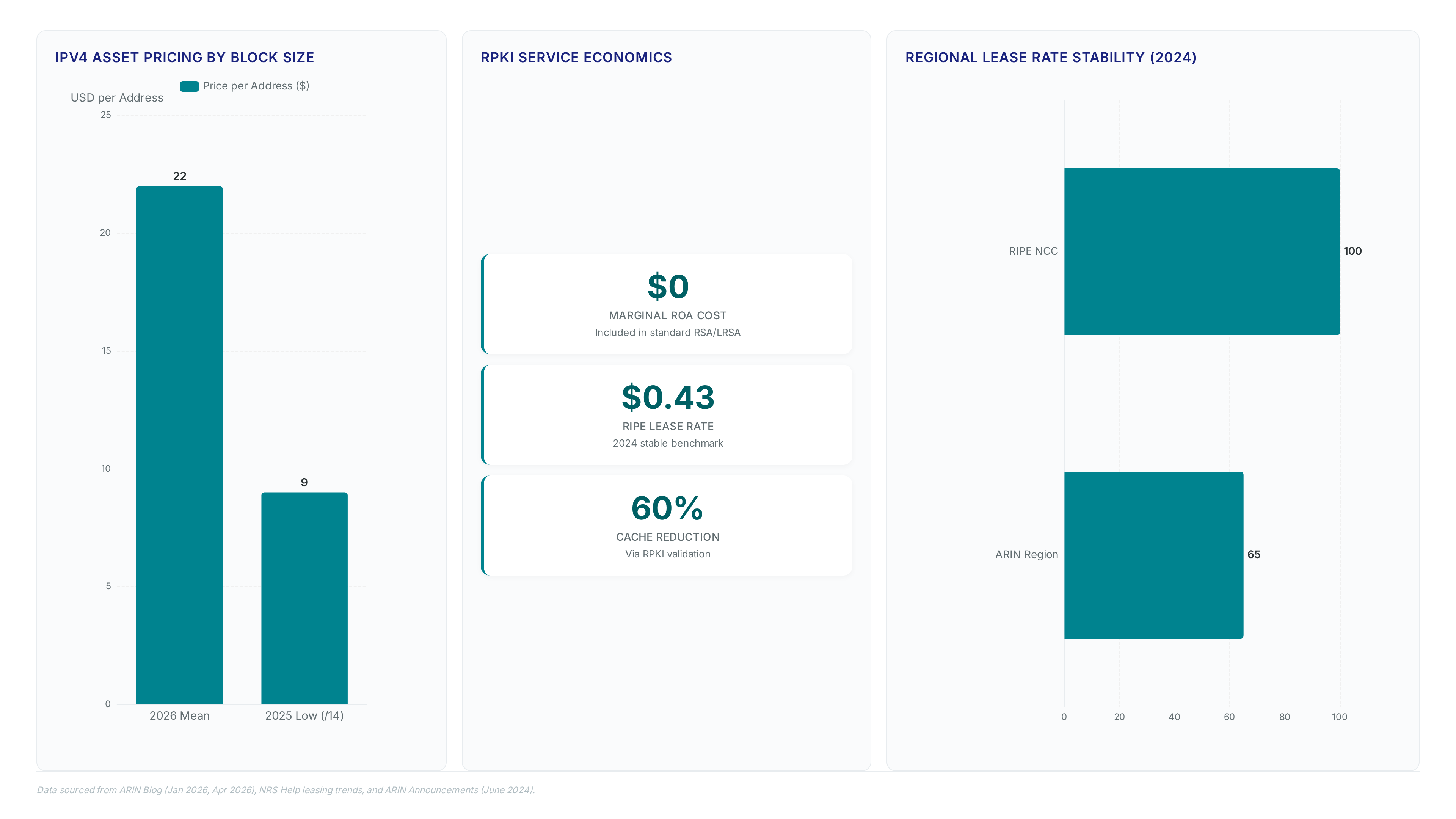
Organizations opting for full autonomy must provision their own HSMs to sign objects, shifting the burden of cryptographic availability entirely to the enterprise. While this grants total control over the Certificate Authority hierarchy, it introduces a single point of failure if local hardware cannot process churn rates during incidents. Optimization strategies become mandatory, such as removing End-Entity certificates to shrink repository payloads and preserve signing capacity. Studies indicate such tuning can reduce Routinator cache requirements by 60%, indirectly easing the processing load on validation infrastructure.
ARIN Dashboard ROA Auto-Renewal and IRR Auto-Manager Mechanics
August 2024 auto-renewal implementation removes expiration dates from ROAs, eliminating periodic manual renewal cycles for network operators. This mechanism ensures certificates persist indefinitely until an administrator explicitly deletes the object via the RESTful provisioning endpoint. Operators no longer face service interruptions caused by forgotten calendar reminders or staff turnover affecting routine maintenance tasks. The limitation remains that accidental misconfigurations also persist forever without active monitoring, requiring stricter change-control policies than before. Permanent validity shifts the operational burden from renewal scheduling to continuous accuracy validation of prefix origins.
- Log into the ARIN Online portal and navigate to the routing security section.
- Select existing ROAs to verify the system applied the auto-renewal flag automatically.
- Configure internal alerting to detect unauthorized changes rather than expiration warnings.
- Use the IRR Auto-Manager suite to synchronize legacy IRR data with RPKI objects.
January 2025 deployment of the IRR Auto-Manager automates synchronization between registry databases and validation caches. Manual synchronization errors drop significantly because the tool suite manages interconnections without human intervention. However, operators lose granular control over timing, as the system pushes updates on a fixed schedule rather than on-demand. This rigidity benefits large networks needing consistency but hampers debugging during active incident response windows.
Implementation: Step-by-Step ROA Configuration via ARIN Online and RESTful API
Access the unified Routing Security Dashboard in ARIN Online to begin ROA creation for specific IP blocks. Operators select the Hosted model to let ARIN manage the certificate authority while defining origin AS numbers and maximum prefix lengths manually. This interface consolidates navigation for both RPKI and IRR services, removing the need to switch between disjointed administrative portals. Automation scripts use the RESTful API to submit bulk authorization requests through a single call, bypassing manual form entry for large networks. The system applies auto-renewal logic automatically, ensuring objects persist indefinitely without operator intervention or calendar-based maintenance tasks.
- Log into ARIN Online and navigate to the Routing Security Dashboard.
- Select the target IPv4 or IPv6 block from the eligible resource list.
- Define the originating AS number and set the maximum prefix length constraint.
- Submit the object via the web form or push JSON payloads to the API endpoint.
Accidental misconfigurations now persist forever unless actively deleted, creating a hidden risk where stale authorizations validate incorrect routes indefinitely.
Pre-Deployment Validation Checklist for Route Origin and Path Authorization
Verify AS path authorization objects exist before enabling strict reject policies on border routers. Operators must confirm that Autonomous System Provider Authorizations cover every customer relationship to prevent legitimate traffic drops during validation. The checklist requires four distinct verification steps to ensure routing integrity prior to production cutover.
- Audit all ROAs for alignment with current BGP announcements using the dashboard.
- Generate ASPA objects for upstream providers to authorize specific transit paths.
- Test validation logic in the Operational and Test Evaluation environment.
- Confirm auto-renewal settings are active to prevent accidental expiration.
| Validation Target | Required Object | Failure Mode |
|---|---|---|
| Origin AS | ROA | Invalid Origin |
| Transit Path | ASPA | Path Leak |
| Certificate Chain | TA Trust | Untrusted Root |
Neglecting this step leaves networks vulnerable to route leaks that origin validation alone cannot stop.
Strategic Value of Attending the ARIN Deep Dive Event
ARIN Deep Dive Albuquerque: Scope and Expert-Led Curriculum
Marriott Albuquerque hosts the Thursday, 7 May 2026 session featuring expert-led instruction on Route Origin Confirmation and AS Path Authorization. Brad Gorman, the Director of Customer Technical Services, provides targeted guidance on deploying Hosted versus Delegated RPKI models. The curriculum spans 10:00 AM-3:00 PM MT. Hands-on modules allow participants to configure validators using live data from the recent ARIN 57 event. Lunch is provided, removing logistical barriers to full-day technical immersion.
This format enforces immediate application of validation policies under instructor supervision instead of relying on passive webinars. Physical presence in Albuquerque, New Mexico, remains a requirement that excludes remote teams unless they dispatch onsite engineers. Organizations skipping this training risk misconfiguring revocation limits, a frequent error during initial RPKI rollout. Discussion of the updated Trust Anchor Locator compatibility ensures participants leave with validator configurations matching current global standards.
Using Internet2 and ESnet Case Studies for Routing Security
Keynotes by Steven Wallace and Inder Monga at ARIN 57 detailed practical ROA planning strategies for research networks. Internet2 executes year-long efforts including hands-on demonstrations to increase adoption within the higher education community. ESnet applies similar methodologies to secure high-performance scientific data flows against interception or misdirection. The mechanism relies on translating abstract policy requirements into concrete validator configurations that peer networks can audit independently. Replicating these models requires dedicated engineering time that many commercial ISPs cannot spare without external funding or mandates.
Operators attending the Deep Dive event gain access to these specific implementation patterns rather than generic theoretical overviews. Documentation at arin.net/blog/2024/04/09/rpki-updates/) helps automate similar validation workflows in production environments. Networks without signed origins face increasing rejection rates from upstream providers enforcing strict filtering policies. Successful replication demands more than software installation. It requires aligning operational procedures with the continuous monitoring cycles demonstrated by these research backbones. Failure to integrate such rigorous checks leaves BGP announcements vulnerable to accidental leaks that compromise global routing integrity.
The Business Risk of Ignoring Mandated RPKI Implementation
Service providers now mandate ROA creation before finalizing peering agreements, blocking non-compliant networks from necessary interconnection points. Operators lacking valid Route Origin Authorization objects face immediate revenue loss as upstream carriers enforce strict validation policies on border routers. Financial impact extends beyond lost traffic. Potential routing hijacks cause reputational damage that persists long after technical remediation occurs. Substantial entities like Cogent Communications illustrate the shift by adopting ARIN's RPKI services for legacy IPv4 allocations, signaling a broader industry standard. Engineering teams unaware of these evolving contractual requirements risk receiving service termination notices. Automation trends reduce manual overhead. The initial configuration barrier remains high for organizations without specialized training. InterLIR recommends immediate participation to avoid exclusion from the global routing table. The cost of inaction exceeds the time investment required for proper RPKI implementation.
About
Vladislava Shadrina serves as a Customer Account Manager at InterLIR, where she specializes in managing client relations within the complex domain of IP resources. Her daily work involves guiding organizations through the acquisition and secure deployment of IPv4 addresses, making her uniquely qualified to discuss the critical importance of Resource Public Key Infrastructure (RPKI). As InterLIR prioritizes security through clean BGP announcements and verified route objects, Vladislava directly assists clients in implementing these safeguards to prevent hijacking and ensure routing integrity. The upcoming ARIN training in Albuquerque aligns perfectly with her professional focus on network availability and trust. By bridging the gap between theoretical routing security and practical application, she helps InterLIR fulfill its mission of providing transparent, safe IP solutions. Her insights connect the technical necessity of RPKI adoption with the real-world operational needs of businesses relying on stable internet infrastructure.
Conclusion
Scaling RPKI beyond current adoption levels exposes a critical fragility: validator synchronization latency during global table updates can inadvertently drop legitimate traffic if cache refresh cycles are not tuned for high-volume environments. While coverage metrics climb, the operational burden shifts from mere signature creation to maintaining sub-second consistency across distributed router clusters. Organizations must treat route origin authentication as a continuous reliability engineering challenge rather than a one-time compliance checkbox. All networks with more than two upstream providers should complete a full failover test of their validation logic by Q3 2026 to ensure business continuity during cache outages. Waiting for peer pressure to dictate timing invites unnecessary packet loss during inevitable infrastructure hiccups. The window for passive observation has closed; active stress-testing is now the baseline for stable interconnection. Start by auditing your router's `max-age` tolerance settings against your primary validator's update frequency before Friday's maintenance window. This specific configuration tweak prevents stale data rejection errors that often masquerade as upstream filtering issues. Proactive alignment with these mechanical realities secures your BGP announcements far more effectively than simply signing ROAs and hoping for the best.
Frequently Asked Questions
Your traffic faces immediate rejection by providers enforcing strict mandates. Ignoring cryptographic signing threatens business continuity as global IPv4 coverage for validation recently hit 65.5%.
Major carriers migrate to delegated models for superior operational resilience compared to centralized management. This shift supports the 65.5% global IPv4 coverage while easing processing loads on validators.
Yes, you can execute deployment via the ARIN RESTful API alongside the dashboard. This automation helps maintain the 65.5% IPv4 coverage rate required by modern routing security architectures.
No, registration for the Albuquerque event is completely free for all participants. Attendees gain insights into tools supporting the 65.5% IPv4 coverage while enjoying provided lunch at the venue.
No, origin validation ignores transit paths, leaving AS path manipulation possible despite 65.5% coverage. Full protection requires publishing ASPA objects to verify every segment of the routing path.