RPKI validation stops 820k IoT attacks by 2027
Implementing three specific security invariants could theoretically prevent up to 65% of security breaches according to APNIC analysis. (APNIC's improving rpki uptake in the asia pacific region) Trusting legacy IRR systems is dead. The industry has moved to cryptographically verifiable routing data.
RPKI and ASPA protocols are no longer optional best practices; they are critical infrastructure. All RIRs commit to full ASPA adoption by 2027 to stop path manipulation. This shift forces operators to implement route objects and ROAs, moving beyond simple origin validation to build a resilient network perimeter.
The trajectory is undeniable: ROA coverage climbed from 20% in 2019 to nearly 45% by late 2025. Gaps remain, giving attackers room to maneuver. APNIC's 2026 strategic pivot toward outcome-based themes addresses this volatility. Network operators must abandon vague security postures for concrete, data-driven protections. This isn't about compliance. It's about network survivability in a hostile routing environment.
The Role of RPKI and ASPA in Modern Routing Security
RPKI and ASPA: Core Protocols for Route Origin Validation
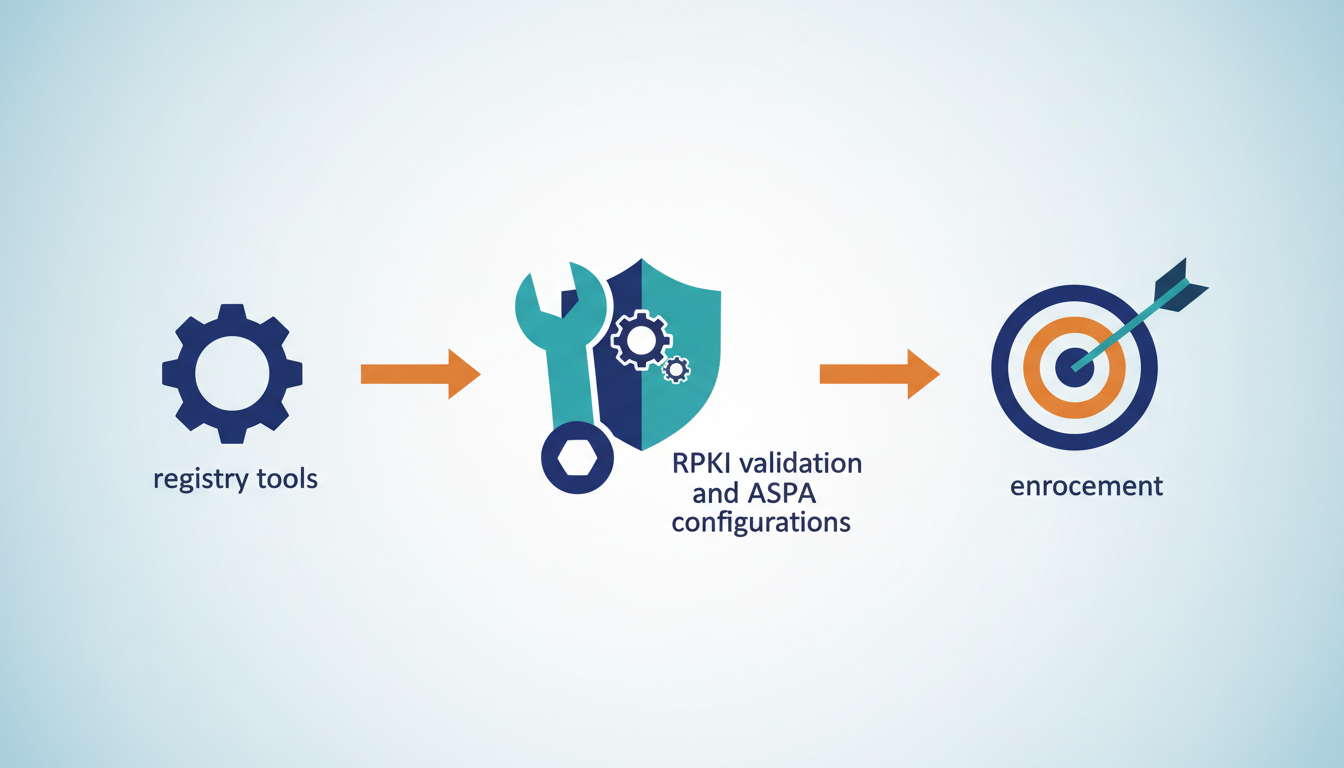
Route Origin Validation uses ROA signatures to cryptographically bind IP prefixes to authorized origin ASes, stopping basic hijacks. Global coverage hit 45% by late 2025. Origin validation alone leaves the AS path exposed. ASPA fixes this by authorizing specific upstream providers, ensuring the announced path matches reality. All RIRs must support ASPA authorizations by 2027. This shifts path security from optional to mandatory.
Skipping provider lists breaks the chain. The AS path remains unsigned even with valid origin data. Enforcement drives adoption faster than voluntary best practices. The Indonesian Internet Exchange dropped invalid routes across 15 interconnection points. Nearly 800 ASNs had to validate announcements or lose connectivity. Hard boundaries work. Regions relying on gradual policy shifts still suffer from persistent misconfigurations without immediate traffic consequences.
| Feature | RPKI (ROA) | ASPA |
|---|---|---|
| Validates | Origin AS only | Full AS path |
| Prevents | Origin hijacks | Path leaks & hijacks |
| Requirement | Prefix signature | Upstream provider list |
Deploying ROV without ASPA leaves you open to lateral hijacks. A legitimate origin announces via an unauthorized peer. Traffic reaches the correct destination but traverses untrusted transit links, bypassing policy controls. Deploying three security invariants prevents 65% of routing breaches by enforcing cryptographic path validation. These invariants turn BGP from a trust-based protocol into a verified system where invalid announcements trigger automatic rejection. Financial penalties for substantial entities like British Airways decreased because documented mitigation efforts proved adherence to such standards.
IRR vs RPKI Functionality: Why Cryptographic Validation Wins
Legacy Internet Routing Registry entries lack cryptographic binding. BGP announcements remain vulnerable to unauthorized origin claims.
| Feature | IRR Model | RPKI Model |
|---|---|---|
| Validation Basis | Trust-based filters | Cryptographic signatures |
| Data Integrity | Mutable text objects | Signed ROA records |
| Enforcement | Voluntary peer filtering | Mandatory drop policies |
Cryptographically strong approaches solve what legacy databases cannot: spoofing. Regional exchanges like IIX now enforce "drop invalid" policies. This affects nearly 80% of participating ASNs where validation fails. Voluntary IRR maintenance offers no mechanism to reject forged path attributes automatically. Operators relying solely on text-based registries face persistent exposure to route leaks despite community filtering efforts. Migration costs involve coordinating with upstream providers to sign authorizations. The alternative is accepting unverified traffic.
RouteViews aggregates full routing tables from over 50 existing peers and 28 new participants to feed the DASH analytics engine. This architecture ingests raw BGP updates directly from diverse vantage points. It creates a thorough view of global reachability without relying on sampled data. The system processes these streams to identify anomalies, feeding the Network Health Dashboard with real-time visibility into prefix origins and path changes. Participation in this data collection effort grew by 20% in 2025, expanding the dataset available for detecting route leaks. Operators gain immediate access to this telemetry to spot misconfigurations before they escalate into outages.
The processing pipeline distinguishes between legitimate path changes and malicious hijacks by correlating announcements against known RPKI states. Unlike passive looking glasses, this active aggregation allows for historical trend analysis across multiple collectors simultaneously.
| Input Source | Data Type | Latency |
|---|---|---|
| Existing Peers | Full Tables | Near Real-time |
| New Participants | Incremental Updates | Real-time |
| RIR Feeds | Validation State | Delayed |
A critical limitation exists in the delay between route propagation and dashboard visualization. Fast-flux hijacks lasting only minutes can slip through. The sheer volume of updates requires significant storage, often demanding the 8GB RAM minimum suggested for local analysis tools. Reliance on voluntary peer participation means coverage gaps remain in regions with fewer contributing ASes.
Operators cross-reference IRR route objects against RPKI ROAs to flag invalid paths in live environments. Manual database maintenance fails under scale. Automated generation of filter lists via IRRToolset is required. This workflow produces router configurations that enforce strict origin policies before traffic ingests. Validation logic compares the announced AS number in the AS path against the signed authorization record. A mismatch triggers an invalid state, prompting immediate rejection of the suspect prefix. The Indonesian IIX mandates prove that voluntary filtering leaves networks exposed to persistent spoofing attempts.
Relying solely on origin validation ignores path manipulation attacks. The source might be legitimate, but the route gets hijacked mid-transit. Invalid routes traverse peers until explicit path authorization arrives. Operators must publish both route objects and cryptographic signatures to close this window.
| Validation Layer | Data Source | Failure Mode |
|---|---|---|
| Origin Check | ROA records | Valid origin, invalid path |
| Path Check | ASPA profiles | Missing upstream authorization |
| Policy Check | IRR filters | Stale or spoofed objects |
This capacity ensures the analysis engine processes complete BGP updates without sampling errors. Operators who skip this step risk missing subtle leaks that partial datasets obscure. Suspicious activity often hides within normal traffic volumes until a thorough view reveals the anomaly. Fixing these misconfigurations demands real-time correlation between registry data and live packet flows.
Operational Checklist for ASPA and RPKI Deployment
All RIRs commit to supporting ASPAs
- Generate AS SETs using IRRToolset to define authorized upstream providers.
- Sign ROAs for every announced prefix to establish origin legitimacy.
- Configure routers to reject paths failing path validation checks.
- Monitor BGP streams via DASH for unauthorized path deviations.
| Validation Layer | Scope | Enforcement Mechanism |
|---|---|---|
| RPKI ROA | Origin AS only | Drop invalid origins |
| ASPA | Full AS path | Reject unauthorized hops |
| IRR | Policy intent | Filter based on text objects |
ASPA deployment stalls without publishing upstream lists. The AS path remains unprotected against leaks. Operators skipping this step face persistent vulnerability despite having valid ROAs. Failure to align SETs with actual peering contracts results in legitimate traffic rejection during strict enforcement phases.
Implementing Route Objects and ROAs for Network Protection
ROA Creation Mechanics and IRR Object Structure
Creating a valid ROA requires signing a prefix and maximum length with a private key. Plain text IRR entries cannot do this. Legacy databases rely on mutable text objects lacking cryptographic proof of origin authority. The industry now prioritizes cryptographically strong approaches. Operators must generate AS SETs using tools like IRRToolset to automate filter list production for diverse router architectures. Automation reduces human error when translating policy intent into enforceable configuration rules.
- Define the prefix and maximum length in the RPKI portal.
- Sign the object to create the Route Origin Authorization.
- Publish the signed record to the global validation infrastructure.
- Configure routers to perform Route Origin Validation on ingress updates.
Route Origin Verification allows networks to verify attestations and drop invalid routes automatically. Legacy text objects offer flexibility; signed records demand rigidity. Strict enforcement rejects valid traffic if the AS path deviates from the single authorized origin.
Executing ASPA Configurations for AS Validation
Passive validation fails without active rejection policies at exchange points. ASPA adoption requires RIR publication. Coordination delays often leave the AS path unsigned during transition periods. The cost of strict path validation is measurable: misconfigured provider lists cause immediate traffic blackholing until corrected.
Operators must verify that their upstream providers have published corresponding customer authorizations to prevent mutual rejection loops.
Pre-Deployment Validation Steps for Route Security
Operators must verify cryptographically strong approaches
- Audit existing IRR entries against live BGP announcements to identify discrepancies.
- Generate ROAs for all prefixes, ensuring maximum length values match actual subnetting.
- Test validation logic in report-only mode to capture false positives without dropping traffic.
- Confirm AS SET definitions align with physical interconnection agreements.
| Check Type | Target Object | Risk if Skipped |
|---|---|---|
| Origin Auth | ROA | Legitimate traffic rejected as invalid |
| Path Auth | ASPA | Route leaks propagate unchecked |
| Policy Map | AS SET | Upstream filters block valid paths |
Skipping the report-only phase risks severing connectivity for peers lacking updated ROA records. This dual-maintenance burden creates operational friction but remains necessary until universal RPKI adoption occurs. Failure to validate AS path integrity prior to enforcement turns security tools into availability threats.
Operational Best Practices for Sustained Routing Security
APNIC DASH and Outcome-Based Internet Security Themes
APNIC DASH translates raw BGP stream data into actionable visibility for operators managing complex peering fabrics. Community feedback revealed that valuable services lacked clear connection to solving specific Member operational problems. The 2026 strategic shift organizes tools around outcome-based themes to clarify problem-solving intent. Visualizing routing paths helps teams identify misconfigurations before they trigger traffic drops or hijacks. Operators apply these insights to enforce drop policies similar to the Indonesian Internet Exchange. Legacy reliance on unverified text objects creates gaps that cryptographic validation closes effectively. Industry momentum now favors cryptographically strong approaches.
Dashboards alone do not fix broken configurations; manual intervention remains required after alert generation. Security teams must correlate visual anomalies with RPKI validity states to distinguish attacks from errors. Ignoring path deviations leads to prolonged exposure even when origin validation passes successfully. The cost of delayed detection exceeds the effort needed to maintain continuous network health monitoring. Operators who ignore these visual cues risk becoming the weak link in global routing integrity.
Integrating DASH Insights into Daily Network Health Operations
APNIC DASH visualizes BGP streams to flag suspicious internal activity before it escalates into outages.
Operators embed this tool into morning health checks to spot route leaks that standard monitoring misses. The platform translates raw path data into actionable alerts, revealing deviations from expected AS path sequences. Community feedback previously noted that valuable services lacked clear links to solving specific member problems. APNIC now organizes these utilities around outcome-based themes to clarify their operational utility. Daily review cycles catch misconfigurations early, preventing the propagation of invalid announcements across peering edges.
| Workflow Step | Action | Outcome |
|---|---|---|
| Morning Scan | Review DASH anomaly logs | Identify spoofed sources |
| Mid-day Audit | Cross-check IRR objects | Validate peer claims |
| Evening Report | Document path changes | Track stability trends |
Human response time is the bottleneck. Automated detection means nothing without immediate mitigation policies. Teams must configure routers to reject paths failing validation checks immediately upon alert. This approach aligns with the broader industry shift toward cryptographically strong approaches. Without this integration, operators remain reactive to incidents instead of proactive against them. The cost of delay is measurable in dropped packets and lost trust among downstream peers.
Throughout 2026, providers will offer more ways to build capability in routing security and network health. Operators ignoring these signals risk falling behind peers who enforce strict hygiene. Visibility without action creates a false sense of security that worsens eventual failure modes.
Application: Validation Steps for Adopting 2026 Strategic Security Tools
Operators must align tool adoption with the 2026 outcome-based. Feedback indicates previous services lacked clear operational utility for Members managing complex fabrics. Validation begins by auditing legacy IRR entries against live BGP announcements for discrepancies. Teams should generate ROAs for all prefixes while testing logic in report-only mode. This approach prevents accidental blackholing before enforcing strict drop policies on edge routers. InterLIR recommends participating in the 2026 APNIC. Community input drives the shift toward cryptographically strong approaches. Skipping this feedback loop leaves operators blind to emerging threat vectors.
| Validation Step | Target Object | Operational Risk |
|---|---|---|
| Data Audit | IRR entries | Stale objects cause false rejects |
| Cryptographic Signing | ROA records | Missing signatures trigger drops |
| Policy Test | Report-only mode | Unchecked logic breaks peering |
| Feedback Loop | Survey responses | Tools miss real-world needs |
The cost of skipping validation is measurable traffic loss during enforcement windows. Most operators fail to test AS path constraints before going live. Blind deployment of RPKI filters often rejects legitimate customer routes immediately. Strategic alignment ensures security tools actually resolve observed network health issues.
About
Alexei Krylov serves as the Head of Sales at InterLIR, a specialized marketplace dedicated to the redistribution of IPv4 resources. His extensive background in B2B sales and direct engagement with Regional Internet Registries (RIRs) uniquely qualifies him to analyze APNIC products. In his daily role, Krylov guides clients through complex network infrastructure challenges, where understanding the collaboration between IP resource acquisition and operational security tools is critical. This article connects InterLIR's mission of ensuring network availability with APNIC's strategic shift toward outcome-based themes. By using his practical experience in cybersecurity consulting and IP management, Krylov elucidates how APNIC tools solve real-world problems for network operators. His insights bridge the gap between acquiring necessary address space and implementing the resilient, secure networks that modern digital infrastructure demands, offering a clear perspective on maximizing these vital industry resources.
Conclusion
Scaling cryptographic validation exposes a hidden bottleneck: memory contention on legacy border routers that cannot handle the expanding global table without hardware upgrades. Coverage metrics look promising, but the operational reality shifts from simple configuration to continuous data hygiene management. Operators who treat signing as a one-time task will face increasing route rejection rates as neighboring networks tighten their policies in 2026. The industry must move beyond basic adoption to automated lifecycle management of routing objects, ensuring that stale entries do not trigger self-inflicted outages during critical maintenance windows.
Network teams should mandate full RPKI enforcement by Q3 2026, but only after completing a rigorous six-week shadow mode trial. This timeline allows for the detection of edge cases where legitimate traffic might otherwise be discarded due to misconfigured AS path constraints. Do not enforce drop policies until your monitoring stack confirms zero false positives over a complete business cycle. Rushing this transition creates avoidable instability that undermines trust in the security framework.
Start this week by exporting your current IRR dataset and cross-referencing it against live BGP announcements using a local validator with at least 8GB RAM. Identify any prefixes where the registered origin differs from the announced path before you even consider generating new ROAs. This immediate audit reveals the specific gaps that will cause failures when strict validation goes live.
Frequently Asked Questions
Implementing three specific security invariants prevents 65% of routing breaches. This approach enforces cryptographic path validation to transform BGP into a verified system where invalid announcements trigger automatic rejection by operators.
Global ROA coverage reached 45% by late 2025 to prevent basic hijacks. However, significant gaps remain for attackers to exploit since origin validation alone leaves the AS path exposed to manipulation.
The Route Views effort grew by 20% in 2025, expanding the dataset available for analysis. This growth supports local analysis that often demands significant storage and an 8GB RAM minimum suggestion.
Traditional routing security relies on IRR databases that lack cryptographic signing entirely. This allows spoofed origins to propagate unchecked, making the era of trusting these legacy systems effectively over for operators.
The mechanism fails if operators skip publishing provider lists, rendering the AS path unsigned. This leaves networks vulnerable to lateral hijacks where legitimate origins announce via unauthorized peers despite valid origin data.