SCION routing stops hijacks with crypto paths
48.18 percent of invalid RPKI prefixes fail due to length violations. This single statistic proves legacy BGP is broken. Decades of patching have not fixed the core issue: the protocol trusts everyone by default. SCION architecture does not patch this foundation; it replaces it. We are moving from a system of implicit trust to one of cryptographic path validation. This shift makes route hijacks and nation-state interception mathematically impossible, not just policy-violating.
We must stop treating BGPsec and ROA extensions as solutions. They are band-aids on a gaping wound. They cannot prevent route leaks because they lack native address ownership verification. Isolation Domains change the game. They allow regions to establish independent trust roots, a capability driving European digital sovereignty initiatives reported by The Register. The proof exists in Swiss financial infrastructure, where legacy BGP routing once invited catastrophe. Now, high-stakes environments operate with deterministic security.
ARIN struggles with misconfigured autonomous systems daily. SCION eliminates this trust deficit by design. The Swiss deployment proves that abandoning the "boat full of holes" current internet routing represents is not theoretical. It is operationally superior for protecting sensitive data flows against sophisticated adversaries.
The Critical Security Gaps in Legacy BGP Routing
BGP accepts every route announcement without cryptographic proof. Hostile networks claim address blocks they do not own, and the internet believes them. Engineers built the protocol to move packets between thousands of autonomous systems quickly. They sacrificed security for scale. This architectural gap turns route hijacking into a recurring event. Operators have spent four decades applying patches like RPKI to reduce risks at the edges. These extensions cannot fix the deep problem of implicit trust between peers.
Hidden expenses dominate the operational reality. Managing route leaks and hijacks that divert traffic through unsafe networks creates a persistent cost of insecurity. Efforts to repair this via BGPsec bring new constraints. Every update message needs cryptographic signing and verification at each hop. Such demands force hardware upgrades for legacy routers. Security now depends on universal adoption across the entire path, a coordination nightmare.
| Vulnerability Type | Root Cause | Consequence |
|---|---|---|
| Route Hijack | Missing origin validation | Traffic diversion to hostile AS |
| Route Leak | Missing path policy enforcement | Service outage via unsafe transit |
| Session Spoofing | Lack of peer authentication | Control plane compromise |
Data from March 2020 shows the scale of these failures. 48.18% of invalid prefixes failed due to bad maximum prefix length violations. The remaining 44.14% resulted from bad origin Autonomous System mismatches. Manual configuration cannot match the scale of global routing. Route hijacks reroute traffic through hostile networks while leaks knock services offline. Nation-state cyber crews weaponize BGP to intercept communications or alter availability. These attacks succeed because the protocol lacks native verification for address ownership claims. Operational costs include traffic blackholing or diversion through unsafe networks.
The Swiss Federal Department of Defence connected military systems to SCION in November 2022. This deployment uses isolation domains to keep communication independent of potentially hostile external routing influences. Such architectural separation prevents cascading failures. Existing mitigation attempts like BGPsec face "incremental deployment" costs. Path security functions only if every AS supports the protocol. This creates a coordination cost barrier that stalls widespread adoption among tier-2 providers.
| Threat Vector | Mechanism | Consequence |
|---|---|---|
| Route Hijack | False origin claim | Traffic diversion to hostile AS |
| Route Leak | Improper propagation | Service outage via blackholing |
| State Interception | Path manipulation | Confidentiality breach |
Legacy routers struggle with the CPU overhead required for cryptographic verification at every hop. Immediate security conflicts with gradual rollout. Most paths remain unprotected today.
RPKI and BGPsec function as optional extensions. They validate origins or paths without replacing the insecure BGP foundation. These measures help at the margins but leave the core trust model unchanged. Operators deploying RPKI-based Route Origin Authorization face administrative overhead generating ROAs and maintaining validator infrastructure. Validation remains an add-on rather than a default property of the routing exchange.
BGPsec attempts to secure the full AS path but introduces severe deployment friction. Every router in a specific path must support the protocol for security to hold. This requirement forces a flag day or perfectly synchronized incremental rollout across independent networks. The computational cost scales linearly with path length. Hardware upgrades are mandatory to handle cryptographic signing on every UPDATE message. Legacy routers often lack the processing power to verify these signatures in real-time.
| Feature | RPKI / BGPsec Patch | SCION Redesign |
|---|---|---|
| Trust Model | Optional extension to existing sessions | Integrated into packet headers by default |
| Deployment | Requires universal hop support for full effect | Operates as an overlay on current IP+BGP |
| Validation Scope | Origin or Path ( | Full path with cryptographic isolation |
| Hardware Impact | High CPU overhead for signature verification | Eliminates need for expensive middleboxes |
Patching BGP yields perpetual incompleteness. Security exists only where every participant upgrades. A single non-compliant hop breaks the chain of trust. This fragility contrasts with architectures embedding validation directly into the forwarding plane.
Isolation Domains and the SCION Control Plane Foundation
SCION replaces the flat BGP trust model with hierarchical Trust Domains. Adrian Perrig developed this architecture at ETH Zürich in 2009. He partitioned the global network into distinct Isolation Domains (ISDs) rather than relying on a single global registry. Each ISD agrees on a coherent root of trust. Routing failures or misconfigurations in one region cannot cascade to others. This structural isolation prevents the widespread outages common in legacy systems.
The control plane operates through coordinated top-to-down propagation within these domains. It achieves O(k·n) communication complexity for route updates. This design supports frequent refreshes and short route timeouts to maintain high path freshness without overwhelming core routers. Unlike BGP, which stores forwarding state in every router, SCION embeds the entire path and cryptographic authenticators directly in the packet header. Stateless routers simply verify these embedded signatures. Large global routing tables at core nodes become obsolete.
| Feature | BGP Architecture | SCION Architecture |
|---|---|---|
| Trust Model | Global implicit trust | Localized ISD roots |
| Forwarding State | Router-stored tables | Packet-carried state |
| Failure Scope | Global cascade risk | Domain-contained |
Operators gain immediate containment of faults. The drawback is the requirement for explicit inter-domain peering agreements. The cost is measurable coordination overhead to establish trust anchors between independent ISDs. InterLIR notes that migrating from implicit global trust to explicit local validation demands a fundamental shift in operational philosophy.
Executing Cryptographic Path Validation in Under 100 Nanoseconds
Packet authentication completes in under 100 nanoseconds. SCION embeds cryptographic signatures directly within the header rather than querying external databases. This mechanism relies on a symmetric key derivation system. Each router verifies the packet header authenticity using local state instead of expensive asymmetric operations. The validation process follows a strict sequence: the sender constructs the path, intermediate nodes append hop fields, and egress routers verify the chained authenticators before forwarding.
- The source endpoint requests multiple paths from the control plane.
- The router embeds the full path and cryptographic authenticators into the data packet.
- Each hop validates the signature against the embedded key material in nanoseconds.
- Invalid packets trigger an immediate drop without consulting global routing tables.
This approach eliminates the need for expensive middleboxes that traditionally inspect traffic flows for anomalies. Throughput improves notably via multipath selection. Operators can apply parallel links that BGP would leave idle during normal operation. The cost is increased packet header size, which consumes bandwidth on low-MTU links despite the processing speed gains. Network operators gain deterministic security properties. Path deviations are cryptographically impossible. Statelessness at the core removes the risk of table exhaustion attacks that plague legacy border routers.
Define local trust roots for each Isolation Domain before activating beacon servers to prevent global cascade failures.
- Configure beacon servers to propagate path segments strictly within the assigned ISD boundary.
- Enable multipath operation on endpoints to apply diverse routes simultaneously for increased durability.
- Verify that cryptographic authenticators embed directly in the packet header to reduce router processing costs compared to legacy validation methods.
- Select specific paths based on latency or bandwidth preferences rather than accepting the single best path chosen by the network.
Path control shifts responsibility from the core network to the edge device. Application-level logic must manage path selection policies effectively. This architectural shift eliminates the need for coordinated "flag day" deployments. The system functions as an overlay on existing infrastructure. Gradual adoption is possible without replacing every router in a specific path immediately. Administrators often overlook the necessity of defining clear ISD boundaries. Misconfigured trust anchors occur if regions overlap improperly. Proper configuration ensures that a routing error in one domain remains contained.
Real-World Deployment of SCION in Swiss Financial Infrastructure
The mandate to replace the aging Finance IPNet stemmed from daily interbank clearing volumes reaching 220 billion Swiss francs. Minutes of downtime represented unacceptable financial risk. SIX Group operates infrastructure for roughly 120 financial institutions. The 20-year-old MPLS network was a single point of failure for the national economy. Legacy failover sequences required three to four minutes. This latency window is incompatible with modern high-frequency trading and real-time settlement requirements.
Management rejected SD-WAN proposals. Accepting proprietary vendor lock-in for critical national infrastructure was politically impossible. The solution required a complete replacement of the underlying architecture. Incremental patches leave fundamental trust gaps open. Fritz Steinmann, leading the engineering effort since 2015, identified SCION as the only viable path. It achieves sub-millisecond failover while maintaining sovereign control over routing policies.
The operational constraint was absolute. The new system had to prevent route hijacking without relying on external certificate authorities unwilling to underwrite financial-grade risk. This drove the creation of a private certificate authority embedded within the Secure Swiss Finance Network governance model.
Design work for the Secure Swiss Finance Network began in 2019. This established a five-year runway before the Finance IPNet sunset target.
SIX Group initiated this architectural shift to eliminate single points of failure affecting 120 financial institutions. The project team spent two years on security assessments and governance design. They rejected standard SD-WAN solutions due to vendor lock-in risks. Operators set strict admission policies. They issued short-lived certificates valid for only three days to enable rapid revocation during incidents. This approach embedded governance decisions directly into the protocol via Trust Root Configuration. It does not rely on external commercial authorities.
The live deployment occurred in phases. The network went active in November 2021 while the legacy MPLS system continued parallel operation. Testing revealed failover times dropping from minutes to below one millisecond. Carrier outages became invisible to applications. Full replacement of the interbank infrastructure targets September 2024. This marks the complete decommissioning of the previous routing fabric.
| Phase | Start Date | Key Activity |
|---|---|---|
| Design | 2019 | Governance and CA setup |
| Live Pilot | November 2021 | Parallel operation start |
| Sunset | September 2024 | Legacy network off |
Adoption requires abandoning the comfort of established vendor ecosystems. Organizations must accept that no commercial entity assumes liability for the routing logic. The burden of operational continuity rests entirely on the participating consortium.
SIX Group rejected SD-WAN due to the political impossibility of accepting proprietary vendor lock-in for critical national infrastructure. Reliance on a single operator creates a dependency. Governance decisions would rest with an external vendor rather than the consortium of 120 Swiss financial institutions sharing the network. Unlike SCION, which functions as a secure overlay network atop existing IP+BGP infrastructure, SD-WAN solutions often demand a coordinated "flag day" replacement of edge hardware. This deployment model introduces significant risk. Every router in a path must support the specific proprietary protocol to prevent bypass conditions. The cost of such rigid architecture is measurable. Administrators face heavy overhead maintaining validator infrastructure and generating authorizations for each site. Nist.gov/services-resources/software/ is required. True durability demands that path selection logic remains under local administrative control, not hidden within a vendor's closed software stack.
Strategic Barriers to Global SCION Adoption and Sovereignty Benefits
IETF Standardization Gaps Blocking SCION Global Expansion
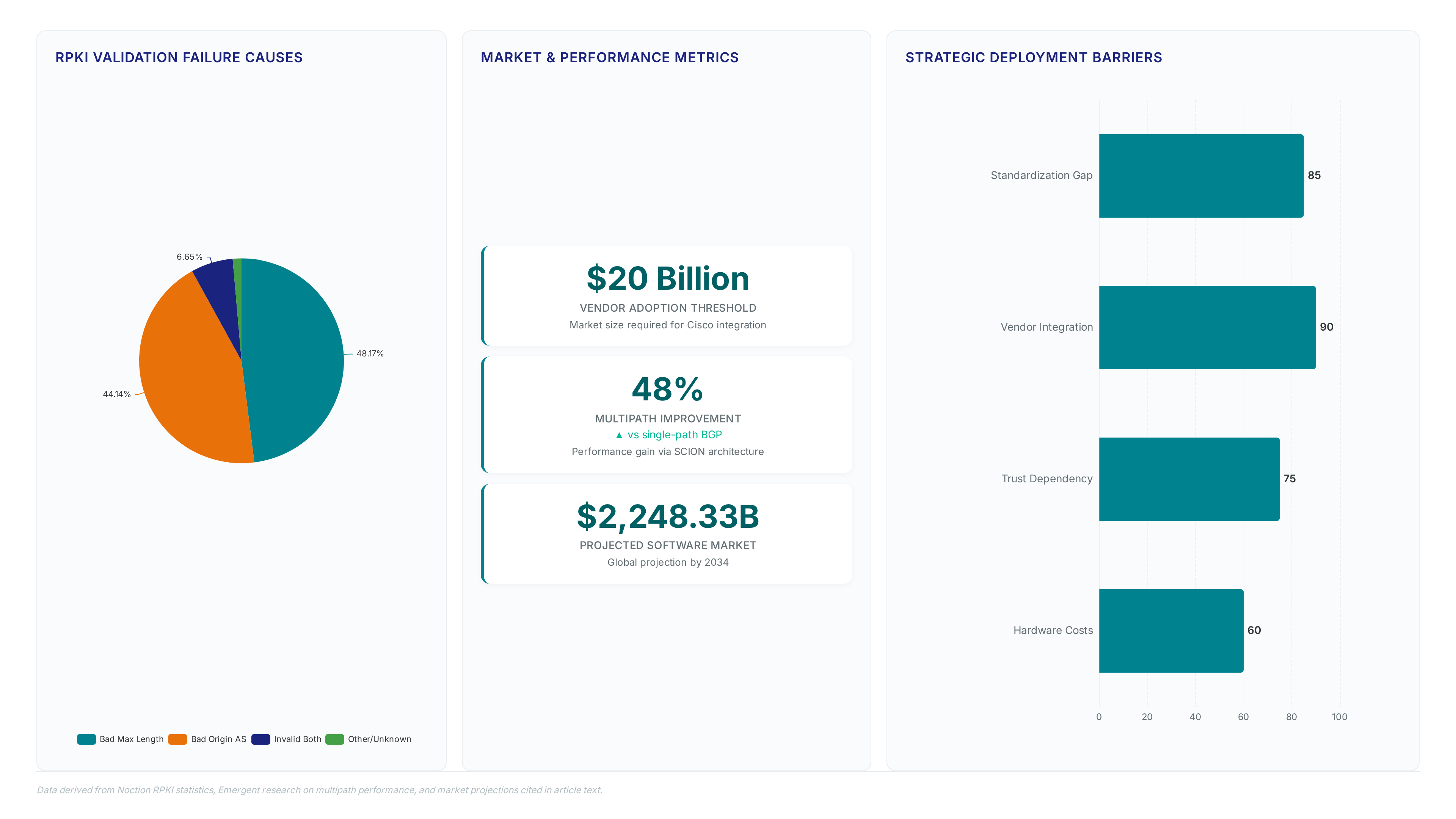
BGP holds full IETF standard status. SCION remains on the Independent Stream. This classification gap stalls vendor integration. Substantial hardware vendors like Cisco dismiss the architecture until it represents a $20 billion market opportunity. The absence of the working group process delays the inclusion of path validation logic in merchant silicon. An IETF Independent Stream RFC is currently in progress. Full standardization has not commenced. Without this seal of approval, network operators hesitate to replace proven, albeit flawed, routing tables with unproven alternatives.
| Dimension | BGP Status | SCION Status |
|---|---|---|
| Standards Track | Full IETF Standard | Independent Stream RFC |
| Trust Anchors | Global Web of Trust | Regional Isolation Domains |
| Market Maturity | Decades of Deployment | Emerging Niche Adoption |
| Vendor Support | Universal Hardware Integration | Single Commercial Provider |
The SCION Association operates as a non-profit guardian to bridge this gap. It lacks the enforcement power of the standards body. This structural deficit forces adopters to rely on digital sovereignty arguments rather than technical consensus to justify deployment costs. A substantial amount by 2034, suggesting capital exists for next-generation infrastructure if standards align. However, the chicken-and-egg problem persists. Vendors wait for standards, while standards bodies wait for vendor adoption.
Isolation Domains enable regions to define trust roots independent of US-based certificate authorities. This creates a sovereign alternative without external kill switches. Each domain maintains a local Trust Root Configuration that cryptographically binds certificate servers to regional policy rather than global consensus. This architecture prevents routing failures in one jurisdiction from cascading globally. This is a frequent occurrence in the current BGP mesh.
Adrian Perrig frames this capability as optionality rather than sovereignty to sidestep political friction while retaining technical control. Operators gain the ability to reject paths that do not meet local compliance standards without relying on external validation chains. The trade-off is fragmentation. Distinct trust domains require explicit peering agreements to exchange traffic. This adds coordination overhead absent in the default-accept model of legacy routing.
Full path validation eliminates hijacks but demands that every hop supports the protocol. This limits immediate interconnectivity with non-SCION peers. Organizations must weigh the benefit of failure isolation against the operational cost of maintaining parallel infrastructure during transition periods.
Organizations tolerate known latency spikes and route hijacks. The pain of incremental deployment costs exceeds the perceived risk of current outages. Fritz Steinmann observes that network operators have grown numb to these failures. They lack enthusiasm for a new foundation despite its technical superiority. This psychological inertia creates a barrier. Flawed but familiar systems persist over secure alternatives. The economic calculus favors status quo maintenance until a catastrophic event forces change.
The global software market projects significant growth through 2034. Capital allocation remains tied to legacy protocols. Operators fear that replacing functioning foundations resembles tearing down a house to fix the basement. Path security effectiveness diminishes without universal autonomous system support. This creates a coordination deadlock. European entities increasingly view Isolation Domains as a sovereign necessity rather than a luxury upgrade. The cost of inaction is silent interception. Yet the industry waits for a dramatic failure to justify the switch. InterLIR recommends evaluating sovereignty benefits before such an incident occurs.
About
Alexander Timokhin, CEO of InterLIR, possesses the strategic expertise to analyze critical internet infrastructure challenges like BGP vulnerabilities. Leading a specialized IPv4 marketplace founded in Berlin, his daily operations require rigorous validation of network resources to ensure security and trust. Unlike the legacy BGP system described in this article, which lacks native verification, Timokhin's work at InterLIR mandates clean BGP announcements and verified route objects for every transaction. This hands-on experience managing global IP redistribution provides him with a unique perspective on why secure routing alternatives, such as SCION, are necessary for modern network availability. As an entrepreneur focused on IT infrastructure and international policy, he understands that the industry cannot rely on decades-old protocols prone to hijacking. His leadership in creating a transparent, secure marketplace directly connects to the urgent need for the world to adopt safer routing standards beyond traditional BGP.
Conclusion
Scaling SCION reveals that parallel infrastructure maintenance creates a hidden operational tax. Most budgets cannot sustain this indefinitely. The architecture functions perfectly in isolation, but value creation stalls when interconnectivity gaps force traffic back onto vulnerable BGP paths for legacy peers. This hybrid state introduces complex debugging scenarios. These often outweigh the theoretical security gains during the early adoption phase. European digital sovereignty mandates will likely force the hand of multinational corporations before technical maturity fully resolves these friction points.
Organizations in regulated sectors must commit to a three-year migration window starting immediately. Treat Isolation Domains as mandatory compliance infrastructure rather than optional performance upgrades. Delaying this transition until a substantial geopolitical incident occurs will result in reactive, costly scrambles that compromise service stability. The window for proactive implementation closes as soon as new sovereignty laws take effect.
Start by auditing your current upstream providers for SCION-ready peering capabilities within the next five business days. Identify which critical data flows can move to an Isolation Domain without disrupting existing customer connections. This specific inventory forms the basis for a realistic phased rollout. Avoid the trap of attempting a simultaneous "big bang" replacement.
Frequently Asked Questions
BGPsec demands cryptographic signing for every update message at each hop. This computational overhead forces costly hardware upgrades because legacy routers cannot handle the required processing load efficiently.
SCION embeds cryptographic authenticators directly in the packet header to eliminate expensive middleboxes. This design reduces per-router processing costs significantly compared to the heavy overhead of BGPsec implementations.
Data shows that 48.18% of invalid RPKI prefixes result from length violations. This statistic proves that manual configuration cannot match the massive scale of global routing requirements.
Approximately 44.14% of failures resulted from bad origin Autonomous System mismatches. These errors demonstrate why legacy protocols fail to verify address ownership claims effectively.
The internet has operated on this insecure foundation for four decades without proper architectural fixes. Engineers have only applied superficial patches rather than replacing the broken trust model.