SEE 14 Engineers: Stop IPv6 Growth Flatlining
Global IPv6 adoption hit 50.10% on March 28, 2026. Growth has since flatlined to a dangerous 2–3%. The SEE 14 conference in Belgrade is not a celebration; it is an intervention. Technical communities must use this venue for direct knowledge transfer to break the stagnation. We are bridging a maturity gap that threatens regional stability: Northern Europe sits at 97.7% penetration while Central Asia lags at 82.0%. (RIPE's activity plan and budget 2026 published) Generic webinars cannot solve the complex routing and RPKI challenges causing these diminishing returns. This guide dissects the technical mechanics required to reverse the trend and details the execution workflows for registration and presentation submissions. Engineers must contribute to DNS operations and data centre discussions before the February 26 deadline.
Ignoring the flattening curve invites obsolescence. The gathering at Crowne Plaza Belgrade is a necessary pivot for network engineers and regulators. The RIPE Network Coordination Center enables this exchange to enforce the best practices needed when organic growth stalls. Participation defines the difference between adapting to a saturated market and being left behind.
The Strategic Role of SEE 14 in Regional Internet Infrastructure
SEE 14: RIPE NCC's South East Europe Meeting for Network Engineers
SEE 14 convenes engineers at Crowne Plaza Belgrade on 21-22 April 2026 to close regional routing gaps. This RIPE NCC gathering targets infrastructure disparities where Northern Europe reaches 97.7% penetration while Central Asia stalls at 82.0%. The agenda covers IPv6 deployment, RPKI validation, and data centre technologies alongside regulatory updates. Open registration removes financial barriers, a sharp contrast to paid industry summits that lock out academic researchers.
| Feature | SEE 14 | General Industry Summits |
|---|---|---|
| Cost | Free | $1,500+ |
| Audience | Engineers, regulators, academics | Vendors, executives |
| Focus | Technical tutorials, operations | Marketing, sales |
Stop treating regional meetings as policy forums. SEE 14 prioritizes technical tutorials over legislative debate. Configuration errors in BGP security cause more outages than regulatory delays ever could. Northern operators often assume universal readiness, ignoring the significant connectivity gap persisting in emerging markets. SEE 14 operationalizes IPv6-only architectures using 464XLAT and DS-Lite following the 50% global adoption milestone. Transitioning mobile broadband requires 464XLAT while fixed networks deploy DS-Lite to bypass the 4 billion IPv4 address ceiling. Cloud infrastructure services now generate over a substantial sum annually, demanding the limitless 128-bit address space that IPv6 provides. Operators mitigate shadow network risks by enforcing RA Guard on access switches to filter unauthorized Router Advertisements. SEcure Neighbor Discovery adds cryptographic validation but increases control-plane CPU utilization on legacy hardware.
| Mechanism | Deployment Scope | Primary Constraint |
|---|---|---|
| 464XLAT | Mobile Broadband | Requires CLAT on device |
| DS-Lite | Fixed Broadband | Needs AFTR gateway |
| RA Guard | Layer 2 Access | Hardware ACL support |
| SEND | Host/Router | Certificate management |
Regional meetings like SEE 14 differ from general summits by focusing on specific routing security implementations rather than high-level governance. Generic conferences often omit the configuration nuance required for RPKI validation in multi-vendor environments. The cost of skipping Neighbor Discovery inspection is measurable: unguarded segments allow rogue routers to redirect traffic silently. Adoption stalls when teams treat security extensions as optional add-ons instead of core protocol requirements.
Technical Mechanics of Knowledge Transfer at SEE 14
SEE 14 tutorials decompose 464XLAT for mobile broadband and DS-Lite for fixed access to enable IPv6-only cores. Operators facing global leasing rates between $0.38 and $0.45 per IP/month find economic pressure to abandon dual-stack architectures. The dual-stack approach remains common yet incurs double operational overhead as adoption growth slows to 3% annually.
| Mechanism | Target Network | Translation Point |
|---|---|---|
| 464XLAT | Mobile Broadband | Device-side CLAT |
| DS-Lite | Fixed Broadband | Provider-side AFTR |
Migration touches every layer. You cannot achieve this by moving just a single service. Google's enterprise migration required four years to complete, illustrating the scale of effort needed for full transition. A specific technical risk involves the inadvertent creation of shadow networks when operating systems enable IPv6 without corresponding security management updates. These solutions depend on carrier-grade NAT availability, which introduces latency penalties for real-time applications.
Applying RA Guard blocks unauthorized Router Advertisements using switch-port policies set in Cisco enterprise guides.
Staff from RIPE NCC will assist with membership issues during the event. Engaging directly with experts clarifies implementation gaps found in standard documentation. Applying these controls prevents local subnet compromise before traffic reaches the core.
Executing Participation Through Registration and Submission Workflows
SEE Programme Committee Submission Categories and Deadlines
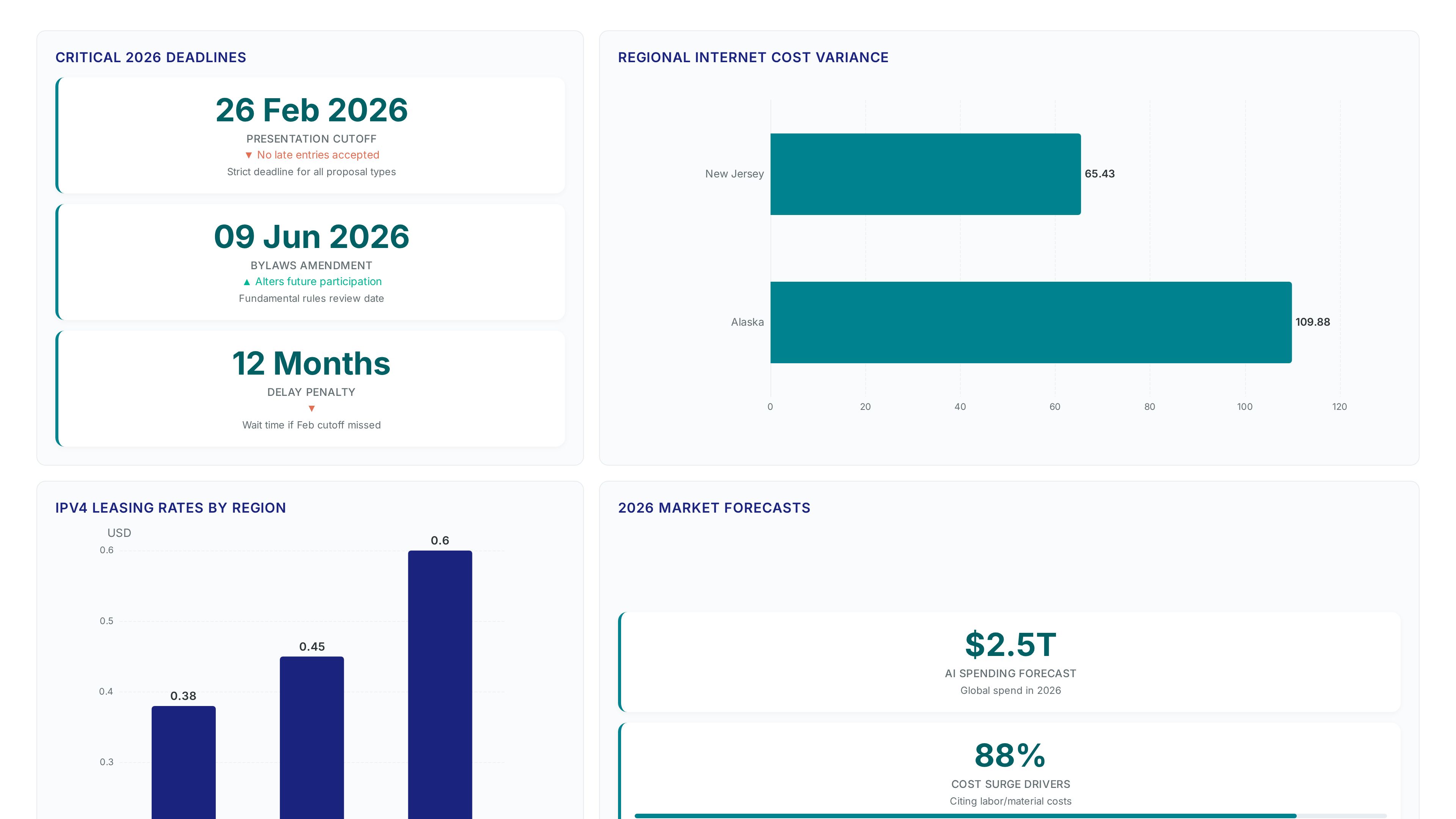
Submissions for Plenary presentations, Panels, Lightning talks, and Workshops close strictly on 26 February 2026. The SEE Programme Committee accepts proposals from individuals possessing specific expertise or insights to share regarding Internet infrastructure. Content should address emerging 2026 trends identified by analysts like Jeffrey Hewitt and Gene Alvarez from Gartner, specifically the impact of AI agents on operations.
- Draft a proposal abstract focusing on hybrid computing or routing security implementations.
- Verify alignment with community priorities before the hard deadline arrives.
- Submit the final document through the official portal immediately.
Operators ignoring this window miss the chance to shape regional discourse before the Customer Standing Committee reviews related governance amendments. A second critical date involves Fundamental Bylaws Amendments due by June 9, 2026, which may alter participation rules for future cycles. Late entries face automatic rejection without appeal, creating a hard barrier for unprepared vendors. Missing the February cutoff forces organizations to wait until the next cycle, delaying knowledge exchange by twelve months.
Executing Proposal Submission for AI and Hybrid Computing Trends
Submit your proposal now through the official portal before the 26 February 2026 deadline to secure a speaking slot.
- Draft an abstract detailing how AI agents reshape Infrastructure and Operations by delivering quicker outcomes despite tool sprawl (outcomes).
- Align content with hybrid computing strategies that orchestrate diverse and incompatible compute environments (orchestrating).
- Validate that the submission format matches Plenary, Panel, Lightning talk, or Workshop requirements set by the SEE Programme Committee.
- Confirm receipt via email before the window closes to avoid disqualification.
Global spending on artificial intelligence is forecast to reach approximately $2.5 trillion in 2026, creating urgent demand for infrastructure insights (trillion). Proposals ignoring this economic shift risk rejection due to misalignment with current operator priorities. The workflow has a strict cutoff; late entries receive no consideration regardless of technical merit. Treat the submission portal as a hard gate rather than a flexible interface.
Visit the event page for further details regarding SEE 14 logistics and venue specifications. InterLIR recommends finalizing drafts early to accommodate peer review feedback before the final upload. Missing the deadline eliminates visibility for entire teams seeking to share routing security innovations.
About
Evgeny Sevastyanov serves as the Support Team Leader at InterLIR, a specialized IPv4 marketplace headquartered in Berlin. His daily responsibilities involve managing critical RIPE database objects and guiding clients through complex IP leasing processes, making him uniquely qualified to discuss the upcoming South East Europe Meeting. As a professional based in Varna, Bulgaria, Sevastyanov possesses direct insight into the region's specific infrastructure challenges and the expanding demand for IPv4 resources across the Balkans. His hands-on experience ensuring clean BGP announcements and regulatory compliance aligns perfectly with SEE 14's focus on technical knowledge sharing among engineers and regulators. Through his work at InterLIR, he actively supports the development of the local IT sector by facilitating access to necessary network assets.
Assuming universal readiness now invites systemic failure. The remaining connectivity gap represents the most difficult infrastructure to upgrade, not the easiest. Organizations continuing to treat these summits as mere networking opportunities without addressing this stagnation will face rising operational costs when legacy translation layers like 464XLAT become maintenance burdens rather than transition tools.
You must pivot your strategy from general participation to targeted technical contribution by Q4 2027, specifically focusing on solutions for stalled regions rather than mature markets. Do not wait for the next cycle to assess your readiness; the window for influencing the 2026 agenda closes sooner than the the deadline suggests. Start by auditing your internal IPv6 deployment metrics against a modest growth baseline this week to identify exactly where your infrastructure stalls. If your data shows similar flattening, rewrite your proposal abstract immediately to address this specific bottleneck instead of generic AI trends. This immediate diagnostic step ensures your submission offers tangible value to operators facing diminishing returns, securing your relevance before the portal locks.
Frequently Asked Questions
Registration for the SEE 14 meeting is completely free for all attendees. This contrasts sharply with general industry summits that often charge fees of $1,500 or more for similar access.
Northern Europe achieves 97.7% penetration while Central Asia stalls at 82.0%. This 15.7% connectivity gap persists in emerging markets and threatens regional stability if left unaddressed by engineers.
SEE 14 focuses on technical tutorials rather than vendor sales pitches found elsewhere. Generic summits cost $1,500 yet often ignore the specific configuration nuances required for complex routing security implementations.
Attendees learn strategies to bypass the 4 billion IPv4 address ceiling using IPv6-only architectures. This avoids monthly leasing rates ranging from $0.38 to $0.45 per IP address globally.
The global IPv6 adoption hitting 50% necessitates using 464XLAT and DS-Lite for IPv6-only cores. These mechanisms allow operators to maintain connectivity as organic growth targets vanish rapidly.