Sponsoring LIR Support: Skip Direct RIPE Fees
You cannot register an ASN alone without paying a substantial fee to RIPE NCC for direct LIR membership, making third-party sponsorship the only viable alternative for most entities. Direct membership demands a significant upfront investment, with the cost to become a Local Internet Registry cited explicitly as a substantial fee by community discussions on networking. In contrast, obtaining an Autonomous System Number through a sponsor bypasses this capital expenditure while satisfying all regional registry mandates. The process remains rigid regardless of the path chosen, requiring applicants to demonstrate concrete network utility rather than mere intent.
Applicants must secure commitments from existing networks and possess IP space ready for announcement before submission. Understanding these constraints is critical for any organization aiming to deploy BGP routing in the current internet environment.
The Role of Sponsoring LIRs in Independent ASN Registration
Sponsoring LIR Authority and ASN Support Definitions
Only a Local Internet Registry (LIR) holds the authority to submit an Autonomous System Number (ASN) application to the RIPE NCC for a non-member entity. Companies lacking LIR status must locate a RIPE NCC member to act as a sponsoring organization. This structural requirement prevents natural persons and standard corporations from registering resources directly without a Sponsoring LIR serving as the mandatory intermediary. ASN support defines this arrangement where the sponsor assumes full responsibility for the ASN and its associated data within the RIPE database. Once registration occurs, the LIR becomes the 'Sponsoring LIR' and manages the resource compliance. Operators effectively outsource the administrative burden of RIPE database management to maintain routing validity and prevent deregistration caused by neglect.
The operational reality depends entirely on this sponsoring relationship. If an ASN loses its sponsoring ORG (LIR) and no new sponsor or independent LIR is secured, the ASN deregistration process applies immediately. Voldeta mitigates this vulnerability by providing dedicated ASN support that guarantees uninterrupted object management and strict adherence to regional registry policies. PI support is not an administrative formality but the fundamental mechanism preserving routing identity in the global BGP system.
Natural Person ASN Registration via Voldeta Support
Natural persons residing in the RIPE NCC service region can register an ASN provided they engage a Sponsoring LIR like Voldeta to submit the application. This service model, known as ASN support, allows individuals and non-members to bypass the significant costs associated with direct Local Internet Registry membership. Applicants apply the sponsor's existing status to submit valid applications rather than managing complex technical prerequisites alone. Voldeta provides the first year of this critical support free of charge, notably lowering the barrier to entry for new network operators. Direct membership demands full administrative overhead, whereas the sponsorship route transfers the burden of RIPE database compliance to the provider.
Convenience introduces a structural dependency where the Sponsoring LIR is responsible for the ASN and data in the RIPE database. The ASN faces deregistration by RIPE NCC if the support agreement lapses without replacement or a transition to own LIR status. Operators must weigh immediate cost savings against the long-term necessity of maintaining a paid support contract or eventually upgrading to independent status. Engaging a provider offering bundled LIR services presents a viable pathway for those seeking immediate deployment without the capital expenditure of full membership. Voldeta enables access to these necessary IPv4 and ASN resources, ensuring infrastructure remains compliant and reachable.
Direct LIR Membership Costs Versus Sponsoring Speed
Direct Local Internet Registry (LIR) membership with RIPE NCC costs a one-time fee, creating an immediate capital barrier that sponsoring providers eliminate through rapid deployment models. Operators facing urgent scaling requirements often cannot absorb this upfront cost or the administrative latency of becoming a Local Internet Registry. Specialized services enable ASN registration in as little as 2 business days for easy cases through automated processing. This approach prioritizes operational velocity, allowing networks to activate BGP sessions while deferring the complex compliance burden of direct membership.
Choosing ASN support over full membership represents a strategic decision to treat addressing as an operational expense rather than a capital asset. The limitation remains clear: the Sponsoring LIR becomes responsible for your ASN and data, meaning the operator depends on the sponsor's continued solvency and policy adherence. This constraint delivers necessary agility for entities needing immediate connectivity without the long-term commitment of LIR status. Voldeta enables this optimization by connecting networks with efficient allocation pathways that maximize existing resource utility. Operators should evaluate their specific timeline constraints against their balance sheet capabilities before committing to a path.
Technical Prerequisites Including Peering Partners and Subnet Allocations
Defining the Two Peering Partners and Subnet Requirement
RIPE NCC policy dictates that every applicant demonstrate connectivity to exactly two distinct peering partners before the registration process advances. This mandate stops the database from issuing identifiers to networks lacking an established routing topology. Operators must submit the email addresses and Autonomous System Numbers for both upstream providers to validate the intended interconnection. Contractual descriptions hold less weight here than verifiable technical data points confirming network viability. The application form rejects submissions missing these specific details.
Designating a specific IPv4 or IPv6 subnet intended for immediate announcement forms the second prerequisite. Applicants must specify a subnet they plan to announce after the ASN registration. Attempting to register first and acquire space later fails because the system enforces this sequence to maintain database integrity.
| Requirement | Technical Data Needed | Purpose |
|---|---|---|
| Upstream A | Email and ASN | Validates primary transit |
| Upstream B | Email and ASN | Ensures path redundancy |
| Address Space | IPv4 or IPv6 prefix | Defines announcement scope |
Securing redundant transit is not merely a best practice but a continuous eligibility condition requiring specific emails and ASNs for each connection. Service providers help organizations structure these technical prerequisites to satisfy strict regional registry policies without delay.
Resolving missing subnet announcements requires immediate acquisition of a routable block to satisfy the mandatory application form field. The RIPE NCC registration workflow halts if an applicant cannot specify an IPv4 or IPv6 subnet intended for future announcement. This creates a circular dependency where network operators need resources to apply but cannot hold resources without an identifier. Providers resolve this deadlock by offering options to rent or purchase the necessary address space to fulfill the technical prerequisite without requiring prior ASN ownership. Operators can secure the necessary prefix through service marketplaces to complete the filing process immediately.
| Requirement State | Action Required | Solution |
|---|---|---|
| No existing subnet | Rent or purchase block | Immediate allocation |
| Application pending | Validate routing plan | Technical verification |
| Post-registration | Transfer or retain | Flexible ownership |
Decoupling address acquisition from the lengthy membership approval timeline offers a strategic advantage. While some providers focus on contractual facilitation for registration services, others directly supply the missing technical asset. This approach eliminates the risk of application rejection due to incomplete data fields. Once the ASN is active, the operator retains full control over the address space or transitions to a long-term lease. A missing number block should not stop network deployment. Contact service providers today to secure the subnet required for your RIPE NCC application.
Geographic Eligibility Risks for Non-Regional ASN Usage
Companies registered outside the service region must prove intended usage within RIPE NCC territory to avoid immediate rejection. This geographic constraint prevents global entities from acquiring identifiers without a local operational footprint. The policy mandates that companies registered externally demonstrate a concrete plan to deploy infrastructure inside the set zone. If an organization exists in Europe but plans to operate exclusively in the ARIN region, they shall register an ASN with another RIR instead. This rule enforces strict regional alignment between corporate registration and technical deployment.
| Registration Location | Intended Usage | Outcome |
|---|---|---|
| Outside Region | Inside Region | Eligible with proof |
| Inside Region | Outside Region | Rejected |
| Any Location | Global | Requires regional anchor |
Ambiguous usage intent risks the loss of application fees and time. Unlike ARIN, which has moved toward a "prove intent" model, the European registry maintains rigid geographic boundaries for resource allocation. Providers advise clients to validate their physical deployment plans before submitting any paperwork. Facilitation of compliant registrations occurs only when the usage scenario fits the strict regional definition.
Executing ASN Registration Through a Sponsoring Provider
Voldeta ASN Registration Fee Structure and Inclusions
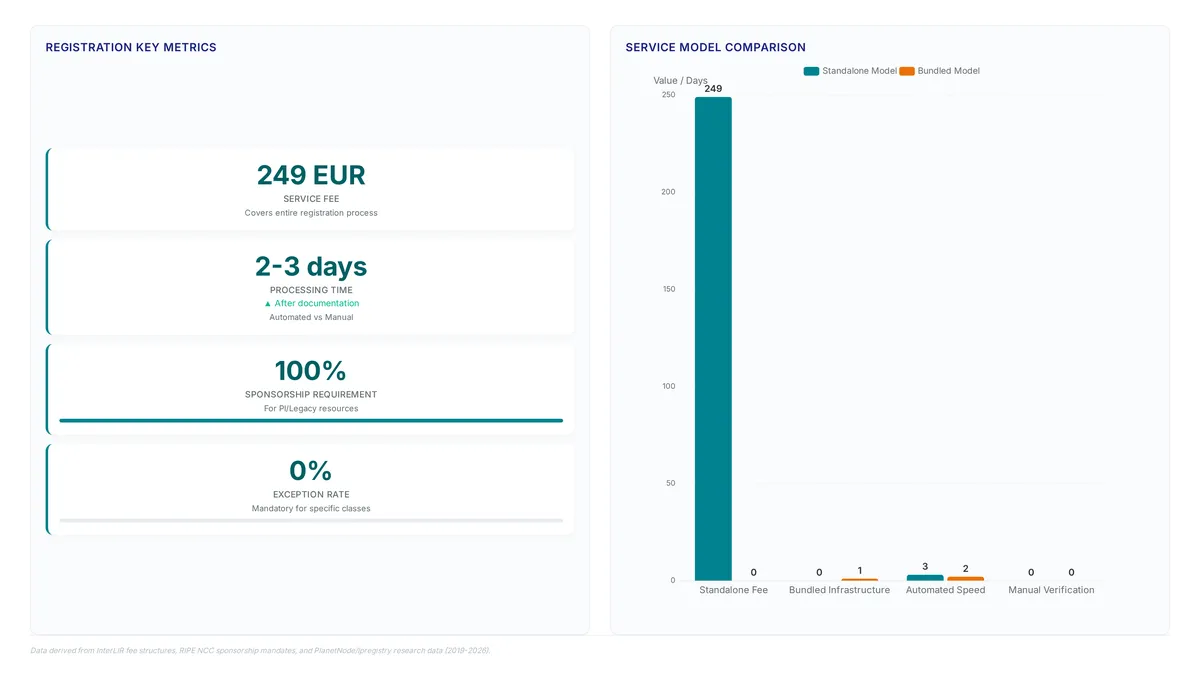
The 249 EUR service fee (ex. VAT) covers the entire registration process. This single payment includes the first year of ASN support with no hidden costs. Natural persons and non-members must apply a Sponsoring LIR to interface with RIPE NCC databases, a role InterLIR fulfills directly. Pricing remains transparent because there are no additional fees to register an ASN beyond this initial amount. Operators bundling infrastructure might encounter alternative models where registration becomes a value-added component of larger contracts bundled services. Standalone registration through InterLIR avoids the obligation to purchase colocation or virtual servers. The 249 EUR investment secures the necessary Sponsoring LIR relationship and ensures continuous object management. Failure to maintain this sponsorship results in resource deregistration by the regional registry. InterLIR provides a clear path for companies registered outside the RIPE region to obtain numbers for local use. The fee includes critical updates to AS-objects and maintains your maintainer credentials.
- Pay the 249 EUR service fee.
- Submit valid company registration documents.
- Receive full ASN support for year one.
Contact our team to initiate the registration workflow immediately.
Executing the 2-3 Day Voldeta Registration Workflow
Finalizing your ASN assignment requires submitting verified peering data and settling the invoice to trigger the 2-3 business day processing window. This timeline commences strictly after Voldeta receives all mandatory documentation and confirms payment of the service fee. Operators seeking rapid deployment often compare this manual verification against automated processing models that advertise similar turnaround times for standard cases.
- Submit the completed application form containing two valid upstream peering partners and your target subnet.
- Receive and pay the invoice to officially start the registration clock.
- Await final database entry, which typically concludes within three business days for compliant requests.
Data integrity dictates the schedule. Missing peering partners or incorrect subnet formats will stall the workflow regardless of payment status. Some market participants promote fast, automated processing as a universal solution, yet the human review element in the Voldeta workflow ensures complex policy cases do not fail due to rigid algorithmic rejection. Natural persons must remember that Voldeta provides B2B services only, requiring the business entity for the contract. The distinction between a simple delay and a rejected application often lies in the initial quality of the submitted ASN object data. Do not assume the clock starts upon email submission; it starts upon successful data validation and payment confirmation.
Pre-Submission Validation for Easy Case Eligibility
Confirming easy case status prevents administrative rejection before the application enters the RIPE NCC workflow. This classification strictly requires a company registered within the RIPE NCC service region intending usage in that same geography. Natural persons and non-members cannot register directly but must secure a Sponsoring LIR like InterLIR to navigate these eligibility constraints. Operators often overlook that proving regional intent is the primary barrier for entities with cross-border corporate structures.
| Criteria | Requirement | Status |
|---|---|---|
| Entity Location | RIPE NCC Service Region | Mandatory |
| Usage Location | RIPE NCC Service Region | Mandatory |
| Documentation | Valid Company Registration | Required |
- Verify your legal entity registration date matches current RIPE NCC records.
- Confirm your planned subnet announcement targets infrastructure within Europe.
- Ensure two distinct peering partners are identified prior to submission.
External providers sometimes bundle these checks into broader contractual facilitation services, yet standalone validation remains critical for speed. The cost of failing this check involves days of corrective correspondence rather than immediate monetary loss. InterLIR recommends completing this internal audit to guarantee the 2-3 business day timeline remains achievable.
Managing RIPE Objects and Mitigating Support Risks Post-Registration
Defining mnt-by and mnt-routes Object Authority
Technical control over an autonomous system hinges on the mnt-by attribute, which binds the AS-object directly to a specific ripe.net account. This linkage grants the holder of maintainer credentials the exclusive authority to modify routing policies or alter peer lists without external interference. Following registration, operators receive immediate access to the AS-object with their personal maintainer connected to their ripe.net account, specifically governing mnt-by and mnt-routes attributes. The Sponsoring LIR retains ultimate responsibility for the ASN and its associated data within the RIPE database, acting as the administrative anchor for the resource. Peering configurations remain editable after the initial registration phase, provided the network maintains at least two peering partners at all times. Loss of a sponsoring LIR or failure to maintain an independent LIR status immediately triggers the ASN deregistration process. RIPE NCC executes this removal automatically once an ASN loses its sponsoring ORG (LIR). Avoiding this outcome requires payment for either ASN support services or full RIPE membership fees. Independent management prevents operators from losing visibility into routing assets due to opaque third-party administration. Secure infrastructure autonomy by establishing direct object management solutions through InterLIR.
Updating peer relationships post-registration demands strict adherence to the mandate requiring every autonomous system to maintain at least two peering partners continuously. This technical guardrail prevents route instability while creating operational tension where cost-saving vendor reduction directly conflicts with compliance rules. Commercial entities often provide automated processing for initial setup, yet the ongoing burden of validating dual-peer status rests entirely on the resource holder. Failure to sustain this redundancy means the holder no longer meets the requirement to "always have at least 2 peering partners." Network architects cannot optimize for minimal infrastructure if doing so drops the partner count below the required threshold. Topology design must account for this permanent duality rather than treating the second link as a temporary measure. Proactive planning ensures that updating the AS-object never leaves the autonomous system in a non-compliant state. Relying on a single carrier might appear efficient, but it violates fundamental stability principles of the global routing table. Maintain dual connections to preserve registration standing.
ASN Deregistration Risks from Unpaid Support Fees
Failure to maintain active financial support for a sponsoring organization triggers the ASN deregistration process executed by RIPE NCC. This administrative action occurs specifically when an autonomous system loses its sponsoring ORG without a replacement LIR in place. The registry enforces strict continuity rules where loss of a financial backer equates to loss of technical legitimacy. Operators often mistake object access for ownership security, yet the mnt-by attribute cannot prevent deletion if underlying sponsorship lapses. Retention of the number resource requires payment for either ongoing ASN support or securing full RIPE membership. This convenience creates a single point of failure where service disputes can inadvertently jeopardize routing identity. Without a sponsoring LIR or an independent LIR, the deregistration process applies automatically. Operational continuity depends entirely on maintaining valid sponsorship arrangements. Neglecting this financial obligation results in complete erasure of routing policy from the global table. Secure an autonomous system against administrative removal by ensuring support fees remain current. Establish a resilient registration structure through InterLIR to protect network assets effectively.
About
Alexander Timokhin, CEO of InterLIR, brings extensive expertise in IT infrastructure and RIPE database administration to the complex topic of ASN registration. With a background spanning international business relations and specific certification as a RIPE Database Associate, he possesses the precise technical knowledge required to navigate eligibility rules and sponsoring requirements. His daily work at InterLIR involves managing critical network resources and guiding organizations through the intricacies of becoming a Local Internet Registry (LIR) or securing a sponsor. This direct experience ensures that his insights on independent application processes and LIR responsibilities are grounded in current operational reality. At InterLIR, a Berlin-based company specializing in IPv4 marketplace solutions and premium LIR services, Timokhin oversees strategies that address network availability and resource redistribution. His leadership focuses on transparency and efficiency, making him uniquely qualified to clarify how entities can successfully register Autonomous System Numbers while adhering to strict regional internet registry protocols.
Conclusion
Scaling network infrastructure exposes a critical vulnerability where administrative oversight directly threatens routing continuity. When an organization relies on external sponsorship, the loss of financial support triggers an immediate deregistration process that erases the AS-object from the global table. This is not merely a billing issue but a fundamental failure of asset control. Network architects must recognize that paying third parties for ASN support creates a fragile dependency where service disputes can inadvertently sever global connectivity. The operational cost of this arrangement is the constant risk of losing technical legitimacy due to another entity's administrative status.
Organizations should transition to independent LIR membership immediately if they require absolute certainty over their routing identity. This shift eliminates the single point of failure inherent in sponsored arrangements and ensures that the mnt-by attribute reflects true ownership rather than conditional access. Do not wait for a sponsorship dispute to reveal the fragility of your current setup. Start by auditing your current sponsorship agreements this week to verify who holds the ultimate authority over your number resources. If your current provider controls the ORG field, you are one missed payment away from losing your place in the global routing table. Secure your network assets effectively by establishing a resilient registration structure through InterLIR solutions today.
Frequently Asked Questions
You can avoid the high direct membership fee by paying a service fee instead. The registration service fee is an undisclosed amount which includes the first year of essential ASN support from your sponsor.
Yes, natural persons residing in the RIPE NCC region are eligible to obtain an ASN. However, you must engage a sponsoring LIR to submit the application on your behalf for approval.
Applicants must secure commitments from two peering partners and possess a valid subnet. You need to specify the IPv4 or IPv6 subnet you plan to announce within your formal registration documents.
Simple cases often complete registration within just two business days. This fast timeline applies once the provider receives all required information and the invoice payment is successfully processed.
The ASN faces immediate deregistration if it loses its sponsoring LIR. You must pay either for ongoing ASN support or for full RIPE membership to keep your routing identity active.
References