Zone transfer fees: Fix AWS NLB pricing errors
Double-crossing Availability Zones with an AWS Network Load Balancer instantly doubles your transfer bill to $0.04 per GB.
This architectural oversight silently drains budgets when traffic bounces between zones unnecessarily. Amazon Web Services confirms that routing client requests to a Network Load Balancer in a different zone, which then forwards traffic to a target back in the original zone, triggers charges at every hop. The default DNS affinity setting of 0 percent exacerbates this by distributing requests evenly across all healthy endpoints, ignoring physical proximity and guaranteeing expensive inter-zone data transfer for a significant portion of your workload.
You will learn how to calculate the precise financial bleed caused by these redundant hops and why zonal affinity matters more than uniform distribution. Finally, the guide details the execution of a migration strategy to achieve Availability Zone independence, ensuring your Amazon EC2 instances communicate locally without incurring the $0.01 per GB penalty in each direction. Stop letting AWS default settings dictate your infrastructure spend.
The Financial Impact of Inter-Zone Data Transfer on NLB Operations
AWS Inter-Zone Data Transfer Charges Explained
Cross-AZ traffic triggers a $0.01/GB levy at both the ingress and egress points of every zone boundary. This symmetric billing model means a single request-response cycle between a client and an NLB in different zones incurs a total $0.02/GB charge. The mechanism applies strictly to data crossing Availability Zone borders, whereas same-AZ communication between clients, load balancers, and targets remains free of transfer fees. Symmetry in pricing ensures that return traffic is billed identically to forward traffic, doubling the proven cost for bidirectional flows. Accumulation occurs rapidly in distributed systems where microservices span multiple zones without affinity constraints.
Real-World EKS Cluster Cost Impact Analysis
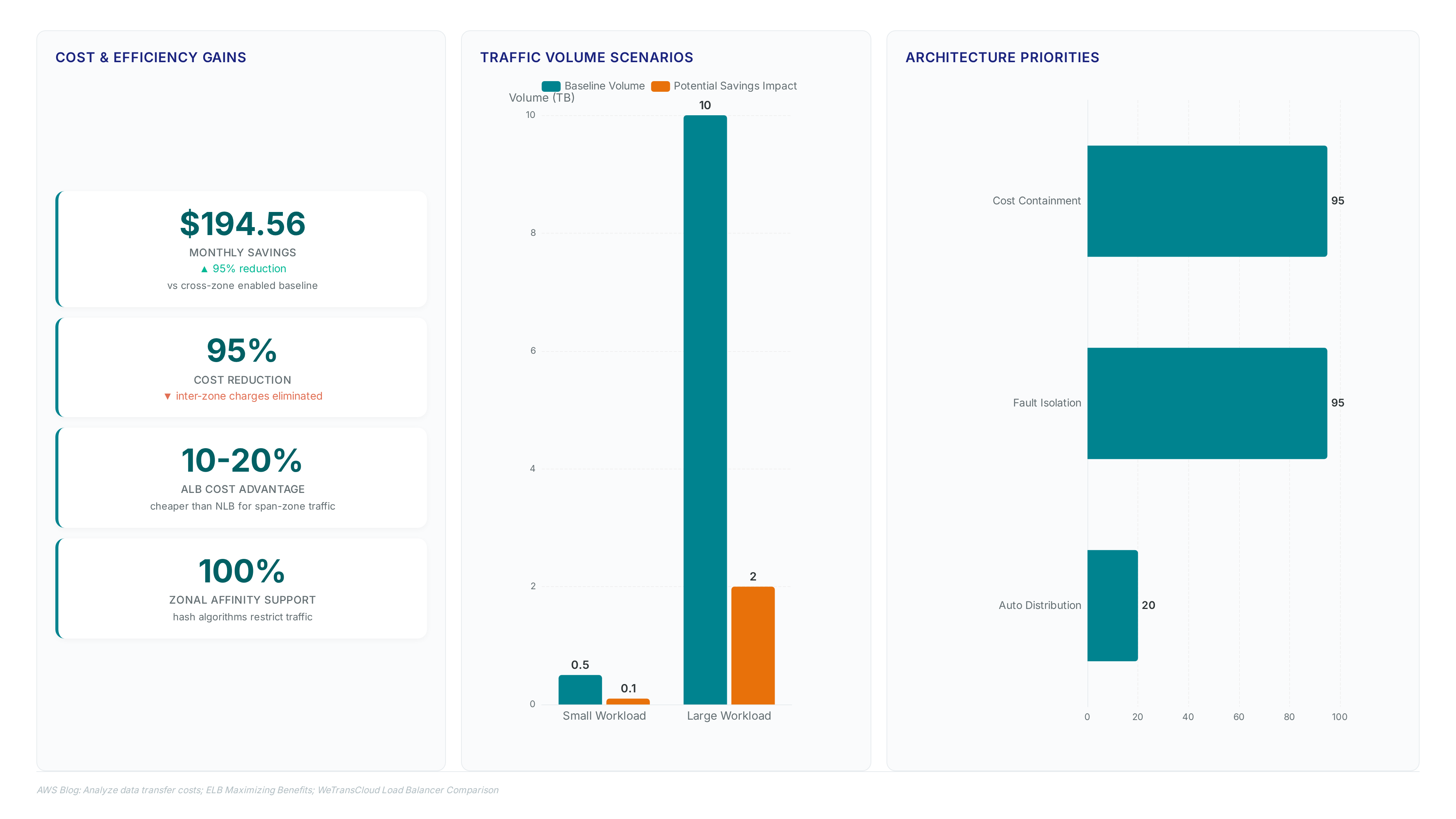
A busy EKS cluster with 50 services generates several terabytes to 10 TB of monthly inter-AZ traffic. Unoptimized flows across three availability zones trigger double-billing events at every zone boundary. Implementing zonal affinity reduces this expense to $10.24/month by confining traffic within single zones. This 95% reduction eliminates the redundant charges inherent in cross-zone replication patterns. Architecture reviews of the fictional foo service demonstrate how ingress and egress fees compound during data synchronization. Redundant storage platforms replicating data across zones without optimization effectively double the cost impact per gigabyte. The mechanism charges both the sender and receiver, creating a symmetric tax on distributed state. Operators must align target capacity with expected traffic patterns to prevent zone starvation. Uneven service placement leads to failed connections when local endpoints lack sufficient capacity. The constraint is operational complexity versus predictable billing. Failure to balance target counts manually results in availability gaps during zonal outages.
Configuring Zonal Affinity to Eliminate Cross-AZ Traffic
Availability Zone Independence requires shifting the DNS record client routing policy from the default none setting to 100% to force local resolution. The cost of this imbalance is measurable: traffic concentrates on fewer nodes, potentially requiring manual capacity adjustments via Auto Scaling groups. However, the limitation is strict: if a zone fails completely, clients in that zone lose connectivity rather than failing over to a neighbor. Unlike Azure's integrated Zone-Redundant Load Balancers, AWS requires explicit attribute modification to achieve this isolation. Teams must verify target health in every zone independently before committing to this topology.
| Routing Policy | DNS Response Scope | Traffic Pattern | Cost Implication |
|---|---|---|---|
| 0 percent (Default) | All Healthy AZs | Random Distribution | High Inter-Zone Fees |
| 100 percent | Client AZ Only | Localized Flow | Zero Inter-Zone Fees |
Enabling strict locality introduces a failure mode where DNS resolution fails if the local zone lacks healthy endpoints. The system then reverts to returning addresses from other zones to maintain availability, reintroducing the very costs the policy sought to eliminate. This fallback behavior ensures continuity but complicates capacity planning for teams targeting Availability Zone Independence. Successful deployment requires matching target capacity in each zone to expected client volume rather than relying on automatic rebalancing.
Mechanics: Inter-Zone Data Transfer Charges From Unintended Cross-AZ Target Routing
Disabling cross-zone load balancing forces each NLB node to route requests exclusively to registered targets within its own Availability Zone. This configuration creates a strict boundary where traffic entering an NLB in Zone A cannot egress to a target in Zone B, effectively siloing the data path. The mechanism relies on local target health checks; if no local targets are healthy, the node drops the connection rather than forwarding it-zone. Operators must account for the resulting asymmetry in target utilization. Without the global distribution provided by enabled cross-zone settings, traffic volume correlates directly with client proximity to specific NLB nodes.
| Configuration State | Target Routing Scope | Cost Implication |
|---|---|---|
| Disabled | Local AZ Only | Zero inter-zone fees |
| Enabled | All Registered AZs | Per-GB transfer charges |
Mitigation requires pairing Topology Aware Routing with disabled cross-zone settings to keep pods and balancers co-located. The architectural penalty for ignoring this mechanic is a permanent overhead on every byte transferred between mismatched zones.
Executing the Migration to Availability Zone Independence
Availability Zone Independence and Zonal Evacuation Strategies
Disabling cross-zone load balancing enforces strict local traffic paths to achieve Availability Zone Independence. This configuration isolates failure domains so operators can execute zonal evacuation without triggering cascading inter-AZ charges. Traffic stays contained within healthy zones during an outage instead of leaking across boundaries to incur fees. Each NLB node drops connections if local targets vanish rather than performing a silent failover to distant resources.
- Navigate to the Attributes tab for the specific load balancer.
- Select Edit under the Availability Zone routing configuration.
- Set the Client routing policy to Availability Zone affinity. 4.5. Verify that target groups maintain disabled cross-zone settings.
This approach supports zonal evacuation strategies Capacity starvation becomes a risk if one zone loses all healthy targets while others remain underutilized. Manual intervention becomes necessary to rebalance traffic during partial outages since the system will not automatically spread load across surviving zones. The architecture prioritizes cost containment and fault isolation over automatic global distribution.
Console and CLI Steps to Disable Cross-Zone Load Balancing
Disable cross-zone load balancing via the AWS Console Attributes tab or the `modify-load-balancer-attributes` CLI command to enforce local routing.
- Select the target Network Load Balancer in the EC2 console and navigate to the Attributes tab.
- Edit the configuration to set Cross-Zone Load Balancing to disabled at the load balancer level.
- Apply the change immediately to stop inter-zone backend traffic flows.
Execute the same logic programmatically to ensure configuration consistency across environments:
This action forces every NLB node to drop connections if local targets are unavailable rather than forwarding traffic to distant zones. Maintaining proportional target capacity in each Availability Zone prevents service degradation during partial outages. Client distribution must align with target density because uneven spreads cause hotspots without global pooling. AWS architectural guidance explicitly links this pattern to reducing cost Disabling the feature also impacts Client IP Preservation behaviors described in technical blogs, demanding careful validation of logging pipelines.
Real-time inter-AZ latency monitoring via the Infrastructure Performance feature in AWS Network Manager confirms successful traffic isolation.
- Enable the Infrastructure Performance module within AWS Network Manager to capture flow metrics between specific subnets.
- Filter results by Usage Type Group to isolate inter-Availability Zone transfer events from standard VPC traffic.
- Correlate latency spikes with architectural guidance
- Validate that NLBs drop connections during local target failures rather than routing cross-zone.
Application-level rack awareness complements this infrastructure check by aligning database replication with physical zones. Infrastructure Performance detects latency but does not automatically block non-compliant flows. Operators must manually adjust security groups or routing tables if the dashboard reveals residual cross-AZ hops. This validation step ensures the architecture supports true Availability Zone Independence before relying on cost projections. Configuration prevents the default behavior where Route 53 resolvers distribute any healthy NLB IP addresses across all zones regardless of client location. Operators achieve Availability Zone Independence by locking these flows, ensuring that a zonal outage triggers a local failure rather than expensive cross-zone leakage. The architectural shift supports rapid zonal evacuation strategies without incurring the hidden penalties of silent failover.
Strict locality introduces a capacity tension that demands proportional target distribution. Enabling this policy can lead to uneven traffic distribution Cross-zone load balancing masks capacity deficits by borrowing from distant zones, yet AZI forces connection drops when local resources vanish. Operators must maintain balanced client presence and target density across all active zones. AWS updated architectural guidance blogs Operators gain predictable billing and set failure boundaries but lose the automatic smoothing of traffic spikes. This configuration forces DNS resolution to return only local IP addresses, preventing the default behavior where resolvers distribute any healthy NLB IP addresses
Performance consistency conflicts with target utilization efficiency under strict locality rules. A specific NLB node may saturate if one zone hosts notably more clients while others remain underutilized. Topology Aware Routing mitigates this imbalance in Kubernetes clusters by annotating endpoints with zone information, allowing kube-proxy to route traffic locally before it reaches the load balancer. This prevents the generation of inter-AZ traffic at the network plugin level. Operators should validate improvements using the Infrastructure Performance feature in AWS Network Manager to monitor real-time inter-AZ latency metrics. A successful deployment shows zero bytes traversing zone boundaries during steady-state operation.
Operators often activate this mode to prevent target starvation, yet even distribution Billing aggregates these flows into massive monthly invoices so the financial penalty accumulates silently. Costs spiral when the load balancer node. This architecture prioritizes statistical balance over fiscal reality by assuming network capacity is infinite and free. Operational simplicity conflicts with cost control. Disabling the feature risks uneven utilization if client presence skews heavily toward one zone. Maintaining proportional target capacity per zone resolves this without incurring transfer fees. InterLIR recommends auditing target group attributes weekly to verify cross-zone settings remain disabled. Perfect load symmetry holds less value than predictable billing. The hidden cost includes the architectural debt of designing for failure modes that rarely occur while paying for them every second.
About
Evgeny Sevastyanov serves as the Head of Customer Support at InterLIR, a specialized IPv4 marketplace based in Berlin. While his daily work focuses on IP address leasing and managing RIPE database objects, his deep understanding of network infrastructure makes him uniquely qualified to analyze AWS Infrastructure Load Balancer costs. At InterLIR, Sevastyanov routinely advises clients on optimizing network architecture to ensure efficient resource utilization, a skill directly applicable to minimizing inter-zone data transfer fees. His experience troubleshooting complex connectivity issues allows him to identify how architectural patterns impact billing, particularly when traffic flows across Availability Zones. By connecting practical support scenarios with cloud cost management, Sevastyanov provides actionable insights for organizations using both dedicated IP resources and AWS services. This perspective bridges the gap between fundamental network planning and modern cloud expense optimization, ensuring businesses maintain high-availability without incurring unnecessary data transfer charges.
Conclusion
Scaling this architecture reveals that fiscal unpredictability becomes the primary bottleneck, not throughput. The operational burden shifts from managing uptime to constantly reconciling why a stable cluster incurs variable, usage-based penalties. Relying on default distribution logic assumes infinite budget elasticity, a flawed premise for production workloads running beyond the pilot phase. You must treat cross-zone routing as a paid premium feature rather than a standard reliability guarantee, activating it only when specific failover testing proves local redundancy insufficient.
Disable cross-zone load balancing immediately if your target groups maintain proportional capacity across all availability zones. Reserve the paid mode strictly for disaster recovery scenarios where zone asymmetry is unavoidable, and re-evaluate this setting quarterly during capacity planning cycles. This approach trades theoretical perfect balance for deterministic cost structures, ensuring your network bill reflects actual utility rather than architectural inefficiency.
Start by exporting your current NLB target group configurations this week to identify any enabled cross-zone attributes, then cross-reference these against your actual pod distribution metrics to calculate potential savings before the next billing cycle closes.
Frequently Asked Questions
Double-crossing zones raises the effective rate to $0.04 per GB for bidirectional flows. This happens when traffic crosses zone boundaries twice, triggering charges at every hop and significantly increasing your total monthly infrastructure spend.
Implementing zonal affinity reduces monthly expenses from $204.80 down to $10.24 for large clusters. This specific configuration change confines traffic within single zones, eliminating the redundant charges inherent in standard cross-zone replication patterns.
Shifting the DNS record client routing policy from 0% to 100% forces local resolution. This setting ensures clients connect only to load balancers in their own zone, preventing expensive inter-zone data transfer levies from accumulating.
An unoptimized EKS cluster with 50 services generates 5 TB to 10 TB of monthly inter-AZ traffic. These unoptimized flows across three availability zones trigger double-billing events at every single zone boundary encountered.
Cross-AZ traffic triggers a $0.01 levy at both the ingress and egress points of every zone. This symmetric billing model means a single request-response cycle between different zones incurs a total $0.02 charge.