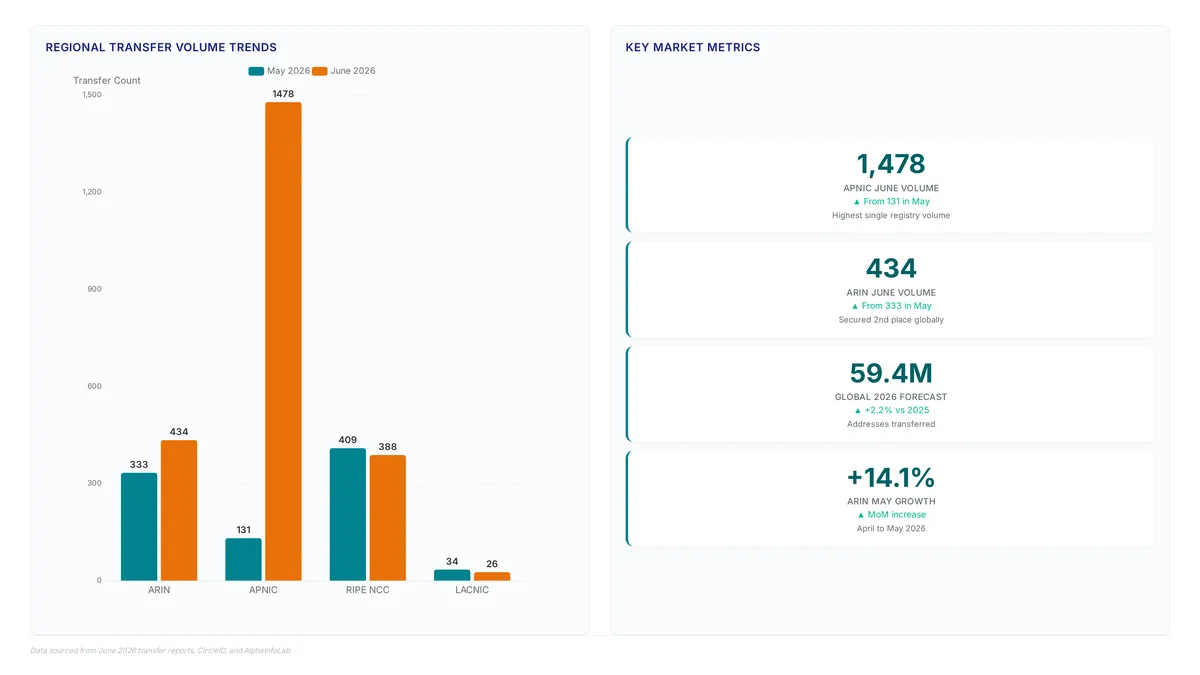
IPv4 Market Shifts: APNIC's 1,478 June Surge
APNIC transfers surged from 131 in May to 1,478 in June, defining the liquidity shock of the 2026 IPv4 market.
 Nikita Sinitsyn
8 min read
Nikita Sinitsyn
8 min read

IPv4 transfer markets, BGP routing security, RPKI adoption, and ASN governance — analysis for network operators.
APNIC transfers surged from 131 in May to 1,478 in June, defining the liquidity shock of the 2026 IPv4 market.
Nikita Sinitsyn
8 min read

With small blocks reaching $45 per unit, InterLIR helps secure clean IPv4 assets before 2026 price corrections tighten the market further.
 Vladislava Shadrina
15 min read
Vladislava Shadrina
15 min read

Stop burning cash on bad IP blocks. Validate geolocation and routing before signing any lease to avoid the 2019 RIPE NCC scarcity risks.
Nikita Sinitsyn
15 min read

RIRs enforce strict rules like ARIN's 12-month lock on new resources. Learn how these policies shape global IPv4 transfers in 2026.
Vladislava Shadrina
14 min read

The 2022 IPv4 market saw block transactions drop 28% while total addresses transferred surged 35%, per IPv4.Global data.
Nikita Sinitsyn
12 min read

APNIC draws a hard line for moving IPv4 addresses and AS numbers no longer under active management.
 Alexei Krylov
13 min read
Alexei Krylov
13 min read

Start your LIR registration for €350.00 to own a /22 IPv4 block. Eliminate third-party dependency and manage your IP resources with full autonomy.
Nikita Sinitsyn
16 min read

BGP lacks native transport layers, exposing TCP sessions. Learn to enforce prefix limits and secure IPv4 blocks against RFC 1163 flaws.
 Evgeny Sevastyanov
17 min read
Evgeny Sevastyanov
17 min read

BGP links hundreds of thousands of networks yet lacks inherent verification, leaving global data flow open to hijacks without strict validation.
Vladislava Shadrina
14 min read

BGP hijacking exploits trust flaws to redirect traffic globally in minutes, as seen when attackers stole over $160,000 in crypto assets.
 Alexander Timokhin
15 min read
Alexander Timokhin
15 min read

A single malicious announcement disrupted Google for an hour in 2018. Secure your network integrity with verified IPv4 allocations from InterLIR.
Evgeny Sevastyanov
14 min read
BGP hijacking exploits trust to redirect traffic; one attack stole $150,000 in Ethereum by announcing false prefixes to cloud providers.
Nikita Sinitsyn
13 min read