IPv4 Transfer Market: ARIN's $500 Fee Reality
With /16 block prices dropping below $20 in June 2025, the IPv4 transfer market remains a critical, albeit volatile, avenue for network expansion. As the free pool vanishes across the United States, Canada, and parts of the Caribbean, businesses must navigate a environment where carrier-grade NAT delays but does not eliminate the need for legitimate address space.
Readers will learn why the minimum transfer size of a /24 block creates a hard floor for entry and how regional internet registries enforce justification rules requiring proof of need for up to 24 months. We dissect the five-step execution plan for a compliant acquisition, detailing the necessity of ARIN Online accounts and the mandatory $500 processing fee that applies to every request. The discussion also covers the critical importance of verifying seller authority and routing hygiene to avoid inheriting tainted assets.
Despite the rise of IPv6, most networks continue running dual stacks, ensuring that IPv4 addresses retain significant operational value. However, relying on outdated assumptions about availability or pricing invites failure. By understanding the specific verification rules and documentation requirements imposed by ARIN, organizations can secure the resources they need without falling afoul of policy changes or fraudulent sellers. The path forward requires precision, not just capital.
The Role of IPv4 Transfers in Modern Network Infrastructure
Defining IPv4 Transfers and ARIN Region Scope
An IPv4 transfer constitutes the regulated reassignment of registration rights rather than the creation of new address space. This mechanism is mandatory because the ARIN region, covering the United States, Canada, and parts of the Caribbean and North Atlantic, holds no unallocated inventory for direct distribution. Organizations must acquire existing blocks through a market where the minimum transfer size is strictly enforced as a /24 block, which equates to 256 individual IP addresses. Unlike regions with flat fee structures, this jurisdiction mandates that recipients justify a documented need for address space to prevent artificial scarcity. The regulatory environment explicitly excludes reserved-pool addresses from eligibility, fundamentally limiting the available market inventory. IPv4 leasing serves as a strategic alternative for operators requiring temporary capacity without long-term capital commitment or permanent ownership obligations. InterLIR enables these compliant acquisitions by guiding clients through the complex verification of utilization proofs and seller authority.
| Feature | Requirement |
|---|---|
| Geographic Scope | US, Canada, Caribbean, North Atlantic |
| Minimum Block | /24 prefix (256 addresses) |
| Utilization Proof | Documented need justification |
| Reserved Pools | Ineligible for transfer |
Recipients must justify their need for address space, and ARIN may request documentation showing deployment plans or prior utilization metrics. The tension between immediate network expansion and rigid regulatory justification creates a barrier that only prepared entities can overcome efficiently.
Applying the 80% Utilization Rule for IPv4 Justification
ARIN mandates that recipients demonstrate 80% utilization of prior allocations or a documented plan for 50% deployment within two years. This strict threshold prevents hoarding while ensuring active networks secure necessary resources for growth. The Registration Services Agreement (RSA) legally binds the organization to these usage metrics throughout the holding period. Operators must submit detailed network diagrams and traffic projections to prove their request aligns with a genuine need. InterLIR assists entities in compiling these rigorous justification documents to satisfy regulatory scrutiny without delay. The regulatory contrast is sharp; unlike some regions, ARIN enforces needs-based validation for every single transfer transaction. A common pitfall involves submitting vague growth estimates that lack specific technical grounding or subnet-level detail. Accurate forecasting requires precise inventory management rather than speculative aggregation of address space. Businesses often underestimate the administrative burden of proving IPv4 necessity under current policies. This preparation ensures the application reflects actual operational constraints and avoids costly processing delays.
Buying Versus Leasing IPv4 Addresses Amid Price Drops
IPv4 acquisition strategies now diverge between permanent ownership and temporary rental models. Market data indicates that in June 2025, the average price per address for /16 blocks fell below $20 for the first time since 2019, altering the capital expenditure calculus for network operators. This price point suggests that purchasing may offer superior long-term value compared to recurring lease payments, provided the organization can satisfy the strict justification rules mandated by ARIN. Conversely, leasing provides an alternative path for those seeking flexibility. The market is increasingly moving towards a model where leasing serves as a viable option alongside buying, reflecting a broader trend towards flexible consumption models for internet resources. Operators must weigh the factors of how long they need the space and how much control they want when choosing between these models. Leasing offers a different set of considerations regarding duration and control. InterLIR enables both pathways, ensuring clients navigate these regulatory frameworks efficiently to secure necessary network capacity. Organizations should evaluate their specific timeline and compliance readiness before committing to either transfer mechanism.
Inside the ARIN IPv4 Transfer Workflow and Verification Rules
ARIN's 24-Month Supply Justification and Documentation Rules
Recipients must justify their need for up to a 24-month supply of IPv4 addresses to satisfy regional policy. This regulation prevents operators from purchasing available blocks without proving future deployment plans. ARIN may require documentation showing deployment plans so addresses get utilized efficiently. Verification examines whether technical roadmaps align with the requested block size rather than accepting broad business assertions.
| Requirement Type | Documentation Focus | Common Failure Mode |
|---|---|---|
| Future Need | Projected growth metrics | Vague expansion claims |
| Current Usage | RDAP utilization records | Unsubnetted legacy space |
| Prior History | Previous allocation efficiency | Missing utilization reports |
Operators attempting to acquire resources without demonstrating sufficient need face rejection or reduced allocation sizes. The strict needs-based reality means a company must substantiate their requirement for the full duration of the requested supply. Documentation hurdles stop speculative hoarding but complicate rapid scaling for organizations with fluid development cycles. Organizations should prepare granular network diagrams before initiating transfer requests to ensure compliance with these rigid.
Verifying Transfer Status and Block Eligibility via RDAP
RDAP queries return the authoritative registration status and origin details for every candidate IPv4 block. Operators must confirm that potential acquisitions meet the strict /24 minimum size before initiating any purchase agreement, as the minimum transfer size is a /24. The protocol explicitly flags reserved ranges, ensuring that addresses covered under specific policy sections remain excluded from the secondary market.
| Validation Check | Requirement | Failure Consequence |
|---|---|---|
| Prefix Length | Minimum /24 size | Immediate rejection |
| Pool Status | Non-reserved only | Ineligible for transfer |
| Holder Record | Verified owner | Authorization denied |
Buyers apply these RDAP records to pre-validate inventory, preventing clients from wasting the non-refundable $500 processing fee on invalid blocks. A common oversight involves assuming that visible routing equals transfer eligibility; many routed blocks belong to permanent reserved pools and cannot change ownership. This distinction separates viable assets from stranded resources that offer no path to regulatory approval. Businesses relying on unverified listings risk significant delays while attempting to rectify status errors post-transaction. Secure your expansion by verifying block eligibility through direct protocol inspection rather than trusting third-party claims. It is recommended to perform this technical due diligence before signing any sales contract.
ARIN Needs-Based Testing Versus RIPE NCC Transfer Hub Dynamics
ARIN mandates proof of a 24-month supply need, whereas RIPE NCC imposes no such needs-based requirements. This regulatory divergence creates distinct operational constraints for network operators acquiring IPv4 resources. The United States and Canada fall under strict scrutiny where documentation must validate specific deployment timelines. In contrast, the European region functions as a transfer hub, attracting capital and address blocks from more restrictive jurisdictions. Market observations confirm that this policy gap drives pricing disparities and cross-regional valuation shifts.
Sellers and buyers must ensure documentation meets the granular project milestones required for ARIN approval. Generic business plans frequently fail the needs-based test, causing significant delays in transaction finalization. Assistance is available to help clients structure compliant justification documents that satisfy these rigorous verification.
| Feature | ARIN Region | RIPE NCC Region |
|---|---|---|
| Justification | Strict 24-month proof | None required |
| Market Role | Regulated consumer | Global transfer hub |
| Documentation | Detailed deployment plans | Minimal paperwork |
The tension between liquidity and compliance defines the current market state. Operators seeking rapid expansion face a choice: endure the lengthy ARIN validation process or navigate complex inter-regional transfers. Inter-RIR transfers can only be conducted between Regional Internet Registries that share reciprocal, compatible policies. InterLIR mitigates this risk by pre-validating seller documentation against current policy frameworks before agreements are signed. This proactive approach prevents the rejection of transfer requests due to incomplete technical roadmaps. The cost of non-compliance is a frozen asset and lost capital opportunity.
Executing a Compliant IPv4 Acquisition in Five Steps
Defining the Five-Step ARIN Transfer Workflow
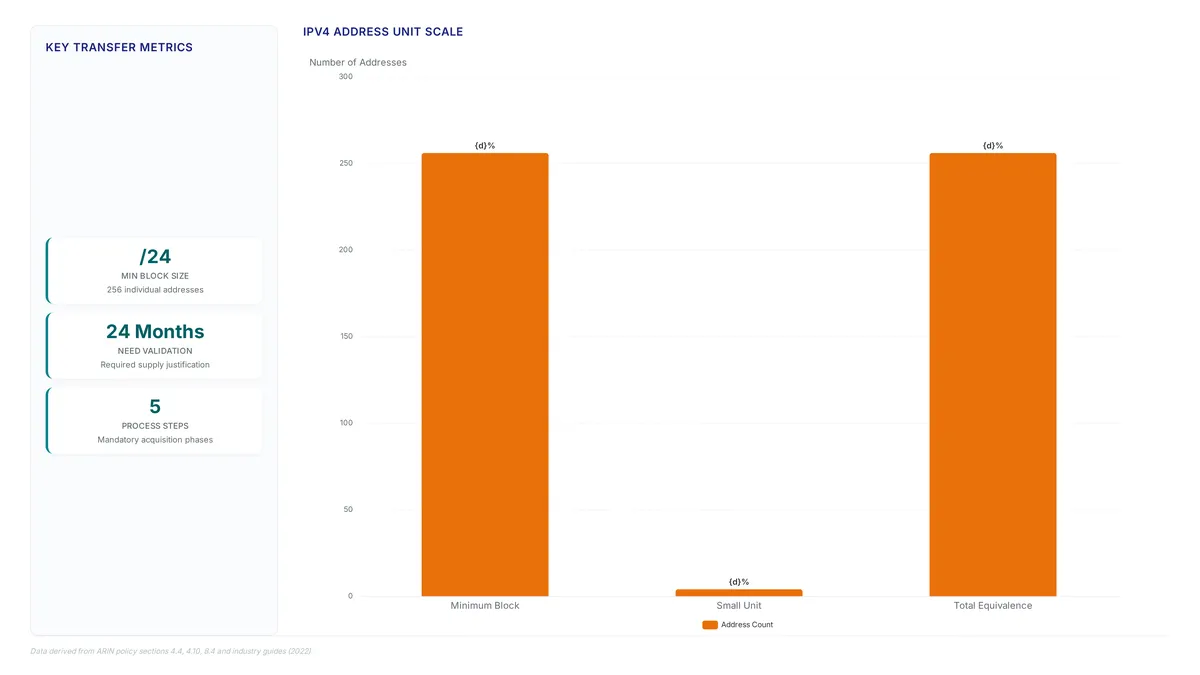
Acquiring IPv4 space begins with establishing a verified ARIN Online account and organization identifier. This core action enables the pre-approval workflow required to validate a 24-month need before market engagement. The complete acquisition lifecycle proceeds through five mandatory phases:
- Create an ARIN presence and register points of contact.
- Select a compliant sourcing path via qualified facilitators or private channels.
- Perform technical due diligence on block history and routing hygiene. 4.5. Verify final registration updates in Whois and RDAP databases.com/what-is-arin-transfer-process/) scenarios where reciprocal policies apply. Direct peer-to-peer deals often apply professional escrow services to secure funds during the approval window.
Establishing an ARIN presence is a prerequisite, as the registry cannot process transfers for unverified entities. Adherence to this sequence helps prevent rejection due to administrative incompleteness. Following the correct order ensures that buyers are prepared to act when a suitable block becomes available.
Executing Seller Verification and Escrow Protocols
Operators must confirm the block is not part of the reserved pool excluded from secondary markets. Neglecting this check risks purchasing ineligible assets that ARIN will reject. The process requires verifying registration details match the alleged owner and reviewing historical blocklist data to avoid inheriting reputation damage. Financial safety relies on using an escrow service to hold capital until the registry confirms the transfer. This mechanism ensures funds are released only when the transfer completes.
- Verify the seller's legal right to transfer the specific IPv4 range.
- Audit the block for prior spam activity or policy violations.
- Deploy escrow instructions that tie fund release to ARIN approval.
- Submit the finalized transfer request with all diligence documentation.
A critical tension exists between transaction speed and security; while some may seek to accelerate deals, using escrow ensures protection if a seller fails to deliver or if the block contains hidden defects.
Identifying Transfer Red Flags and Fee Obligations.
Rejected transfers often stem from unapproved inter-RIR movements or invalid supply justifications. Warning signs include a seller unwilling to use escrow, blocks with a heavy blocklist history, and promises of instant inter-RIR transfers to or from regions that are not approved. Promises of instant cross-region transfers frequently violate established reciprocal agreements between registries. Financial planning must account for the non-refundable processing fee attached to every transaction request.
- Confirm the seller agrees to use a reputable escrow service for fund security.
- Audit the specific block for historical spam listings or routing anomalies.
- Validate that inter-RIR movements rely on existing reciprocal agreements rather than hypothetical speed.
- Budget for mandatory administrative costs before signing purchase agreements.
The tension between transaction speed and regulatory compliance creates a common failure point. Rushing a deal without verifying the 24-month supply justification guarantees administrative rejection regardless of seller reputation. This delay forces operators to restart the diligence phase while market prices fluctuate. Secure expansion requires prioritizing verified adherence over accelerated timelines. InterLIR solutions mitigate these risks by validating resource eligibility prior to market engagement.
Strategic Outcomes of Secure IPv4 Market Participation
Leasing IPv4 Space as a Temporary Alternative to Buying
Leasing IPv4 blocks offers a strategic alternative to purchasing for organizations facing short-term capacity constraints without long-term capital commitment. Direct acquisitions demand proof of need for up to a 24-month supply, whereas rental agreements provide flexibility for temporary requirements. Market intermediaries enable this approach so businesses address space as operational needs fluctuate rather than locking assets on balance sheets. Risk mitigation becomes paramount when project timelines remain uncertain or immediate connectivity is required before permanent resources are secured. The cost is higher over time, yet speed outweighs asset ownership in temporary deployment scenarios. Operators must verify that lessors maintain clean routing hygiene to avoid potential issues. InterLIR solutions optimize this decision by providing access to verified IPv4 inventory tailored for both short-term leasing and permanent acquisition strategies. Selection between models depends entirely on the specific duration of need and the organization's tolerance for regulatory overhead versus recurring expenditure.
Applying Cost and Duration Factors to IPv4 Acquisition Decisions
Operators align IPv4 procurement strategies with project lifecycles to optimize capital expenditure against regulatory constraints. Market intermediaries enable this distinction, offering pathways to address space when duration uncertainty outweighs asset accumulation benefits. Tension exists between the liquidity of leasing and the long-term value retention of purchased blocks, especially as policy frameworks evolve to support market fluidity.
| Factor | Buying Strategy | Leasing Strategy |
|---|---|---|
| Duration | Long-term supply | Short-term need |
| Compliance | Requires 24-month justification | Flexible documentation |
| Capital | High upfront investment | Operational expense |
InterLIR recommends purchasing blocks only when organizations demonstrate definitive growth trajectories requiring sustained address availability. Lessees surrender long-term equity and face potential price volatility upon contract renewal. Secure transactions depend on verifying seller authority and reviewing routing hygiene to ensure network integrity. Businesses avoid over-provisioning while maintaining strict adherence to regional registry mandates by evaluating the specific time horizon of network requirements.
Avoiding Blocklist History and Escrow Risks in IPv4 Transfers
Acquiring IPv4 blocks with heavy blocklist history presents significant challenges for network operators. Blocks flagged for poor reputation lead to connectivity issues, necessitating costly remediation efforts. The financial allure of discounted addresses frequently masks these latent liabilities, creating a false economy for uninformed buyers. Sellers refusing escrow services present a severe warning sign indicative of problematic transfers. Secure transactions apply escrow to ensure that funds are released only when the transfer completes. Market intermediaries identified as leading entities in 2026 emphasize that bypassing this protection exposes buyers to capital loss without recourse leading marketplace
| Risk Factor | Consequence | Mitigation Strategy |
|---|---|---|
| Blocklist History | Routing hygiene issues | Full reputation audit pre-purchase |
| No Escrow | Capital loss, failed transfer | Mandatory third-party escrow |
When evaluating buy vs lease IPv4 addresses options, organizations must recognize the importance of due diligence regardless of the acquisition method. Lessors often maintain hygiene to protect their broader inventory, whereas private sellers may offload toxic assets. InterLIR recommends rigorous due diligence on routing history before any commitment. Buyers prioritizing lowest upfront cost without verifying history or escrow terms compromise their entire network perimeter. Secure acquisition protocols remain the single most effective control against inheriting another operator's compliance failures.
About
Evgeny Sevastyanov serves as the Customer Support Team Leader and Account Manager at InterLIR, a specialized IPv4 marketplace headquartered in Berlin. His daily work directly addresses the critical challenges of IPv4 address transfer discussed in this article. Leading the support team, Evgeny manages complex technical processes including the creation of objects in RIPE and APNIC databases, ensuring that every transaction maintains clean BGP routes and verified IP reputation. This hands-on experience with the mechanics of IP resource redistribution positions him to explain why businesses in the ARIN region and beyond must navigate the transfer market as free pools dwindle. At InterLIR, his team enables secure, transparent IPv4 leasing and purchasing solutions, helping organizations in sectors like telecommunications and cloud services acquire the necessary network resources they need without hidden fees or intermediaries. His expertise bridges the gap between high-level market demand and the precise technical execution required for successful address acquisition.
Conclusion
Scaling IPv4 acquisitions reveals that regulatory compliance often breaks before technical integration does. While market prices for /16 blocks have dipped, the operational cost of validating a 24-month deployment plan remains high for unprepared teams. Organizations cannot simply purchase addresses and hope for approval; they must prove immediate utility or face rejection from regional registries. The window for acquiring cheap inventory without a verified utilization strategy is closing as auditors tighten scrutiny on documented need.
Buyers should mandate a full reputation audit and escrow protection for every transaction, regardless of block size. Relying on seller assurances without independent verification invites routing failures that cost far more than the initial savings. InterLIR advises securing escrow services immediately to mitigate capital risk, especially as non-compliant transfers increase in frequency. This approach ensures that financial outlays align with strict regional policies regarding 80% utilization thresholds.
Start by auditing your current allocation utilization rates against registry requirements this week to establish a baseline for any new purchase. This data becomes the foundation for your justification document, ensuring you meet the rigorous standards required for approval. Secure your network's future by treating address hygiene as a critical operational asset rather than a secondary concern. InterLIR provides the specialized framework needed to navigate these complex transfers safely and efficiently.
Frequently Asked Questions
You must demonstrate 80% utilization of your existing blocks to qualify. Failing this metric requires a documented plan showing 50% deployment of new space within two years to proceed.
Every transfer request requires a mandatory $500 processing fee that is non-refundable. This cost applies even if the transaction fails due to invalid blocks or missing documentation from the seller.
The minimum transferable unit is a /24 block containing 256 addresses. This hard floor prevents buyers from acquiring smaller fragments and ensures all market participants meet baseline inventory requirements for network operations.
No, reserved-pool addresses are explicitly ineligible for transfer in the secondary market. This restriction limits total available supply and forces buyers to seek inventory solely from existing private holders or facilitators.
Average prices for /16 blocks dropped below $20 per address in June 2025. This shift alters budget planning for large acquisitions while strict justification rules for a 24-month supply remain unchanged.
References