Autonomous System Number Lookup: Map Real Paths
An Autonomous System Number uniquely identifies a network operator like an ISP or cloud provider on the internet backbone.
Global routing integrity hangs on Autonomous System Numbers. These integers are not just labels; they are the anchors for BGP routing data structures that define every path your traffic takes. Engineers use ASN data to map infrastructure and detect threats because the alternative-trusting raw IP addresses-is blind faith.
The ShowMyIP team notes that valid identifiers span 16-bit ranges up to 65,535 and 32-bit values starting at 65,536. Possessing an ASN means an entity controls its own routing and peering. This separates them from organizations that simply lease IP blocks. That distinction is the difference between steering your own ship and hoping your upstream provider doesn't drift. Analyzing modern lookup utilities lets security teams link disparate IP addresses to a single network operator, revealing the true scope of potential threats or outages.
The Role of Autonomous System Numbers in Global Routing
An Autonomous System Number acts as the unique identifier for a network within global routing tables. This label allows large organizations, ISPs, and cloud providers to manage interconnections without chaos. Assigning a distinct value to each administrative domain keeps BGP routing tables organized so traffic reaches the correct next hop without confusion. Operators apply these integers to separate their infrastructure from peers on the internet backbone. Major network operators like ISPs and large tech companies rely on this system to maintain strict control over their IP prefixes.
The ShowMyIP tool automatically determines the ASN from any IP address by querying global routing databases. Validating network paths and securing infrastructure against hijacking threats requires this capability. Possessing an ASN implies full routing responsibility. Organizations without one must rely on upstream providers for path selection. This distinction creates an operational divide where only entities with their own number can enforce granular peering policies. InterLIR enables access to the necessary IPv4 resources to support these independent routing architectures. Understanding the specific registration details and organization name linked to an identifier is the first step in mapping internet topology accurately.
Applying ASN Data for BGP Routing Analysis and Firewall Rules
Network operators apply ASN data to validate path ownership and enforce precise firewall rules. This mechanism allows engineers to distinguish between legitimate traffic sources and potential hijacking attempts by mapping IP blocks to their governing entities. By querying regional internet registries, a team can retrieve the Organization Name, Country, and specific IP Ranges associated with a suspicious prefix. This intelligence transforms raw logs into actionable context for security operations.
SOC teams often use this workflow to block entire autonomous systems associated with known bad actors rather than individual IPs. However, relying solely on ASN blocking carries the risk of collateral damage if a legitimate provider shares infrastructure with malicious entities. Precision matters more than volume here.
Public vs Private ASN Ranges and IP Block Ownership Distinctions
Public Autonomous System Numbers enable global BGP propagation. Private ranges remain confined to internal network borders. Organizations must distinguish between holding IP address space and possessing the routing authority that an ASN provides. An entity can own IP blocks without an ASN by using a provider's routing infrastructure for transit. This separation means IP ownership does not inherently grant control over the global routing table or peering policies.
Private ASN ranges, specifically 64512-65534, are reserved for internal use. These values must be stripped before advertisements reach the public internet. Confusing these scopes leads to route leaks where internal topology becomes visible externally. Never let a private identifier bleed into the global view.
Inside BGP Routing and ASN Data Structures
16-bit vs 32-bit ASN Identifiers and BGP Scope
The original BGP protocol specification restricted AS Numbers to 16-bit integers, capping the global namespace at 65,535 unique identifiers. This legacy constraint forced the industry to adopt 32-bit ASN expansions, pushing the identifier range beyond 65,536 to accommodate exponential internet growth where the older space is exhausted. Operators analyzing routing tables must now distinguish between these legacy values and modern four-byte identifiers to correctly parse the AS path attribute. AS Numbers are typically 16-bit (1-65535) or 32-bit (65536+) identifiers.
| Feature | 16-bit ASN | 32-bit ASN |
|---|---|---|
| Range | 1 – 65,535 | 65,536 – 4,294,967,295 |
| Format | Integer | Integer |
| Capacity | Exhausted | Scalable |
| Adoption | Legacy/Small ISPs | Global Backbone/Cloud |
Thorough datasets claim coverage of all assigned values, ensuring visibility across both identifier types for accurate IP ranges mapping. Large providers like AWS, Azure, and substantial ISPs control extensive ranges within this expanded space. Accurate identification remains the baseline for securing infrastructure against hijacking threats, as understanding ASNs helps detect route hijacking attacks.
Mapping Peering Relationships Using CIDR Blocks
CIDR blocks define the precise IP ranges an autonomous system announces to the global routing table. Operators map these boundaries to visualize traffic flow between networks effectively. By querying specific IP addresses, engineers identify the governing Organization Name and associated IP Ranges instantly. Tools allow immediate retrieval of routing information for identifiers such as AS14061. This data reveals how substantial providers like AWS or Azure segment their extensive infrastructure across different geographic regions. Developers can integrate this intelligence directly via API access tiers offered by various providers for automated topology discovery.
| Data Field | Utility | Source Context |
|---|---|---|
| IP Ranges | Defines network perimeter | CIDR blocks |
| Country | Jurisdictional compliance | Registration data |
| Organization | Ownership verification | ASN registry |
Mapping peering relationships requires correlating these CIDR blocks with observed BGP updates to detect anomalies. A significant limitation arises when organizations hold IP space without a public ASN, obscuring true ownership behind upstream providers. Consequently, traffic analysis might misattribute route origins if only IP ownership is considered without verifying AS Numbers. Having an ASN means the organization controls its own routing and peering, indicating a larger, more independent network. This approach secures the network edge against misconfiguration and unauthorized path manipulation.
Detecting BGP Hijacking Through ASN Anomalies
When an IP prefix suddenly originates from an unfamiliar autonomous system, the AS path attributes deviate from established baselines, creating immediate security risks for downstream networks. Operators must analyze these routing anomalies by cross-referencing announced prefixes against historical ownership data to identify unauthorized transfers. Standard lookup utilities reveal Registration Details and Country codes, allowing engineers to spot discrepancies where traffic might be diverted to malicious actors.
Advanced tools now integrate a risk score metric alongside standard data, offering a quantifiable assessment of network trustworthiness in a single query. Specific services provide this risk score feature to help security teams automate the detection of suspicious network shifts without manual database auditing. While some tools offer "real-time insights," data currency depends on the update cycles of Regional Internet Registries. Consequently, security teams cannot depend solely on static snapshots but must implement continuous monitoring streams. Ignoring these subtle shifts in routing information leaves networks vulnerable to data exfiltration and service disruption. Effective defense requires validating every path change against authorized peering agreements.
Operational Value of ASN Intelligence for Security and Planning
Defining ASN Intelligence Scope for Threat Actors
Converting raw AS Numbers into actionable context allows security crews to pinpoint malicious infrastructure without manual tracing. Operators identify the specific provider managing an IP address while simultaneously mapping complex BGP routing paths. Defense teams apply these insights to align infrastructure planning with ranges controlled by known bad actors. The scope reaches beyond simple ownership charts to include risk scoring and behavioral analysis inside containerized environments.
| Component | Function | Operational Value |
|---|---|---|
| ISP Identification | Maps IP blocks to providers | Validates traffic origin |
| Network Routing | Traces AS path sequences | Detects hijacking attempts |
| Threat Intelligence | Correlates ranges with risks | Accelerates incident response |
Security operations centers depend on this dataset to link multiple suspicious IPs to a single network operator during forensic reviews. Modern tooling integrates directly into DevOps pipelines, enabling automated blocking of hostile autonomous systems. Static ownership data creates blind spots when attackers lease space within legitimate cloud provider ranges. Large providers like AWS or Azure host both benign and malicious traffic under the same 16-bit or 32-bit identifier. Filtering policies must target specific abuse patterns rather than entire organizations. Accurate mapping remains the foundation of effective Network Forensics.
Executing Network Forensics by Linking IPs to Operators
Extracting the AS Number from each address reveals shared infrastructure ownership across multiple suspicious IPs. Analysts cross-reference these identifiers to group disparate events under a single administrative entity, effectively mapping the scope of a compromise. This process relies on accurate datasets that map IPs to AS Numbers for precise attribution IPinfo. Security teams then track IP ranges controlled by known bad actors, using tools that output organization name and country code to validate jurisdictional risks APIVoid.
| Data Point | Forensic Utility |
|---|---|
| IP Ranges | Defines the full blast radius of an attacker |
| Routing Information | Identifies upstream transit providers for escalation |
Adversaries apply bulletproof hosting within large 16-bit space, causing malicious traffic to blend with legitimate customer noise. Operators must distinguish between the provider and the actual renter to avoid collateral damage during mitigation. Ignoring this granularity risks blocking entire cloud regions rather than specific hostile subnets. Transforming raw data into actionable intelligence stops future incursions.
Checklist for Validating Peering Relationships and Topology
Confirming AS Numbers match declared upstream providers prevents misconfigurations before establishing BGP sessions. Operators map network topology to ensure physical links align with logical paths set in routing databases. Traffic traversing unintended transit partners causes latency spikes and routing loops. Security teams use ASN data for threat detection by correlating suspicious prefixes with known malicious infrastructure planning datasets.
| Validation Step | Technical Action | Risk Mitigated |
|---|---|---|
| Upstream Verification | Cross-check peer AS against RIR records | Prevents route leaks |
| Path Consistency | Validate AS path length and sequence | Reduces hijack success |
| Scope Analysis | Enumerate all prefixes announced by peer | Limits blast radius |
Engineers retrieve immediate network infrastructure data for specific identifiers like AS14061 using specialized lookup tools instantly. Modern workflows integrate these checks into containerized environments to automate policy enforcement before deployment. Rapid provisioning often conflicts with rigorous validation requirements. Skipping validation leads to accepting routes from unverified sources. This discipline ensures that network routing decisions remain grounded in verified ownership data rather than flexible claims.
Implementing ASN-Based Firewall Rules and Controls
ASN-Based Firewall Logic and 16-bit vs 32-bit Identifier Scope
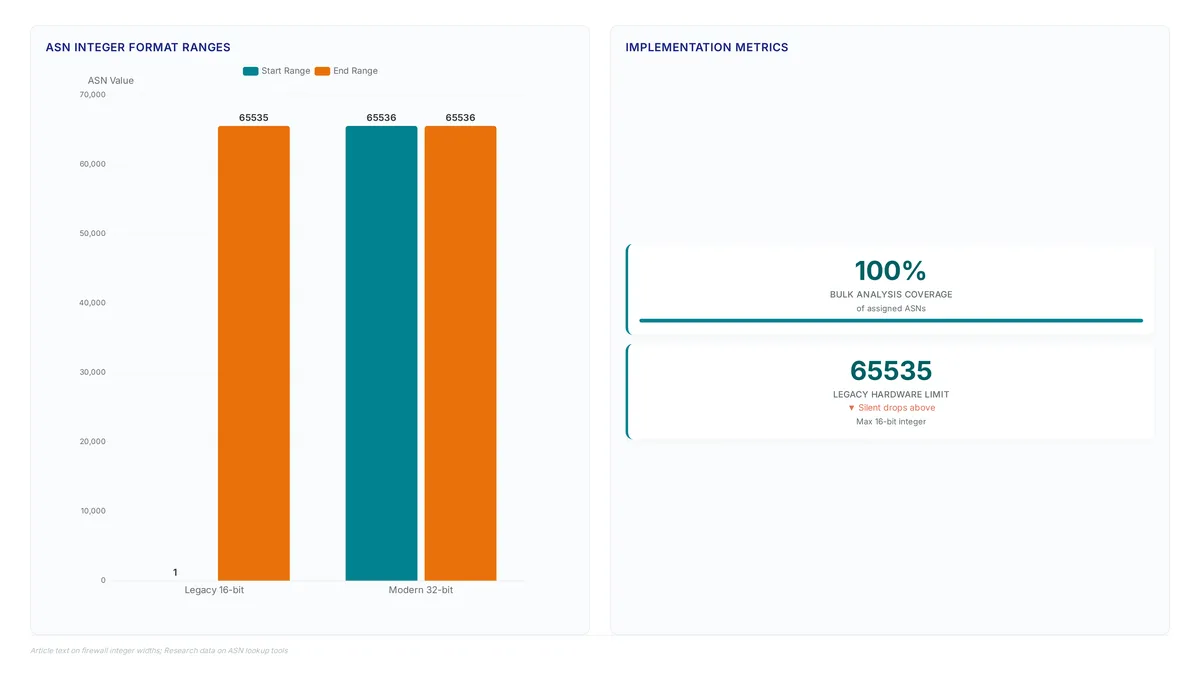
Firewall engines reject traffic matching incorrect integer widths, demanding precise syntax for legacy 16-bit ranges like 1-65535 and modern 32-bit values starting at 65536. Operators must first retrieve accurate ownership data using an ASN lookup to map IP prefixes to their governing autonomous systems before drafting rules. The mechanism requires distinguishing between public identifiers and private ranges, as the latter are invalid on the global internet backbone.
- Query the global routing table to verify the AS Number associated with the target IPv4 block.
- Select the correct integer format in your firewall policy to match the 16-bit or 32-bit scope.
- Apply the rule to the BGP routing stream to filter unauthorized path announcements effectively.
A critical limitation exists where older hardware fails to parse 32-bit integers, causing silent drops for legitimate cloud traffic. Unlike simple IP filtering, this approach validates the organizational source rather than just the endpoint address. Failure to update syntax for 32-bit scopes leaves networks vulnerable to hijacking attempts originating from modern large-scale providers.
Implementing Threat Blocking Using Greip Risk Scores and APIVoid Data
Automating firewall updates requires integrating risk score metrics to dynamically block high-threat autonomous systems. Operators can configure security gates to query APIs like Greip or APIVoid, retrieving real-time ownership data and threat assessments for incoming traffic sources. This mechanism allows network edges to reject connections from flagged entities before they establish a session.
- Query the API using the source IP to retrieve the current AS Number and associated risk profile.
- Compare the returned risk metric against your internal tolerance threshold for network access.
- Push an immediate deny rule to the firewall if the score exceeds acceptable limits.
The limitation of this approach lies in the potential for false positives where legitimate traffic originates from shared hosting environments with mixed reputations. Blocking an entire AS Number based on a neighbor's activity can alter valid business operations. While real-time data enhances security posture, reliance on external scoring introduces a dependency on third-party availability.
Validate CIDR-to-ASN alignment immediately to prevent routing discrepancies before traffic flows. Operators must verify that announced prefixes match registered ownership records exactly. This process detects BGP route hijacking attempts where unauthorized entities advertise blocks they do not control. Understanding AS Numbers helps detect route hijacking attacks by revealing mismatches between expected and actual originators.
- Cross-reference your IPv4 blocks against live RIR databases to confirm current organization name and country code assignments.
- Use free API access to automate continuous monitoring of prefix announcements for unexpected changes.
- Compare observed routing paths with historical data to identify anomalies in routing information.
| Check Type | Data Point | Action |
|---|---|---|
| Ownership | Organization Name | Verify against contract |
| Geography | Country Code | Confirm jurisdiction |
| Topology | IP Ranges | Match CIDR exactly |
A critical tension exists between rapid deployment and strict validation; skipping checks invites hijacks, yet excessive polling triggers rate limits. Most operators overlook that private AS ranges appearing in global updates signal immediate configuration errors. InterLIR recommends integrating these steps into standard operating procedures to maintain network routing integrity.
Failures here compromise the entire infrastructure planning model, rendering firewall rules ineffective against spoofed sources.
About
Alexei Krylov, Head of Sales at InterLIR, brings critical industry expertise to the complex topic of Independent System Numbers. With a specialized background in managing B2B IP resource transactions and deep familiarity with Regional Internet Registries (RIRs), Krylov understands that accurate ASN data is the backbone of reliable network operations. His daily work involves verifying IP reputation and ensuring clean BGP route objects for clients across global markets, making the technical details of network ownership and routing policies second nature to him. At InterLIR, a leading IPv4 marketplace founded in Berlin, his team relies on precise ASN lookups to validate assets and maintain transparency in address transfers. This practical experience allows Krylov to explain not just how to find ASN information, but why verifying network prefixes and peering details is essential for cybersecurity and efficient resource management in today's constrained IPv4 environment.
Conclusion
Scaling network defense reveals that static ownership records fail to capture the flexible nature of modern BGP route hijacking. The operational cost of relying solely on basic identification is the inability to distinguish between a legitimate neighbor and a compromised peer within the same AS Number. Security-centric enrichment now demands that operators layer risk assessment over raw registry data to avoid the collateral damage of blanket blocking. You must transition from periodic verification to continuous, automated validation of prefix announcements.
Implement a policy where any IPv4 block showing a mismatch between its announced origin and registered organization name triggers an immediate alert, not just a log entry. This approach isolates configuration errors before they become exploits. Do not wait for a quarterly review; integrate these checks into your daily deployment pipeline.
Start by cross-referencing your current CIDR assignments against live RIR databases this week to establish a verified baseline. Use free API access to automate this comparison, ensuring your firewall rules reflect real-time ownership rather than historical assumptions. This specific action validates your infrastructure planning and ensures that your routing integrity remains reliable against unauthorized advertisements.
Frequently Asked Questions
Holders control their own routing and peering policies independently. This authority allows entities to enforce granular peering policies rather than relying on upstream providers for path selection decisions.
Teams map IP blocks to governing entities to distinguish legitimate sources. This process reveals the true scope of potential threats by linking disparate addresses to a single network operator.
Valid identifiers span 16-bit ranges up to 65,535 and 32-bit values start at 65,536. These distinct integer formats allow the global routing system to organize tables for diverse network sizes.
Aggressive filtering risks collateral damage if legitimate providers share infrastructure. Operators must balance security posture with availability requirements to prevent service disruption for innocent customers.
Entities can own IP blocks by utilizing a provider routing infrastructure. However, lacking an ASN means they cannot control their own routing or manage independent peering relationships globally.
References