CHINOG 2026: Why Global Outages Demand Local Action
Global ISP outages surged 92% in Q1 2026. CHI-NOG 13 is not a social; it is an operational lifeline. Tom Kacprzynski issued the call for presentations via the NANOG mailing list on April 3, 2026. The message was clear: share tactical data before we meet at the voco Chicago Downtown on May.
This analysis cuts through the noise. We examine how CHI-NOG drives regional network operations by aggregating localized intelligence on Midwest infrastructure that global forums ignore. We dissect the core mechanics of SRv6 and MPLS segment routing to understand why these protocols are the only viable defense against the cascading failures plaguing 2026 backbones. The discussion moves immediately to implementing automation frameworks and zero-trust security models, detailing how operators harden unstable networks without relying on opaque vendor solutions.
Abstract speculation ends now. With the presentation deadline looming on April 6, the industry has no time for theory. Datacenter network fabrics and AI cluster networking demand immediate, peer-validated strategies to handle current load spikes. By focusing on concrete troubleshooting and infrastructure as code, this roadmap gives network engineers what they need to survive an era where instability is the baseline.
The Role of CHI-NOG in Advancing Regional Network Operations
CHI-NOG as a Vendor-Neutral Regional Forum
CHI-NOG is the only Chicago-based Network Operators Group that explicitly bans product promotion. Tom Kacprzynski, acting as CHI-NOG PC Chair, runs the technical program through a rigorous abstraction review designed to kill commercial pitches. This organization connects Midwest professionals who need space to discuss operational failures without sales interference. Global ISP outages increased by 92% in early 2026. The demand for the peer-to-peer troubleshooting models this forum provides is urgent. Presentations here emphasize raw operational data, not marketing narratives, delivering actionable intelligence on infrastructure instability.
Submit your abstract by the April 6, 2026 deadline. Operators must use the official submission portal before the window closes on Monday, April 6th. Tom Kacprzynski, CHI-NOG PC Chair, confirmed this cutoff via the NANOG mailing list to ensure program finalization. Accepted speakers gain complimentary conference access and receive exclusive apparel, removing financial barriers for individual contributors. Presenting here offers distinct professional value as enterprises automate over 30% of network activities this year. The cost savings from such automation drive demand for shared operational war stories regarding AI cluster networking.
CHI-NOG 13 rejects product pitches to prioritize operational case studies like the Michaels network overhaul completed in three weeks. The Program Committee distinguishes authentic engineering shifts from promotional material by demanding evidence of actual deployment rather than feature lists. Vendor marketing obscures implementation complexity; operator presentations detail specific failure modes and configuration constraints encountered during rollout. Real-world transformations, such as the rapid NIaaS platform adoption by substantial retailers, demonstrate tangible speed advantages over traditional hardware refresh cycles. Career advancement for network engineers now hinges on documenting these practical integrations instead of merely listing vendor certifications. Operators seeking to present should focus on architectural trade-offs and measurable outcomes rather than generic solution benefits.
Acceptance criteria favor submissions that expose the gritty reality of migrating legacy systems to modern fabrics. Successful abstracts often reference specific automation frameworks or quantify the reduction in mean-time-to-repair following an architectural change. Industry forecasts indicate a surge in enterprises automating significant portions of their daily network activities within the current year. Engineers who articulate these transitions gain visibility as leaders capable of navigating complex infrastructure instability. The forum specifically requests narratives around metro routed optical deployments that solve bandwidth constraints for AI workloads. Presenters must avoid vague claims and instead provide concrete data points regarding latency improvements or capacity gains. Submissions lacking this level of technical specificity fail to meet the vendor-neutral mandate of the organization. Career growth accelerates when professionals share lessons learned from high-stakes production environments rather than lab simulations. The deadline for such high-value technical discourse remains firm for early April submissions.
Core Mechanics of Modern Routing and Fabric Architectures
SRv6 replaces 20-bit MPLS labels with 128-bit IPv6 addresses embedded in extension headers to encode path logic. This architecture eliminates the separate label distribution protocol, allowing routers to process segment lists directly from the packet header without maintaining distinct forwarding tables. Operators gain the ability to steer traffic through specific nodes for zero-trust enforcement while satisfying strict data sovereignty mandates. MPLS requires complex control-plane synchronization, whereas SRv6 uses standard IPv6 routing updates to distribute topology information.
| Feature | MPLS Architecture | SRv6 Implementation |
|---|---|---|
| Header Overhead | 4 bytes per label | 16 bytes per segment |
| Control Plane | LDP or RSVP-TE | IS-IS or OSPFv3 |
| Programmability | Limited to predefined actions | Full instruction set in packet |
Larger header size reduces proven payload capacity on links with small MTU settings. A fast-food chain with 500 outlets utilized similar cloud-based routing to overcome the lack of onsite IT staff and manage unique connection setups centrally. The transition demands hardware capable of parsing extension headers at line rate, a constraint older edge devices often fail to meet. Geopolitical instability increasingly influences routing decisions, forcing global enterprises to diversify physical routes to ensure business continuity via jurisdiction-aware infrastructure. Network teams must weigh the operational simplicity of a unified protocol against the potential throughput penalty on constrained WAN circuits.
Precise flow control costs more in configuration complexity and stricter hardware homogeneity requirements. Failure to isolate storage traffic from AI bursts causes cluster-wide training stalls. Legacy architectures rely on hub-and-spoke topologies that force all traffic through a central datacenter, creating latency bottlenecks for branch offices. SD-WAN controllers actively monitor link quality and steer packets over the optimal transport without manual intervention. This shift allows enterprises to automate over 50% of routine network activities, moving beyond the <10% adoption rate seen in mid-2023.
| Feature | Traditional WAN | SD-WAN Architecture |
|---|---|---|
| Transport Mix | Single MPLS circuit | Broadband, LTE, 5G, Fiber |
| Provisioning | Manual CLI per device | Centralized orchestration |
| Failover | Seconds to minutes | Sub-second application aware |
| Cost Model | High per-megabit | Low commodity internet |
Distributing intelligence to the edge increases the attack surface, requiring native zero-trust enforcement within the fabric to prevent lateral movement. Operators deploying these systems face a tension between rapid automation and the complexity of managing heterogeneous underlay networks. 5G integration demands precise spectrum coordination often absent in standard ISP contracts. Blindly trusting controller decisions without local telemetry creates single points of failure during control-plane outages.
Implementing Automation and Security in Unstable Networks
Agentic AI Architecture for Autonomous Network Operations
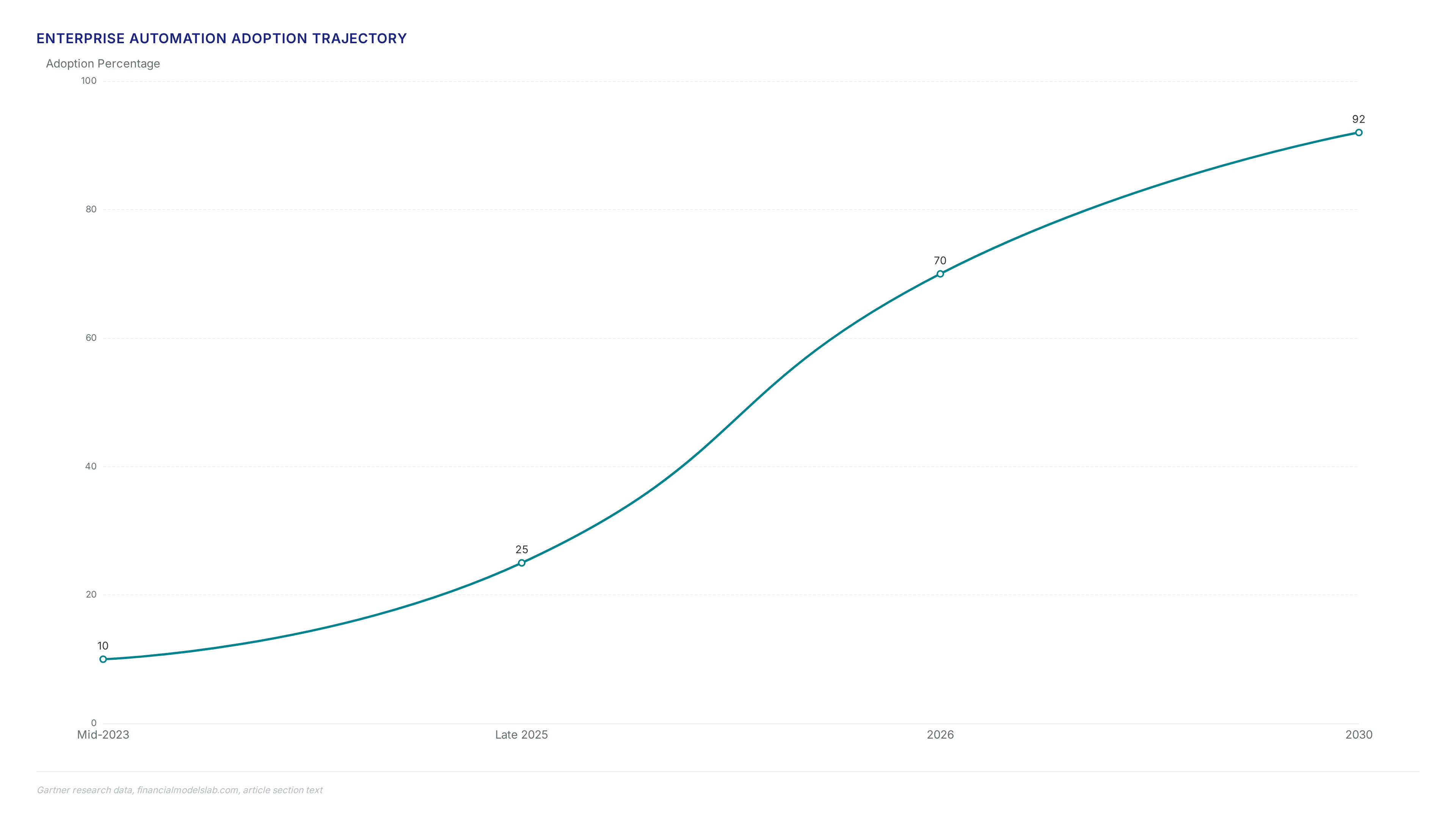
Agentic AI Architecture shifts operations from scripted reactions to systems capable of independent planning and reasoning across complex workflows. Traditional automation executes predefined playbooks, whereas agentic systems analyze state, formulate strategies, and remediate issues without human intervention. Gartner predicts these platforms will replace manual effort for complex tasks, evolving from minimal adoption in late 2025 to become the dominant approach for runtime activities by 2030 according to analyst reports itential.com/resource/analyst-report/gartner-predicts-2026-ai-agents-will-reshape-infrastructure-operations/). The mechanism relies on continuous telemetry ingestion to construct flexible topology maps rather than static configuration files.
Michaels resolved nationwide visibility blackouts in three weeks by deploying Alkira's NIaaS platform. The mechanism ingests raw flow data from distributed edges and normalizes it into a single control plane without requiring hardware swaps at remote sites. The cost structure favors retailers facing peak-season traffic surges over static enterprise environments with predictable loads. Operators must weigh the speed of multi-cloud transformation. Traditional monitoring stacks often fail to correlate application performance with underlying transport changes when telemetry sources are virtualized. Full observability requires API integration maturity that many internal teams lack.
| Deployment Factor | Legacy Hardware Refresh | NIaaS Implementation |
|---|---|---|
| Timeline | 6 to 18 months | 3 weeks |
| Upfront Capital | High | Minimal |
| Team Structure | Large field engineering | Centralized cloud ops |
Accepting reduced visibility into physical layer anomalies buys instantaneous logical topology updates. Network architects should prioritize this model only when business velocity outweighs the need for deep packet inspection at the edge. This validation ensures the transport layer handles real-time data processing without packet loss at the edge.
- Confirm priority flow control frames pause queues instead of dropping packets during congestion.
- Audit optical networking margins against vendor profit targets like the €2-€2.5 billion Nokia forecast for 2026.3.
- Measure latency jitter across mixed transport mixes including broadband and fiber.
- Validate zero-trust policy enforcement points exist at every 5G ingress node.
| Validation Step | Legacy WAN Check | 5G-Ready NaaS Requirement |
|---|---|---|
| Throughput Baseline | High-capacity MPLS cap | 100+ Gbps lossless fabric |
| Security Model | Perimeter firewall | Distributed zero-trust nodes |
| Deployment Speed | Months for circuit install | Weeks via Alkira's NIaaS platform |
| Observability | SNMP polling gaps | Full-stack telemetry |
Skipping step two carries a measurable cost: misaligned optical budgets trigger head-of-line blocking under heavy AI workloads. Most operators overlook that rapid deployment shifts capital expenditure to operational budgets, requiring significant wage allocation for core teams. Failure to validate these four steps leaves networks vulnerable to the blind spots affecting the majority of organizations today.
Strategic Lessons from Early Adopters of Agentic AI and NaaS
Lessons: Agentic AI Architecture: From Reactive Scripts to Autonomous Reasoning
Agentic AI Architecture systems plan, reason, and execute complex workflows beyond the capabilities of traditional automation scripts. This shift moves operations from reactive troubleshooting toward autonomous remediation and predictive performance optimization. Traditional tools follow static playbooks, whereas agentic systems analyze network state to formulate flexible strategies without human intervention. Itential. Transition phases introduce visibility gaps despite advanced reasoning engines. Operators face tension between deploying autonomous agents and maintaining sufficient human oversight during the learning curve. Blind spots in critical segments remain a risk until the system fully ingests historical telemetry data.
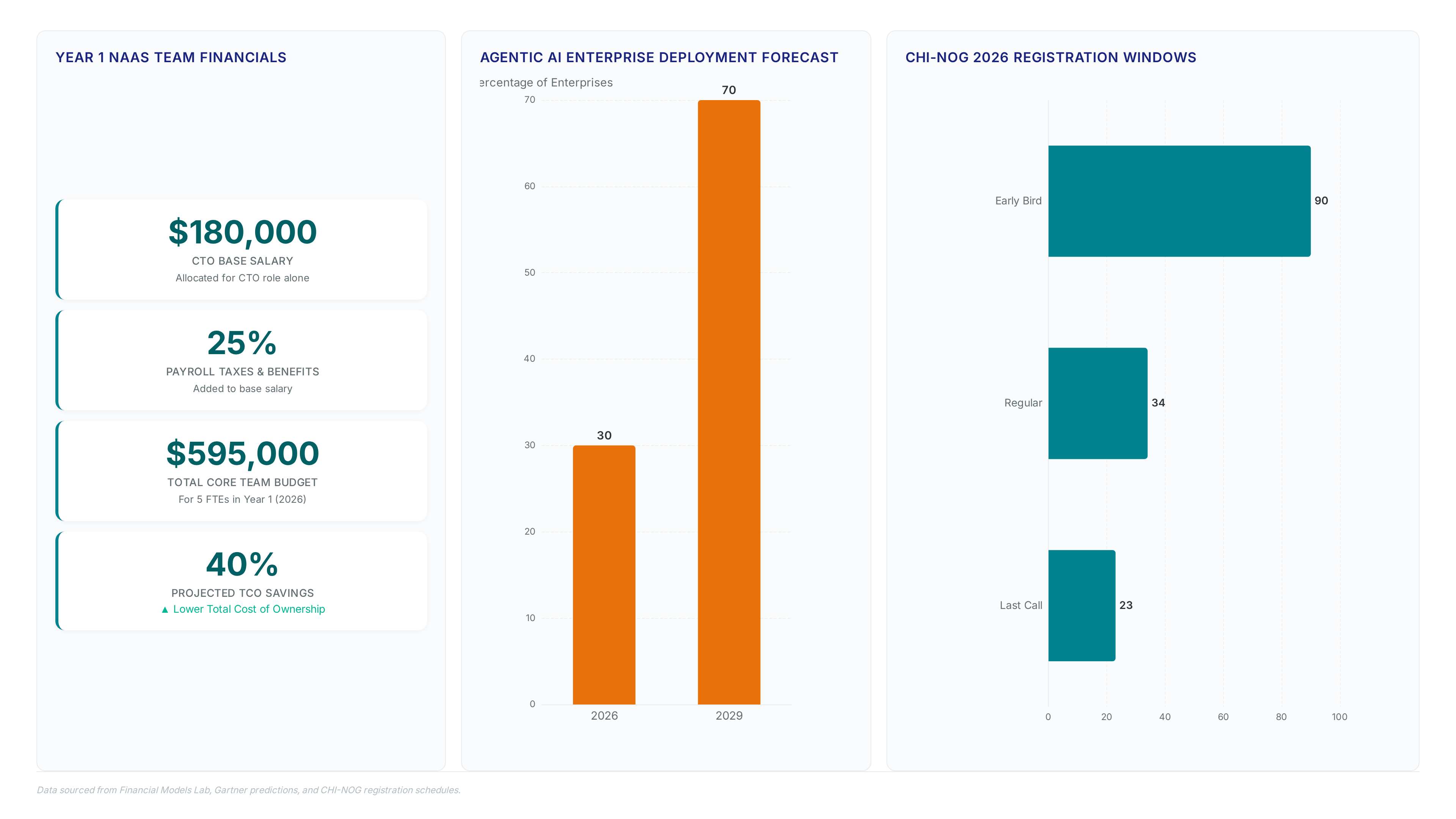
Adoption trajectories suggest a rapid climb as enterprises seek to eliminate latency in incident response. Prolonged outages that scripted tools cannot resolve independently drive the cost of inaction. This financial model shifts capital expenditure into operational budgets, creating a breakeven tension where savings only materialize after the initial staffing outlay. The mechanism relies on abstracting control plane functions to reduce hardware refresh cycles, yet the human cost remains rigid regardless of traffic volume. A typical Year 1 wage budget allocates $180,000 for the CTO role alone, leaving limited flexibility for junior engineering hires until efficiency gains compound.
Blind spots prevent the validation of Zero-Trust Enforcement policies across distributed edges. InterLIR recommends auditing telemetry pipelines before expanding NaaS footprints to ensure AI agents receive accurate state information. Failure to address this gap renders advanced automation useless during actual incidents. Organizations must prioritize data fidelity over agent count. Raw flow exposure enables correct reasoning. Aggregated metrics hide the very anomalies these systems aim to fix. The path forward demands granular visibility first. Only then does autonomous action become reliable.
About
Alexei Krylov serves as the Head of Sales at InterLIR, a specialized marketplace dedicated to IPv4 address redistribution. His unique qualification to discuss CHI-NOG stems from his daily immersion in the operational realities of network operators who face critical IP scarcity. At InterLIR, Krylov manages complex B2B transactions and ensures clean BGP routing, directly addressing the infrastructure challenges that define the CHI-NOG community agenda. As CHI-NOG 13 convenes in Chicago to tackle evolving network operations, Krylov's frontline experience with Regional Internet Registries and IP resource management offers vital context. His work bridging the gap between limited IPv4 supplies and expanding demand aligns perfectly with the technical discussions scheduled for the event. By connecting InterLIR's mission of transparent IP access with the collaborative spirit of NANOG affiliates, Krylov provides an authoritative perspective on sustaining global network growth through efficient resource allocation.
Conclusion
Scaling autonomous networks fails when telemetry fidelity cannot match the speed of Agentic AI decision loops. As throughput demands exceed extremely high speeds, aggregated metrics create dangerous blind spots where control plane anomalies hide until they trigger cascading outages. The operational cost of maintaining a five-person core team becomes unsustainable if these experts spend their time manually correlating data instead of defining policy boundaries. Enterprises attempting to automate over 30% of network activities without raw flow exposure will inevitably face regression, as AI agents cannot reason effectively about state they cannot see. You must treat high-salary security specialists as architects of data pipelines, not just firewall managers, to prevent this bottleneck.
Commit to a six-month transition window where you replace legacy monitoring with lossless fabric telemetry before expanding your NaaS footprint. Do not deploy additional automation agents until your existing stack exposes unfiltered flow details to the control plane. This specific sequencing ensures that future autonomous remediation acts on truth rather than statistical averages. Start by auditing your current telemetry pipeline this week to identify exactly which switches are aggregating data rather than streaming raw packets to your analytics engine. Fix these specific ingestion points immediately to validate that your AI systems receive the granular state information required for precise corrective action.
Frequently Asked Questions
Security specialists commanding base salaries of $130,000 must often develop internal tools. This high cost arises because budget approvals for new software frequently lag behind rapid threat evolution cycles.
A typical Year 1 wage budget for a NaaS platform core team is $595,000. This substantial figure illustrates the high financial stakes involved in managing modern infrastructure environments effectively.
Global ISP outages increased by 92% in early 2026, creating urgent demand for peer-to-peer troubleshooting. These forums provide actionable intelligence on instability that commercial vendor slides often obscure or ignore completely.
Enterprises are currently automating over 30% of network activities to manage increasing complexity. This shift drives intense demand for sharing operational war stories regarding AI cluster networking and deployment strategies.
The Program Committee enforces a strict 30minute session limit to maximize technical density during events. This rule effectively filters out marketing noise and ensures attendees receive raw operational data instead.